Following Our Programming

Alex Mayyasi flags some fascinating research on how we interact with computers:

[Professors Clifford Nass and Youngme Moon of Stanford and Harvard] found that people were too polite to give honest feedback in the form of an on screen evaluation to a mediocrely helpful computer. But when they evaluated the computer’s helpfulness on another computer, people proved as forthcoming as students privately complaining about their terrible teacher. And just as we will generally go to greater lengths to help people that have helped us, Nass and Moon found that participants asked to “help” a computer match a color palette with human perception spent much more time doing so with computers that had provided helpful search responses than computers that returned bad search results.

We don’t treat computers exactly like humans. We don’t cry when they die (usually) and we don’t excuse ourselves when we suddenly leave our computers to grab a coffee. But to a surprising extent, we do apply rules and expectations from the social world to interactions with computers.

The Legacy Of The Marquis

Hussein Ibish revisits the Marquis de Sade’s writings and considers the more nuanced points of the amoral aristocrat:

Sade’s deeply idiosyncratic views on the morality of personal violence are probably Exhibit A for why he cannot pass muster as any kind of guide for left-liberal cultural resistance. If we take his work at face value, he was not opposed to individual murders. He frequently had his characters argue that murder should not be punished by the state at all. Yet there probably has never been a more passionate opponent of capital punishment—the only form of premeditated homicide that normative “rational” thought typically considers potentially justifiable. This is Sade’s challenge to his readers in a nutshell: he specializes in justifying the conventionally unjustifiable while absolutely and passionately condemning what many would regard as, at least plausibly, defensible and rational.

There is, however, a much surer gauge of what might be called a vulgar Sadean legacy: the mainstreaming of American porn.

Pornography is now so ubiquitous in contemporary American culture—so impossible to get away from—that the two things one may be assured of being offered in even the cheapest motel are pay-per-view porn on the television and a Gideon Bible in the bedside table, should you find yourself in sudden need of one form or the other of shameless mystification. I’m sure I’m not the only frequent traveler who has never availed himself of either of these kindly offerings, but they’re always there. One can’t help but imagine both Sade and [John] Calvin bitterly grousing, in whatever mutually disappointing afterlife to which they’ve been jointly consigned, about how their intellectual legacies have been downgraded into all-but-interchangeable items of consumer convenience.

Recent Dish on pornography and its Sadean tones here.

Shutting Down The Shares

Last week the city of New York fined an Airbnb host $2,400 for violating a law against “illegal hotels.” Emily Badger suspects that more cases like this will trigger a reassessment of city codes:

It’s reasonable for cities to create some standards for how residents might operate what the [Sustainable Economies Law Center] calls “host homes” or “no-host homes.” Perhaps regulation could require the host to register the property for a small fee, while limiting the number of nights in a year that guests can stay there (this could be a concession to neighbors who don’t want their block or building to become a revolving door for tourists). The SELC also floats a cap on the income that a host can make in a year, tied for example to the cost of actual rent or the market value of a property (for example: your Airbnb income can’t exceed 75 percent of your actual yearly rent and utilities).

This last idea would certainly codify the notion that the “sharing economy” is fundamentally a different kind of economy, one where the ultimate goal for individual participants isn’t to make as much profit as possible.

Marcus Wohlsen insists government will have to make way for the share economy sooner rather than later:

New York is a city built on bureaucracy, and bureaucracies are inherently resistant to change, especially when a new technology comes along to undermine the assumptions on which those bureaucracies were built. And in a way that’s by design. The mechanization of the economy and the mechanization of government have occurred in parallel, often in the form of agencies meant to check industries’ more flagrant violations of the social contract. In a sense, those bureaucracies’ express mission is to hinder progress.

Still, renting out your room when you’re not home or your car when you’re not driving it hardly feels flagrant. If people and the politicians they elect feel the same way, these bureaucratic roadblocks to the sharing economy’s rise will also turn out to be very temporary. Whether or not Airbnb, RelayRides or Uber turn out to be the companies that define the future of sharing, the idea of using technology to leverage any resource’s excess idle capacity seems too sensible—and popular—to fail.

Walter Mead nods:

In the case of Airbnb, New York City’s zoning and administrative codes were so numerous and confusing that the client hit with the fine had no idea that he was breaking the law simply by renting out his room. A legal system in which the average citizen can’t make sense of when or how he or she is doing something illegal is not only unfair but a serious detriment to quality of life. America is not going to create the service jobs it needs to stay vital in the post-industrial age by making it hard for small-time entrepreneurs to succeed.

Previous Dish on Airbnb and the share economy here, here and here.
The Best Of The Dish Today

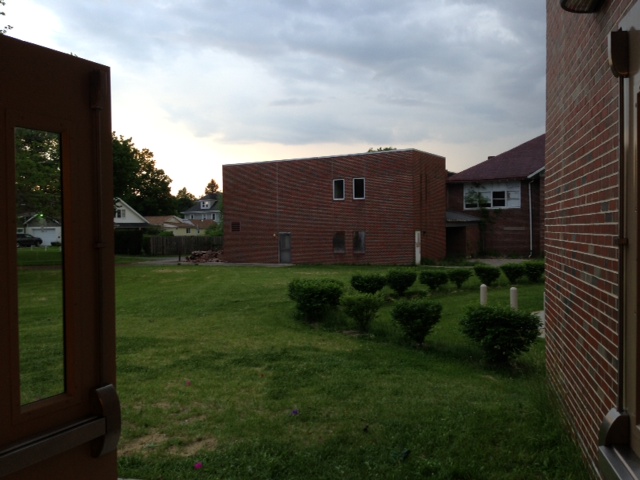
If you have five posts to read today, I recommend my critique of Ross Douthat, the homophilic ironies of scouting, the face that lit up Fenway Park, the vast complexities surrounding “race” and IQ, and an evocatively banal view from West Virginia.

The two most popular posts were those on Ross Douthat and an enduring post from the weekend: “Where The Atheists Are.”

See you in the morning.

Why Is Americaness Next To Cleanliness?

Katherine Ashenburg, author of The Dirt on Clean, explains why Americans are clean-freaks:

Oddly enough it was the Civil War that got Americans interested in being clean. The army’s initially derided Sanitary Commission, headed by the landscape architect Frederick Law Olmsted, had proved that simple soap and water could significantly reduce military mortality, and by the end of the war cleanliness was seen as patriotic, progressive and distinctively American. Good hygiene had other virtues: it was a way to mark status and civility in a country without an aristocracy, and it could “Americanize” the hundreds of thousands of Europeans who began arriving in the 1880s.

Those ideas drew 19th-century Americans to cleanliness, but it was advertising that kept them interested. Body soap first became widely available in the late 19th-century, around the birth of modern advertising. Since there was little to distinguish one soap from another, advertising and soap grew up together.

The Recession’s Silver Lining

Fewer deaths:

With more accidents at work and on the road during expansions, expansions have more deaths by such accidents, and recessions have fewer. It turns out that the business cycle for suicides is more than offset by the business cycle for other deaths.  Mortality and the unemployment rate are negatively correlated.  Christopher J. Ruhm, a professor of public policy and economics at the University of Virginia, has looked at all causes of death and found that most of them – suicide was the exception – occur less frequently at the depths of the business cycle.

Peter Orszag adds:

Taken together, the evidence suggests that a combination of forces contribute to the increase in life expectancy during times of higher unemployment: Motor vehicle deaths decline, people tend to avoid unhealthy behavior, air pollution is diminished, and nursing home staffing improves.

None of which should make us wish for economic trouble. Higher unemployment means loss of productivity, lower income and mental anguish, and those are more than sufficient reasons to combat joblessness. There may be some small consolation, though, in learning that it probably doesn’t harm human health the way that we all imagined.

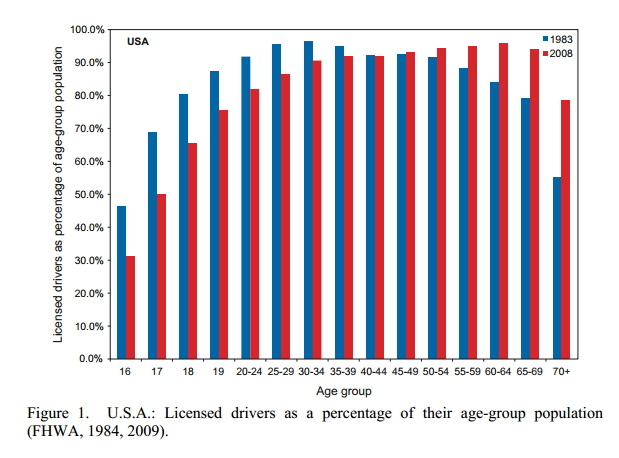
The Young And The Carless, Ctd

dish_driverdata

Brian Merchant believes that the car’s dominance in American culture has been eclipsed by Facebook and Brooklyn:

I’m evidence, I guess—once one of those wide-eyed car lovers, I moved to Brooklyn from car-heavy southern California and sold my Ford. I haven’t regretted ditching it at all. Brooklyn certainly isn’t the only model, but it has become a “global brand” for hip urbanity … Young, affluent people now overwhelmingly want to be able to walk or bike to artisanal restaurants, sweaty music venues, and bars stocked with organic beers. That’s partly why places like Charlotte are focusing on walkability. That’s in no small part Brooklyn’s doing/fault.

But the other explanation for the decline in driving is more interesting: the rise in internet use amongst the same demographic that used to be so eager to hop behind the wheel. A study conducted by researchers at the University of Michigan discovered that “a higher proportion of internet users was associated with a lower licensure rate,” which they found to be “consistent with the hypothesis that access to virtual contact reduces the need for actual contact among young people.”

Relatedly, Felix gives a thumbs up to NYC’s new bike-share:

Don’t worry about safety. I wore a helmet, many people won’t, it’s all OK. There’s a paradox here: the less safe you look and feel, the wider a berth cars give you. If I’m zooming down the street on a singlespeed, taxis will happily zoom past me, with inches to spare. But if I’m wobbling down the street on a CitiBike, not so much.

In fact, there’s very little evidence that helmet use reduces bike-injury rates. Certainly if you fall on your head, you want to be wearing a helmet. But CitiBikes, for one, are big and heavy and much less precarious than most bikes. They’re hard to fall off of, and they make it almost impossible to go flying over the handlebars.

Recent Dish on the the decline of driving among the young here.

Unhappy, Unhealthy

Earlier this month, the blogosphere weighed in on an Oregon study that found that Medicaid enrollees, when compared to non-enrollees, had lower rates of depression but little difference in things like cholesterol and blood pressure. Bill Gardner pushes back against one headline writer’s claim that enrollees were “happier but not healthier”:

[M]ental illness isn’t just about happiness: Mental illness kills. Sometimes by suicide, of which mental illness is a principal cause. But most of the excess deaths among the mentally ill are caused by diseases such as cardiovascular disease or cancer.  In a sense, mental illness amplifies the risk or lethality of physical health problems. This occurs for many reasons.  Mentally ill people are more likely to develop tobacco, alcohol, and substance abuse addictions. Mentally ill people also experience high levels of stress from the loss of jobs, marriages, and families. Chronic diseases such as diabetes require intensive daily self-care routines and mental illness undermines a patient’s ability to carry these out.