
The Delusions Of Ross Douthat

TO GO WITH AFP STORY By Otto Bakano -- T

Ezra weighs in on Chait’s piece on Josh Barro and the plight of reformists on the right:

If you imagine a policy spectrum that that goes from 1-10 in which 1 is the most liberal policy, 10 is the most conservative policy, and 5 is that middle zone that used to hold both moderate Democrats and Republicans, the basic shape of American politics today is that the Obama administration can and will get Democrats to agree to anything ranging from 1 to 7.5 and Republicans will reject anything that’s not an 8, 9, or 10. The result, as I’ve written before, is that President Obama’s record makes him look like a moderate Republicans from the late-90s.

He is indeed a moderate Republican, which is why I’ve always liked his approach to governing and to policy. And that, of course, makes Ross Douthat nervous, because Ross is a smart man trying to engage a party that is currently out of its tiny mind. He reminds me of sane and sober Labourites in the early 1980s. But at least they fully copped to the extremism of their own side.

Ross won’t quite. He disputes Ezra on two grounds: first that the political environment has changed too. He says, for example, that the GOP’s retreat from cap-and-trade is a function of the 2008 economic meltdown, a temporary abatement in warming, the failure of global cap and trade, etc. But that would lead to healthy conservative skepticism of policies like cap and trade, and an attempt to think through alternatives. Jim Manzi represents this line of thinking best. But what Ross’s party has actually done is embrace total climate change denialism. That’s a huge shift toward irrationalism, fueled by fundamentalist Christianity, which, of course, Ross won’t recognize as a core part of the GOP problem. Because if he did, he would be Frummed out of the party altogether.

Then Ross argues that the GOP is more moderate than Ezra claims. So Ross defends the GOP on, say, immigration, because it has a healthier internal debate, which more closely represents public divisions. But, in fact, the GOP base, as Ross knows, is dedicated to destroying immigration reform, just as it did when even Bush was in office. Again, compare this with Reagan’s amnesty and an era where open borders conservatives were mainstream in the GOP (yes, I remember that). The actual Ronald Reagan would not stand a chance in today’s GOP. And the only argument for immigration reform that has any real traction in the party is electoral and arithmetical, not ideological. And those spearheading the effort, like Marco Rubio, face a perilous future in their party.

On taxes, the GOP is relentless, even though the boundaries of the debate have shifted dramatically their way since the 1980s. With revenue far too low, and structural spending bound to increase as we support baby-boom retirees, an absolutist refusal to raise any more revenues is a 10 on the scale of 1 – 10. This is especially true when the GOP is demanding much more spending on national “defense”. Yes, there are, mercifully, a few civil libertarian voices on the right, but surely Ross knows that his party reacted to Obama’s war on terror speech last week as if it were treason. Butters:

“At a time we need resolve the most, we’re sounding retreat.”

Peter King, the former terrorist-funder turned terrorist scourge, echoes the Ailes line:

“In many ways al Qaeda is more dangerous now than it was prior to September 11.”

Does Ross believe that? Does any sane person believe that? The truth is that the GOP is the most extreme, nihilist pseudo-conservative party I have seen in my lifetime in any developed country.

The GOP, for example, is in favor of torture as a national policy, placing it outside every mainstream right-of-center party in the West. How far have they traveled? Reagan strongly supported and signed the UN Convention Against Torture (and anything even close to it).

On Medicare, Ross is right that premium support, done right, is an arguably centrist position. But we know what Paul Ryan originally wanted – and Obama is the first Democratic president willing to cut Medicare seriously as part of a big fiscal deal. Every time Obama moves to the fiscal right, the GOP moves the goalposts one more time – and then demonize the president for, say, a stimulus package that was one third tax cuts. On social issues, the GOP is now further to the right than it has ever been, while the country has found a new middle. The GOP supports a constitutional amendment to ban gay couples from having any formal rights at all; and a federal ban on all abortions. Again, you have to find a neo-fascist party in other Western countries to see any Western equivalent. The fundamentalists cannot compromise on this – because their God won’t compromise. And the base has no other ideological foundation than fundamentalism of various neurotic kinds.

There’s a case to be made for pure oppositionism. But I truly think Ross under-estimates the depth of the nihilism that truly motivates his party, the thinly veiled racism and unveiled homophobia that courses through its activist veins, and the theocratic impulses that uniquely fire up the base. And I don’t think the fever is breaking. The IRS scandal will deepen and intensify all the defensive and self-defeating paranoia on the partisan right. Issa will be their champion; Ailes the fanner of the conspiratorial flames; and talk radio the defining ideological conversation.

Barro sees this as plainly as day. Ross is making, presumably, another calculation. For my part, I suspect there’s little hope for the GOP; and I increasingly see it as conservatism’s most implacable ideological, radical, destructive foe. I thought it would get worse before it got better; but I see no signs of the pathologies weakening. In the wake of an epic defeat, they appear to be gathering strength.

Ask Josh Barro Anything

This embed is invalid

[Re-posted from yesterday with many questions added by readers]

A brief bio of Barro:

He is the lead writer for the Ticker, an economics and politics blog hosted by Bloomberg L.P.. He appears regularly on Bloomberg Television and has appeared on Real Time with Bill Maher on HBO. Time named Barro’s Twitter feed one of “The 140 Best Twitter Feeds of 2013”, one of ten in the Politics category. In 2012, Forbes selected him as one of the “30 Under 30” media “brightest stars under the age of 30.” Barro describes himself as a Republican, but has expressed opposition to the policies of the Republican party.

Last week the Dish highlighted Chait’s profile of Barro. Andrew Leonard wrote of him recently:

He is, in my opinion, a rare breed indeed: an intellectually honest analyst of political and economic affairs who makes up his own mind, does not hew to any preset ideology and relies on facts to makes his arguments. People who disagree with him have labeled him conservative, liberal and libertarian. That’s not easy to achieve! Barro can wage total war against the notion that austerity is the correct prescription for our economic problems while at the same time arguing that public sector unions are bankrupting state governments. I follow him because I always learn something from him, even when I disagree with him. … Josh Barro is also the gay son of the famously arch-conservative economist Robert Barro, which makes him inherently interesting for reasons that have nothing to do with the quality of his analysis, and everything to do with the social and cultural splits that define our current society.

To submit a question for Josh, simply enter it into the Urtak survey after answering all of the existing questions (ignore the “YES or NO question” aspect and simply enter any open-ended question). To vote, click “Yes” if you have a strong interest in seeing Josh answer the question or “No” if you don’t particularly care. Thanks for your help.

Where Can Colleges Cut Back?

Wilkinson asks why moving courses online is a better option than trimming administrative bloat:

[S]tudents have faced rapidly rising tuition costs not due to large increases in the cost of instruction, but mostly due to the dramatic, rapid growth of the university bureaucratic class, which offers nothing of obvious worth to the education of their universities’ increasingly cash-strapped and indebted students.

According to a 2010 study on administrative bloat from the libertarian Goldwater Institute, tuition tripled from 1993 to 2007 at my own school, the University of Houston. Over that period, instructional spending per student changed not at all, while administrative spending per pupil nearly doubled. This is fairly representative of the national pattern. This seems to me to suggest that state university systems might first seek savings in leaner management before outsourcing instruction to glorified versions of YouTube. Public-university systems might take a page from Sweden, a paradisaical Scandinavian social democracy, which outsources to private companies the management of some of its public hospitals, as Schumpeter discusses, and recommends. In any case, it’s outrageous that students should be made to pay ever more to support assistants to assistant deans, in exchange for the right to earn a degree filling in worksheets and ignoring videotapes from home.

Recent Dish on MOOCs here, here and here.

Quote For The Day

“Your letter … contained some amount of backbiting, name-calling and sneering. We refrained from wading into this battle in the past out of a hope that the crooked could be straightened by the easiest and softest means. … But the wound continued to bleed, and in fact increasingly bled, until your last letter arrived, ending any hope of stanching the wound and healing it,” – the leaders of al Qaeda in Maghreb to a difficult employee.

I loved this bit:

The list of slights is long: He would not take their phone calls. He refused to send administrative and financial reports. He ignored a meeting in Timbuktu, calling it “useless.” He even ordered his men to refuse to meet with al-Qaida emissaries. And he aired the organization’s dirty laundry in online jihadist forums, even while refusing to communicate with the chapter via the Internet, claiming it was insecure.

Where’s The Ceiling On Clean Energy?

Village Relies Only On Alternative Energy Sources

Peter Bronski takes on skeptics who question the possibility of “high renewable” energy future:

Such skeptics often point to a number of familiar criticisms: that high penetrations of renewables are not possible; that such a future requires major technological innovation; that it requires unreasonable amounts of energy storage to balance variable wind and solar; that it requires massive build-out of transmission infrastructure, biomass generation capacity, large-scale hydro, or all of the above; that it requires major investment that simply isn’t there; that it is uncompetitively costly (at least without large subsidies); that variable renewables will undermine the reliability of grid power. Couple such skepticism with IEA’s recent report noting that renewables have yet to make a serious dent in the carbon intensity of the global energy system—on which fossil fuels seem to have a strangle hold—and it’d be easy to side with the skeptics, but they are wrong.

Renewables’ track record shows that they continue to outpace skeptics’ expectations.

“People thought that maybe renewables would get to two percent. When they did that, people said maybe five percent. Then 10 percent,” says Hutch Hutchinson, managing director at [the Rocky Mountain Institute]. “Renewables have been fighting and scratching the entire way. Now, there’s good analytical evidence that with some creativity and customary levels of reinvestment in our energy system, we can get to a high renewables future.”

Bronski insists that the energy industry needs to change its mindset:

“Renewable energy futures are no longer a matter of technology—we have all the technologies we need—and are no longer a matter of economics either,” says REN21’s [Eric] Martinot. “We’re just not making the cost comparisons in the right way. It’s our way of thinking and our power industry structure that makes renewable energy seem more expensive, not the technology itself.” That power industry structure includes hefty and durable fossil fuel subsidies, which amount to $1.9 trillion per year or more, according to a report from the International Monetary Fund earlier this year. Those fossil fuel subsidies far outweighed the smaller and more transient subsidies offered to renewables, according to the International Energy Agency’s World Energy Outlook 2012.

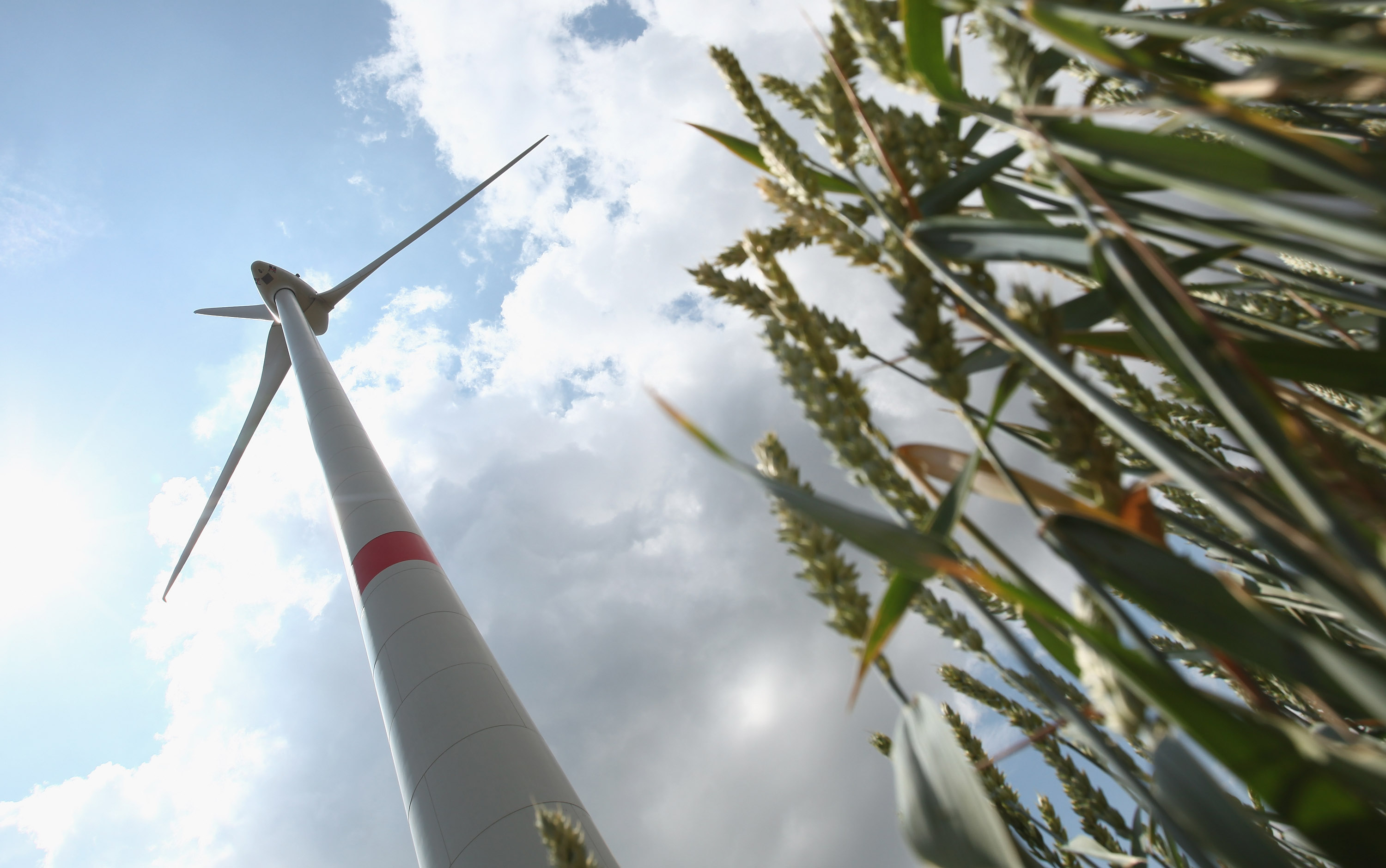
(Photo: A 2 MW wind turbine of German alternative energy producer Energiequelle GmbH spins in a field of wheat on June 20, 2011 near Feldheim, Germany. The country is investing heavily in renewable energy sources as part of its plan to abandown nuclear energy by 2022. By Sean Gallup/Getty Images.)

Does Immigration Need To Be Offset?

Ron Unz thinks that “principled liberals and conservatives should both demand that any immigration reform proposal also include a sharp rise in the federal minimum wage”:

The reason is simple. Any increase in the supply or job mobility of willing workers will tend to benefit Capital at the expense of Labor, stifling any growth in working-class wages, especially given our high unemployment rates. The last 40 years have seen a huge increase in immigration, and it is hardly coincidental that median American wages have been stagnant or declining throughout most of this same period. A large boost in the minimum wage, perhaps to $12 an hour or more, would be the best means of reversing our current economic race to the bottom.

Cowen, on the other hand, doesn’t see unskilled immigration as threat:

In my view the evidence (and here) suggests that the negative wage pressures on unskilled labor, to the extent they have international origins at all (as opposed to TGS or automation or political factors), come more from outsourcing and trade than from immigration.  So if you limit low-skilled immigration, outsourcing likely will go up, as it would be harder to find cheap labor in the United States.  The United States will lose the complementary jobs as well, such as the truck driver who brings cafeteria snacks to the call center.  Conversely, if you increase low-skilled immigration, you will also get more investment in the United States and more complementary jobs as well and possibly some increasing returns from clustering and maybe more net tax revenue too.  On top of that the individuals themselves have greater choice as to where to spend their lives and build their careers.

Bringing A Super PAC To A Gun Fight

Michael Bloomberg is targeting Democrats who voted against gun control:

Senate Democrats up and down the caucus, from West Virginia’s Joe Manchin to Majority leader Harry Reid of Nevada, have been trying to warn Bloomberg off his strategy of running ads that attack vulnerable Democrats over gun control votes. And it’s not because they disagree with what Bloomberg is after—a new law to require background checks for guns bought online or at gun shows. Rather, they think keeping the Senate in Democratic hands in 2014 is more important than any single Senator’s vote on guns.

How Alec MacGillis understands Bloomberg’s actions:

What Bloomberg has embarked upon now is nothing less than the construction of a mirror image to the NRA. There is plenty of latent public support for gun control, his logic goes, but politicians only see a risk in voting for it. He wants to reverse that calculation.

To that end, Bloomberg created a Super PAC, Independence USA. In 2012, it spent $10 million on ads supporting pro-gun-control candidates running against NRA-friendly opponents in districts where polling suggested such a stance should be a liability. This investment was credited with unseating Democratic Representative Joe Baca of California. In the past year, Mayors Against Illegal Guns, which now has 975 mayors, has expanded from 15 paid staff to more than 50, with lobbyists in Washington and field organizers around the country who will likely be deployed to states with legislative fights looming. The organization is also developing its own candidate rating system.

Above all, Bloomberg is planning to hit the airwaves on a scale Washington has not fully grasped. “He described his effort last year as putting his toe in the water,” says Wolfson. Bloomberg plans to spend heavily in the 2014 midterms to support Louisiana’s Mary Landrieu and North Carolina’s Hagan, both of whom voted for background checks.11 And he plans to spend very heavily against the Democrats up for reelection who voted against the bill—Alaska’s Mark Begich and Arkansas’s Mark Pryor.