Obamacare Can Work? Ctd

Despite the recent announcement of low premiums for Californians under Obamacare, Sarah Kliff isn’t celebrating yet:

California’s health-care marketplace isn’t like those being set up elsewhere in the country. When California created the country’s first-ever health insurance exchange, way back in November 2010, it made a very significant policy decision. The state decided that it would act as an “active purchaser” that would select a small number of health plans allowed to sell on the California exchange. Health plans would have to do more than meet a set of requirements in the Affordable Care Act. They would need to be selected by the California exchange’s board to compete in the marketplace. …

In an active purchaser exchange, health plans know that they’re competing against others for the chance to access millions of customers with tax subsidies. That could easily effect the bids that they submit, the ones they hope will get them into the new marketplace. That’s the dynamic in California, but not in most other states. That makes it a bit difficult to generalize what the state’s insurance rates say about what will happen elsewhere, where this downward pressure doesn’t exist.

Lanhee Chen, Romney’s former policy director, argues that the California’s rates aren’t as favorable as they first appear:

The only way Covered California’s experts arrive at their conclusion [that individual health insurance premiums in 2014 may be less than they are today] is to compare apples to oranges — that is, comparing next year’s individual premiums to this year’s small employer premiums.

They’re making this particular comparison, they explain, because they believe that the marketplace for individually purchased insurance will look like the marketplace for small employer-purchased insurance next year. For example, the state already requires insurers to issue policies to all comers in the small employer market. Premiums are therefore higher today for small employers than for individuals purchasing coverage on their own.

What this means, however, is that Covered California is creating for itself a very favorable and already higher baseline from which to compare next year’s individual health insurance premiums. That’s how they’re able to create the appearance that Obamacare’s reforms will lower individual premiums.

Meanwhile, Yglesias thinks Obamacare’s Cadillac tax on high-cost healthcare plans is beginning to pay off:

Conservative ACA critics in their scorched earth campaign against Obamacare have been insisting that this, like every promising cost-control measure in the law, is doomed to failure and/or will never be implemented. The story today about actual employer and insurer response to the Cadillac tax indicates that, no, it is beginning to have an impact. Note that this is not the first piece of good news about health care spending aggregates, and that by and large we should expect the press’ understandable and inevitable negativity bias to underestimate Obamacare.

Cohn argues that this is a tax conservatives should support. Previous Dish on California’s low ACA premiums here and here.

The View From Your Weirder Windows

Karanga Campsite, Machame Route, Kilimanjaro, Tanzania

Karanga Campsite, Machame Route, Kilimanjaro, Tanzania

OLYMPUS DIGITAL CAMERA

Monument Valley, on the Utah-Arizona state line

RichmondKy13113930am

Richmond, Kentucky, 9.30 am

DSC_4015

Priest Lake, Idaho, 12 pm

IMG_20120919_071155

“Istanbul, from the morning ferry to Bandimir”

IMG_1464

Off the coast of Nigeria, 6.45 pm

Previous installment here.

Caring For Concision

Lydia Davis, famed for writing stories as short as a few words, has won this year’s Man Booker International Prize. Adam Sherwin offers some examples of Davis’ works:

Index Entry

Christian, I’m not a

Getting to Know Your Body

If your eyeballs move, this means that you’re thinking, or about to start thinking.

If you don’t want to be thinking at this particular moment, try to keep your eyeballs still.

The Outing

An outburst of anger near the road, a refusal to speak on the path, a silence in the pine woods, a silence across the old railroad bridge, an attempt to be friendly in the water, a refusal to end the argument on the flat stones, a cry of anger on the steep bank of dirt, a weeping among the bushes.

All taken from The Collected Stores of Lydia Davis, published by Penguin Books.

Judge Christopher Ricks wonders how to categorize her work:

“Should we simply concur with the official title and dub them stories? Or perhaps miniatures? Anecdotes? Essays? Jokes? Parables? Fables? Texts? Aphorisms, or even apophthegms? Prayers, or perhaps wisdom literature? Or might we settle for observations?”

… Davis herself has said that she is happy to stick with “story” as a categorisation for her work. “When I first began writing seriously, I wrote short stories, and that was where I thought I was headed. Then the stories evolved and changed, but it would have become a bother to say every time, ‘I guess what I have just written is a prose poem, or a meditation’, and I would have felt very constrained by trying to label each individual work, so it was simply easier to call everything stories,” she told the Observer in 2010.

And “even if the thing is only a line or two, there is always a little fragment of narrative in there, or the reader can turn away and imagine a larger narrative,” she said.

A recent profile provides further insight into her logic:

When she was asked her why she writes “short fiction” she invoked the Scottish poet Edwin Morgan and his homage to Zukofsky, the point being that the title of his poem is three words and the poem itself is only one word, “the.”

Obscenity In The Ear Of The Beholder

Did you know that the 1963 song “Louie Louie,” famous for its garbled lyrics, inspired a two-year FBI investigation?

Part of the FBI’s job is to fight obscenity, and in the FBI’s files on the case, they explain that someone from Sarasota High School complained that the lyrics to the song were obscene. “The lyrics are so filthy that I can-not enclose them in this letter,’” the complaint read. “We all know there is obscene materials available for those who seek it,” it went on, “but when they start sneaking in this material in the guise of the latest teen age rock & roll hit record these morons have gone too far.”

The alleged obscene lyrics and the actual lyrics are here. How the FBI handled the case:

[R]ather than attempting to figure out where the different, dirty versions of the lyrics came from, the FBI spent two years analyzing the song. They even played it at different speeds to see if they were missing some hidden obscene message. And in all that time, the bureau never once contacted Jack Ely, the man who sang the words of the song in the first place. At the end of the two years, the FBI didn’t even exonerate “Louie Louie,” they simply said that “the lyrics of the song on this record was not definitely determined by this Laboratory examination, it was not possible to determine whether this recording is obscene.”

When Rescuers Become Victims

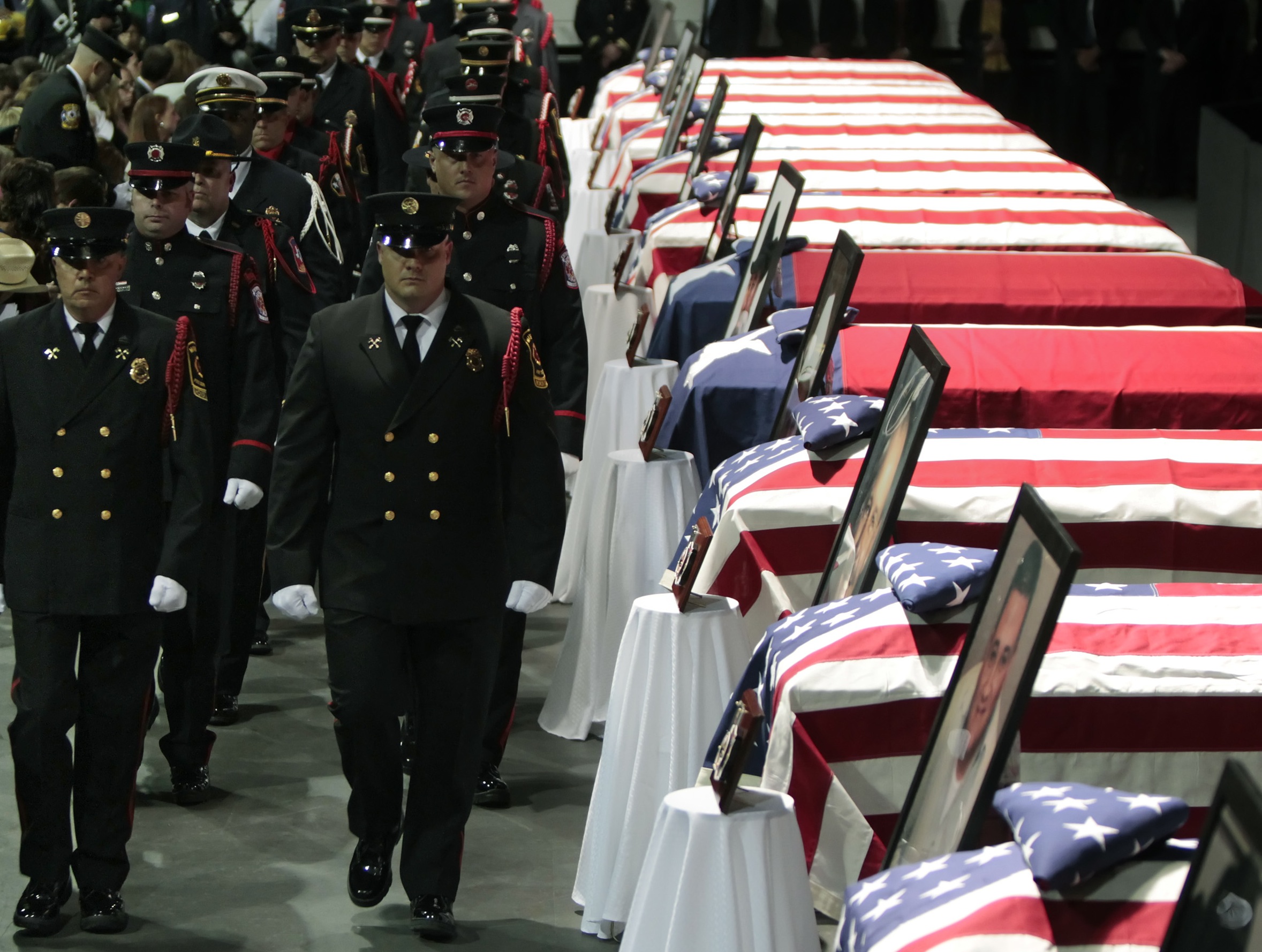
Victims Of Texas Fertilizer Plant Explosion Memorialized

It’s very common:

In certain situations, the data show, more people are killed trying to rescue others than are killed in the initial accident. The Occupational Safety and Health Administration recently examined reports for fatal, confined-space accidents and found that when multiple deaths occurred, the majority of the victims were rescuers. The National Institute for Occupational Safety and Health previously reported that rescuers account for more than 60 percent of confined-space fatalities.

OSHA defines confined spaces as those with limited or restricted entrances or exits, places that are not designed for continuous occupancy. They include, for instance, underground vaults, tanks, storage bins, manholes, pits, silos, and pipelines.

Meanwhile, Dan Hopkins examines the political consequences of disasters. Bottom line:

We reward spending to respond to disasters by backing incumbents more strongly, but we shrug when it comes to spending to get us ready for a disaster down the road. [Researchers Andrew Healy and Neil Malhotra] also estimate that a dollar spent on disaster preparedness reduces subsequent damage by $15, making such investments highly cost-effective.

(Photo: A firefighter honor guard marches past the caskets of the 12 fallen volunteer firefighters at the West memorial service held at Baylor University in Waco, Texas on April 25, 2013. The memorial service honored the volunteer firefighters that lost their lives at the fertilizer plant explosion in West, Texas. By Erich Schlegel/Getty Images)

Vision Without Revisions

In a 1968 interview, Jack Kerouac advocated a spontaneous, confessional writing ethos that has little time for fussy editing or punctuation:

By not revising what you’ve already written you simply give the reader the actual workings of your mind during the writing itself: you confess your thoughts about events in your own unchangeable way . . .

Well, look, did you ever hear a guy telling a long wild tale to a bunch of men in a bar and all are listening and smiling, did you ever hear that guy stop to revise himself, go back to a previous sentence to improve it, to defray its rhythmic thought impact. . . . If he pauses to blow his nose, isn’t he planning his next sentence? And when he lets that next sentence loose, isn’t it once and for all the way he wanted to say it? Doesn’t he depart from the thought of that sentence and, as Shakespeare says, “forever holds his tongue” on the subject, since he’s passed over it like a part of a river that flows over a rock once and for all and never returns and can never flow any other way in time?

Incidentally, as for my bug against periods, that was for the prose in October in the Railroad Earth, very experimental, intended to clack along all the way like a steam engine pulling a one-hundred-car freight with a talky caboose at the end, that was my way at the time and it still can be done if the thinking during the swift writing is confessional and pure and all excited with the life of it. And be sure of this, I spent my entire youth writing slowly with revisions and endless rehashing speculation and deleting and got so I was writing one sentence a day and the sentence had no FEELING. Goddamn it, FEELING is what I like in art, not CRAFTINESS and the hiding of feelings.

Previous Dish on Kerouac here, here and here.

Do We Have A Suicide “Epidemic”?

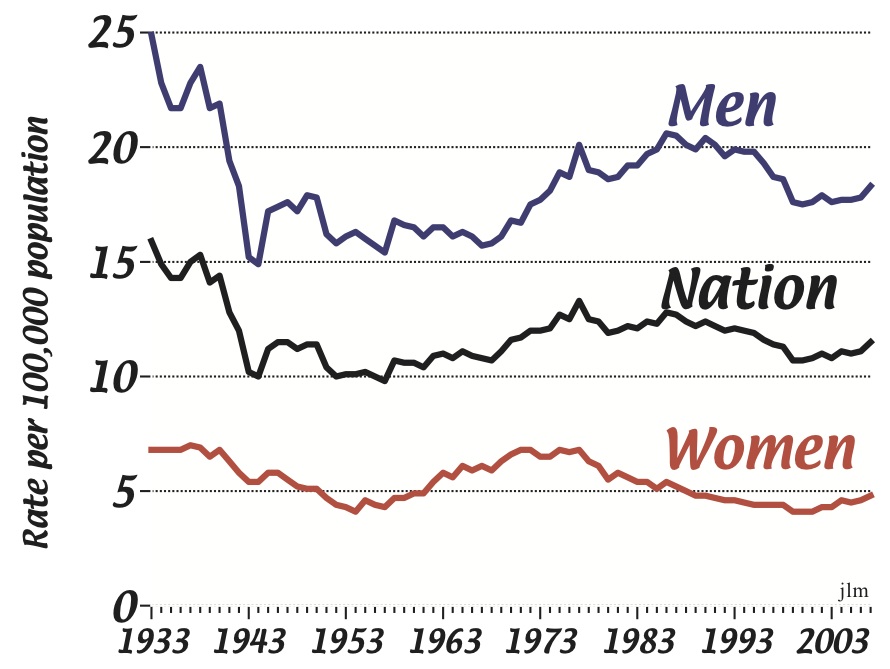
Suicide Rate

Tony Dokoupil claims we do:

[T]he last decade isn’t just a statistical blip, a function of a bad recession, unlocked gun cases, or an aging counterculture. It’s much darker, and deeper than all that. This is the “new epidemiology of suicide,” as [Julie Phillips, a sociologist at Rutgers University,] puts it, one where the tectonic changes of the last decade—socially, culturally, economically—have created a heavy burden of suicide, growing heavier by the year.

Nate Cohn, who posts the above chart, disagrees:

[T]alk of a “suicide epidemic” borders on sensationalism. Dokoupil’s piece is generally sound, but he contends that we live in a dystopic era of “unprecedented despair,” and that “we have never been more burdened by sadness.” Suicide rates have, indeed, climbed since 1999, a year that represented the all-time low for suicide in the United States, but today’s suicide rates are roughly comparable to those between 1940 and 1990, and below the rates of the 1930s.

That trendline corresponds with long-term trends in the national economy, adding credibility to the economic explanation for the suicide surge.

Sean Trende slices the data on suicide differently:

As it turns out, once you control for gun ownership, religiosity does have a statistically significant relationship with suicide … in a hypothetical state with no guns and no religion, we’d expect a suicide rate of 17 (per 100,000), give or take a few points. In a state where everyone had guns, and no one practiced religion, we’d expect a suicide rate of 39. If everyone were religious, but no guns: 11. Everyone religious, everyone owns a gun: 21. From a political perspective, there’s really something for both the left and right to like here.

Unfriending Ted Cruz

John Dickerson notes that the new Texas senator has already butted heads with several of his colleagues:

Do you need friends in the Senate anymore? Ted Cruz, Sen. Rand Paul of Kentucky, and Sen. Mike Lee of Utah are testing this theory in new ways. The power of Tea Party activists in Republican politics, the public’s low esteem for Congress, and structural changes in the Senate like the elimination of earmarks and the weakening of appropriations power have created more incentives for senators to get by without a little help from their friends.

Cruz has had a series of run-ins with his colleagues since being sworn in only four months ago. He battled Democratic Sen. Dianne Feinstein over gun control, his Senate Republican colleagues over a threat to filibuster gun legislation; and most recently he tangled with McCain and Republican Sen. Susan Collins over budget procedure.

Should Cruz run for president, John Sides expects this could hurt him:

Cruz’s path to the presidency—if he decides to run—must consist precisely of convincing “the middle” of the party that he’s electable despite the fact that he may be the most conservative member of the Senate (pdf).  To do that, he’ll need the support of his fellow party leaders to send that signal.  It doesn’t matter if he has “a knack for making his opponents lose their wits.”  His opponents will be busy nominating Hillary Clinton or whoever.  And it doesn’t matter whether, deep in his heart, he trusts Republicans. What matters is whether he has a knack for making his fellow Republicans trust him.

Commemorating The Confederacy

800px-Confederate_Monument_-_E_frieze_and_Minerva_-_Arlington_National_Cemetery_-_2011

Over the Memorial Day weekend, Jamie Malanowski called for [NYT] the government to rename Army bases named for generals who served the Confederacy:

Changing the names of these bases would not mean that we can’t still respect the service of those Confederate leaders; nor would it mean that we are imposing our notions of morality on people of a long-distant era. What it would mean is that we’re upholding our own convictions. It’s time to rename these bases. Surely we can find, in the 150 years since the Civil War, 10 soldiers whose exemplary service not only upheld our most important values, but was actually performed in the defense of the United States.

Erik Loomis focuses on the soldiers asked to serve at these forts:

[Malanowski asks] a fair question. And it is indeed an insult to ask African-American soldiers to serve at a fort named after P.G.T. Beauregard or John Gordon, who followed his war career by becoming the head of the KKK in Georgia.

Josh Marshall doesn’t mince words:

There’s a major difference between respecting and honoring sacrifice – which exists separately from the political movement you’re fighting on behalf of – and honoring people in this way. Today most of us probably see the problem as the fact that these guys fought to protect slavery. And whatever revisionist nonsense you hear out there that is unquestionably true. But that’s only one part of the equation. At least as big in my mind is that these men were traitors – rebels against the democratic ideal and the federal union around which any American patriotism has to be based. Taken together these two things are a really, really big deal. One can only begin to imagine what Union soldiers who died on the battlefield would make of all this. … Perhaps we’ve come far enough – regardless of the equities at stake 100 or 75 years ago – that we can revisit this question.

Dr. Charles Cogan counters:

These are memorials to the great and not-so-great Confederate generals: Fort Lee (understandable) but also Fort Bragg. I do not object to such a practice, as it is a recognition that both sides suffered during the war –just as Memorial Day honors the dead of both Union and Confederate soldiers. (Though at the beginning, Memorial Day was solely a Northern commemoration.)

This joint mourning has been central in achieving a reconciliation between North and South that has been truly remarkable – to the extent that talk of re-secession is never taken seriously. Indeed the South has become the most “patriotic” and military-oriented section of the country – partly due to its long and pre-bellum tradition of military honor. But while we can hardly object to the South’s honoring of its Pantheon of Civil War generals and of the thousands who died in the service of the Confederacy, we should not lose sight of the underlying imperatives of the Civil War: the preservation of the Union, and the abolition of slavery.

Slog’s David Goldstein explores the justification for honoring Confederates:

Over the years, I’ve had the chance to talk to a few proud Southerners about what it is exactly that they are so proud of, and while they may not use these exact words, invariably they say it was the nobility of the struggle that they honor. But whether or not they acknowledge it, the cause the South struggled for was preserving (and expanding) the institution of slavery. I don’t mean to go all Godwin and everything, but I’m sure many Nazi soldiers fought courageously too, yet you don’t see Germany building monuments to its World War II heroes.

TPM reader and Southerner CH worries about the potential backlash:

Before President Obama was elected, I would have agreed that maybe it is time to rename some military bases (and colleges) and maybe even consider doing something about the carving on Stone Mountain. And I would have agreed with you that after 1865 it was never again seriously considered that history might repeat itself. But as things now stand, I’m not sure that those same considerations which led to the mollification decisions back then, have become irrelevant; I’m not sure that the rationale for those decisions has outlived its usefulness.

Most rural Southern white men already feel that “their” country has been “taken” from them by a black Muslim. They watch Fox exclusively and without ceasing so they are constantly on edge and genuinely and earnestly believe that President Obama’s sole mission is to destroy America. I don’t know if we are sitting on a powder keg again or not. On a rational and academic level, I think that notion is absolutely ridiculous. But on a gut and emotional level, I worry. Sometimes I think all they need is a final straw to rally around. So maybe we could wait until a new president is in office again before we risk giving them a rallying point. Maybe the temperature down here will drop some by then.

(Photo: Detail of the southeast corner of the frieze on the Confederate Monument at Arlington National Cemtery in Arlington, Virginia, in the United States. The goddess of war, Minerva (l), looks at the fallen “The South” while “spirits of war” trumpet for assistance. To the right, a sapper (with bag) and a soldier answer the call. An African American soldier answers the call to defend slavery with his white master. From Wikimedia Commons)