Tales From The Crit

Tara McGinley sympathizes with an art student who flipped out during a critique (seen above):

Whether or not this is staged (performance art?) it’s hard to tell. But it does show what it’s like to have your work shit on during a crit by a bunch of assholes (and why so many people say “fuck it” to art degrees). For some reason this whole freak-out reminds me of an episode of Girls.

Traveling The Crowded Skies

With travel season upon us, Daniel Gross checks in on the airline industry:

Ten years ago, the load factor—the percentage of seats actually occupied—was generally in the mid-70 percentages. The load factor has climbed steadily over the past decade—to 83 percent in 2011. As the Bureau of Transportation Statistics reported, in February, the most recent month for which numbers are available, “The system load factor of 79.2 percent, the domestic load factor of 81.0 percent, and the international load factor of 75.8 percent were record highs for the month of February.” That means your flight is more likely to be crowded, totally booked, or overbooked, that your ability to go standby or get an upgrade will be degraded, and that the prospects of getting stuck in a middle seat between a screaming baby and a person of size are substantially greater. By the time you do get on board, it will more likely that the overhead compartments will be full and you’ll have to check the bag.

On the plus side:

When you reach your destination this summer, your luggage will be much more likely to be there.

After realizing it costs them a few hundred dollars each time they lose a bag, airlines have engineered an impressive reduction in the incidence of lost luggage. The rate of “mishandled bags” have plummeted from 7.05 per 1,000 passengers in 2007 to 3.15 per 1,000 in the first quarter of 2013.

An excerpt from Cockpit Confidential, airline pilot Patrick Smith’s new book, tries to put flying in a better light:

We’ve come to view flying as yet another impressive but ultimately uninspiring technological realm. There I am, sitting in a Boeing 747, a plane that if tipped onto its nose would rise as tall as a 20-story office tower. I’m at 33,000 feet over the Pacific Ocean, traveling at 600 miles per hour, bound for the Far East. And what are the passengers doing? Complaining, sulking, tapping glumly into their laptops. A man next to me is upset over a dent in his can of ginger ale. This is the realization, perhaps, of a fully evolved technology. Progress, one way or the other, mandates that the extraordinary become the ordinary. But don’t we lose valuable perspective when we begin to equate the commonplace, more or less by definition, with the tedious? Aren’t we forfeiting something important when we sneer indifferently at the sight of an airplane — at the sheer impressiveness of being able to throw down a few hundred dollars and travel halfway around the world at nearly the speed of sound? It’s a tough sell, I know, in this age of long lines, grinding delays, overbooked planes, and inconsolable babies. To be clear, I am not extolling the virtues of tiny seats or the culinary subtlety of half-ounce bags of snack mix. The indignities and hassles of modern air travel require little elaboration and are duly noted. But believe it or not, there is still plenty about flying for the traveler to savor and appreciate.

Should The Government Buy Kidneys?

Kidney Shortage

Rohin Dhar thinks so:

What’s the advantage of letting Medicare buy kidneys instead of creating a free market? First, it would save Medicare and private insurers money since the current cost of dialysis for people on the waitlist is so high. These parties have a financial incentive to consider a plan like this.

Second, a government-regulated system can address concerns about equity. Rather than rich people privately contracting poor people to buy their kidneys, the government and the UNOS can continue to allocate purchased kidneys based on need (Objection 1). Moreover, the risk for organ thieves is eliminated in this scenario (Objection 2). Would an organ thief show up at the Medicare office with bag of kidneys? Instead, individuals would have to go through an approval process to ensure that they are not selling their organ under duress and understand the risks.

(Chart from Mark Perry)

Ask Josh Barro Anything

This embed is invalid

A brief bio of Barro:

He is the lead writer for the Ticker, an economics and politics blog hosted by Bloomberg L.P.. He appears regularly on Bloomberg Television and has appeared on Real Time with Bill Maher on HBO. Time named Barro’s Twitter feed one of “The 140 Best Twitter Feeds of 2013”, one of ten in the Politics category. In 2012, Forbes selected him as one of the “30 Under 30” media “brightest stars under the age of 30.” Barro describes himself as a Republican, but has expressed opposition to the policies of the Republican party.

Last week the Dish highlighted Chait’s profile of Barro. Andrew Leonard wrote of him recently:

He is, in my opinion, a rare breed indeed: an intellectually honest analyst of political and economic affairs who makes up his own mind, does not hew to any preset ideology and relies on facts to makes his arguments. People who disagree with him have labeled him conservative, liberal and libertarian. That’s not easy to achieve! Barro can wage total war against the notion that austerity is the correct prescription for our economic problems while at the same time arguing that public sector unions are bankrupting state governments. I follow him because I always learn something from him, even when I disagree with him. … Josh Barro is also the gay son of the famously arch-conservative economist Robert Barro, which makes him inherently interesting for reasons that have nothing to do with the quality of his analysis, and everything to do with the social and cultural splits that define our current society.

To submit a question for Josh, simply enter it into the Urtak survey after answering all of the existing questions (ignore the “YES or NO question” aspect and simply enter any open-ended question). To vote, click “Yes” if you have a strong interest in seeing Josh answer the question or “No” if you don’t particularly care. Thanks for your help.

Quotes For The Day

“It is time for the world’s major central banks to acknowledge that a sudden burst of moderate inflation would be extremely helpful in unwinding today’s epic debt morass … Moderate inflation in the short run – say, 6% for two years – would not clear the books. But it would significantly ameliorate the problems, making other steps less costly and more effective,” – “austerian” Kenneth Rogoff, 2008.

“Larry Ball makes the case that we would be a lot better off with a 4 percent inflation target rather than the 2 percent that is now central bank orthodoxy. Intellectually, this position is hardly outlandish; indeed, Ball’s case is very similar to the case Olivier Blanchard made three years ago, just stated more forcefully and with more evidence,” – “anti-austerian” Paul Krugman, last week.

More discussion here.

Hardcore Curriculum, Ctd

Next spring, Routledge will publish Porn Studies, the first academic, peer-reviewed journal about pornography. A member of the editorial board explains why the field is worth studying:

[Editor Clarissa] Smith emphasizes three reasons in particular: pleasure, censorship, and controversy. First, porn is an important part of many people’s intimate lives, including their sexual relationships and identities, as well as their desires and fantasies. Second, pornography is often the focus for thinking about issues like censorship, regulation, freedom of speech, and ethical issues around sex and the media. And thirdly, pornography continues to be a controversial topic in the media and in other public forms of commentary, but, according to Smith, the way it is discussed often fails to engage with the evidence we have about porn.

But perhaps the biggest reason why pornography warrants critical engagement by scholars is that it’s a multi-billion dollar global industry that creates products that circulate widely and are consumed by many, yet we know surprisingly little about the conditions under which pornography is made and consumed, and how it affects people’s intimate lives and sexual identities.

On a related note, Camille Paglia rails against recent scholarly studies of kink and S&M, calling for a more rigorous approach to the topic. Previous Dish on porn in academia here.

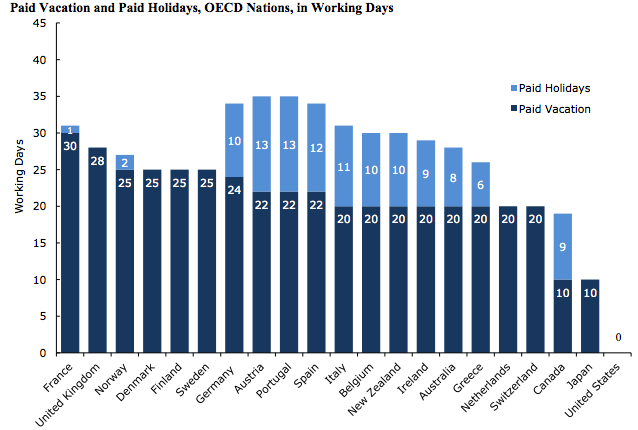
The Nation’s Vacation Policy

Is nonexistent (pdf):

America Vacation

What this means in practice:

[A]mong richer workers, almost all employers offer paid vacation and holidays, and quite a bit of it. Among poorer workers, less than half get paid vacation, and even when they do, their employers offer a lot less of it. This is one more way in which the poor often end up working much harder than the rich.

Not Everyone Is Created Genetically Equal

Dish alum Zack Beauchamp reports on the Richwine affair. He digs up some new details but also downplays the importance of genetics. Zack’s research does suggest to me that Richwine’s thesis was “good enough” empirically, but way too broad in its inferences. But then Zack writes something like this:

Alleging that, as a group, an enormous percentage of Americans are and always will be dumber than their fellow citizens isn’t just normal academic inquiry.

That’s not what even the most genetically-inclined scholars believe. There are huge overlaps of IQ among self-reported racial groupings – with all of them having much more in common than apart. And Charles Murray has never doubted that environment matters – especially in the first few years. But when you’re dealing with scores that get you into Ivy League colleges, for example, those minor differences between groups as a whole will lead to obvious racial disparities. There will be far more Asians and Jews than are represented in the population at large. Soon, liberals may have to confront this not as a black or white problem, but as a question of whether it is just to deny places to Asians and Jews just because of their ethnic background. I think liberals dismiss this data at their peril.

Freddie sighs:

Beauchamp goes hard on the notion that environment trumps everything when it comes to IQ. Indeed, he goes so hard on that attitude that most readers will likely think that there is nothing to the notion of a genetic basis for IQ. That’s simply not in keeping with the large majority of the data.

For example, that adopted children have IQs that correlate far more highly with their biological parents than their adoptive parents has been replicated repeatedly. (See, for example, Plomin et al. from 1997, for just one.) James Flynn, who I will remind you is deeply committed to social justice and is also the preeminent researcher in IQ, wrote in 2007, “The most radical form of environmental intervention is adoption into a privileged home. Adoptive parents often wonder why the adopted child loses ground on their natural children. If their own children inherit elite genes and the adopted child has average genes, then as parents slowly lose the ability to impose an equally enriched environment on both, the individual differences in genes begin to dominate.” That Flynn piece, I think, is really excellent as a discussion of how to think through and understand the interactions between genetics and environment in IQ. It is not defeatist, and could never be called racist. But it is far more sober and clear about the relationship between genetics and IQ than Beauchamp’s piece.

Why Freddie keeps fighting this fight:

We don’t have to misrepresent the importance of genetic parentage to IQ to recognize the importance of environment. Beauchamp makes some very good points about what it means to be Hispanic and about what a race is. I myself have written four times in the last week or two about why we shouldn’t listen to Jason Richwine. By misrepresenting the actual extant evidence, well-meaning people play into the hands of those who work tirelessly to establish the idea of a conspiracy to hide the truth.

Removed from the emotional grindhouse of race, why does all of this matter? It matters because our educational debates are dominated by a piety that almost everyone argues but almost no one believes: that all people are of equal ability. If you think that’s an exaggeration, consider No Child Left Behind, which insists: 100% must achieve the standard, 100% compliance. Here in the real world, 100% of people will never reach the standard in anything at all. Yet this notion that our problems can all not only be improved upon but literally erased permeates education at all levels. It is the most glaring orthodoxy in our educational debates: you must never suggest that anyone will ever fail.

Freddie, who self-identifies as a socialist, goes on to write, “I don’t mind pointing out that human beings are substantially unequal in their abilities because I don’t think that this should condemn anyone to a life of poverty.” Me too. I oppose any public policy based on racial profiling, including affirmative action. I believe in a firm safety net. I just believe in dealing with reality and making the best of it. If that means more aggressive early intervention in child-rearing, then we need to put that on the table, especially if affirmative actions falls.