Great moments in Jumbotron history:
Living Only In The Moment
From a review of Permanent Present Tense, Suzanne Corkin’s account of the fascinating life of Henry Molaison, perhaps the most famous amnesiac:
When he was 27, a disastrous brain operation destroyed his ability to form new memories, and he lived for the next 55 years in a rolling thirty-second loop of awareness, a ‘permanent present tense’. During this time he was subjected to thousands of hours of tests, of which naturally he had no recall; he provided data for hundreds of scientific papers, and became the subject of a book (Memory’s Ghost by Philip Hilts) and a staple of popular science journalism; by the 1990s digital images of his uniquely disfigured hippocampus featured in almost every standard work on the neuroscience of memory.
Henry, of course, did not comprehend his condition:
His short span of consciousness led to repetitive behaviour – making the same
observation repeatedly, or mechanically eating two lunches in a row – but his conversation was characterised by a gentle wit and quizzical, punning exchanges that seemed to test every statement for possible meanings. … In many respects he displayed the serenity and detachment promised by the Buddhist ideal of living in the now, freed from regrets about the past or anxieties for the future. He was certainly more content than his most extreme opposite, Solomon Shereshevsky, the subject of A.R. Luria’s The Mind of a Mnemonist. Shereshevsky’s inability to forget became a life-destroying torment. ‘The trail of memory can feel like a heavy chain,’ Corkin observes, ‘keeping us locked into the identities we have created for ourselves.’ Henry was, by contrast, ‘free from the moorings that keep us anchored in time…’

Jenni Ogden, who worked with Henry, observes his lasting impact on science:
The last chapter, ‘Henry’s Legacy’, recounting the dramatic final journey of the most famous brain in the world, is a page turner as exciting—more exciting— than the best thriller, and takes us into the future; a future more mind-boggling than any science fiction book. After nine hours of in situ MRI brain scanning in Boston, followed by a delicate autopsy to remove the brain from the skull, followed by more scanning, Henry’s carefully protected brain had its own seat for the flight across America to the University of California, San Diego. There it was cut into 2,401 very thin slices, each one photographed. Now there is more work to do as the slices are stained and mounted on large glass slides, and the digital images used to create a 3-dimensional, stunningly detailed model of Henry’s brain that will be freely available on the internet. In the epilogue of her book, Dr. Corkin reminds us of the lovely man Henry was, as the people who cared for him and worked with him say their goodbyes, and reminisce about the good times they shared with the man who never remembered them.
(Photo: Henry Molaison at aged 60, 1986, taken at MIT by Jenni Ogden, author of Trouble In Mind: Stories from a neuropsychologist’s casebook, OUP, 2012.)
Bukowski On Being Censored
In 1985, the Public Library of Nijmegen, Netherlands pulled from its shelves Charles Bukowski’s Tales of Ordinary Madness, calling the book “very sadistic, occasionally fascist and discriminatory against certain groups (including homosexuals).” Bukowski reacted in a letter to journalist Hans van den Broek:
If I write badly about blacks, homosexuals and women it is because of these who I met were that. There are many “bads”—bad dogs, bad censorship; there are even “bad” white males. Only when you write about “bad” white males they don’t complain about it. And need I say that there are “good” blacks, “good” homosexuals and “good” women?
In my work, as a writer, I only photograph, in words, what I see. If I write of “sadism” it is because it exists, I didn’t invent it, and if some terrible act occurs in my work it is because such things happen in our lives. I am not on the side of evil, if such a thing as evil abounds. In my writing I do not always agree with what occurs, nor do I linger in the mud for the sheer sake of it. Also, it is curious that the people who rail against my work seem to overlook the sections of it which entail joy and love and hope, and there are such sections. My days, my years, my life has seen up and downs, lights and darknesses. If I wrote only and continually of the “light” and never mentioned the other, then as an artist I would be a liar.
Censorship is the tool of those who have the need to hide actualities from themselves and from others. Their fear is only their inability to face what is real, and I can’t vent any anger against them. I only feel this appalling sadness. Somewhere, in their upbringing, they were shielded against the total facts of our existence. They were only taught to look one way when many ways exist.
(Video: Tom Waits reads Bukowski)
Face Of The Day
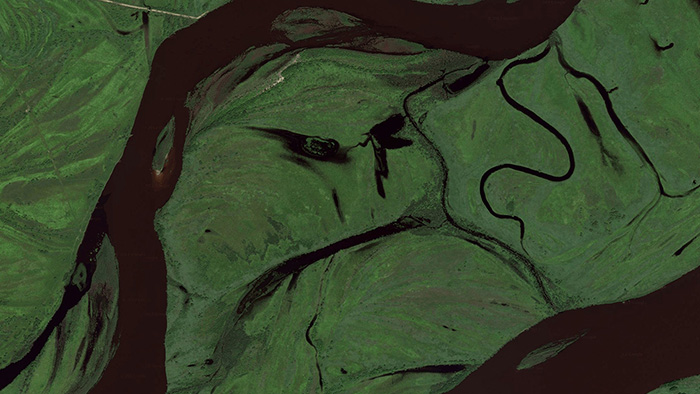
The artists’ group onformative combines facial recognition software with satellite images from Google Maps to reveal the planet’s “GoogleFaces.” Explain the artists:
Our Facetracker already circumnavigated the world a couple of times and astonished us with quite versatile results. As it continues to travel the world within the upcoming months, it continuously zooms into the earth. This process decreases the step-size for each iteration and therefore increases the amount of images and travel time exponentially. Some of the detected images aren’t usable at all, as we are not able to recognize any face-like patterns within the detected images. Other satellite images, on the other hand, inspired our imagination in a tremendous, yet funny way.
An interactive version of the project is here.
(Hat tip: ANIMAL)
Dürer’s Demons
The great German artist Albrecht Dürer inured himself to the melancholy of his time by embracing religion:
Like so many of his contemporaries, Dürer was haunted by death and guilt and the fear of damnation. He had good reason to be. Death was everywhere. Dürer had seventeen siblings, and only two made it to adulthood.
Both his trips across the Alps to Italy—in 1494 and 1505–1507—were partly inspired by the desire to flee outbreaks of the plague in his home town, Nuremberg. “Anyone who is among us today,” Dürer wrote in one poem, “may be buried tomorrow.” This was not a poetic conceit. It was the brutal truth. …
To overcome the inborn tendency to evil, Dürer appears to have believed there were three things you could do, if you received the grace to do them. One was to mortify the flesh. It may sound morbid to us, but mortification was a common part of religious practice then. It is even recommended in the third of Luther’s Ninety-Five Theses: “penitence is null unless it produces outward signs in various mortifications of the flesh.”
We do not know for a fact that Dürer also practiced this discipline, but his sense of its attractions is evident in his art. … If the artist did not actually practice self-flagellation, he surely understood why someone would and sympathized with the impulse.
The second was to throw yourself onto the mercy of God. His writings are full of sayings such as “Always seek grace, as if you might die any moment” and “No help could have reached us save through the incarnation of the son of God.”
The third was to work without ceasing. Never stop. … Work was a form of prayer and art was a form of praise. Dürer wrote, “[Painting] is useful because God is thereby honored.” But if you ever stopped, you would lose your way and fall into error, like the idle genius in Melencolia I. To quote [Martin Luther’s spiritual advisor Johann von] Staupitz once more, “The first sign of true faith is the battle against the demons.”
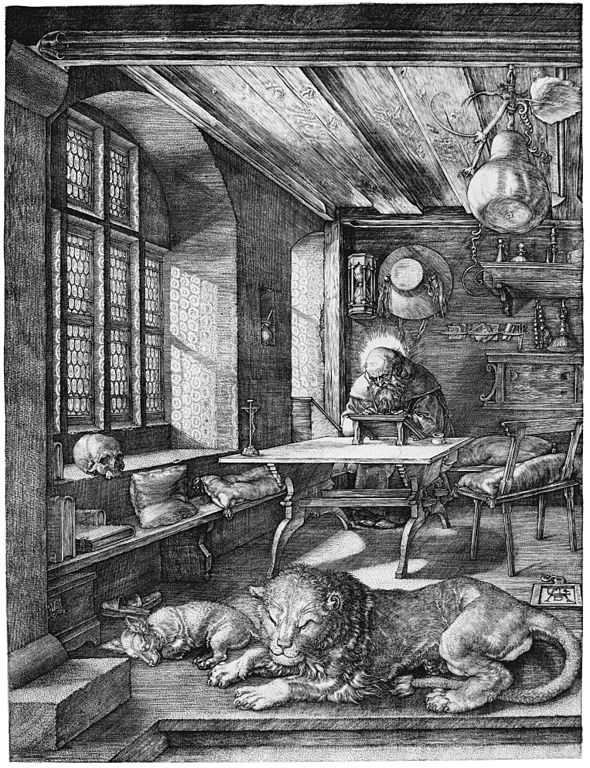
(Image: St. Jerome in His Study, Albrecht Dürer, 1514, via Wikimedia Commons)
The View From Your Window Contest

You have until noon on Tuesday to guess it. City and/or state first, then country. Please put the location in the subject heading, along with any description within the email. If no one guesses the exact location, proximity counts. Be sure to email entries to contest@andrewsullivan.com. Winner gets a free The View From Your Window book. Have at it.
Poseur Alert
“The animated GIF, meanwhile—whose origins go back to the antediluvian age of dial-up modems and whose natural home is the resolutely non-artistic bottom-feed of Internet image production—rudely interrupts the unbroken sheen of all the slick shit, since to GIF an image is not only to create a loop, but—in very literal terms pertaining to the effects of LZW compression—to apply a verfremdungseffekt, or distancing effect. The shiny mirror finish of HD video is dithered to dust, dots and dashes, and all the smoothing of Photoshop reduced to a crude cartography of color. The v-effekt was one of political playwright Brecht’s theatrical techniques to ensure an audience never get too comfortable: a device to make the abstract immediate and the political relatable. Here, the distancing effect allows the moving image to circulate widely on low-bandwidth connections, bringing it closer to home. To GIF is to reduce a picture to the “poor image” defended by Hito Steyerl; the conditions of its own circulation made visible. ‘The poor image is no longer about the real thing—the originary original. Instead, it is about its own real conditions of existence: about swarm circulation, digital dispersion, fractured and flexible temporalities… In short: it is about reality.’
The animated GIF is a Brechtian medium not only in the distancing effects of image compression, but also in that the repetition of a single gesture ad infinitum constitutes a sort of gestus—a symbolic moment that is amplified in context to represent a whole paradigm of existence,” – Jesse Darling.
(Hat tip: Cyborgology)
An Invented Space
Dressing The Air digs up a short film by Alex Roman:
Entirely built and rendered on computer, this impossibly controlled journey around Louis Kahn’s Exeter Academy Library evokes the soul of the architecture with very particular attention to material and light. Roman is managing to distill more into these digital “fictions” than most photographer/filmmakers manage from encounters with actual built structures.
From an interview with Roman:
I find inspiration in the aesthetics of the fine arts; specifically painting, but even something as varied as architecture. For technical reference, I find inspiration in still image photography for static renderings, and TV and film for animation.
A shot from the making of the film here.
The View From Your Window

Jacksonville, Florida, 7.18 pm
Punk: Fashion Or Philosophy?
Prospero pans the 2013 Met Ball, designed to celebrate the Metropolitan Museum of Art’s new exhibition “Punk: Chaos to Couture”:
It was a silly idea to begin with. Doing punk through the clothes is like trying to do hippiedom with peace symbols.
Punk was never about the threads. The clothes, the hair, the makeup, the sewn-on patches and the badges conveyed a message about who you were and what you stood for. For those who were not interested in punk’s message, the clothes served as a warning. But punk was always more than a fashion statement. …
To look at punk viewed only through the attire, rather than the beliefs, is to make a cultural error. Punk wasn’t “chaotic”, as the title of the Met’s new fashion exhibit suggests. Some punks were anarchists, but anarchy and chaos are not synonyms. The anarcho-punks believed that an absence of government would produce harmony. They were libertarians who believed in personal freedom and individualism—a bit like Texans, but unwashed and smelling of petunia oil. An exhibition that juxtaposes the idea of chaos and punk makes it appear that punk was about nothing. The establishment often undermines youth movements this way. Dismissing them as incoherent is easier than answering angry questions.

Or maybe, as Morgan Meis argues, “Punk was about fashion from the beginning”:
The bored, blank stare of the punk rocker can be seen most clearly in one other place of popular culture: the catwalk. … Punk was important not because it was more than a fashidon, but because it was the soul of fashion. In exploring the dark side of fashion it explored the dark side of modern life … Usually we don’t have the strength to take a good look at our empty, death-driven culture. For a short time in the 1970s, punk rockers did just that. Then they died. Literally or figuratively.
(Photo: Paloma Faith attends the Costume Institute Gala for the ‘PUNK: Chaos to Couture’ exhibition at the Metropolitan Museum of Art on May 6, 2013 in New York City. By Andrew H. Walker/Getty Images for People.com)


