A phobia finally gets its horror flick:
An Investment That Wasn’t A Lemon
Connor Simpson is impressed by Tesla’s early repayment of their Department of Energy loan, which has earned the government a $20 million profit:
It’s quite an accomplishment considering the fates that have befallen other green energy companies. The Department of Justice seized $21 million from electric car maker Fisker before the company went into bankruptcy after it received a $529 million loan guarantee in 2009. Battery maker A123 Systems spent $132 million of its $250 million guarantee from the Department of Energy before they bit the dust. That does not sound great, but the Department of Energy guarantees are actually creating jobs.
Peter Eavis notes that “Tesla has not fully weaned itself from government support” because buyers “of Tesla cars can get substantial tax credits that reduce the purchase price.” Yglesias defends this tax credit:
Now it’s quite right to say that current policy is not exactly optimal. A $20 per ton carbon tax with the funds used to lower other taxes would be much better nudge than a regressive tax credit initiative. But you rarely get optimal policy, and the course we’re taking is a reasonable and practical one.
An Islamist Beheading In Britain, Ctd

Greenwald refuses to label the beheading in London “terrorism,” calling it just another attempt to stir paranoia against Muslims:
[T]he term at this point seems to have no function other than propagandistically and legally legitimizing the violence of western states against Muslims while delegitimizing any and all violence done in return to those states …
I really have to try restrain my anger here. First off, Glenn’s adoption of the view that the wars in Iraq and Afghanistan amounted to “continuous violence by western states against Muslim civilians” seems a new step toward the memes of Islamist propaganda. Does Glenn really believe that the wars in Afghanistan and Iraq, however flawed, were deliberate attempts to kill Muslim civilians, in the way al Qaeda deliberately targets and kills Muslim civilians?
If he does, then I beg to differ. The reason we invaded Afghanistan was not because we decided to launch a war on Islam. It was because wealthy, Islamist, hypocritical bigots launched an unprovoked Jihadist mass murder of Western innocents from a cell based in a country run by a regime that specialized and specializes in the mass murder of other Muslims.
Before 9/11, America had saved Muslims in the Balkans from Christianist fanatics. We helped liberate Muslims in Afghanistan from Soviet oppression. We continue to give vast amounts of money to Muslim countries like Egypt, and, because of our economic development and need for oil made multi-billionaires out of Saudi clerics. And the war against Saddam, though a criminal enterprise and strategic catastrophe, nonetheless removed one of the most vicious mass murderers of Muslims on the planet. And the sectarian murder of Muslims that followed, however the ultimate responsibility for the occupying forces, was not done by Westerners. It was done by Muslims killing Muslims. The West, moreover, is committed to removing its troops from Afghanistan by next year and is fast winding down drone strikes.
How can that legitimize a British citizen’s brutal beheading of a fellow British citizen on the streets of London? If we cannot call a man who does that in the name of God and finishes by warning his fellow citizens “You will never be safe” a terrorist, who would fit that description, apart, of course, in Glenn’s view, Barack Obama?
The barbarian with the machete was not born in a Muslim country or land. He was born in Britain, educated at Marshalls Park school in Romford and Greenwich University.
He does not have a history of concern with foreign policy – or even sensitivity toward the mass murder of Muslims. There is no record of his protest against the mass murders by the Taliban – because those kinds of murders of Muslims he approves of. He is a convert to the Sunni Islamism of Anjem Choudary, whose street thugs were involved in a melee in a London street only last week as they attacked and scuffled with Shi’a Muslims. Choudary’s group wants Sharia law imposed on the UK, a war against Shiites everywhere, the brutal subjugation of women, and suppression of every freedom Glenn cares about. The idea that this foul, religious bigotry – when it provokes its adherents to the kind of barbarism we saw two days ago – is some kind of legitimate protest against a fast-ending war is just perverse.
I want the war in Af-Pak to end. I agree that blowback is a real problem. I was horrified by the Iraq war. I remain appalled by GTMO and the legacy of torture. But I cannot defend any analysis of what happened in London as some kind of legitimate protest against Western foreign policy rather than terrorism in its most animal-like form, created and sustained entirely by religious fanaticism which would find any excuse to murder, destroy and oppress Muslims and non-Muslims in the name of God.
They did this before 9/11 and before our invasions of Afghanistan and Iraq. They are doing it now in Syria in the name of the same God. These genocidal theocrats did not need to be spurred by the US and UK’s actions – although they can view those as a further inflammation. They are living out their twisted, foul faith – which requires them not merely to kill, but to hack and mutilate and dismember another human being and celebrate that fact with a glee and a pride that has absolutely nothing to do with foreign policy and everything to do with the evil lurking in the totalitarian’s soul.
I have to say I have always respected the sincerity and clarity of Greenwald’s critique of the war on terror. But his blindness to the savagery at the heart of Salafism is very hard to understand, let alone forgive.
Recent Dish coverage of the Woolwich beheading here, here, here and here.
Eat In, Get Thin
As long as you stick to the serving sizes:
Jane Brody pushes back against attempts to pin the obesity epidemic on sugar:
Sugar, it turns out, is a minor player in the rise. More than half of the added calories — 242 a day — have come from fats and oils, and another 167 calories from flour and cereal. Sugar accounts for only 35 of the added daily calories. Demographic changes, and how the food and restaurant industries responded to them, compounded the problem. As more women entered the work force, family meals and especially home-cooked meals became less frequent. (Relatively few husbands became family cooks, sadly.) From 2005 to 2008, according to the Department of Agriculture, 20 percent of American calories were consumed in fast-food and full-service restaurants, more than triple the amount in 1977-78.
Eating just one meal a week away from home can translate into two extra pounds a year for the average person, the department calculated. Although the recent economic downturn forced more people to dine at home, the average adult now eats out nearly five times a week.
Zak Stone highlights a troubling implication of this trend:
The advice for the American diner, which, is also the message of Michael Pollan’s new book Cooked: A Natural History of Transformation, is to cook your own meals using unprocessed ingredients if you want to buck the trend toward becoming overweight. The problem, of course, is that this is not a reality for many overworked, poor Americans who don’t have access to healthy food in their neighborhoods–the exact demographic most likely to battle obesity.
Meanwhile, Wisconsin is currently considering a bill that would prohibit local governments from limiting food or beverage portions. Two top children’s health officials take to the op-ed page to oppose the bill:
Adults may defend the right to choose a healthy or unhealthy lifestyle, but avoiding collective responsibility to provide a healthy environment for children is difficult to defend. In Wisconsin, 39 percent of students in grades three through five are overweight or obese. Unless change is made, most are doomed to be obese adults. Refusing to even consider policies that could alter this trend is an expensive proposition. In 2013, Wisconsin will spend about $2.7 billion on obesity-related medical expenses that trickle down to communities.
What You Don’t Know Could Save Your Life
A couple months ago, the American College of Medical Genetics and Genomics (ACMG) recommended that doctors share incidental genetic findings with patients. Robert Green explains:
The recommendations state that laboratories performing a sequencing analysis of the protein-coding regions of DNA (the exome) or of the entire genetic code (the genome) for any medical indication should also examine 57 genes for well-recognized mutations that might signal a risk for one of 24 life-threatening but treatable conditions. While there are literally thousands of genes that could potentially influence a person’s future health, the ACMG felt that discovering mutations for these 24 conditions (such as hereditary cancers or heart conditions that could cause sudden death) was so important that a laboratory sequencing the genome should deliberately search for these mutations, and that these were genetic “panic values” that should always be returned to the ordering physician. The recommendations called for analyzing and returning this information without seeking the patient’s explicit permission for each and every gene to be tested, and regardless of the age of the patient being sequenced.
Not everyone in the scientific community agrees. Ronald Bailey’s view:
I predict that, as genomic testing becomes more precise and prognostic, failing to tell a patient about her genetic disease risks will be seen as being just as moral as neglecting to tell her about an aortic aneurysm discovered during an ultrasound examination for gallstones. Keeping people ignorant is rarely the right thing to do.
The View From Your Window

Copenhagen, Denmark, 6.10 pm
Who Should Pay For Early Education?
Lane Kenworthy believes that, eventually, “the United States is likely to have universal publicly-funded early education for children aged one to four.” How he would like the system designed:
American parents with a child younger than age five in out-of-home care currently pay, on average, about $9,000 per year for that care. Childcare expenditures amount to 40% of income for families with incomes below $18,000, and 20% for those with incomes between $18,000 and $36,000. That’s far too much.
How much should parents pay? A sliding scale, with the user fee rising in proportion to family income and capped at around 10%, seems sensible.
Should it be free for those with low incomes? I think that would be a mistake. Early education differs from services that relatively few people opt out of, such as police protection, healthcare, and even K-12 education. Families that prefer to provide stay-at-home parental care for their young children will elect not to use it. This argues for having parents who do use it pay something — even parents with little income. The fee should be modest, but it shouldn’t be zero.
Some recent polling on who should pay for early education:
[A]ccording to the latest Reason-Rupe poll, only 37 percent of Americans favor raising taxes to create a universal preschool system, while 61 percent oppose. When asked who should be “primarily responsible” for paying for preschool, 57 percent of Americans think parents should pay and 32 percent want the government to be responsible for paying.
What The Hell Is Happening In Sweden?
Who knew that refugees from Somalia would consider themselves “deprived” in Sweden. Just ask the BBC: bbc.co.uk/news/world-eur…
— Michael Ross (@mrossletters) May 23, 2013
There has been rioting in Sweden for the past five nights (NYT):
As the unrest spread from the outlying district of Husby, where it was apparently set off on Sunday by the fatal police shooting of a local man wielding a knife, gangs of youths have torched schools and other public buildings and set alight scores of cars. The rioting, for which the authorities have sought to blame a small group of troublemakers, has been focused in areas with a majority population of poor immigrants and asylum-seekers.
The Guardian adds that the rioting has “exposed a faultline between a well-off majority and a minority, often young people with immigrant backgrounds, who cannot find work, lack education and feel marginalised.” Niklas Pollard and Phillip O’Connor find that the violence shows the “ugly side of the ‘Nordic model'”:
Conversations with residents of this immigrant neighborhood soon bring tales of fruitless job hunts, police harassment, racial taunts and a feeling of living at the margins that are at odds with Sweden’s reputation for openness and tolerance. … The Swedish model of welfare – such as its 480 days of parental leave for each child – hides another side. Some 15 percent of the population is foreign born, the highest in the Nordic region. … [And e]ven second generation immigrants struggle to find white collar employment. As one Asian diplomat puts it: “On the one hand Sweden has all these immigrants. On the other hand, where are they? It sometimes seems they are mostly selling hotdogs.”
Elias Groll records the reactions of the politicians. Samuel Goldman examines the implications for Americans:
What’s happening around Stockholm, then, can’t be explained away as a reaction to official neglect or poverty. Rather, it’s a predictable consequence of mass immigration from the Third World into a small, ethnically and culturally homogeneous society.
Immigration critics on this site and elsewhere worry that the United States is failing to assimilate the millions who have come here, legally and illegally, since the 1960s. I think those fears are mostly exaggerated. Although fashionable multiculturalism can inhibit assimilation, American life has proven to be an reliable solvent of foreign identities. As Christopher Caldwell has argued, however, the classic nation-states of Europe lack the cultural resources to absorb an influx of population from some of the poorest and most backward societies in the world. I’m glad I don’t live in Stockholm tonight.
Obamacare Can Work? Ctd
Yesterday California announced premium rates for its healthcare exchanges. Sarah Kliff points out that the premiums are lower than many estimates:
Health insurers will charge 25-year-olds between $142 and $190 per month for a bare-bones health plan in Los Angeles. A 40-year-old in San Francisco who wants a top-of-the-line plan would receive a bill between $451 and $525. Downgrade to a less robust option, and premiums fall as low as $221. These premium rates, released Thursday, help answer one of the biggest questions about Obamacare: How much health insurance will cost. They do so in California, the state with 7.1 million uninsured residents, more than any other place in the country.
It’s also worth noting that, thanks to Obamacare’s subsidies for the poor, many will pay less than the already low sticker prices. In case you missed it, Jonathan Cohn weighed in this morning in a must-read. Ezra notes how California is a vital test:
It’s not just the largest state in the nation. It’s also one of the states most committed to implementing Obamacare effectively. Under Gov. Arnold Schwarzenegger — remember how that really happened? — California was the first state to begin building its insurance exchanges. The state’s outreach efforts are unparalleled. Its insurance regulators are working hard to bring in good plans and make sure they’re playing fair. If California can’t make the law work, perhaps no one can. But if California can make the law work, it shows that others can, too.
Elspeth Reeve adds that other states have had similar experiences:
We’ve see this happen in other states. Earlier this month, rate proposals released by insurance companies in Washington state showed some people’s premiums would actually go down. Premera Blue Cross had estimated that premiums would rise about 50 percent to 70 percent. When Oregon released proposed health care premiums online in May, two insurers requested the chance to adjust their rates — to make them lower. Why is this happening? “The premiums and participation in California, Oregon, Washington and other states show that insurers want to compete for the new enrollees in this market,” the Kaiser Family Foundation’s Gary Claxton told The New Republic. The glories of the free market.
Let us now praise the Heritage Foundation, that Marxist-Leninist den that originally came up with the idea of healthcare exchanges.
How Harmless Is Your High?
As part of a “Room for Debate” series on how to sell marijuana safely, psychiatry professor A. Eden Evins spells out the risks for stoners:
Regular cannabis use has been associated with an 8- to 10-point drop in I.Q. over the course of 20 years, a change that would bring one from the 50th percentile to just over the 30th. Again, those who started regular use in adolescence experienced greater I.Q. decline than those who started as adults. Marijuana worsens cognitive performance, particularly in the domains of verbal learning, verbal working memory and attention accuracy. Some deficits appear to be lasting. Attention accuracy deficits associated with cannabis use do not improve with abstinence. These results suggest hippocampal, subcortical and prefrontal cortex abnormalities, some of which may be lasting.
As usual, these potential drawbacks are never related to the drawbacks of many other legal substances, like, say tobacco or alcohol. In fact, our public discussion of these pleasures almost never focuses on their potential harm. Alcohol clearly does far more harm to people than marijuana. It foments violence, can destroy the liver, breaks up families and is far more addictive than pot. So let’s see how the same newspaper, the New York Times, covers those risks:
Sipping a good gin and tonic is like finding a 20th-century oxford shirt in the closet and realizing that you can still wear it downtown tonight without looking out of step with the century we’re stuck in.
It just works.
But that hasn’t stopped mixology-besotted bartenders from trying to make it better. You’ll find a few of them who can’t resist filling a glass with more and more flavor dimensions, creating a gin and tonic that’s such a complicated spectacle, you barely recognize it. The good news, though, is that plenty of fresh and successful variations are being dreamed up by bartenders and restaurateurs who don’t view the word “restraint” as an epithet.
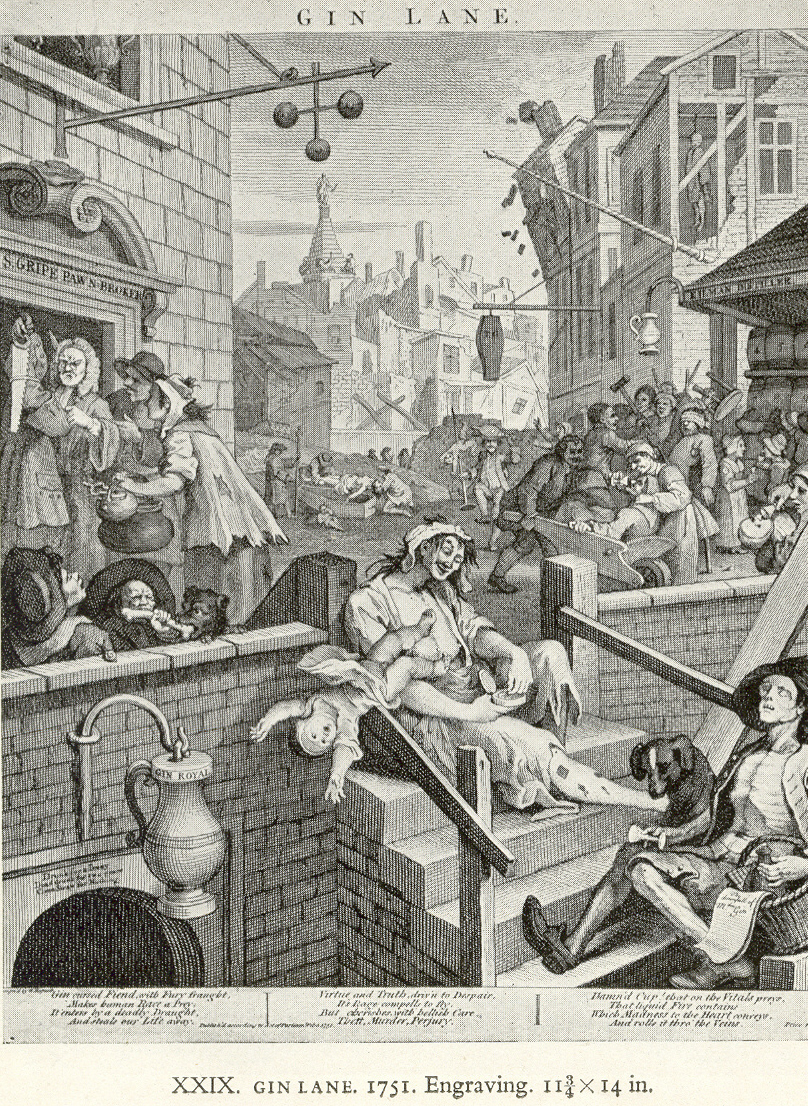
Notice how “restraint” is clearly here a negative notion. So you have the same newspaper celebrating the lack of restraint for a form of alcohol that once turned London into a chaotic, crime-ridden, besotted mess (see above), while noting small, long-term effects for a much safer form of recreational release. I’m all for weighing the costs of smoking or inhaling cannabis. We should be aware that, like all substances, it can give pleasure and also physical or mental harm. But when it is singled out for obloquy in the same space that a far more dangerous drug is not just celebrated but lionized, something other than science is at work.
(Illustration: Gin Lane by Hogarth, 1751.)

