White Picket Fence Poverty

It’s on the rise:

According to a new report put out by the Brookings Institute, more poor inhabitants of the U.S. now live in suburbs than in cities and rural areas. Between 2002 and 2011, the population of the suburban poor rose 67%. That’s over twice the number seen in urban areas.

Brad Plumer summarizes key points from the report:

The biggest driver is that suburbs simply grew faster than urban areas during the 2000s, particularly in the South. At the same time, jobs have been migrating to the suburbs for many years — and that includes low-paying jobs in retail and hospitality. As a result, many of the working poor have been moving to the suburbs, too.

Reihan’s perspective:

[T]he fact that a fifth of New York city’s population lives in poverty while the same is true of only 9 percent of the population in its suburbs doesn’t represent a failing — rather, it reflects the fact that density and the widespread availability of mass transit are particularly valuable to the poor, who find it more difficult to purchase and maintain automobiles and for whom density facilitates greater access to service jobs. … So suburban poverty poses problems that poverty in dense cities well-served by transit does not. The problem we face is that the U.S. has relatively few dense cities that are well-served by transit, as such cities can greatly facilitate upward mobility for the very poor.

Literary Memory

Ian Crouch reflects on his tendency to read voraciously, only to completely forget books shortly after:

This forgetting has serious consequences—but it has superficial ones as well, mostly having to do with vanity. It has led, at times, to a discomfiting situation, call it the Cocktail Party Trap (though this suggests that I go to many cocktail parties, which is itself a fib). Someone mentions a book with some cachet that I’ve read—a lesser-known work of a celebrated writer, say Eliot’s “Daniel Deronda,” to take an example from my shelf—and I smile knowingly, and maybe add, “It’s wonderful,” or some such thing. Great so far, I’m part of the in-crowd—and not lying; I did read it. But then there’s a moment of terror: What if the person summons up a question or comment with any kind of specificity at all? Basically, what if she aims to do anything other than merely brag about having read “Daniel Deronda”? Uh-oh. It’s about mining, right? Maybe blurt something about that. No, wait, that’s Gaskell’s “North and South.” I must either vaguely agree with what she says, hoping she isn’t somehow putting me on or lying herself, or else confess everything, with some version of the conversation killer: “I read that entire novel and now can tell you nothing of any consequence about it.” Or else slink away, muttering about needing to refill a drink.

The Story Of Wikileaks

Daniel Stuckey chats with Alex Gibney about his Wikileaks documentary:

I think the seeds of whom Assange has become today were always there: In his childhood, in the way he approached the world through the computer, in his kind of solitism, in the way he kind of took to himself and also imagined himself to always be a grander figure than he necessarily was, a kind of self-regarding narcissism. These were always there, but they were balanced with a healthy sense of idealism, and a self-deprecating humor. The Julian Assange that Mark Davis captured just before the Afghan War logs is a more interesting figure.

I think in the late scene, and through much of the more vicious attacks on Wikileaks, his character flew out of balance, and now he’s something that’s closer to a human megaphone. If you look at the Wikileaks’ twitter page, I think there’s something like 1.5 million followers. And then look at how many people that site is following. Two. And they’re both Wikileaks sites, so, you know (laughs), that’s kind of a grand metaphor. Lots to say, but not much to listen. Not much patience for listening, not much bandwidth for listening.

Reason also has an excellent new interview with Gibney about his film:

Twin Personalities

Ben Thomas compiles evidence that variances in young adulthood, early childhood, and even in utero nutrition set in motion the distinct personalities of genetically identical twins:

In short, Kempermann says, “Experience matters. Genes are clearly critically important – but even given identical genes and an identical environment, different experiences lead to different personalities, and to the individualization of the brain.” It’s a comforting thought, in its way: Even if DNA encodes the basic recipe for your personality; even if epigenetic changes started cooking up the ingredients months before you were born, your personal choices and experiences also define how those ingredients come together – and, to a certain extent, what sorts of recipes you pass on to your children.

It doesn’t seem reasonable, then, to claim that individuality is somehow innate at the moment of conception; or at any single point in anyone’s development. Rather, it’s a process – a series of changes that begin at the molecular level and add up over time, spurred on by the unbroken flow of unique accidents, triumphs, letdowns and challenges each individual faces every day, from pre-conscious prenatal development to the last gasping breaths of old age.

Not Knowing What You Know

Fluency Learning

Alex Mayyasi summarizes a study (pdf) on the gap between perceived and actual learning:

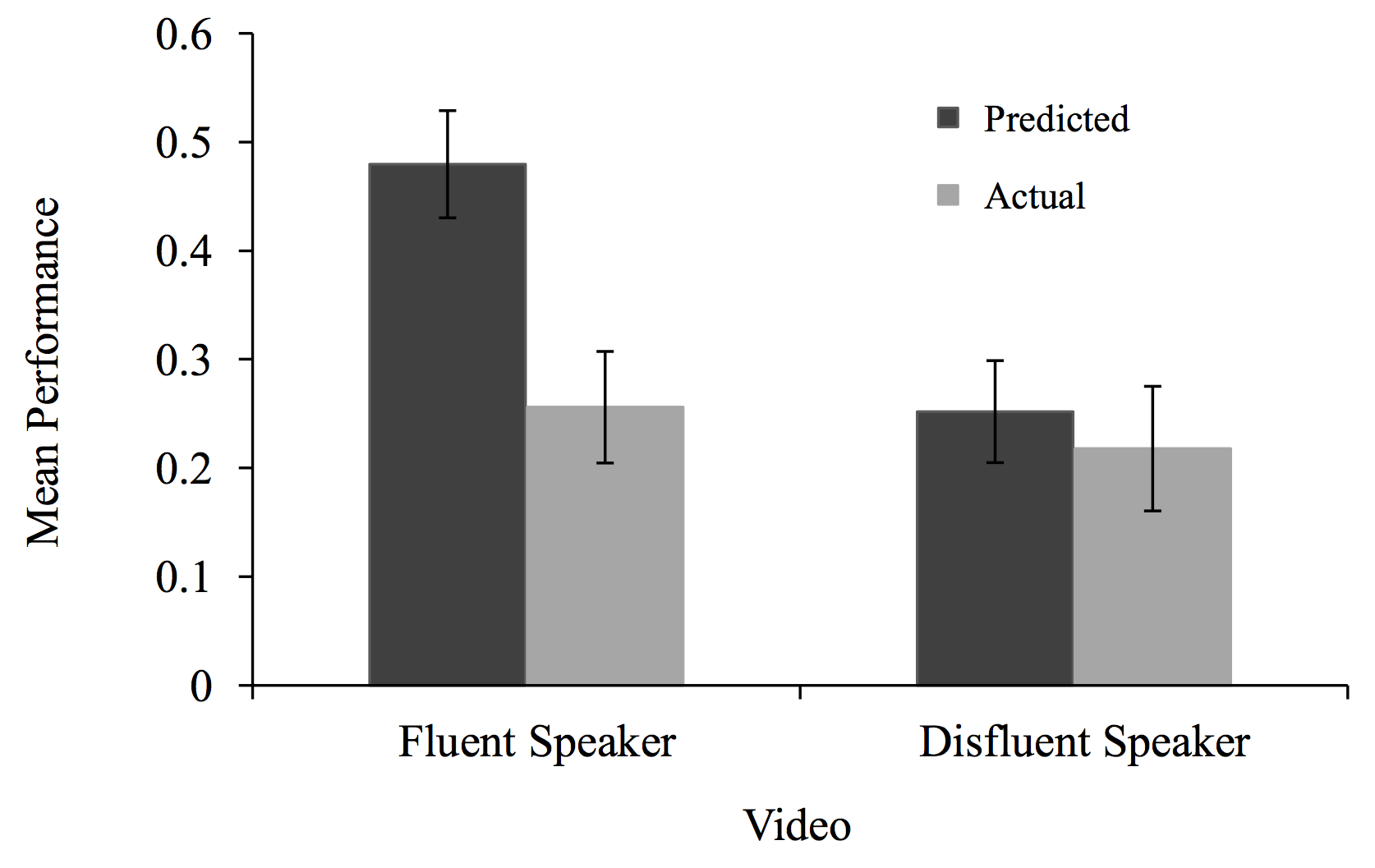
One group saw a lecturer who presented with the skills of a TED speaker. The other watched the lecturer read haltingly from notes. Afterwards the students answered questions about how much they felt they had learned. As expected, students who had watched the lecturer with better presentation skills expected to remember more of the material, believed that they understood the material better, and rated their interest and motivation more highly than the students who watched the dud instructor.

But a test found that both groups had retained roughly the same amount of information:

The students who watched the skillful (or “fluent”) lecturer barely outperformed the students who watched the “disfluent speaker.” But they did much poorer than they expected to do, whereas the other group did about as well as they expected.

Drum adds:

If these results hold up, it means that flashy, TED-style lectures don’t actually impart any more knowledge than boring old-school lectures. But they do make you more confident that you learned something. Is that worthwhile all by itself? Or is it better to have a proper grasp of just how much you really know?

Machine Gun Parties

Bryan Schatz attends a “building party”, where gun enthusiasts privately collect and assemble pieces from various assault rifles:

Although US customs laws ban importing the weapons, parts kits—which include most original components of a Kalashnikov variant—are legal. So is reassembling them, as long as no more than 10 foreign-made components are used and they are mounted on a new receiver, the box-shaped central frame that holds the gun’s key mechanics. There are no fussy irritations like, say, passing a background check to buy a kit. And because we’re assembling the guns for our own “personal use,” whatever that may entail, we’re not required to stamp in serial numbers. These rifles are totally untraceable, and even under California’s stringent assault weapons ban, that’s perfectly within the law.

His takeaway:

I’m left wondering: Seeing how easy this is, are build parties monitored? Do hand-built weapons ever surface in crimes? Are the cops worried? When I call local law enforcement representatives from Los Angeles, Orange County, Santa Ana, and Garden Grove, they say they’ve never heard of such a thing. “That doesn’t happen here,” says Bruce Borihanh, an LAPD spokesman. But a cursory browse of online gun forums is enough to show that, well, clearly it does. There seems to be one about every month. Plus, I just attended one less than an hour’s drive from his office.

I’m reminded of what one of the build party hosts said before I left: “Remember that thing I told you about why people do this: These builds can happen only because they aren’t blown out to the public and law enforcement.”

Why Cord Cutting Hasn’t Killed Cable

Cable Earnings

Derek Thompson explains how “cable is still making more and more money every year, despite a structural decline in cable TV subs”:

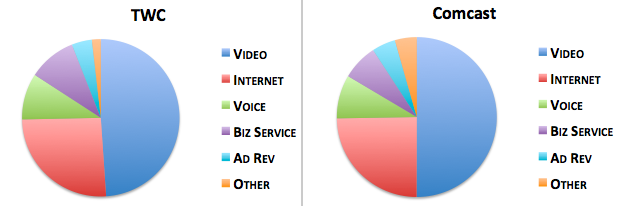
Cable ≠ video, and nothing says it more clearly than the latest earnings reports from the Big Two: Comcast, the largest provider of pay-TV in the country; and Time Warner Cable, the second largest cable provider (but behind DirecTV and Dish in total video subs). Comcast’s total revenue is almost twice TWC’s, but their businesses are remarkably similar.

Upshot: If you equate “cable” with TV, you are literally getting only half the story. Cable providers are in the business of communications transport. They’re still in business because selling communications access is still a pretty good business, with high barriers to entry and voracious demand.

Pet Provisions

A reader responds to our latest reality check:

I would argue that the average amount people spend on their pets is significantly higher than those figures suggest. The $500/year average is a bit misleading; it was calculated across all households and is not limited to those with pets. In addition, the survey doesn’t capture the largest cost I incur: higher rent overall and additional monthly pet rent. I live in DC, where housing choices are limited for those with dogs, so my rent is higher than what it would be if I didn’t have an animal. Second, most apartments require a non-refundable deposit upon move-in ($300 in my case, often more) and charge a monthly pet rent ($25-75/month).

Second, I’m not sure the comparison to the poverty threshold is fair. Spending $2,000/year on my dog is perhaps more ethical than spending it on entertainment or other alternatives, and the high cost of pet ownership here is simply a function of location. I adopted my dog when I was living in Sierra Leone and her standard of living there was equivalent to what it is now, and it cost very little to provide for her.

Another provides a different reality check:

There are a vast number of vain and luxurious things that Americans spend way more than $61.4 million a year on: 14.6 million cosmetic surgeries a year (that is surgeries, not dollars!), Starbuck’s net revenues for 2012 were $13.3 billion (at least 11 billion from U.S. sales), Netflix had $3.61 billion in sales in 2012. There are no shortage of these kinds of spending statistics that show the obscene wealth gap between Westerners and the rest of the world.  Pet ownership hardly scratches the surface!

An End In Sight

US-POLITICS-OBAMA-COUNTERTERRORISM

[Re-posted from earlier today. Blogosphere response to the pivotal speech here.]

The challenges that Barack Obama faced upon taking office were, even his critics would admit, daunting: an economy tail-spinning toward a second Great Depression, two continuing, draining and tragically self-defeating wars, and an apparatus of vastly expanded executive power (including torture) which had only just begun to be checked by the judiciary. More to the point, the United States was formally at war in a conflict which seemed to have no conceivable end.

And so easily the most important thing the presidents said today, it seems to me, was the following:

We must define the nature and scope of this struggle, or else it will define us, mindful of James Madison’s warning that “No nation could preserve its freedom in the midst of continual warfare.” … The AUMF [Authorization for Use of Military Force Against Terrorists] is now nearly twelve years old. The Afghan War is coming to an end. Core al Qaeda is a shell of its former self. Groups like AQAP must be dealt with, but in the years to come, not every collection of thugs that labels themselves al Qaeda will pose a credible threat to the United States.

Unless we discipline our thinking and our actions, we may be drawn into more wars we don’t need to fight, or continue to grant Presidents unbound powers more suited for traditional armed conflicts between nation states. So I look forward to engaging Congress and the American people in efforts to refine, and ultimately repeal, the AUMF’s mandate. And I will not sign laws designed to expand this mandate further. Our systematic effort to dismantle terrorist organizations must continue. But this war, like all wars, must end. That’s what history advises. That’s what our democracy demands.

“Ultimately repeal the AUMF’s mandate”. I wish the word “ultimately” were not there. But the announcement of an eventual, discrete, concrete end to this war may have been a step enough for now. For my part, I think it should be a critical goal of this administration to repeal that AUMF by the end of its second term. Our goal must not be an endlessly ratcheting of terrorist and counter-terrorist violence that creates more enemies than friends. Our goal must be normalcy and freedom, even as we continue strong counter-terrorism strategies outside of the context for warfare.

I’m glad the president defended the strike against Anwar al-Awlaki as forcefully as he should:

When a U.S. citizen goes abroad to wage war against America – and is actively plotting to kill U.S. citizens; and when neither the United States, nor our partners are in a position to capture him before he carries out a plot – his citizenship should no more serve as a shield than a sniper shooting down on an innocent crowd should be protected from a swat team.

My view entirely. I’m struck too by his Niebuhrian grasp of the inherent tragedy of wielding power in an age of terror – a perspective his more jejune and purist critics simply fail to understand. This seems like a heart-felt expression of Christian realism to me:

It is a hard fact that U.S. strikes have resulted in civilian casualties, a risk that exists in all wars. For the families of those civilians, no words or legal construct can justify their loss. For me, and those in my chain of command, these deaths will haunt us as long as we live, just as we are haunted by the civilian casualties that have occurred through conventional fighting in Afghanistan and Iraq. But as Commander-in-Chief, I must weigh these heartbreaking tragedies against the alternatives.

Indeed he must. And in the aggregate, I think history will look back on the balance he struck and see more wisdom in it than the purism on the civil liberties left and right or the lawless violence and torture of the Bush-Cheney years.

A few more key points: he will end the moratorium on releasing Yemeni prisoners at GTMO; he has appointed a figure to expedite the closure of the former torture camp (perhaps his newfound friendship with John McCain can accelerate the process). But he offered no real solution to the 50 or so prisoners deemed still dangerous to the world but who cannot be tried for lack of admissible evidence. He had noting really on that – except a self-evidently vain appeal to a Congress unwilling to give an inch on anything.

But the broader framework of the speech was the most important: the possibility of a return to normality, to a point where the understandable trauma of 9/11 no longer blurs our ability to construct a realist but restrained counter-terror strategy. That’s the promise of his presidency: the healing of a giant wound to this country’s psyche and values. And here’s where it came through most tellingly for me:

The scale of [the current] threat closely resembles the types of attacks we faced before 9/11. In the 1980s, we lost Americans to terrorism at our Embassy in Beirut; at our Marine Barracks in Lebanon; on a cruise ship at sea; at a disco in Berlin; and on Pan Am Flight 103 over Lockerbie. In the 1990s, we lost Americans to terrorism at the World Trade Center; at our military facilities in Saudi Arabia; and at our Embassy in Kenya. These attacks were all deadly, and we learned that left unchecked, these threats can grow. But if dealt with smartly and proportionally, these threats need not rise to the level that we saw on the eve of 9/11.

We can envisage a world in which this war is over, and yet our counter-terrorism continues “smartly and proportionally”. It is a tough and usually lonely task to make these calls. Which is why a president is ultimately accountable for them. Today, he stood accountable; and he neither shirked from responsibility nor apologized for the inherent tragedy of any armed conflict.

From this hard realist assessment, however, came a light at the end of a psychological and political tunnel; a small flicker hope at the end of a long dark night of fear.

(Photo: US President Barack Obama speaks about his administration’s drone and counterterrorism policies, as well as the military prison at Guantanamo Bay, at the National Defense University in Washington, DC, May 23, 2013. By Saul Loeb/AFP/Getty Images.)