If only Americans appreciated how hard this was to do, given the institutional resistance, and how singularly the President himself, within the government, actually understands this in its broader context. I was there at the speech, and moved to tears. Even the interruption by the Code Pink woman turned out to be a blessing in disguise — instead of the usual bromides about the virtues of free speech, after a full minute or two of interruption, in one of the most important speeches of his tenure, he responded: “the voice of that woman is worth paying attention to.” Can you imagine any other chief of state extemporizing with that line in those circumstances? — acknowledging the power of her concerns and honoring them?
And then at the end, it occurred to him to incorporate the incident again, once more because he realized it helped make his point:
Now, we need a strategy – and a politics –that reflects this resilient spirit. Our victory against terrorism won’t be measured in a surrender ceremony on a battleship, or a statue being pulled to the ground. Victory will be measured in parents taking their kids to school; immigrants coming to our shores; fans taking in a ballgame; a veteran starting a business; a bustling city street; a citizen shouting her concerns to her President.
Wow.
I’m with my reader who was there. We remain lucky to have him, as we long have been.
Researchers have finally discovered the precise pathogen that caused the Great Famine. Why it matters:
The study is the first time that the genetics of a plant pathogen have been analyzed by extracting DNA from dried plant samples, opening up the possibility that researchers can study other plant diseases based on the historical collections of botanical gardens and herbaria around the world. Better understanding the evolution of plant diseases over time, the team says, could be instrumental in figuring out ways to breed more robust plant varieties that are resistant to the pathogens that infect plants today.
(Photo of the Dublin memorial to the Irish Potato Famine by Tim Sackton)
Room For Debate tackles the question. Garrett Peck ponders marijuana taxes:
The nation’s powerful alcohol lobbies have managed to rebuff any federal alcohol excise tax increase, last raised in 1991. States should be on the lookout for what will inevitably happen: the marijuana industry will go along with taxation as part of the grand bargain for legalization – just as the alcohol industry did in the 1930s – and then over time change its position to be anti-tax. They will claim that taxes are bad for business and bad for consumers, neither of which is true, given that products like alcohol, gasoline, marijuana and tobacco have a fairly inelastic demand. Here’s a bit of advice to states: index marijuana taxes to inflation, and you will avoid a lot of big debates over raising taxes.
Among other suggestions, Kleiman recommends a strict advertising rules:
Don’t allow marketing. The legal marijuana industry, like the alcohol, tobacco and gambling industries, will have a financial interest directly opposite to the public interest. Responsible use is the goal, but dependent use generates sales volume. A public monopoly would probably work best; short of that, tight limits on advertising (the Supreme Court permitting) and keeping the industry fragmented to minimize its lobbying power might limit some of the damage.
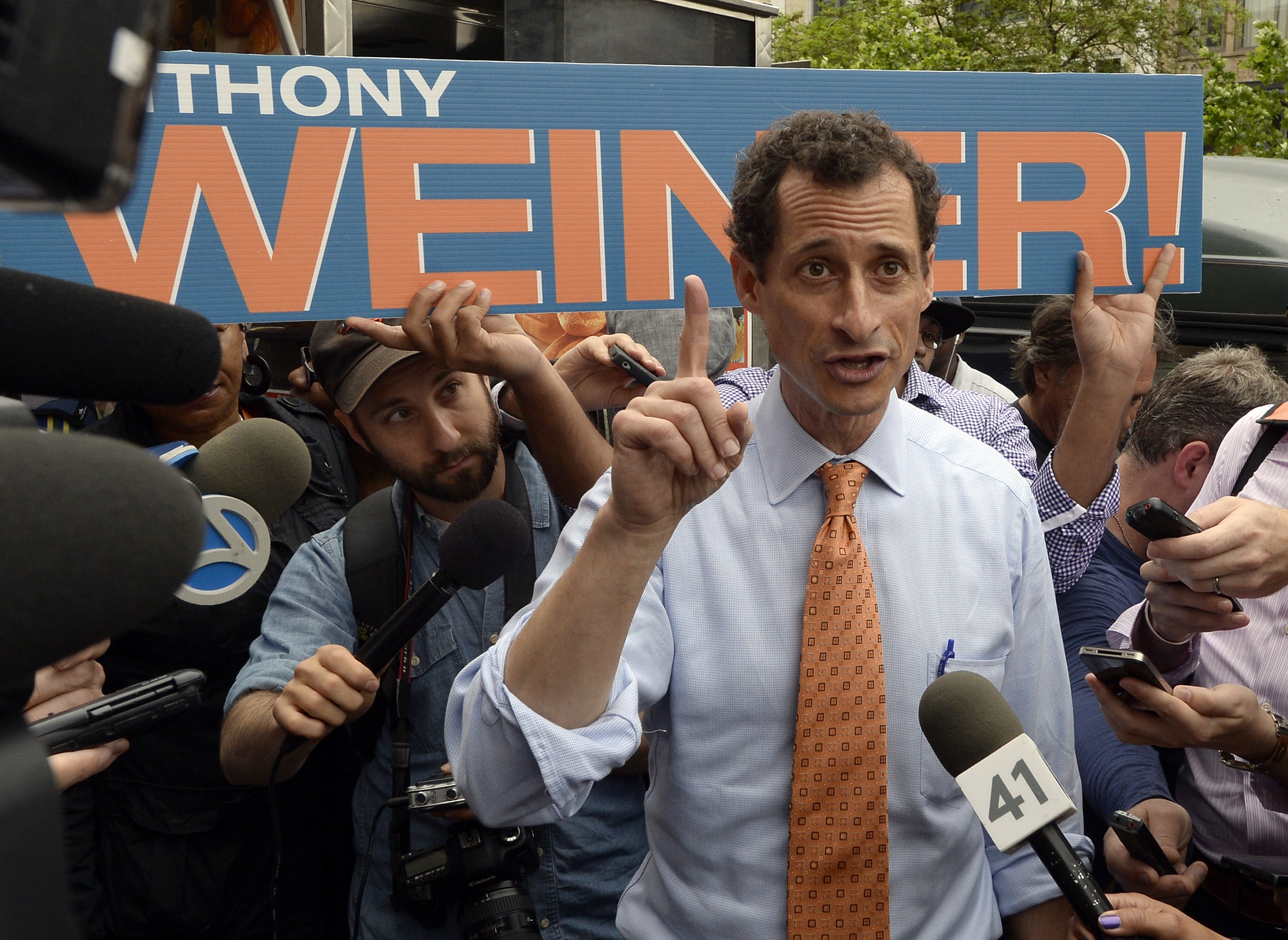
Former US Representative Anthony Weiner speaks to voters in the Harlem neighborhood of New York City on May 23, 2013 after he announced he is running for New York City Mayor. By Timothy Clary/AFP/Getty Images.
[L]anguage can express a concept from various angles, positively or negatively, or with a noun or a verb. For example, a journalist once marveled that an obscure language of India has a verb referring to how a baby is fat and treats this as evidence of a unique “way of seeing the world”—neglecting that our term baby fat refers to exactly the same concept, just with a different part of speech.
In the same way, if Americans use the word decency less than before, since the sixties we have marked our awareness of exactly that concept with none other than asshole. As Geoff Nunberg’s clever book taught us last year, the word refers precisely to someone who transgresses rules in cognizance of doing so, such as cutting people off in traffic. The asshole transgresses decency, in which we are interested as the Victorians. We just happen to refer to it with a noun, and a negative one, and also with a certain pungency, because the sixties happened and changed how we process profanity.
As we discover more details about the DOJ’s investigation of Fox News journalist James Rosen, former FBI agent David Gomez compiles a list of best practices for journalists:
Take a lesson from the Mafia and never use phones for anything other than the most innocuous conversations — i.e., “Meet me at our usual spot” or “We need to talk.” Better yet, “I’m going out for pizza, so I won’t be around to meet you today ” — the last part being previously arranged code for “Meet me at our usual spot.” …
Like the phone, the Internet is a sieve, and a goldmine for lawful and unlawful penetration through technical means by law enforcement. Never use the Internet or email for any kind of contact with a source if your beat is national security because it creates too many electronic trails, all of which are traceable and usually recoverable by even the newest rookie FBI cyber-agent. Social media outlets like Twitter and Facebook are the worst because they are public, and even though you may direct message your source or delete a contact tweet, it can be recorded by any number of interested followers, including the FBI, and preserved for all time on Google.
A number of IRS employees developed criteria that was politically biased both in appearance and in effect. They were reined in once by their superiors, and then they changed the criteria again, and had to be reined in a second time. Their actions called the fairness of the agency into question and kicked off a national scandal. Even if their intent was pure, they showed bad judgment, more than a bit of incompetence, and perhaps even a touch of insubordination. That is reason enough to fire people, even if the process is difficult.
Daniel Foster doubts that Lois Lerner, director of the misbehaving IRS office, will get axed:
Statistically speaking, the firing of a federal employee is a rare event. A Cato Institute study showed that in one year, just 1 in 5,000 non-defense, civilian federal employees was fired for cause. A widely cited analysis by USA Today found that in FY 2011, the federal government fired just 11,668 out of 2.1 million employees (excluding military and postal workers). That’s a “separation for cause” rate of 0.55 percent, roughly a fifth the rate in the private sector.
And the firing of employees who fit Lerner’s profile is rarer still. Lerner is very much a “white-collar” employee, and the same analysis found that blue-collar employees (such as food-service workers) were twice as likely to be fired.
There are many more examples [of misbehaving employees] at the local, state, and federal level. None so far has prompted Democrats or progressives to acknowledge that public employees are so well-protected that the ability to run well-functioning institutions is sometimes being compromised. In one way, the IRS controversy is sure to be unrepresentative since it is getting so much more press than almost any other act of wrongdoing by federal employees. But it will afford us a high-profile opportunity to watch the process play out.
How Chait understands Obama’s remarks (seen above):
President Obama’s speech today defending his conduct in the war on terror was notable for what he was defending it against — not against the soft-on-terror (and maybe sorta-kinda-Muslim) attack that Republicans have lobbed against him since he first ran for president, but against critics on the left. … Politically, if not substantively, Obama’s speech today represents a watershed moment. For the first time in the post-9/11 world, the domestic political threat in the war on terror comes from the left rather than the right.
There was much to like in Obama’s speech today if you like words, and share the broad worries he outlined above. And it is surely true that changing policy becomes easier after you make public arguments about changing policy. But the fact is Barack Obama is the president of the United States, and according to both the Constitution and especially the way executive power has accrued over the past century, Obama actually has quite a bit of latitude to impose his values on the waging of American war. After 52 months in office, it’s long since past time to stop judging the man by his words alone.
Max Fisher focuses on the case Obama made for drones:
Although there’s a complexity to Obama’s moral case for drones, it reduces down to a binary: Using drones can kill civilians, but not using them would lead to even more civilians being killed. There are many, many more moral, ethical and legal issues related to drones, some of which are in the speech and some of which aren’t. And there is a wide range of gray areas in how they’re implemented, against whom, under what circumstances and what guidelines. But it’s this basic proposition – taking lives to save others – that seems at the heart of Obama’s case.
Obama’s new approach to the drones in Year Thirteen of the war on terror should feel familiar. It contains an echo of how he wound down the Iraq and Afghanistan wars: not by drawing a hard and fast end to them, but by allowing military commanders to very slowly reduce the size of their forces. If it worked well enough for flesh-and-blood troops, Obama is basically saying it’ll work well enough for robots.
One phrase deployed by Obama really struck home. In America’s continuing battle against terrorists, there is “no moral safe harbor.” Not, anyway, for a president, this one or the next. Virtually every counterterrorism path that a president pursues is a trade-off–a little security here for a piece of your liberty there; 10 innocents killed in exchange for a thousand later saved–and it’s just so damn refreshing to hear a president admitit rather than suppress it through a fog of uberheroic, hyperpatriotic neocon bullshit. Wars do compromise our values; we eventually become what we hate; and President Obama appeared to be running the clock back. He knows where this is headed, and it ain’t good.
He’s offering a robust defense of drone warfare to a public that already accepts it. The speech is really just an unusually exhaustive compendium of the foreign-policy establishment’s favorite counterterror bromides. Foreign Policy magazine has a Cliff’s Notes version of the four major takeaways, but none of them are actually major. He wants to close Gitmo, which we knew; he kinda likes the idea of independent oversight on drone strikes but maybe not too much, which we could have guessed; he wants to codify drone practices to make sure they’re used as narrowly as possible, but an Obama official couldn’t tell FP how that differs from the current policy; oh, and he thinks it’s time to stop thinking of this as a “boundless” global war on terror and start thinking in terms of discrete actions, which is semantic nonsense.
Kilgore was stuck by how often Obama blamed Congress:
One thing is fairly clear: the speech poses a challenge to congressional Republicans that may not be that easy for them to meet, distracted as they are and as divided as they tend to be on national security policy these days. As Slate’s Dave Weigel quickly noted, Obama four times shifted responsibility for current dilemmas at least partially to Congress: on drones (where he insisted the appropriate congressional committees have known about every single strike); on embassy security; on the 9/11-era legal regime that still governs anti-terrorist efforts; and on Gitmo (where Republicans have repeatedly thwarted effort to transfer detainees to U.S. prisons).
And Benjamin Wittes thinks Obama is more powerful than he lets on:
Obama does not need Congress to narrow or repeal the AUMF or to get off of a war footing. He can do it himself, declaring hostilities over in whole or in part. And Obama, needless to say, did not do anything like that. To the contrary, he promised that “we must finish the work of defeating al Qaeda and its associated forces” and while he used a lot of nice words about law enforcement and a lot of disparaging words about perpetual states of war, he also promised to continue targeting the enemy with lethal force under the AUMF. In other words, he promised—without quite saying it directly—to keep waging war
After an earthquake struck southwest China earlier this year, social media and mobile phones proved instrumental in relief efforts. Patrick Meier considers the broader implications for the Chinese government:
[U]sing social media to crowdsourced grassroots disaster response efforts serves to create social capital and strengthen collective action. This explains why the Chinese government (and others) faced a “groundswell of social activism” that it feared could “turn into government opposition” following the earthquake (6). So the Communist Party tried to turn the disaster into a “rallying cry for political solidarity. ‘The more difficult the circumstance, the more we should unite under the banner of the party,’ the state-run newspaper People’s Daily declared […], praising the leadership’s response to the earthquake” (7). …
Aided by social media and mobile phones, grassroots disaster response efforts present a new and more poignant “Dictator’s Dilemma” for repressive regimes. The original Dictator’s Dilemma refers to an authoritarian government’s competing interest in using information communication technology by expanding access to said technology while seeking to control the democratizing influences of this technology. In contrast, the “Dictator’s Disaster Lemma” refers to a repressive regime confronted with effectively networked humanitarian response at the grassroots level, which improves collective action and activism in political contexts as well. But said regime cannot prevent people from helping each other during natural disasters as this could backfire against the regime.
Earlier Dish on crowdsourced disaster efforts here.