Ending The Perpetual Emergency, Ctd

Rosa Brooks asks Obama to channel his inner law professor and offer a concretely legal defense of his war powers during his speech this afternoon:

Speaking not just as a law professor but as a citizen: It would be nice to know if President Obama thinks the [Authorization for Use of Military Force (AUMF)] authorizes him to use military force in Boston, wouldn’t it? Not whether he would as a matter of policy refrain from using military force in Boston, but whether as a matter of law he believes that Congress has authorized him to use military force in Boston if “the enemy” turns up there. … President Obama should tell us if he agrees that the 2001 AUMF gives him open-ended authorization to send U.S. troops into combat anywhere on Earth, as long as he asserts that their mission is to fight al Qaeda or “its associates.” Or does he think there is some limit — geographical, functional, or temporal — on the scope of his authority under the AUMF? And: If there are some limits, how can Congress and the American public be sure his administration is abiding by those limits?

And, Mr. President? “Trust us, we have very careful procedures” is not the right answer here. Convince me that “checks and balances” refers to something other than the federal budget.

Stay tuned. I’ll be listening closely.

Meat-Cleaving Terror

Anthony Lane focuses on the weapons used in Woolwich:

There is a particular horror associated with low-grade or homemade violence of this kind. The bombs used in the attack on the Boston Marathon were, as has become clear, frighteningly easy to construct; but there remains something hideous about the use of weapons that are, to other people, barely weapons at all, but household or kitchen implements. That was true of the box-cutters used by the hijackers on 9/11, and it is no less true, though of course on a far smaller scale, of the blades employed [yesterday].

He continues:

Cheap weaponry is also likely to cause concern to the security services; you can track the purchase and handling of explosives, but how on earth do you prevent someone from buying a few steak knives at a hardware store or a supermarket? Why should such a purchase even come to your attention?

The ordinariness and randomness of the act – requiring no gun or bomb – is what makes its terror so powerful. But it also, it seems to me, backfires massively against the perpetrators. The barbarism of hacking a human being’s body to pieces in the middle of the street cannot possibly win any converts to the cause, and will not prompt stoic Brits to see the world from the Pakistani Islamist’s point of view.

It’s nihilism. Which will, in due course, annihilate itself – as it has done even in largely Muslim countries like Iraq and Jordan, which saw al Qaeda up close and rightly recoiled. We should not feel fear of these lunatics. We should feel a form of baffled contempt. This is a form of human behavior that belongs in the dark ages.

Regulate The Reefer Already

Despite the fact that “Canadian teens were the most likely to smoke pot of all teens in the developed world,” Soraya Roberts isn’t ready to start toking:

Call it reefer madness, but I don’t trust my already-precarious anxiety-addled brain to survive pot intact. Particularly these days—this ain’t the pot my parent smoked. In the ’60s, you got high off a doobie with a potency of 4 percent. These days a hit peaks at 25 percent; such is the strength of “Dr. Grinspoon,” a strain named after the Harvard psychiatrist who wrote several books on cannabis, including 1970’s Marihuana Reconsidered and Marihuana: The Forbidden Medicine.  “If you take hold of Dr. Grinspoon and smoke a lot of it, you could probably have quite a reaction,” its namesake told me. Like insanity?, I didn’t reply. Research shows that people who have predisposition for schizophrenia can experience early onset from smoking marijuana. My genetic loading for mental health isn’t ideal. I wouldn’t want to rock the brain boat.

There is an irony to this thought process, stemming from the fact that I have taken prescription medication for years—for anxiety (peanut gallery: “Of course!”).

I don’t deny the paradox. But there is a certain security to be found in taking a legal drug that the government has tested. Even if the FDA’s methods are not up to snuff, that’s some kind of standard. With pot being illegal, there is no standard. Marijuana may be “healthier than anything you can buy from the pharmaceutical industry,” according to Grinspoon, but how could I ever ensure I was getting the real McCoy? “I’ll try it if you can assure me it will be clean,” I told an acquaintance recently. “Clean? Like, you want it to be washed?” he quipped. Um, no, but I don’t want it to be laced with meth or cut with those synthetic cannabinoids that leave seizures and high blood pressure in their wake. I don’t have any scruples about smoking an illegal joint, but I’m not willing to risk my health for it.

Update from a reader:

Weed laced with meth? Had there been liquid in my mouth when I read that line, I would have done a spit-take. Does she really believe weed dealers put meth in their product so you’ll smoke it and stay up for three days? Clearly Soraya Roberts hasn’t the first clue what she’s talking about when it comes to marijuana. And of course she makes the same old tired objection about today’s cannabis being stronger than ‘my parent’s’ cannabis, with nary a nod toward the dose-response relationship – as though people decide the quantity of weed they will smoke and then do it without regard to the potency and resulting effect.

Quote For The Day

“Austerity has failed in the UK and it has failed in the eurozone. Its failure was predictable and, by some at least, predicted. It turned a nascent recovery into stagnation. That imposes huge and unnecessary costs, not just in the short run, but in the long term, as well: the costs of investments unmade, of businesses not started, of skills atrophied and of hopes destroyed.

This is not, as many seem to believe, a debate about the short term versus the long term. It is a debate about both the short and the long term, because what we do in the short term shapes the long term. What is being done here in the UK and also in much of the eurozone is worse than a crime, it is a blunder,” – Martin Wolf (registration required), Financial Times.

An Islamist Beheading In Britain, Ctd

Investigations Continue Into The Brutal Street Killing Of A British Soldier

A reader balances this reader’s rage:

I am a Muslim and I was never taught that violence is acceptable. I went to a mosque to study Quran between the ages of 7 and 9. All I know about Islam is to forgive, be patient, love your family, friends, neighbor and be good to people. What the pope says is awesome and most Muslims I know are following just that. The prophet taught humility, forgiveness and love. He forgave people who treated him badly and forgave people who killed his family members. There are a lot of “mullahs” who preach jihad (which doesn’t necessary mean kill the infidel, more like that struggle for the better society with your words, your pen and deeds). The violence that is perpetuated is wrong and is not true to the core of Islam.

It seems Islam is going through its Dark Ages, where lack of education and a confusion of tradition with religion in Muslim countries is causing their people to be manipulated by false sermons of violence against the West as some good deed when it’s a sin and a sin alone.

All I know about Islam is that killing a human being is as if killing the whole humanity. The mindless menace of violence has a grip over the Muslim world right now and hopefully with a better-educated younger generation, where people like me can disagree, will help improve this problem. Killing in the name of “the most merciful and benevolent” God (Allah) is not true. The merciful god in Quran says that no human has a right to take another’s life as it is not his to take, even his own. Muslims aren’t even allowed to commit suicide. Combining that with killing innocent people is beyond my capacity to understand.

Islam is not a monolith. Westboro Baptist Church does not represent every Christian. These people who killed an innocent person in Bahrain are no Muslims; they are Muslims in name and have committed a grave sin against their fellow human being and god.

Another:

A reader wrote, “X number of bombs and deaths a year is a normal part of modern life that only unmanly hysterics bother to get upset about. This is something we have never actually experienced in the civilized world.” This is simply not true.  This reader acknowledges that “[p]ast revolutionary groups killed hostages, planted bombs and committed all manner of violent mayhem to try and destabilize the societies they hated.”  There have been bombings and killings going on in the United States – even suicide bombings – throughout the history of this country and unrelated to Islamism.  The killing in London is a terrible tragedy, but so is this one, and this one, and this one, and these two, and all the rest of these.

Those lefty Muslim apologists at Townhall have listed the 10 worst bombings in U.S. history.  Only one of them (1993 WTC bomb, coming in at #10) was committed by Islamists (another remains unsolved). If violent radical Islam magically ceased to exist today, there would still be “X number of bombs and deaths a year.”  That’s not to say that Islamist terror is somehow excusable, just that your reader may in fact be a “hysteric” on the subject.

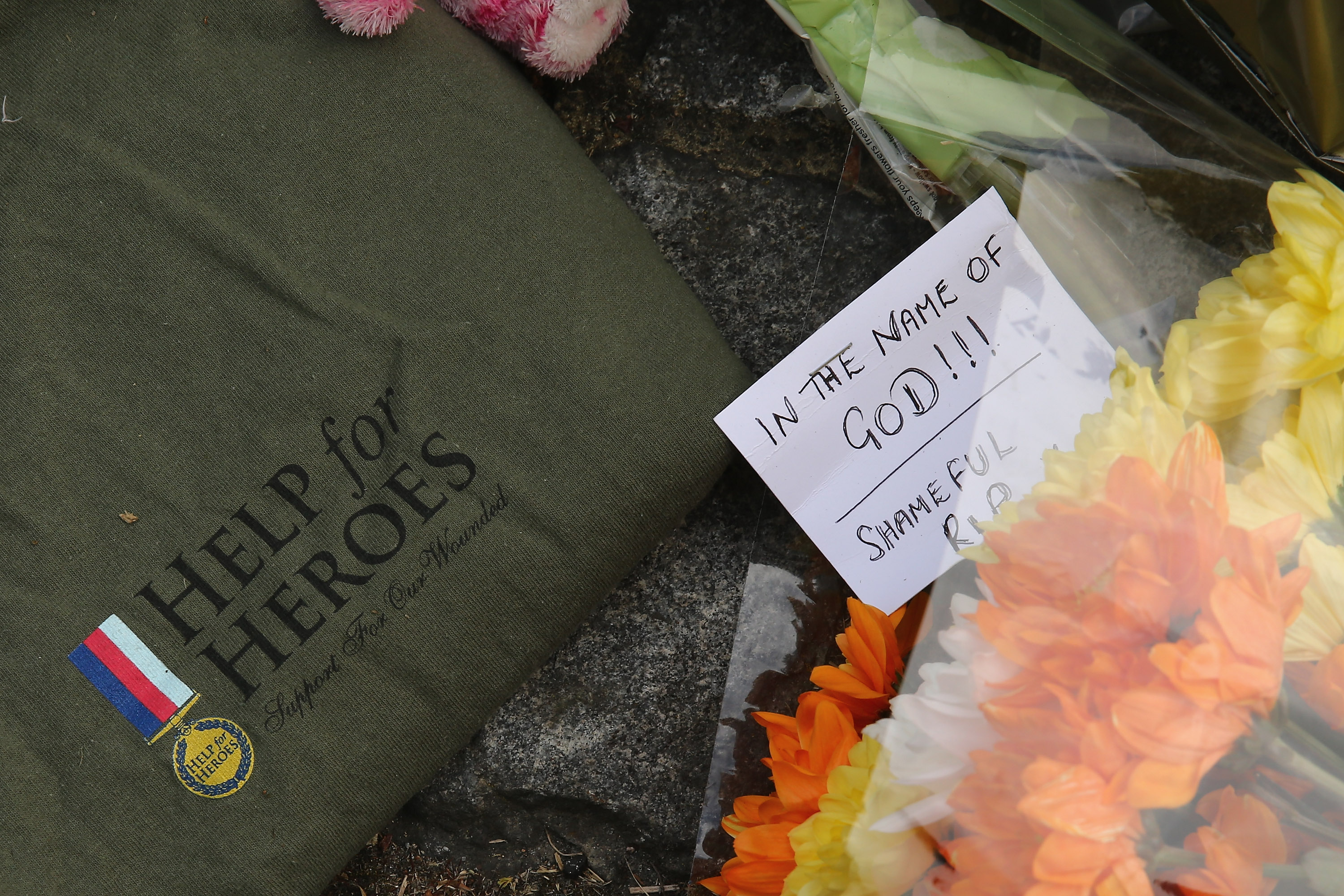
(Photo: Flowers lay outside Woolwich Barracks on May 23, 2013 in London, England. By Dan Kitwood/Getty Images.)

Primed For The Needle’s Prick

Feeling anxious before a shot can make vaccinations significantly more potent:

From an evolutionary perspective, the fact that short-term stress revs up the immune system makes sense. Consider a gazelle fleeing a lioness. Once the gazelle’s eyes and ears alert its brain to the threat, certain brain regions immediately activate the famous fight-or-flight response, sending electrical signals along the nervous system to the muscles and many other organs, including the endocrine glands—the body’s hormone factories. Levels of cortisol, epinephrine, adrenaline and noradrenaline rapidly increase; the heart beats faster; and enzymes race to convert glucose and fatty acids into energy for cells. All these swift biological changes give the gazelle the best chance of escape. At the same time, [Stanford University’s Firdaus] Dhabhar and others’ research suggests, the brain’s recognition of a threat prompts the immune system to prepare for potential injury. The spleen and other organs release immune cells specialized for identifying and destroying invaders and healing damaged tissues. After all, even if the gazelle escapes with its life, it may need to heal wounds sustained during its flight and prevent them from becoming infected.

Reality Check

Hanrob Pet Hotels Launch 'Petskype'

What we spend on our pets:

Americans spent approximately $61.4 billion in total on their pets in 2011. On average, each U.S. household spent just over $500 on pets. This amounts to about 1 percent of total spending per year for the average household.

Timothy Taylor puts this in perspective:

[T]he World Bank often uses a poverty line of $1.25/day in consumption to measure deep destitution in developing countries. Nearly one-third of the population of South Asia and nearly half the population of Africa has a consumption level below this line.  Over 365 days in a year, $1.25/day works out to $456.25.  Thus, the average U.S. household spends more on pets than the poverty line for humans in the developing world. And the statistics don’t include the fact that pets live rent-free.

(Photo: Henry the dog talks to his owner through Skype on May 13, 2012. Luxury pet accommodation group Hanrob Pet Hotels is launching Petskype so people can watch and even chat to their cats and dogs while travelling interstate or overseas. By Tess Follett/Newspix/Getty Images)

Decoding Family Secrets

Recounting the story of a girl who discovered through genomic testing that her brother was actually her uncle, Daniel Engber considers how genetic testing companies deal with potentially startling results:

23andMe does take some steps to warn its users of the risks. The top question on the company FAQ is “What unexpected things might I learn?” and the answer mentions that “genetic information can also reveal that someone you thought you were related to is not your biological kin. This happens most frequently in the case of paternity.” The terms of service specify that “once you obtain your Genetic Information, the knowledge is irrevocable,” and that “you may learn information about yourself that you do not anticipate” and “may provoke strong emotion.”

Yet it’s also true that the chances of discovering a case of nonpaternity through 23andMe, and the relative significance of that discovery, far outweigh almost every other finding that the service can provide. Much of what the scan can tell you is perfectly trivial. Do you have the genes for blue eyes or red hair? (For a first approximation, try looking in the mirror.) Do you have the genes for tasting bitterness in Brussels sprouts? (Maybe, but who cares?) After Steven Pinker signed up for 23andMe, he wrote in the New York Times Magazine, “For all the narcissistic pleasure that comes from poring over clues to my inner makeup, I soon realized that I was using my knowledge of myself to make sense of the genetic readout, not the other way around.”

The Next Generation’s Privacy Settings

Pew Privacy

Jared Keller summarizes findings from a new report by Pew and the Berkman Center for Internet Society:

The joint paper found that teenagers are sharing more and more personal information online: 91 percent of teenagers post at least one photo of themselves (up from 79 percent in 2006), while 71 percent post their school name (up from 49 percent), 53 percent post their email address (up from 29 percent), and 20 percent post their cell phone number (up from two percent). At the same time, teenagers are more and more cautious as to who sees this information: about 60 percent of teen Facebook users set their profiles to private (friends only), and most report high levels of confidence in their ability to manage their settings, with 56 percent of users noting that it’s “not difficult at all” to set privacy controls (while only eight percent say it’s “somewhat difficult”).

Danah Boyd comments:

My favorite finding of Pew’s is that 58% of teens cloak their messages either through inside jokes or other obscure references, with more older teens (62%) engaging in this practice than younger teens (46%). This is the practice that I’ve seen significantly rise since I first started doing work on teens’ engagement with social media. It’s the source of what Alice Marwick and I describe as “social steganography” in our paper on teen privacy practices.

While adults are often anxious about shared data that might be used by government agencies, advertisers, or evil older men, teens are much more attentive to those who hold immediate power over them – parents, teachers, college admissions officers, army recruiters, etc. To adults, services like Facebook that may seem “private” because you can use privacy tools, but they don’t feel that way to youth who feel like their privacy is invaded on a daily basis.

Graphic from Pew.