Why Your Screenplay Needs A Rewrite

hickey-feature-scripts-21

Walt Hickey found a way to quantify the most common problems facing screenwriters:

The Black List offers aspiring screenwriters the chance to have their work evaluated by professional script-readers who work within the industry.1 The readers are drawn from agencies and studios. When scripts are rated highly, the site promotes the screenplays to potential buyers. As a result, The Black List has thousands of script evaluations — grades based on plot, premise, characters, setting and dialogue — from dozens of genres. I asked for a look at those reviews, and they sent over an anonymized record of 4,655 evaluations of 2,784 scripts by 2,221 writers, submitted from March to July of this year. When a script is evaluated, the reader assigns any number of genres to it — from simple drama to prehistoric fantasy — and we can use these to uncover different trends.

First-time writers tend to go one of two ways, said Kate Hagen, a former reader who now oversees the hundred or so readers at The Black List. They write a deeply personal, pseudo-autobiographical screenplay about nothing in particular. “Everybody basically writes that script at first,” Hagen said. “You have to get it out of your system.” Or they swing for the fences and go in the opposite direction, thinking, “I’m going to write a $200 million science fiction movie,” and plan an entire universe and mythology. Those scripts, Hagen said, tend to fail for entirely different reasons.

Quote For The Day

“In the case of Frank Conroy’s ‘essay,’ Celebrity Cruises is trying to position an ad in such a way that we come to it with the lowered guard and leading chin we reserve for coming to an essay, for something that is art (or that is at least trying to be art). An ad that pretends to be art is – at absolute best – like somebody who smiles at you only because he wants something from you. This is dishonest, but what’s insidious is the cumulative effect that such dishonesty has on us: since it offers a perfect simulacrum of goodwill without goodwill’s real substance, it messes with our heads and eventually starts upping our defenses even in cases of genuine smiles and real art and true goodwill. It makes us feel confused and lonely and impotent and angry and scared. It causes despair,” – David Foster Wallace, eighteen years ago, on “sponsored content.”

Back then, an essay sponsored by a cruise line was a rare excrescence. But this excrescence is now the business model for almost all online journalism. It is the business model for the New York Times!

Greece Is Growing

Greece

Finally:

Greece’s crisis-stricken economy has returned to growth following six years of recession, official data showed Friday, marking an end to one of the steepest and longest economic contractions in postwar European history.

But Matt O’Brien warns that “Greece’s comeback, like its collapse, will be nasty, brutish, and long”:

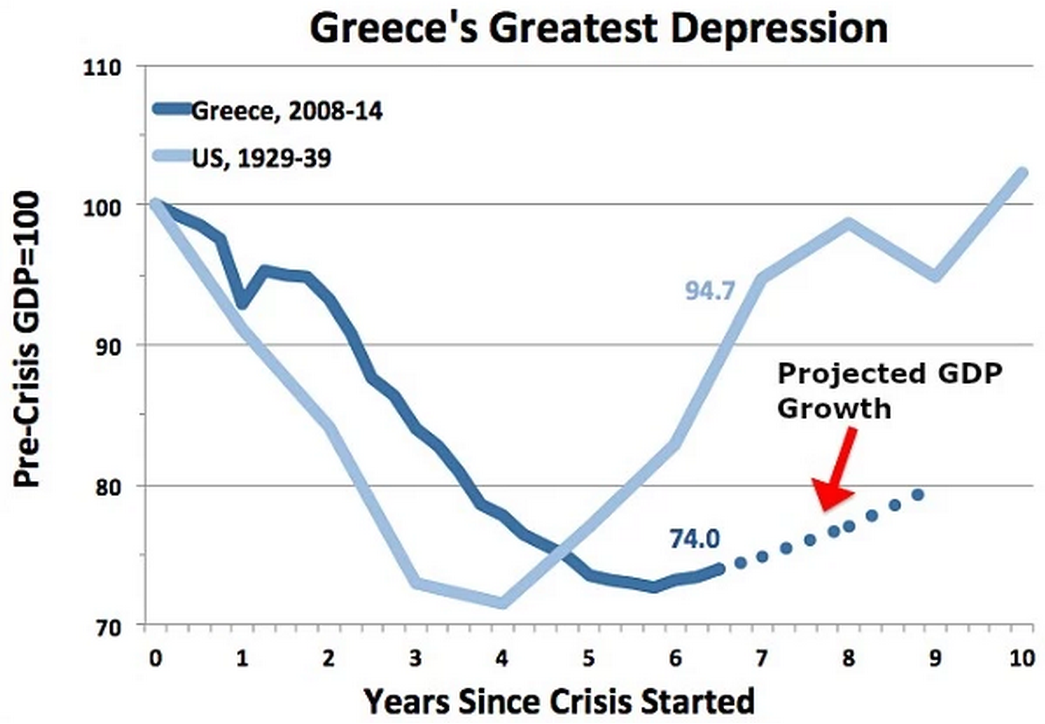
Greece’s depression … is still nowhere near done. You can see that easily enough in the chart above, which I’ve modified from The Economist. It compares Greece the past few years with what used to be the gold standard of economic catastrophe: the U.S. during the Great Depression. Now, Greece’s economy fell marginally less than America’s did back then — around 27 percent at its worst — but the biggest difference between the two is the slope of the recovery. The U.S., as you can see, rocketed back once FDR devalued the dollar and started spending more. Only the double whammy of premature fiscal and monetarytightening knocked it off track in 1937.

Greece, though, has gotten nothing but fiscal and monetary tightening.

Prepared For The Worst

Chris Morgan surveys the “severe and fatalistic” aphorisms of the the neglected Colombian writer Nicolás Gómez Dávila, which he believes exemplify the reactionary, rather than conservative, approach to politics:

Conservatism’s appeal has always rested in its professed unwillingness to compromise in pursuit of its causes. A reactionary distinguishes himself or herself from the movement conservative by being committed and uncompromising to a degree that discomforts the latter. The conservative embraces democracy to the extent that the conservative can direct it in reaching his or her goals. The reactionary merely resigns him or herself to its existence. “I am an aristocrat,” said early 19th-century Virginia congressman John Randolph of Roanoke, “I love liberty, I hate equality.”

If conservatives are characterized by nostalgia, reactionaries are characterized by decadence. Conservatives build networks and speak in sound bites; reactionaries build mausoleums and speak in epitaphs. Reactionaries are aesthetic rather than practical thinkers. They play alongside, if not across, the border of tragedy and fatalism. Civil debate is meaningless to the side that has already lost.

“If the reactionary concedes the fruitlessness of his principles and the uselessness of his censures,” Gómez Dávila wrote in his essay “The Authentic Reactionary,” “it is not because the spectacle of human confusion suffices for him. The reactionary does not refrain from taking action because the risk frightens him, but rather because he judges that the forces of society are at the moment rushing headlong toward a goal that he disdains.”

Christie’s Achilles Heel

His economic record:

No, as much as national pundits like to bemoan Christie’s demeanor and as much as events like Bridgegate have underscored Christie’s reputation as a bully and a back-room brawler, his biggest campaign trail albatross is a more fundamental challenge—one he can’t fix with a smart made-for-YouTube put-down. Chris Christie’s greatest challenge as he contemplates moving onto the national stage is that his own state looks to be in rough shape.

What doesn’t play well on YouTube? As many as 10,000 people unemployed because of the closure, in a matter of months, of at least a third of the casinos in Atlantic City. What doesn’t play well on YouTube? The second worst credit rating among states in the nation. What doesn’t play well on YouTube? Unlike the nation as a whole, which has more than recovered the jobs it lost during the recession, New Jersey has yet to recover half of its lost jobs. Christie once declared a “New Jersey Comeback,” but he has since abandoned that narrative. Opponents in 2016 will want to tell Americans why.

The Washington Raiders

Yesterday, the DEA pounced on several NFL teams for inappropriate use of prescription painkillers:

The unannounced visits by the Drug Enforcement Administration were spurred, in part, by reports of widespread abuse of painkillers that were included in a class-action lawsuit against the N.F.L. The suit, which is being heard in federal court in California, claims that team doctors routinely dispensed Percocet, Toradol, Novocain and other drugs to energize players before games and relieve pain afterward. …  [In 2011], a dozen former players accused the league and its teams of repeatedly administering the painkiller Toradol before and during games, worsening high-risk injuries such as concussions. The players also contend that the league and its teams failed to warn them of the consequences of taking the drug, a blood thinner that, according to the suit, “can prevent the feeling of injury” and therefore made it harder for players to recognize when they had concussions.

Robert Silverman doubts there will be an impact:

The question then is, after decades of treating everyone that pulls on a helmet and pads like so much disposable meat, could this be the scandal-du-jour that proves to be the tipping point? Will the viewing public come to realize that football isn’t really an All-American national pastime, but more closely resembles a bloodsport that leaves an ever-growing list of casualties in it’s wake?

The short answer is, no. It won’t. Despite all of the negative press and worse behavior over the last few months, attendance is at a five-year high, and television ratings are holding steady.

Ed Morrissey sees a “simple solution”:

All teams need to do is have reciprocity in access to home-field dispensaries staffed by a doctor or nurse practitioner, while team doctors who travel on road games consult with the home-team staff. In fact, it’s so simple that I’d be surprised if teams aren’t already doing that — which may be why we didn’t hear about arrests last night.

Black, Magic?

Matthew Hutson flags quite the study:

Adam Waytz of Northwestern University and Kelly Marie Hoffman and Sophie Trawalter of the University of Virginia report the results of several studies on this subject in an upcoming issue of Social Psychological and Personality Science. In one experiment, white Internet users were shown a white face and a black face and asked to decide:

1) Which person “is more likely to have superhuman skin that is thick enough that it can withstand the pain of burning hot coals?” …

5) Which person “has supernatural quickness that makes them capable of running faster than a fighter jet?”

6) Which person “has supernatural strength that makes them capable of lifting up a tank?”

Blacks were selected 63.5 percent of the time, significantly more than whites. The only two items that did not differ significantly were the ones about reading minds (52 percent blacks) and falling from a plane (54 percent).

Jesse Singal considers the implications:

While most people are familiar with the idea of seeing different ethnic or religious groups as subhuman, the researchers write that “the phenomenon of superhumanization has received virtually no empirical attention in psychology.” So what should we make of the fact that white people appear to “implicitly and explicitly superhumanize” black people? The authors state that more work is needed, but they suggest that superhumanization bias could help explain why black patients are undertreated for pain, for example, or why “people consider Black juveniles to be more ‘adult’ than White juveniles when judging culpability.”


Much Ado About A Shirt

A reader writes:

Your take on Matt Taylor is that he was “convicted merely of being a clueless dude, who just happened to have helped land a fricking spacecraft on a comet”. So, why should guys get a pass for being clueless?  Of course, there will always be clueless men (and women), but is that really something we should just wink at and let pass without comment?  And we’re not talking just about him – he can’t have been the only person involved in filming that announcement.  Did no one tell him to change his shirt or put on another layer?  If not, why not??

The next part of this seems to imply that because he did something legitimately impressive (“helped land a fricking spacecraft on a comet”) we shouldn’t worry about the shirt.  I’m sorry, but what he accomplished is irrelevant to this discussion.  Are you saying that people with less impressive CVs can be held to a higher standard?  I assume that isn’t what you wanted to imply.  It sucks that this has overshadowed his accomplishments for a bit, but well, he could have thought about that beforehand.

My point is about the lack of proportion. The hideously inappropriate attire is worthy of a smile or a grimace or a comment – but not of a twittalanche of ideological contempt and outrage. I wonder, for example, what the response would be if a fundamentalist Christian had objected to the shirt on the grounds of sexual immorality and made a big stink out of it. The sins of today are not the sins of yesterday, but the clerisy enforcing proper morals is just as unforgiving.

Another reader reacts at length:

I feel a bit annoyed by your brief comments about Matt Taylor’s apology, and I’m positively flummoxed by Boris Johnson’s column about the incident.

What baffles me is that the shirt is so obviously inappropriate that I’m confounded by the people like you who describe Taylor as merely a clueless dude and Boris who calls Taylor blameless. It’s not some mysterious convention of society that shirts depicting women in leather fetish wear are inappropriate for professional scientists doing press interviews as a part of their job. If Dr. Taylor was unaware of this, he’s not clueless; he’s willfully ignorant.

And he’s willfully ignorant in a way that makes women who are scientists, like Katie Mack, uncomfortable. Mack is the astrophysicist who has been at the center of much of the commentary on Taylor’s shirt, and her name is curiously absent from much of the discussion that seems to focus on the angry, anonymous hordes of people. Except that most of these feminist critics aren’t anonymous. They’re named scientists and science journalists or women in other professional academic fields who are tired of having the “eccentricity” of their male colleagues excused as the price of genius. They don’t care about how many tattoos Taylor has or the fact that he made his apology while wearing a hoodie or that he’s an incompetent driver. But they rightly care about the quality of their workplaces.

As for Boris, what drives me nuts about it is the sheer hypocrisy of the way he charges Taylor’s critics with hypocrisy. He writes:

It’s the hypocrisy of it all that irritates me. Here is Kim Kardashian – a heroine and idol to some members of my family – deciding to bust out all over the place, and good for her. No one seeks to engulf her in a tweetstorm of rage. But why is she held to be noble and pure, while Dr Taylor is attacked for being vulgar and tasteless? I think his critics should go to the National Gallery and look at the Rokeby Venus by Velázquez. Or look at the stuff by Rubens. Are we saying that these glorious images should be torn from the walls?

I think it’s hilarious that Boris, who is emphatically not a space scientist, is here telling all the women scientists who believe that clothing with women in lingerie is inappropriate workplace attire that they are wrong. Also, Boris’s befuddlement about why the shirt is inappropriate is so hard to understand. Does he seriously not understand the difference between Kim Kardashian and Rubens, or that a shirt covered in women in leather fetish wear is inappropriate in a professional setting even if there are no exposed nipples or buttocks?

His choice of Kim Kardashian is especially clueless because she is currently involved in her own storm of unfavorable feminist coverage due to her replication of the racist, heavily sexualized Hottentot Venus. The only reason Johnson is able to charge Taylor’s critics with hypocrisy is that he hasn’t even taken a few moments to see who is talking about his shirt. It doesn’t take long to discover people like Katie Mack or Rose Eveleth, women in serious professional roles who aren’t singing hymns to the glories of the Kardashians while they’re critiquing Taylor’s shirt.

Taylor wasn’t blameless, but he didn’t deserve abuse (nor did the women like Mack who called attention to the shirt’s inappropriateness). Wearing the shirt was a bad idea and sent a bad message to women in the sciences, and he’s apologized for it. Some people overreacted, sure, but the basic criticism was justified.

I guess one solace from this is that Kardashian has run afoul of the culture police as well. It reminds me how the Hollaback video makers got creamed by the femi-left for their racism. Whatever you do, wear or say, there’s an ism you’re now guilty of – and need both confession and absolution from the Twitter mob to recover from.

Here are the key details from that blog post in the tweet embedded above:

Dr. Matt Taylor is an amazing, kind, loving and sensitive person. I never expected him to wear my gift to him for such a big event and was surprised and deeply moved that he did. I made that shirt for his birthday last month as I make clothes just as a hobby and he asked if I would make him one.

The man just obviously hates women, no? Like all the other sinners out there. Now where’s my Tom of Finland t-shirt?