Leaving Bad Enough Alone

Vaughan Bell cautions against “psychological debriefing,” a single-session therapy treatment intended to help trauma victims process their experience:

In our trauma-focused society, it is often forgotten that the majority of people who experience the ravages of natural disaster, become the victims of violence or lose loved ones in tragedy will need no assistance from mental health professionals.

Most people will be shaken up, distressed and bereaved, but these are natural reactions, not in themselves disorders. Only a minority of people – rarely more than 30% in well-conducted studies and often considerably less – will develop psychological difficulties as a result of their experiences, and the single most common outcome is recovery without the need of professional help.

… [W]hat the individual therapist can’t see is that [recovery] would happen more effectively, leaving less people traumatised, if they did nothing. To put icing on the rather grim cake, researchers also asked patients whether they found the technique helpful as they walked out of the door. The patients reported that it seemed useful even though follow-up assessments showed that it impaired their recovery.

Bell clarifies:

Disaster, war, violence and conflict, raise the number of mental health problems in the affected population. The appropriate response is to build or enhance high-quality, long-term, culturally relevant mental health services – not parachuting in counsellors to do single counselling sessions.

Letting The Streets Run Wild

Wayne Curtis believes that pedestrian-friendly roads are making a comeback:

The saint of modern pedestrian revival is the late Hans Monderman. Faced with a small budget and a request that he make streets safer in part of a Dutch village called Oudehaske, Monderman did the unthinkable: He removed curbs and signs and let cars, bikes and pedestrians come together and sort it out on their own.

It worked: The more nuanced environment slowed down drivers, and the intermingling demanded communication using body language and eye contact. Accidents decreased, traffic moved steadily. The concept — called “naked streets” or “shared space” — has been expanding across Europe, and is slowly, tentatively, making its way to American shores. It’s like 1910 all over again.

Distrusting The Government With Your DNA

Proponents of broad-scale DNA testing say that data collection can help solve crimes, locate missing children, and ease immigration processes. But Virginia Hughes discovers that some individuals are personally reluctant:

I asked [researcher Sara] Katsanis whether she would ever contribute a DNA sample to a U.S. government database. She replied with a swift and certain, “No,” and then told me a story about the day she gave a lecture on DNA to some police officers in Greensboro, North Carolina.

“After I lectured to them, I said, ‘What do you guys think of a universal database? Should we just put everybody in it?’,” she recalls. “They said, ‘You mean me, too?’ and I said, ‘Yeah, you too.’ And they said, ‘Oh no, not at all, not ever. I don’t trust the police. I don’t trust us to not misuse that DNA’.”

Signing Up For Servitude

Aylin Zafar explores the dark side of the music industry, focusing on artists who “have found themselves fighting either to release their music or release themselves from their contracts”:

“The fact is, when any new artist signs their first record deal, they have absolutely no bargaining power,” [entertainment lawyer Paul Fakler] says. Unless you’re an artist that’s built up a following on your own and can gain leverage that way, it can be hard to negotiate a contract that will favor the artist, Fakler says, who calls the terms “pretty much akin to indentured servitutude.” “They’re exclusive contracts, the record company has absolute authority with respect to the decision of whether to release the albums that are turned in or not,” says Fakler. “Most artists are just so happy to get signed, they’ll sign anything.”

High-profile examples also include Bow Wow, Metallica, Big Boi, and Amanda Palmer, among others:

Lupe Fiasco went public with his frustrations against his label, Atlantic Records, in 2010. He delivered speeches and interviews discussing the three-year process to release his third album, Lasers, which he claims was artistically controlled by Atlantic. His fans even organized a protest outside the label’s offices in late 2010. “I am a hostage,” Fiasco told the Chicago Sun-Times the following year. “I gave them what they wanted. If I didn’t, at the end of the day the album wasn’t coming out.”

Prince also famously resorted to writing “Slave” on his face, during the 1995 Brit Awards, to try to drum up noise and be released from his contract with Warner Bros. And while he didn’t have an issue with the label holding back his music, his bold act is an example of the creative lengths some artists go to break their contracts.

The Devastation In Oklahoma

A terrifying time-lapse here. Mark Berman is live-blogging. A reader writes:

What would you do if there was announcement on a typical spring morning that a bomb would go off that afternoon? That’s what happened today in Oklahoma City. This morning, all of the normally frantic TV weather people were full of stern and serious warnings. Today – like yesterday – had all of the signs of being a terrible and destructive weather day. All we could do was wait.

At about 3 p.m., huge, ugly tornadoes rolled in, just as kids were being dismissed from school and parents were gambling with the idea of head to them or hunker down. Fortunately, just a few miles north or south made the difference between sunshine and wrath. I made it to my kids, picking them up while my wife, a teacher, sat in a basement with her students on the other side of town.

Now here I sit in the living room, watching a swath of death and debris on a loop from Moore, Oklahoma. The movie theatre we go to. Smashed homes in a path like a giant’s footprints. Two schools in rubble.

My thought was to email you, to let Dish readers know that in the midst of rhetoric what real chaos and fear looks like. Today started with the cold feeling that this would likely happen, which is worse and more dreadful than anything I can imagine. Hug your families, Dish readers. And keep Oklahoma, deep Red and crazy Oklahoma, in your thoughts.

Face Of The Day

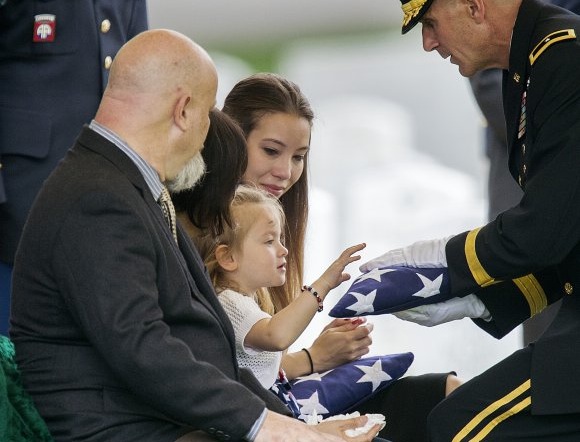
US-AFGHANISTAN-WAR-PHILLIPS

Sophia Phillips receives a flag from Brig. General James Parquarette as her mother and widow Christine Phillips watches as members of the US Army honor guard perform a full military honors burial service for US Army Staff Sergeant Francis G. Phillips IV at Arlington National Cemetery in Arlington, Virginia on May 20, 2013. By Jim Watson/AFP/Getty.

Quote For The Day II

“This is worse than John Major. There was quite a lot of sympathy for him because of the Maastricht rebels. He also listened, though he probably listened too much. With Cameron it feels like this could be terminal – and will be so before the election,” – a “senior figure” in the Conservative Party, putting the knife into the prime minister as only Tories do.

A Broken Nation

In his book The Last Man In Russia, Oliver Bullough describes a Russia that is “dying from within”:

Russians have been on a 50-year bender, and not just men: anyone riding the Moscow subway can see well-dressed young women drinking beer from cans on their way to work. And the more Russians drink, the quicker they die and the less they replace themselves.

Russian life expectancy hit a high in the mid-1960s—69 years, the same as in the contemporary West. Since then, Westerners have added about a decade and a half to their average lifespans, while Russian life expectancy for males has shrunk to 63 and Russians of both sexes are five times more likely to die of “external” causes—murder, suicide, drowning, car crashes—than West Europeans. Birth rates cratered along with the Soviet Union; there were 148 million Russians in 1990; now there are 141 million. …

“If you deny people hope and love and friendship, then they sicken and despair,” [Bullough] writes. “They drink themselves to death, and they stop having children.”

Surge Fail Update

IRAQ-POLITICS-UNREST

Much of David Petraeus’ reputation lies with his vaunted “surge” in Iraq, which neocons hailed as the way forward to a multi-sectarian government. Senator John McCain keeps calling it a success. It was a success in taking advantage of a lull in an exhausted civil war – plus a lot of bribes – to get us out of there with some kind of dignity. But the civil war is now re-starting in earnest. Today alone, over 70 people were killed in sectarian bomb attacks.

(Photo: Iraqi medics attend to a wounded man at a hospital in Fallujah, west of Baghdad, on May 17, 2013 following a bomb blast in a coffee shop. Bombs targeting Sunnis, including two near a mosque and one at a funeral procession, killed 67 people across Iraq, officials said, after dozens died in two days of attacks on Shiites. By Azhar Shallal/AFP/Getty Images.)

Marriage Equality Survives In Britain

 
The cynical wrecking amendment has gone down in flames – by 375 votes to 70. It’s a fascinating insight into the opposition to marriage equality on the far right. A conservative – yes, a conservative – was proposing to extend civil partnerships, i.e.e marriage-lite, to heterosexual couples rather than allow gay couples to be married. Such civil partnerships, if extended to everyone, as in France, would do much much more to undermine the institution of civil marriage than allowing gays to participate in the institution. It’s pretty obvious evidence that bigotry was behind this – a betrayal of core conservative principles in order to prevent gay equality.