Gaza’s Fried Chicken Smugglers

This story about getting KFC into Gaza, first reported by Xinhua, went viral last week:

Paul Mutter wishes the Israeli blockade of Gaza was more prominently mentioned:

According to the Canadian International Development Agency, 50% of the strip’s population is considered “food insecure.” While that number may be lower now, especially with the easing of bans on food imports, but it is still significant that food insecurity exists – just because people are not starving to death in the streets does not mean poor nutrition is less of a problem; developmental deficiencies, chronic illness and stunting are all consequences of food insecurity. Moreover, one of Ariel Sharon’s top aides reportedly said that the 2006–2010 ban on importing certain foodstuffs was meant to put the Palestinians on a “diet” by setting a “calorie limit.” Starvation was not the goal; “economic warfare” was. “Such an artless admission of the use of food as means to control a population is rare,” dryly noted a report prepared for the UN’s Food and Agriculture Organization.

At least, one hopes that this context is remembered, as it is getting dropped out of all the summaries accounts other sites have posted in order to generate hits on the reporting.

Is Race Only A Social Construct? Ctd

My challenge to Ta-Nehisi:

[W]hat I really want TNC to address is the data. Yes, “race” is a social construct when we define it as “white”, “black,” “Asian” or, even more ludicrously, “Hispanic.” But why then does the overwhelming data show IQ as varying in statistically significant amounts between these completely arbitrary racially constructed populations? Is the testing rigged? If the categories are arbitrary, then the IQs should be randomly distributed. But they aren’t, even controlling for education, income, etc.

His response:

I do not know. Andrew is more inclined to believe that there is some group-wide genetic explanation for the IQ difference. I am more inclined to believe that the difference lies in how those groups have been treated. One thing that I am not convinced by is controlling for income and education.

African-Americans are not merely another maltreated minority on the scale of non-WASPs.

They are a community whose advancement was specifically and actively retarded by American policy and private action. The antebellum South passed laws against teaching black people to read. In the postbellum South, black communities were the targets of a long-running campaign of terror. The terrorists took very specific aim at the institutions of African-American advancement. They targeted churches. They targeted businesses. And they targeted schools. In the mid-20th century, as we have been documenting, it was the policy of this country to deny African-Americans access to the same methods of wealth-building, that it was making available to whites.

This alone would be bad enough, but what makes it much worse is segregation. In his book American Apartheid, Douglass Massey looks at the dissimilarity indexes among African-Americans in various cities across the country in the mid to late 20th century. To summarize (and I can talk more about this) the lowest levels of dissimilarity in black communities are higher than the highest levels of dissimilarity among “white” immigrants.

This is not merely a problem for your local diversity and sensitivity workshop. It is a problem of wealth and power. When you create a situation in which a community has a disproportionate number of poor people, and then you hyper-segregate that community, you multiply the problems of poverty for the entire community–poor or not. That is to say that black individuals are not simply poorer and less wealthier than white individuals.  Because of segregation, black individuals and white individuals of the same income and same wealth, do not live in communities of equal wealth.

The consequences of this are profound.* In this paper sociologist John Logan looked at the intersection of housing and segregation and found that, because of segregation, affluent African-American families, on average, lived in poorer neighborhoods than white families of much lower income.

Wrap RIP

Screen Shot 2013-05-20 at 12.54.40 AM

A resounding Yes from readers – only 9 percent of this polled say they read the Daily Wrap on a regular basis and only 14 percent find the Weekend Wrap useful. One writes:

It’s a nice feature but if it takes away from you doing better things, it’s not worth it. If other subscribers can’t be troubled to scroll through the Dish, they’ve got other problems.

About a third of polled readers are the same page as this one:

The Daily Wrap is the Dish’s equivalent of those “We now conclude our broadcast day” messages that TV stations used to air, back in the days when TV stations actually went off the air. It basically says to me, “Don’t bother checking your RSS feeds again until tomorrow morning.”

Another suggests an alternative:

Now that you mention it, The Daily Wrap takes the diffuse, webby, bloggy feel of your work and tries to hammer it into four or five tidy paragraphs, which was a neat feat at first, but now seems strangely redundant.  The day’s work becomes a motley heap of curios, like Harper’s Index.  Sounds like it’s not worth the effort anymore.

But how about a Daily Mash?  Something that takes the day’s (or week’s) posts and stitches them together in a new graphic form? Whether it’s simple like a word cloud or some new, artful link collage, I like the idea of a routine playful, mash-up of your work.

Another gets closer to what we’ve been considering:

I LOVE the re-posting that you have done recently.  For example, I was offline last night and a good portion of the early morning.  So, I would have missed the Peggy Noonan post and I really want to see that damn post. So, I like the reposting of selected stuff and I think you should do more. Maybe that’s the solution to the Daily Wrap.  I rarely read it – the only time I EVER do is when I want to find a post from the prior week – but since you have a decent search feature.

Another suggestion:

You could pick a stand-out video/image, and an automated list linking to the top-3 read, or “read-on”-ed, articles of the day – similar to the “Most-Read” tabs on most major news sites, but posted once at the end of the day.

Another:

Why not end the day with a post containing the headlines and a link to the day’s posts?  That way, a reader trying to keep up with a thread (“Racism in the World, Ctd”) or a particular feature (VFYW, Face of the Day, etc) would have a simple navigation tool to catch up on a day away from the Dish.

And another:

Why not replace it with an automated index of the day’s stories? Since you are using WordPress, this would be a very easy thing to program, and that way you solve two problems at the same time (your time input, which goes to almost zero, and reader usefulness, which stays rather high).

One of a handful of readers defending the status quo:

I was shocked to read that you’re considering nixing the Daily (and Weekly?) Wrap, and that such a large majority want it gone, according to the poll when I took it earlier today. I admit I haven’t used it much recently, though still a little bit, but the Weekly Wrap was especially helpful when I was in South Africa for two years with the Peace Corps. I didn’t have any Internet connection at site, but I did get to go into Polokwane, the provincial capital of Limpopo, once a week. So on Saturdays, I would have a three to four hour block of Internet time, during which I would read through the Weekly Wrap, select the stories I was interested in, save the pages on my desktop, and read the articles throughout the week. I know this isn’t the case for a majority of your readers, but maybe at least the Weekly Wrap is worth keeping for your less than well-connected readers.


No Drama Obama

US-POLITICS-OBAMA

Former Obama speechwriter Jon Favreau describes how Obama handles scandals:

The handwringers and bed wetters in the D.C. punditocracy should know that Barack Obama will never be on their timeline. He does not value being first over being right. He will not spend his presidency chasing news cycles. He will not shake up his White House staff just because of some offhand advice offered to Politico by a longtime Washingtonian or a nameless Democrat who’s desperately trying to stay relevant. And if that means Dana Milbank thinks he’s too passive; if it means that Jim VandeHei will keep calling him arrogant and petulant; if it means that Chris Matthews will whine about him not enjoying the presidency, then so be it. He’ll live.

Favreau knows him as well as anyone – and that rings true. It’s also a deep political strength. Most mortals cannot manage that no-drama glide – I sure can’t. Hillary is more easily provoked into hunkering down rather than sailing through. What troubles me, though, is not that the IRS clusterfuck and the VA backlog are signs of malevolence, but rather that they are indications of a government that doesn’t work right. And no president should glide past that.

We’ve been at war for over a decade. The imminence of vast numbers of disability and pension claims can have been no surprise for the VA. And yet they are two years’ behind schedule. And the more I read about the IRS scandal, the more it seems to me less a political campaign than complete mismanagement:

Over three years, as the office struggled with a growing caseload of advocacy groups seeking tax exemptions, responsibility for the cases moved from one group of specialists to another, and the Determinations Unit, which handles all nonprofit applications, was reorganized. One batch of cases sat ignored for months. Few if any of the employees were experts on tax law, contributing to waves of questionnaires about groups’ political activity and donors that top officials acknowledge were improper.

“The I.R.S. is pretty dysfunctional to begin with, and this case brought all those dysfunctions to their worst,” said Paul Streckfus, a former I.R.S. employee who runs a newsletter devoted to tax-exempt organizations. “People were coming and going, asking for advice and not getting it, and sometimes forgetting the cases existed.”

Much of this arises from the Supreme Court’s unleashing of so much money into the electoral process via groups that were not easy to assess as legit. But the IRS had plenty of advance notice, and yet no one seemed to foresee the challenge or the dangers of getting things wrong. If you want to know why Americans remain leery of government, it’s because of this combination of power and incompetence. All bureaucracies – private and public – are susceptible to this, but when it comes to veterans being denied benefits or political groups being effectively hazed to get the right tax designation, we have a right to question government’s expansion.

That’s the real problem here, it seems to me. The right is paranoid and delusional enough to turn all of this in their minds to a Nixonian war on them. You can’t do much about that, except note that it will likely improve their chances in 2014. But the reasonable center worries simply that government is incompetent and expensive and too complex. If liberals want to restore an activist government, this is the core area they need to focus on – especially when it comes to implementing universal healthcare.

(Photo: Nicholas Kamm/AFP/Getty.)

Live-Blogging Britain’s Marriage Debate

The high drama in the Commons can be monitored at the Guardian here. The Telegraph’s live-blogging is here. I fear the Tories have made themselves look divided as well as cynical, even though support for marriage equality from Cameron and others is genuine. It didn’t help that over the weekend, an unnamed alleged friend of Cameron’s described the Tory party right as a bunch of “mad, swivel-eyed loons”. Not exactly diplomatic.

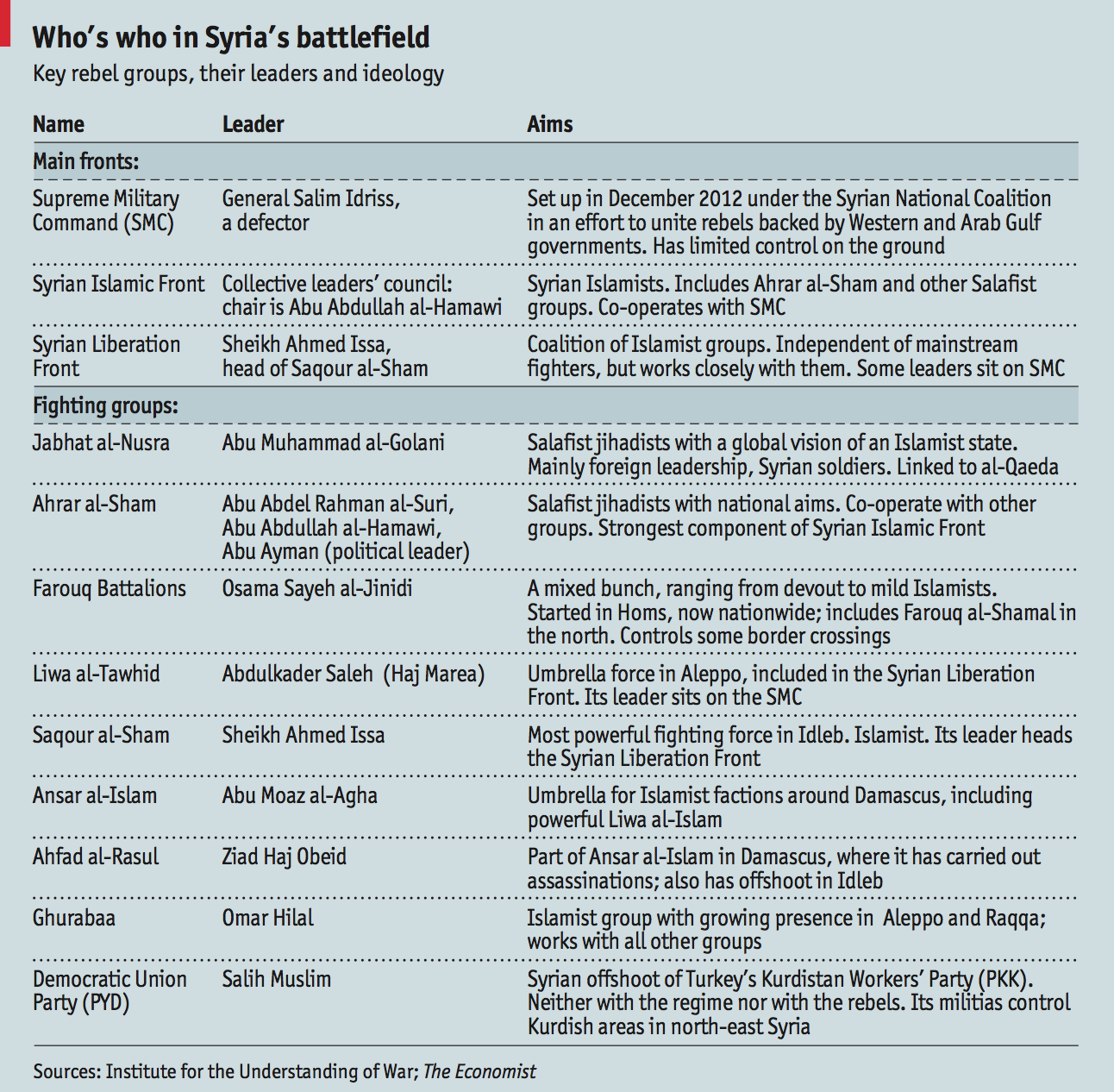
Which Syrian Rebels, Exactly, Should We Arm?

The Economist has a helpful graphic on key rebel groups in Syria:

Syria_Fighting_Groups

Note how may of these groups are described as “Islamists” or “Jihadists.” Matt Steinglass doubts there is much we can do:

[W]hat about trying to just end the bloodshed and freeze the current situation? Given that the country’s population has effectively split into irreconcilable warring camps, wouldn’t it be best for all concerned if those camps were each acknowledged as legitimate in their areas of control? If those areas of control are more homogenous than the overall Syrian state, couldn’t that form a more stable basis for governance? Should America aim for a resolution along those lines in the talks it’s convening with Russia?

Maybe. Then again, maybe not. The problem with formally acknowledging armed secessionist groups as soon as they gain control over a patch of territory is that it encourages new armed groups to secede, provoking yet more civil wars. (See under: Yugoslavia.) And in the middle east, hopes that such splinter groups will grow into non-belligerent stakeholders once they’ve become responsible for controlling populations and territory are often disappointed. (See under: Hamas; Gaza.)

Even Jeffrey Goldberg, who has been itching for a new war, is now wary of getting involved. He thinks the US may have missed its chance:

Early intervention — a coherent, active attempt by the U.S. and its allies to build up, finance and advise what was then a moderate opposition — might have worked. Now, though, the Assad regime is showing signs of real resilience, and the opposition is showing signs of real brutality. It is easy to blame Obama for his early passivity. It is slightly harder to blame him for looking at Syria as it is today and then choosing to ignore calls for deeper intervention on the side of the rebels.

And Conor Friedersdorf wants interventionists to consider non-military ways to alleviate suffering around the world:

When an interventionist wants to put boots on the ground, arguing that it’s necessary to save lives, it means asking ourselves, before acceding, “can more lives be saved by spending this money on anything other than a war”? The fact is that, even granting the smartest critiques of international development work, it is usually a better way to help people than war, and it engenders good feelings rather than blowback.

Obama At Morehouse

Every now and again, an event happens that makes you see much more clearly how divorced from its previous ideals the GOP has become. Obama’s speech at Morehouse was something every conservative has always asked of African-American public figures. We have in Obama a black man raised by a single mother who is now, as even his critics acknowledge, a dedicated father to two daughters, whom he obviously adores. If the right is concerned about the black family, they should be falling over themselves to celebrate what Obama’s family is, and means. But they don’t. It would kill them to say anything gracious about this president.

Drudge yesterday cherry-picked only those parts of the speech that could divide people racially, only those moments when Obama dared to recognize the discrimination and difficulties of young black men – before urging them to overcome them. There’s a racial nastiness here that decent voters still hear and that Republicans have deployed constantly. Their historic refusal to cooperate even one iota with the first black president betrays, it seems to me, a staggering lack of grace and historical sense.

But as with everything Obama says, the speech balanced calls for equality with an admonition that personal responsibility is the inextricable complement to equality. And he did something more in the interstices. A member of the Morehouse faculty writes:

Morehouse is a college dedicated to African American men, the only one of its type in the country.  To hear the first African-American male U.S. president address a class of 500+ African-American men was moving, especially as he touched on his personal struggles of not having a father in the home.

But the reason I’m writing to you though is because he gave two shout-outs to gays.  He encouraged the young men to be a better husband to their wife but then added “or to your husband or partner”.  Later, he told them that their experiences as African-American men should make them more empathetic to others who feel left out, such as Hispanics because of their immigration status, gays and lesbians because of who they love, and Muslims because of how they worship. The ease with which he address gay issues now is striking to me.  Just like with the second inaugural address, it’s just a part of his normal speaking.  It is even more noteworthy because Morehouse once had a reputation as a homophobic place due to several factors, including a student beating about ten years back.

This speech reminded me once again why I supported this man and continue to do so.

Me too. While Washington obsesses over scandals that so far have no connection to him, the president stays calm and carries on.