China’s Doppelgänger Cities

British China

Artists Sebastian Acker and Phil Thompson highlight the surreal phenomenon of “copy towns”, where cities from Europe and the Americas are replicated for Chinese citizens:

[G]enerally China has a long history of copying, especially within architecture and the arts. For centuries the emperors would replicate lands that they had conquered within their own palace gardens. These constructs would often include fauna and plants from the conquered regions. This ability to replicate and maintain the distant land demonstrated the emperor’s control over the original region. Then there is also China’s desire to replicate the West and become a first-world country. A lot of Chinese people look up to the West as an ideal, so the construction of these towns could be seen as a way of accelerating their progress; a quick way of achieving through emulation.

(Photo above of Thames Town by Flicker user triplefivechina. Wikipedia describes it as “a new town in Songjiang District, about 30 kilometres (19 mi) from central Shanghai, China. It is named after the River Thames in England. The architecture is themed according to classic English market town styles. There are cobbled streets, Victorian terraces and corner shops.” )
Like A Fish Out Of Hot Water

Sardines_-_鰯(いわし)

Humans aren’t the only ones being displaced by climate change:

Each cold-blooded fish species has a particular temperature range in which it thrives. If water temperatures depart from that range, they may experience reduced growth and reproduction, ultimately reducing their numbers in a particular area and changing the species’ distribution. Climate change-driven shifts in fisheries pose the biggest threat to livelihoods in developing countries, especially in the tropics, where adaptation capacity of both people and fish themselves are more limited, [researcher William] Cheung said.  …

With climate change predicted to accelerate in coming decades due to the rising amount of greenhouse gases in the atmosphere, even faster shifts in fish populations are possible, which could even lead to disputes between countries if commercially valuable fish shift out of one country’s waters and into another’s, according to Boris Worm, a marine biologist at Dalhousie Univeristy in Nova Scotia who was not involved in the Nature study.

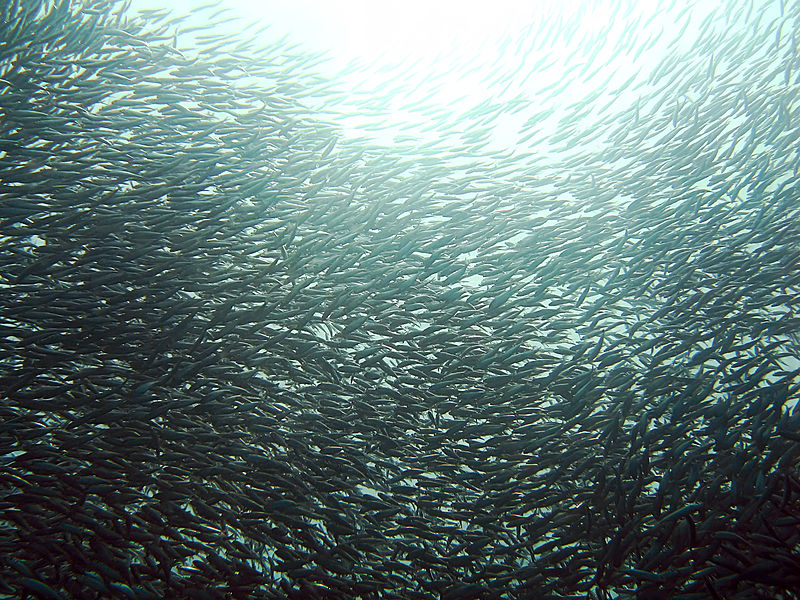
Previous Dish on populations displaced by climate change here and here. Photo of a school of sardines by TANAKA Juuyoh via Wiki.

Chart Of The Day

Civil Unions

Robert Jones and Daniel Cox examine support for civil unions over time:

The changing political composition of civil union supporters shows that the center of gravity of this debate has shifted significantly. The civil union option has moved from being a middle way dominated by political moderates a decade ago to one that is, today, most attractive to political conservatives. And looking ahead, there is evidence that the civil union option may have a limited future, at least if younger Americans are any indication. When given a three-way choice, civil unions are the least popular option among Millennials (Americans born after 1980). Only slightly more than 1-in-10 (13%) Millennials prefer civil unions, while 67% say they support allowing gay and lesbian people to marry, and 15% oppose any legal recognition of a gay couple’s relationship.

Still DADT For Trans Troops

But Chris Geidner highlights a promising development for transgendered members of the military:

The Pentagon formally recognized earlier this month that there are transgender veterans — a step that LGBT advocates say is a long way from open transgender service in the military, but also a significant first step in that process. In a short letter dated May 2, a Navy official told Autumn Sandeen, a veteran and transgender activist: “Per your request the Defense Enrollment Eligibility Reporting System (DEERS) has been updated to show your gender as female effective April 12, 2013.”

A Grammar Rule That Isn’t

John McWhorter defends ending sentences with prepositions:

Should “she refused to come in” be recast as “in she refused to come”? Of course not. [Eighteenth-century author Robert] Lowth [who popularized the preposition rule] was referring only to language in its Sunday best when he wagged his finger about the sentence-ending preposition, and at one point in his book, he even wrote, “This is an idiom, which our language is strongly inclined to.” Whether Lowth was aware of the irony is something he took to his grave.

Are There Jobs Americans Won’t Do?

American Mexican Workers

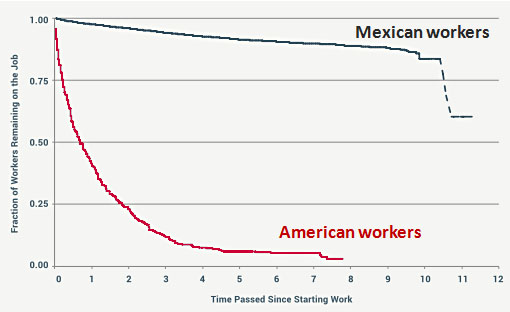
Kevin Drum thinks so. He posts the above chart, which compares the percentage of American and Mexican agricultural workers in North Carolina who stayed on the job over a 12-month period:

Within two months, 80 percent of the native workers had quit. By the end of the growing season, only seven were left. Now, as Matthews notes, this report doesn’t exactly come from a neutral source. It’s from a pro-immigration group working with a group of pro-immigration farmers. But unless they’re flat-out lying here, the numbers are pretty compelling. Most Americans just aren’t willing to do backbreaking agricultural labor for a bit above minimum wage, and if the wage rate were much higher the farms would no longer be competitive.

One of Drum’s readers objects:

Farm laborers in Australia make much more than American ones. And yet they still have a functional agricultural sector. It turns out that allowing companies to import an unlimited number of foreign workers desperate to work at a wage of epsilon will create shitty working conditions and low wages!

Noah Millman wonders about the consequences of paying farm workers more:

What would happen if agricultural labor were better-compensated? To some degree American agricultural enterprises would become less-competitive—we’d import more of some kinds of food from abroad. Which would mean more money flowing into the agricultural sector in those countries, and more employment for agricultural labor there, as opposed to here. From the perspective of the farm laborers that’s not obviously a bad outcome—they have jobs and not have to uproot themselves to get them.

Another possibility is that American farmers would innovate, and find ways to get the same crop yields with fewer workers, through the application of automation. That advance in productivity would reduce agricultural employment overall, with the remaining employees earning a higher wage, more conducive to economic and social security. Genuine advances in productivity are usually counted as a good thing for everybody.

Ugandan Relations

Jon Kelly lists the top 10 “most scandalous euphemisms”:

2. “Discussing Uganda” In 1973, the satirical magazine Private Eye reported that journalist Mary Kenny had been disturbed in the arms of a former cabinet minister of President Obote of Uganda during a party. Variations of “Ugandan discussions” or “discussing Uganda” – the term is believed to have been coined by the poet James Fenton – were subsequently used by the Eye to describe any illicit encounter, and the phrase soon became part of common usage.

Two more choice picks from Jon: “slipping my moorings” and “watching badgers”. These, one should add, are very British. They’re basically inside jokes for an entire country, and Private Eye is their central location.

Dogs vs Cats: Let The Great Debate Begin, Ctd

A reader is on the same page as De Niro, seen above:

I am a life long “dog person” who has been going through a conversion. I am pretty sure I own my last dog precisely because one day the amount of basic existential dependency my dog has on me stopped affirming me and started making me feel guilty and needy. He’s a great dog! But he has no independent purpose beyond me. His work is to do what I’m doing – to follow me to work, where he lays at my feet. And to the dog run, where he will only play with other dogs when I am watching. And to my errands, where if he’s lucky he gets treats and when he’s not he gets tied up outside.

From a resource allocation perspective, my dog is my personal sidecar that eats meat, shits into plastic bags, pees on trees sometimes despite my best efforts, and occasionally needs a car. This bugs me. But what really bugs me is that he wakes up every morning and devotes his life to me for no clear purpose beyond keeping me company. I feel sad and needy when I think about this.

Previous thoughts from readers here.

What Should Count As Drunk Driving?

The National Transportation Safety Board (NTSB) wants to lower the legal limit:

Currently, the threshold is set at a blood alcohol content of 0.08 percent, as a result of a transportation bill signed into law by President Clinton in 2000, which stated that states had to adopt the 0.08 threshold by 2004 or else have their highway funding revoked. But in a new report, the NTSB argues that this threshold is too high, and that it should be reduced further to 0.05. For reference, the average woman weighing 165 pounds would have to consume three beers to top 0.05, four to top 0.08, and five to top 0.10 (change that to four, five and six for the average man weighing 195 pounds).

Kathryn Stewart supports the change:

The United States is among a handful of countries that sets the illegal blood alcohol concentration as high as 0.08 percent. Perhaps that is one reason we trail behind many other developed countries in our traffic safety record. In virtually every country where the illegal level has been lowered, lives have been saved.

When several European countries lowered their levels to 0.05 percent, researchers tallied the reductions in traffic deaths to be somewhere between 8 percent and 12 percent among drivers ages 18 to 49. And in Australia, fatal crashes decreased by 18 percent in Queensland and 8 percent in New South Wales after those states lowered their limits to 0.05 percent. In Sweden, when the illegal level went from an already-low 0.05 percent to 0.02 percent in 1990, the proportion of alcohol-related fatalities declined sharply, from 31 percent in 1989 to 18 percent in 1997. In our own country, lowering the limit from 0.10 to 0.08 was associated with reductions in impaired driving crashes and fatalities from between 5 percent and 16 percent.