Weak Arguments Against Legal Weed

Last week, Damon Linker listed the “3 best arguments against legalizing pot – and why they all fail.” His main point:

As with the lightning-fast evolution of the country on gay marriage, the change in judgments about pot use has been accomplished because of the rise of moral libertarianism. Americans increasingly believe that individuals should be free to engage in behavior that harms no one besides the person who consensually chooses to engage in it, especially when the harm is either minimal or wrapped up with traditionalist religious convictions that (supposedly) have no business being backed up by law and the coercive power of the state. Once the solvent of moral libertarianism is applied to just about any contrary argument, that argument’s cogency dissolves right before our eyes.

And then we are left with an absence of reasons not to engage in behavior that was once presumed to be both immoral and justifiably illegal.

Noah Millman responds:

[W]hat is Linker referring to when he talks about “behavior that was once presumed to be both immoral and justifiably illegal.” What, exactly, is immoral about smoking pot as such?

I can only understand that view within a framework according to which a wide variety of other worldly pleasures – drinking alcohol, smoking tobacco, probably even wearing fancy clothes and eating fancy food – are grouped under the rubric of “vice.” Now, that’s a perfectly fine framework; it served our Puritan ancestors well, and it serves the LDS Church, the various Anabaptist sects, and other groups pretty well today. But it’s simply not true that we must choose between this kind of framework and “moral libertarianism” according to which “do what thou wilt” is the only law (provided you’re not hurting anybody else directly). There are a variety of moral frameworks that view the enjoyment of fleshy pleasures in moderation not merely not as vice, but as essential to health – while still caring about the health of the individual, and not just his or her freedom of action. …

Burke, who did not oppose all change, is more readily enlisted on the side of decriminalization than on the side of prohibition, for the same reason that he is more readily enlisted on the side of same-sex marriage: in both cases, the law would not be driving social change but recognizing a social change that has already occurred. There’s nothing particularly Burkean about using tradition as an excuse for refusing to face that fact that a given custom is now honored largely in the breach.


The View From Your Weirder Windows

Iona-Scotland-12pm

“This is the view from my ferry to the Scottish island of Iona.” We posted other out-of-the-ordinary views on Friday. Many more after the jump:

Mutianyu-China

Air Tram, Mutianyu, China, 2.30 pm

Huntington-Lake-CA

Huntington Lake, California, 2.35 pm

Snowmass-Creek-Colorado

Snowmass Creek, Colorado, 10 am

sea-of-cortez

Sea of Cortes, 10.30 am

Terlingua Ranch Lodge Texas

Terlingua Ranch Lodge, Texas, 8 am

image (3)

Moss Landing, California, 7:52 pm. “I don’t know if you have any rules against car windows, but this van is also my home, so I am quite sure it ought to qualify. Cheers!”

Previous views from your weirder windows here. Airplane views here.

What Drives Foodies? Ctd

Robert Appelbaum challenges John Lanchester’s recent New Yorker piece on foodie culture, writing, “there is a huge discrepancy Lanchester overlooks—a discrepancy between the culture that even a moderately paid professional like Lanchester experiences and critiques, and the culture that the majority of the people in the advanced world (probably not the kind of people who read The New Yorker) are actually experiencing”:

What is missing in Lanchester’s piece is an attempt to draw correlations. Is there not a connection between the flourishing of foodie culture—both in the media and in the business of fine dining—and the degradation of diets, labor conditions, and wages among the masses? You bet there is. Online and on television, we are regaled by a demanding food culture that rewards and celebrates star chefs, fetishizes the value of a rare and expensive meal, and finds itself eating better than ever. But this is only one face of our culture; flip the coin over, and you reveal the side that marginalizes the majority of eaters and impoverishes the majority of food workers. For this is a culture that works by generating social distinctions and segregating incomes, all in the interest of what appears to be glamorous, heroic, virtuous, and delicious efforts. There is a direct connection between foodies getting “out of hand,” and food workers living from hand to mouth.


You Might Like Obamacare If You Try It

Obamacare Ratings

The ACA remains unpopular:

As the Affordable Care Act’s second open enrollment period begins, 37% of Americans say they approve of the law, one percentage point below the previous low in January. Fifty-six percent disapprove, the high in disapproval by one point.

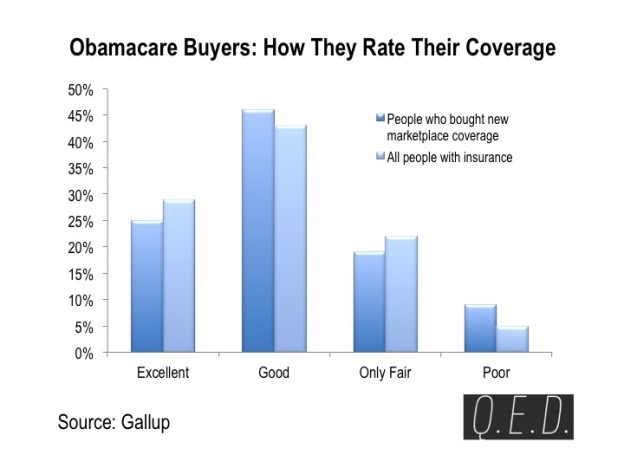
But Obamacare enrollees give the insurance high marks:

Over seven in 10 Americans who bought new health insurance policies through the government exchanges earlier this year rate the quality of their healthcare and their healthcare coverage as “excellent” or “good.” These positive evaluations are generally similar to the reviews that all insured Americans give to their health insurance.

Cohn celebrates that news:

You hear a lot about what’s wrong with the coverage available through the marketplaces and some of these criticisms are legitimate. The narrow networks of providers are confusing, for example, and lack of sufficient regulations leaves some patients unfairly on the hook for ridiculously high bills. But overall the plans turn out to be as popular as other forms of private and public insurance. It’s one more sign that, if you can just block out the negative headlines and political attacks, you’ll discover a program that is working.

Drum agrees:

Republicans can huff and puff all they want, but the evidence is clear: despite its rollout problems, Obamacare is a success. It’s covering millions of people; its costs are in line with forecasts; and people who use it think highly of it. There’s no such thing as a big, complex program that has no problems, and Obamacare has its share. But overall? It’s a standup triple.

It Takes A Potemkin Village

Josh Planos describes an innovative nursing-home alternative in the Netherlands:

Today, the isolated village of Hogewey lies on the outskirts of Amsterdam in the small town of Wheesp. Dubbed “Dementia Village” by CNN, Hogewey is a cutting-edge elderly-care facility—roughly the size of 10 football fields—where residents are given the chance to live seemingly normal lives. With only 152 inhabitants, it’s run like a more benevolent version of The Truman Show, if The Truman Show were about dementia and Alzheimer’s patients. Like most small villages, it has its own town square, theater, garden, and post office. Unlike typical villages, however, this one has cameras monitoring residents every hour of every day, caretakers posing in street clothes, and only one door in and out of town, all part of a security system designed to keep the community safe. Friends and family are encouraged to visit. Some come every day. Last year, CNN reported that residents at Hogewey require fewer medications, eat better, live longer, and appear more joyful than those in standard elderly-care facilities.

There are no wards, long hallways, or corridors at the facility. Residents live in groups of six or seven to a house, with one or two caretakers. Perhaps the most unique element of the facility—apart from the stealthy “gardener” caretakers—is its approach toward housing.

Hogeway features 23 uniquely stylized homes, furnished around the time period when residents’ short-term memories stopped properly functioning. There are homes resembling the 1950s, 1970s, and 2000s, accurate down to the tablecloths, because it helps residents feel as if they’re home. Residents are cared for by 250 full- and part-time geriatric nurses and specialists, who wander the town and hold a myriad of occupations in the village, like cashiers, grocery-store attendees, and post-office clerks. Finances are often one of the trickier life skills for dementia or Alzheimer’s patients to retain, which is why Hogewey takes it out of the equation; everything is included with the family’s payment plan, and there is no currency exchanged within the confines of the village. …

In the years since Hogewey’s founding, dementia experts from the United States, United Kingdom, Ireland, Germany, Japan, Norway, Switzerland, and Australia have all flocked to the unassuming Dutch town in the hopes of finding a blueprint for handling the global problem. While dementia-only living facilities have been created outside the Netherlands, none of them have offered the amenities or level of care per patient that Hogeway provides. Last year, inspired by Hogewey, a nursing home in Fartown, England, built a 1950s village for its residents; a similar project is underway in Wiedlisbach, Switzerland. But because cost is one of the greatest barriers to making self-contained villages the standard in dementia care, it would be extremely difficult to implement in a non-socialized healthcare system—meaning that in the U.S., a facility like Hogewey might be impossible for the forseeable future.

The Stickler Youth

grammar1

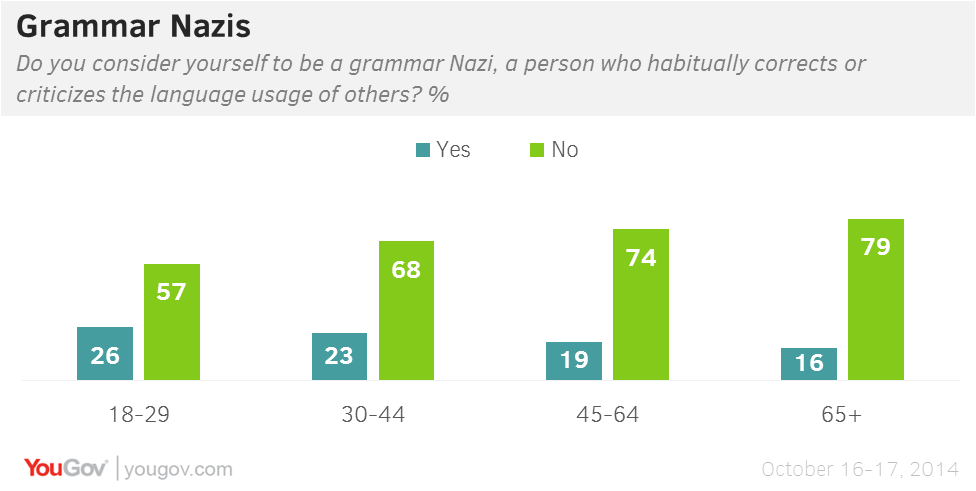
A recent survey tests Americans on our grammar, as well as our fascist tendencies:

Research conducted by YouGov in October shows that, when asked, 21% of Americans consider themselves to be what is colloquially known as a ‘grammar Nazi’, that is someone who habitually corrects or criticizes the language usage of others.

Younger Americans, especially under-30s (26%) are more likely than older American to admit to being grammar Nazis. Only 16% of over-65s say that they habitually correct and criticize the language usage of others. 70% deny being a grammar Nazi, while 9% are on the fence.

This finding is appropriate, as younger Americans were often better than older Americans at accurately identifying the correct grammatical form of particular sentences. When asked about the correct use of ‘it’s’ and ‘its’, 61% of Americans rightly identified the sentence ‘my oak tree loses its leaves in autumn’ as being correct, while 31% said that ‘my oak tree loses it’s leaves in autumn’ was correct, wrongly using the contraction of ‘it is’. 70% of under-30s identified the correct sentence, compared to 56% of over-65s.

Update from a reader:

Well, that’s just a poor survey design. There’s an immediate bias there: older Americans (especially the 70+, I imagine) are going to be less likely to ever identify themselves as any sort of Nazi, even if it’s a relatively benign term like Grammar Nazi.

As this reader attests:

I’m in the 45-64, and I will happily admit to being a habitual correcter of other people’s grammar, but I would answer “no” to that survey because I’d never call myself any sort of “Nazi“.  You can call me a grammar pedant, a grammar nag, or a grammar obsessive, but “Nazi“?  No thanks.

Reading, Writing, Replicants

Jane Greenway Carr notes that “for an outsider genre, science fiction is pretty mainstream in the classroom these days”:

Common Core standards acknowledge it, along with its cousins speculative fiction and fantasy literature, as acceptable content in Language Arts curricula. Many of the current generation of professors in English Departments grew up watching Star Trek and The X-Files, including University of Maryland English professor Lee Konstantinou, who feels that science fiction novels and films help students to process big-picture questions, especially “risk, political conflict, and social and technological systems.” Konstantinou is a contributor to Hieroglyph: Stories & Visions for a Better Future, a recent anthology co-edited by Ed Finn, founding director of the Center for Science and the Imagination at Arizona State University, that goes to the heart of why I think teaching science fiction to more students can change the world: because science fiction productively embodies difference and illustrates emerging technologies, giving students enough of each so that they may interrogate these elements in both the fictional and the real worlds.

The Best Of The Dish This Weekend

As a cultural cherry on the top of the #gamergate cake, Matt Taylor’s confession is hard to beat. Convicted merely of being a clueless dude, who just happened to have helped land a fricking spacecraft on a comet, his tears strike me as another sad product of our over-polarized, over-politicized culture.

This weekend, as I was drinking some great coffee in L.A., I was re-reading Alan Watts on my Kindle. In The Way Of Zen, one of his greats, he wrote the following:

It was a basic Confucian principle that ‘it is man who makes truth great, not truth which makes man great.’ For this reason, ‘humanness’ or ‘human-heartedness’ was always felt to be superior to ‘righteousness’, since man himself is greater than any idea he may invent. There are times when men’s passions are much more trustworthy than their principles. Since opposed principles, or ideologies, are irreconcilable, wars fought over principle will be wars of mutual annihilation. But wars fought for simple greed will be far less destructive, because the aggressor will be careful not to destroy what he is fighting to capture.

Reasonable – that is, human – men will always be capable of compromise, but men who have dehumanized themselves by becoming the blind worshipers of an idea or an ideal are fanatics whose devotion to abstractions makes them the enemies of life.

Our culture is full to the brim of these righteous ideologues right now. Why are we shocked that so much cruelty and fanaticism reign?

Some gems from the weekend: the eighteenth century version of Fox News; the fashionista who made Thatcher punk; the vulnerability of post-Jäger “shot-faces”; the key themes of a sext life; Christopher Nolan’s religiosity in Interstellar; and the natural landscapes of religion.

My personal faves: the poems of Lucille Clifton; and Aquinas on his late-in-life doubt: “Everything I’ve written looks like straw”.

The most popular post of the weekend was What Washington Refuses To Admit; followed by Gruberism And Our Democracy.

We had a big boost in subscriptions late last week, thanks to a reminder email we sent out to lapsed subscribers whose credit cards, by and large, had expired. You can join the recently renewed here – and get access to all the readons and Deep Dish – for a little as $1.99 month. A new subscriber writes:

Hi Andrew, saw you on Bill Maher Friday night and, as usual, I found myself agreeing with about 99% of what you said. (Don’t ask me what the other 1% is, I don’t know …).  I’ve been reading your stuff for at least 15 years, and I find The Dish to be one of the best reads around. Even when I don’t agree with what you are saying, I find that how you say it is rational, well thought out, and almost persuasive. On Maher’s show, the one thing I strongly agreed with was … why does the U.S. have to go over and fight ISIS, especially after the failures we’ve experienced there? Let them fight it out.

I’m partly disabled, living on SS Disability and a small pension from Disney, but the $20 bucks I just spent is worth much more than that. Keep up the good work, and get back on Maher!

“Almost persuasive!” We have a new slogan.

See you in the morning.

A Poem For Sunday

9612786202_3589cdd5d0_k

“to the unborn and waiting children” by Lucille Clifton:

i went into my mother as
some souls go into a church,
for the rest only. but there,
even there, from the belly of a
poor woman who could not save herself
i was pushed without my permission
into a tangle of birthdays.
listen, eavesdroppers, there is no such thing
as a bed without affliction;
the bodies all may open wide but
you enter at your own risk.

(From The Collected Poems of Lucille Clifton 1965-2010, edited by Kevin Young and Michael S. Glasner with a foreward by Toni Morrison © 2012 by The Estate of Lucille Clifton. Used by permission of BOA Editions, Ltd. Photo by Nick Mealey)

The Courage To Be Kind

In an homage to his mother, Cord Jefferson considers the relationship between caring and bravery:

The world at large was frequently as resentful as my grandfather had been at my mother’s decision to marry a person with skin different from her own. There were the confused looks my family received in public, and, if my mother and I were alone, the strangers asking if I was her “real” son. There was the time an entire restaurant of white people in Mississippi gave us dagger stares for daring to eat breakfast around them. There was the time, after my mom and dad had divorced, that a potential suitor abruptly ended a date with my mother after seeing a picture of me, her brown son.

“You didn’t tell me your ex was black,” said the man.

“I didn’t know that mattered,” said my mom.

“Well, it does,” he said, and he left. …

When I think of my mother’s life up to this point, what I find most revealing is how much of the abuse hurled at her throughout the years came about solely because she showed care and love to the wrong kinds of people. Time and again, it was her openness to others that found her shut off from her friends, her church, her colleagues, even her own family. We seem to reserve a special rage in this world for those whose ability to be unafraid in pursuit of something new extends beyond our own. We begrudge them their strange friends and strange experiences under the guise that we find those things to be dangerous or unclean. But really we resent those people because their courage reminds us of how common and terrified we feel inside. Bravery is a virtue people revere in dead soldiers and then turn to disparage in someone extending her hand to a weirdo.