A Fundamental Disagreement

Things got heated between Greenwald and Maher on Real Time last Friday:

David Atkins criticizes the arguments on both sides for being “too simplistic to be taken seriously”:

Maher and Greenwald are both right, and they’re both wrong. Yes, the problem has much to do with oil, imperialism and oppression. But it’s not quite as simple moral relativist academics might like it to be. And yes, the problem is religion–but not in the way that Maher thinks it is.

The problem, as it is everywhere, is fundamentalism. The problem that causes anti-choice terrorists to bomb abortion clinics, Timothy McVeigh to blow up a federal building or Eric Rudolph to bomb innocents at the Olympics, is the same problem that causes so many Muslims to become entrapped in terrorism and anti-progressive movements. It’s a struggle against modernity and against progressivism that occurs : 1) whenever religion of any kind is allowed to be the sole driving force of organizational activity in resistance to oppression, and 2) when people are free enough to congregate and resist without being enslaved or mass murdered, but not free enough to hope for true social advancement.

Digby pushes back:

Unfortunately, David chose to represent Greenwald’s views as being some sort of simplistic “blaming” of all the world’s ills on imperialism. That’s not what he said. Indeed he said several times, in response to Maher’s repeated insistence, that he did not believe that. He was referring specifically to the perennial question of “why they hate us.”  He believes that the beef stems from American foreign policy of the past six decades and not out of some religious hatred for The Great Satan.

Ryan Cooper tries to mediate:

It does seem that Islam is struggling somewhat with the modern world. Whether that is more due to some inherent doctrinal issue or European colonialism followed by six decades of American meddling and violence preventing the emergence of a modern society is fun to argue about, but basically irrelevant. Muslim theology is up to Muslims. …

American Christians can never be part of the intra-Muslim theological discussion. What America can do is try to break out of the cycle of violence which has characterized our relationship with the Middle East for the past half century. We keep pursuing our perceived interests, and in the process trampling one country after the next into the dirt and creating yet more pools of angry, brutalized young men.

Pell Breaking Loose

Felix dissects a recent report revealing how American colleges utilize Pell grant money to skimp on the intended poorer recipients and rake in more rich applicants:

The big picture here is that colleges are spending as much money as they can on “merit” scholarships, rather than “need” scholarships. The former have two big advantages over the latter, as far as colleges are concerned. Firstly, by attracting the best students, rather than the merely impecunious, they improve the quality of the student body, at least in theory. Secondly, and more importantly, because they are smaller, they allow the university to make much more money. As [the New America report] puts it: “it’s more profitable for schools to provide four scholarships of $5,000 each to induce affluent students who will be able to pay the balance than it is to provide a single $20,000 grant to one low-income student.”

Snowflake Diversity

dish_utah-snowflakes

Using a high-speed digital camera system, researchers captured 3-D pictures of falling snowflakes on the slopes of Alta, Utah:

Traditional snowflake photography tends to focus on particular types of crystals that lie flat on a microscope slide, “where a camera can get them perfectly in focus, and the photographer can take the time to get the light exactly right,” Garrett said.

“These perfectly symmetric, six-sided snowflakes, while beautiful, are exceedingly rare — perhaps one-in-a-thousand at the most. Snow is almost never a single, simple crystal. Rather, a snowflake might experience riming, where perhaps millions of water droplets collide with a snowflake and freeze on its surface. This makes a little ice pellet known as graupel. Or snowflakes collide with other snowflakes to make something fluffier, called an aggregate. And everything is possible in between.”

Gallery here.

The Press Withdrawal

Heidi Vogt, who has reported from Afghanistan for four years, worries about the “press drawdown that accompanies a troop drawdown”:

When a suicide bomber blows himself up in 2015, there may be a very small handful of Western reporters still in country to cover it. The current staffers in Kabul will have moved on to Jerusalem or Cairo or London or New York. The freelancers will be in Syria, or wherever the next Syria is. And the Afghan journalists who are so key to any reporting in the country will have less of a shield between them and a government that has shown little commitment to freedom of the press.

We’ve seen this happen already in Iraq.

Did you hear about the car bombings outside Baghdad last month that killed more than 30 people? Or the wave of attacks in March that killed 65 people on the eve of the 10th anniversary of the US-led invasion? An al-Qaida in Iraq front group claimed responsibility. Stories were written about these attacks, but fewer than there would have been two years ago. And those that were written got less space on websites and in newspapers than they would have back then.

Afghanistan, already slipping off the American front page, will show up as a three-inch story in the international section when an American special forces soldier dies.

This Is Your Town On Drugs, Ctd

A reader writes:

Your reader makes an important point about the corporate support for the proliferation of prescription pain medication.  Let me add another dimension: prisoners who are “treated” while incarcerated with a stew of pain medication, anti-depressants and other medications, and then cut off cold turkey when they walk out the door.

I knew a young man who was involved in a tragic accident involving a gun while in high school. He ended serving a jail sentence for six months.  Because of his age, he was kept in a jail rather than a prison to keep him away from more hardened prisoners, which may have been good, but the downside is that jails don’t have much programming for prisoners.  So he sat in isolation, outside for one hour a day, with barely any services.  He developed a toe infection that was ignored until the pain was too great, and then they loaded him up with oxycontin.  When he was depressed, they added more anti-depressants.  Constipated?  More drugs.

Essentially, the jail’s point of view is that the easiest way to control prisoners is to just drug them up.  But when his sentence was up, the prescriptions ended and he walked out sick and addicted.  He’s still struggling four years later to find himself again, utterly derailed by the system.  How much of recidivism is a result of prisoners leaving in an addicted, weakened state?

Another writes:

I was shocked to see that somebody created a film about drugs and Oceana, West Virginia. I know that town well because I grew up in the next town over.

In a place that small, I can assure you that almost everyone knows everyone else and they know their business. Privacy is nearly impossible. My paternal lineage in that area goes back at least five generations to around 1800. It can be a wonderful place to visit with its slower, relaxing environment and with its very friendly people (and I’m related to most of them), but I’m so glad I don’t live there anymore. The problem with drugs in West Virginia (especially the southern portion of the state) has been going on for years – decades, even. It’s just now becoming recognized as the epidemic it has been for a while.

The real cause of the growing drug problem is the lack of economic diversity and the lack of jobs. The problems started around 1980 when technology and mechanization started replacing humans in large numbers. The place never recovered. The jobs that are there don’t pay the relatively high wages they used to pay, and lay-offs are common. You can look at the stats and see that unemployment is not very high, but it hides the number of people who stopped searching for unemployment. Many are instead receiving disability benefits, usually SSDI or workers compensation settlements. Generations of young adults have left the area in search of better jobs elsewhere (most often moving southward) and a better life overall.

My own family has been swept up into the drug problems of that area. A cousin, his ex-wife, my sister … the easy availability of prescription medication written in large quantities is criminal. The number of pharmacies relative to the population is staggering. When you drive through the region and you see five pharmacies on the same stretch of road that are serving a local population of 20,000 people, you know that something is fundamentally wrong. There are more pharmacies than grocery stores and fast food restaurants. Almost every town and county in the region has the same set of problems.

Oxycontin isn’t the only drug abused, as some pharmacies stopped carrying it. The pharmacies often have bars on the windows and doors, like what you would expect to find in a bad, inner-city area, and some post warning signs that they do not dispense painkillers (or not the better ones). Some people have to drive a good distance just to pickup a prescription for 5-10 pills of Oxycontin. This is, of course, ignoring entirely the illicit market. This is just how life works for people on the upside. The downside, as always, is much worse.

So, what do people do when they are in despair? They turn to something that can make them feel better, whether it is legal or not. This is not unique or some earth-shattering revelation, but for an area where people take pride in the beauty of the landscape, the friendliness of their neighbors and the sense of safety for their families, this drug problem has often turned their lives upside-down. You will see people sharing lost son-or-daughter announcements on Facebook only to find later that the son or daughter was discovered passed out in an abandoned home, in a hospital ER or dead in a car in the middle of a creek. Some of the people like to fool themselves into thinking that their children were kidnapped in some conspiracy from the scene of a local high school football game, when in reality their children got caught up in drugs and ran away to binge. They only come home to get cleaned up, eat a few good meals, state that they want to get better, ask for money (or steal it) and then disappear all over again.

There is lax enforcement for doctors writing large quantities of pain medication. The only way to deal with it is to have the parents of drug addicts complain to the police about which doctor prescribed the medication and which pharmacy filled the prescription. These parents are sometimes having to call the police about members of their own families, their friends or neighbors. Life is not so easy in a small town. Again, this is a story from the upside legal market. I don’t know much about the illicit market and I don’t want to. The problems on the legal side of this issue are truly appalling.

Where I live now the population is 15x greater with sirens going off all the time, newspaper and television stories about people getting shot (what city in America doesn’t have this?) but there are no stories of drug use or abuse among my daughter’s friends. No lost-child notices who later turn up dead after having overdosed or being shot for a drug buy gone bad. When it comes to long-term safety for me and my family, I actually feel safer where I am now.

Obama’s Green Program Bears Fruit?

Fisker Automotive, which received millions from the federal government, is in financial trouble. Michael Grunwald defends the government’s investment, and others like it:

Companies that receive tax breaks and subsidies fail all the time. Ordinary Americans who get tax deductions and subsidies fail too. Success is not guaranteed in a capitalist economy. The loan program provided a jump start, not a free ride. But Solyndra’s failure has overshadowed a spectacular boom in the -solar industry, which has grown more than tenfold since Obama took office. Fisker’s failure could overshadow similarly impressive growth in plug-in electrics; there were almost none on U.S. roads before 2008, and now there are more than 100,000. During a presidential debate, Mitt Romney memorably lumped in Tesla Motors with Fisker as an Obama-supported “loser,” but Tesla just had its first profitable quarter and is on track to pay back its federal loan five years early. Its Model S has won the big car-of-the-year awards and received the highest Consumer Reports score of any car since 2007; its reviewers have sounded like teenage boys reviewing porn. So who’s the loser?

The larger point is that overall, as an independent review by Republican Senator John McCain’s finance chairman confirmed, the Energy Department’s $40 billion loan portfolio is performing well. It’s also transforming the energy landscape with America’s largest wind farm, a half-dozen of the world’s largest solar plants, cellulosic biofuel refineries and much more. Obama didn’t support one company or one technology; he supported all kinds of plausible alternatives to fossil fuels. He didn’t pick winners and losers; he picked the game of cleaner energy. And we’re winning. The U.S. has doubled its production of renewable power. Our carbon emissions are at their lowest levels since the early 1990s. And after decades when the U.S. invented products like solar panels and lithium–ion batteries only to see them manufactured and deployed abroad, we’re finally making green stuff at home. For example, not only are we generating twice as much wind power, we’re making twice as many of the components for U.S. wind turbines.

Iran’s Election Just Got Interesting

IRAN-VOTE-REGISTRATION-RAFSANJANI

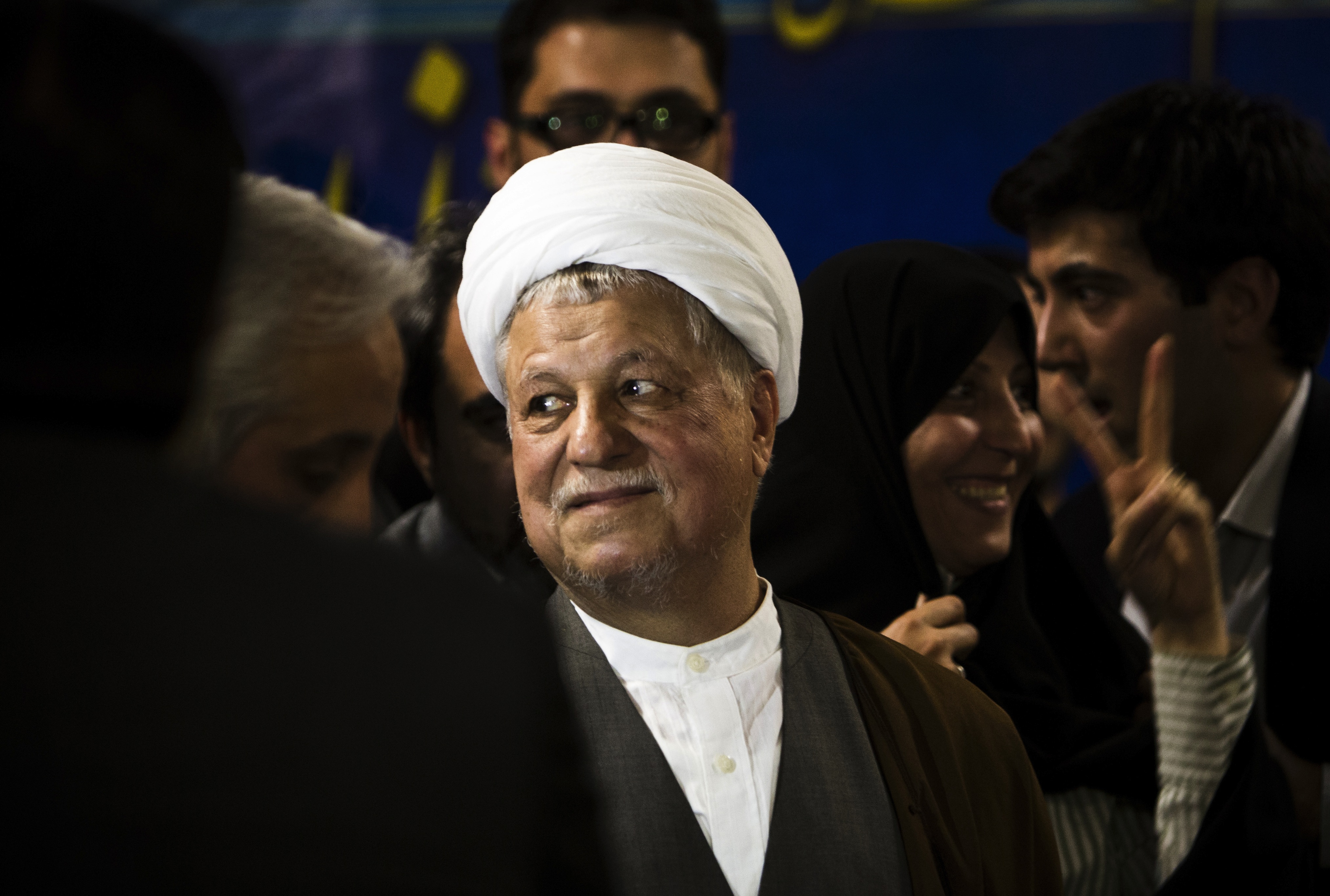
The upcoming presidential election has already taken a dramatic turn, with both former president Rafsanjani and Ahmadinejad-ally Mashaei entering the race over the weekend. Next they will be vetted by the regime’s Guardian Council, along with hundreds of lesser-known candidates. Gary Sick attempts to unpack the political calculus, suspecting the news may indicate waning political influence from Ayatollah Khamenei:

I thought that the Supreme Leader had decided unequivocally that there was to be no repetition of 2009, i.e. no credible individuals challenging the existing system and no mobs in the street with grievances after the vote. He had even talked about eliminating the presidency entirely, in favor of a parliamentary system. … [Mashaei and Rafsanjani entering the race] implies that Khamenei was either unable or unwilling to exercise control of the process or that his objectives were quite different from what we had understood from his observable actions and words. At a minimum, these candidates were willing to put Khamenei in an embarrassing position by publicly ignoring his well-known preferences, apparently without concern for the consequences.

Of course, it is still possible that the Guardian Council will simply disqualify all but the “safe” candidates, despite the past history of leaders like Rafsanjani and their intimate association with both the Leader and the revolution. That would confirm the cynical interpretation of Iran’s leadership after 2009 — that it realized the revolution was dead and there was no need to pretend that it was about anything other than raw power.

Meanwhile, the top reformist candidates from 2009, Mousavi and Karroubi, are still under house arrest and probably won’t play a direct role in this election. What’s left of the reformist camp?

Iran’s reformists have been politically crippled since the disputed 2009 Presidential election, with leading members in prison or under threat of detention, parties banned, and communications disrupted. Curbed in Parliament for almost a decade, they were split over participation in the 2012 Parliamentary elections and won only a small fraction of the vote.

Despite much speculation, a campaign by former President Mohammad Khatami, in office from 1997 to 2005, has not emerged. Khatami’s latest statements ruled out his involvement in the election. In Khatami’s absence, the leading reformist hopeful is Mohammad-Reza Aref, former first vice president under Khatami. Aref said on April 5 that reformists had “boosted their relations” with the Supreme Leader. Mostafa Kavakebian, who presents himself as a leader of the faction in Parliament but who is disliked by many reformists for failing to support the challenge after the disputed 2009 Presidential election, has also declared his intention to stand.

In the current circumstances of regime pressure, neither candidate nor the reformist movement is likely to be of any significance in the race.

So all eyes are on Rafsanjani:

With a month to go before polling day there is plenty of scope for further drama. Observers say one crucial question is whether Ahmadinejad’s controversial former aide – Esfandiar Rahim-Mashaei, who is loathed by Khamenei and his supporters – will be allowed to run. If he is disqualified some believe that the outgoing president, who remains in office, will turn openly on Khamenei – perhaps by spilling the beans on what really happened in 2009 or by refusing to rig the results again. It is also tantalisingly unclear whether Rafsanjani will be a serious candidate or intends rather to play the role of kingmaker.

Farideh Fardi predicts that Rafsanjani’s entry will unleash “an intense battle over the direction of the country”:

Unlike 2005, when Rafsanjani was challenged by both conservatives and reformists, this time he will be coming in with solid support from the reformists.

It is true that the reformists are also a herd of cats, but few doubt [reformer and former president] Khatami’s ability to convince the herd to rally behind Rafsanjani. In fact, most reformist and centrist candidates have already said that they will withdraw if Rafsanjani runs. The exception may be former nuclear negotiator Hassan Rowhani, but, without support from Rafsanjani or Khatami, he will not be a significant candidate anyway. In effect, if Rafsanjani is qualified by the Guardian Council and if he chooses not to back off in favor of another candidate, the conservatives will be facing a centrist/reformist consensus candidate who may even peel away some of their own, particularly the ones in the commercial sector and many in the clerical community in Qom and elsewhere. …

Rafsanjani’s entry into the fray with solid support from Khatami and his followers will force the conservatives not only to scramble for a consensus candidate, but also search for one who is relatively popular or at least better known.

Rodger Shanahan is waiting to see who makes it out of the vetting process:

The fact that these candidates have registered in such dramatic fashion makes for increased interest in the race, but there is no guarantee they will appear on the final ballot. The Supreme Leader wields significant influence over the candidacies, and the the ability of these two men to survive the vetting of the Council of Guardians is anything but assured. Only ten out of 800 hopefuls survived the Council’s deliberations in 2001; in 2005 it was six out of more than 1000.

The economy is the highest priority for most Iranians, and the public’s belief as to whether any of the final candidates can offer some relief in this area will ultimately determine the turnout. The backroom manoeuvrings and positioning of putative candidates is likely to dominate the period until the confirmation of candidates and the three-week election campaign.

At the same time, the Guardian Council may charge Ahmadinejad for illegally endorsing his protegé and chief of staff, Mashaei. For more on the race, head over to Enduring America’s election guide.

(Photo: Former Iranian president Akbar Hashemi Rafsanjani arrives to register his candidacy for the upcoming presidential election at the interior ministry in Tehran on May 11, 2013. By Behrouz Mehri/AFP/Getty Images)

Desperately Seeking An Enemy

David Barash reflects on our primate need for foes and our tendency to be “especially prone to exaggerating them”:

“Whoever lives for the sake of combating an enemy,” wrote Nietzsche, “has an interest in the enemy’s staying alive.” It is reported that at the end of the Third Punic War, after Carthage had finally been destroyed and pillaged, her people killed or enslaved, her land sown with salt, a kind of sadness came over the victorious citizens of Rome, an awareness that with their defining struggle behind them, they would never be the same.

All too often, nationhood, or even selfhood, is defined by one’s opponents. Imagine: Ahab without Moby Dick, the Hatfields without the McCoys. As each has been defined by the other, enmity has subtly been transformed into dependence. If Moby Dick had died of old age, or in the sweet embrace of a giant squid, or by someone else’s harpoon, Ahab would probably have mourned rather than celebrated. But Ahab was a fictional character, while the rest of us­—and our enemies—are very real. Equally real is the fact that sometimes these enemies go away, leaving us frustrated, empty, and strangely alone.

This is especially true about Americans and terrorism. The reaction to the home-grown pressure-cooker bombs by two losers in Boston reveals the degree of the 9/11 PTSD the country is still reeling from. And the panic and hysteria doesn’t actually help the war on Jihadist terror. We gave the Tsarnaev brothers what they craved: full metal media orgasm. They may have killed three people in a horrifying attack – but it led to saturation coverage (yes, we joined in) and to the publicity post-Qaeda Jihadists live for.

In that sense, Pete King is as big an unwitting recruiter for Jihadist terrorism as he was a very witting supporter of Irish terrorism against innocent civilians. He once gave mass-murderers money; now he gives them publicity. What we haven’t yet figured out is that once we have disabled the organized terror groups like al Qaeda, the best thing we can do with rogue Jihadists is to treat them with withering contempt.

At times, many Republicans like King almost seem unconsciously to want there to be another 9/11 – to justify their inability to move past that event.

And so they unwittingly go apeshit over any hint of terrorism – from Fort Hood to Benghazi – as if merely calling it that will do anything but help the terrorists gain publicity and attention. I’m not saying we shouldn’t cover these attempts at mass murder or fail to call them what they are; I’m saying we should also put them in better perspective. Take what happened over the weekend in New Orleans. A Mother’s Day parade, of all things, was assaulted by three men with guns. Nineteen people were injured including two children. If there’s a definition of terror, it would be attending something as routine as a parade and find it turning into a potential bloodbath. And yet, this news is nothing compared to what it would be if the perpetrators were Jihadists.

It’s that disproportion that troubles me – because it gives terrorists more incentives. Sometimes the best way to defeat terrorists is both to prevent them by law enforcement, surveillance, etc, as we are doing, but also to ignore them when necessary, to refuse to change our way of life (like putting an entire city under curfew), and to be less afraid of the boogeyman.

And the point of this kind of strategy is to hit terrorists where it truly hurts: the oxygen supply of hysterical reaction and coverage. I have not changed my mind about the seriousness of the threat of religiously-inspired terror. But I have changed my mind about how best to defeat them. As a country, we began the journey back from Cheneyism in the last years of Bush. Obama has done a huge amount to both defeat the Jihadists and to defuse their message. But the rest of us need to do more.