A reminder that the Dish is seeking a personal assistant – full details here. All applications are due by next Monday, May 13.
Intervene In Syria? Just Say No, Ctd
Fareed Zakaria is, as usual, a sane voice in the escalating crisis:
Would U.S. intervention–no-fly zones, arms, aid to the opposition forces–make things better? It depends on what one means by better. It would certainly intensify the civil war. It would also make the regime of Bashar Assad more desperate. Perhaps Assad has already used chemical weapons; with his back against the wall, he might use them on a larger scale. As for external instability, Landis points out that if U.S. intervention tipped the balance against the Alawites, they might flee Syria into Lebanon, destabilizing that country for decades. Again, this pattern is not unprecedented. Large numbers on the losing side have fled wars in the Middle East, from Palestinians in 1948 to Iraq’s Sunnis in the past decade.
If the objective is actually to reduce the atrocities and minimize potential instability, the key will be a political settlement that gives each side an assurance that it has a place in the new Syria. That was never achieved in Iraq, which is why, despite U.S. troops and arms and influence, the situation turned into a violent free-for-all. If some kind of political pact can be reached, there’s hope for Syria. If it cannot, U.S. assistance to the rebels or even direct military intervention won’t change much: Syria will follow the pattern of Lebanon and Iraq–a long, bloody civil war. And America will be in the middle of it.
Anyone who wants to insert the US into such a bloody, violent, increasingly sectarian civil war needs his or her head examined. We couldn’t control or even understand one while we were occupying Iraq – and, as Fareed notes, scores of thousands were murdered under our very noses, with millions of refugees. An entire country is afflicted with communal PTSD of the most severe kind. Last month, the deaths in Iraq’s continuing civil war reached a post-occupation record of 700. And that’s after we invaded, occupied and tried to set up a non-sectarian government. What are the odds we can guide yet another sectarian civil war from the skies?
Brent Sasley claims that the recent Israeli strikes on Syria can succeed where the US can’t because their goals are pragmatic and limited:
[Israel’s] goal is to prevent weapons and technology from reaching its primary enemy in this specific arena, namely, Hezbollah (the Syrian military is no match for Israel). It doesn’t see itself as responsible for everything else, including interfering in the succession process being played out so violently, protecting civilians from the horrific atrocities being committed against them, and influencing the outcome of the civil war and, from there, the region. All this is reserved for later consideration or others to deal with. Jerusalem defines its responsibilities, rather, as its immediate security needs and the near-term future effects of its actions. Washington’s abilities are much greater, its goals are much broader, and its responsibilities are much bigger. Comparing Israel to the US under these conditions isn’t helpful for understanding America’s actions thus far or its capabilities for doing more.
Michael Koplow agrees – and goes further:
[T]o those who incessantly insist that Israel is of absolutely no strategic worth to American interests and is nothing but an albatross around the neck of the U.S., I’d submit that having the Israeli military around to prevent transfers of Iranian-furnished weapons to Hizballah and to make sure that Assad’s delivery systems for chemical weapons also stay right where they are, all while battlefield-testing American weapons in the process, is pretty useful right about now.
Justin Logan adds that “only a terrifically secure country could have as poor and astrategic a debate about war as the one we’re having” on Syria:
In fairness to [liberal hawks], they are carrying the torch of a time-honored American tradition of foreign policy thinking. Historically, debates over foreign intervention in the United States have featured liberal analysts against realists and the military. In the 1950s, President Eisenhower reportedly had to admonish his activist Secretary of State John Foster Dulles to calm down: “Don’t do something, Foster, just stand there!”
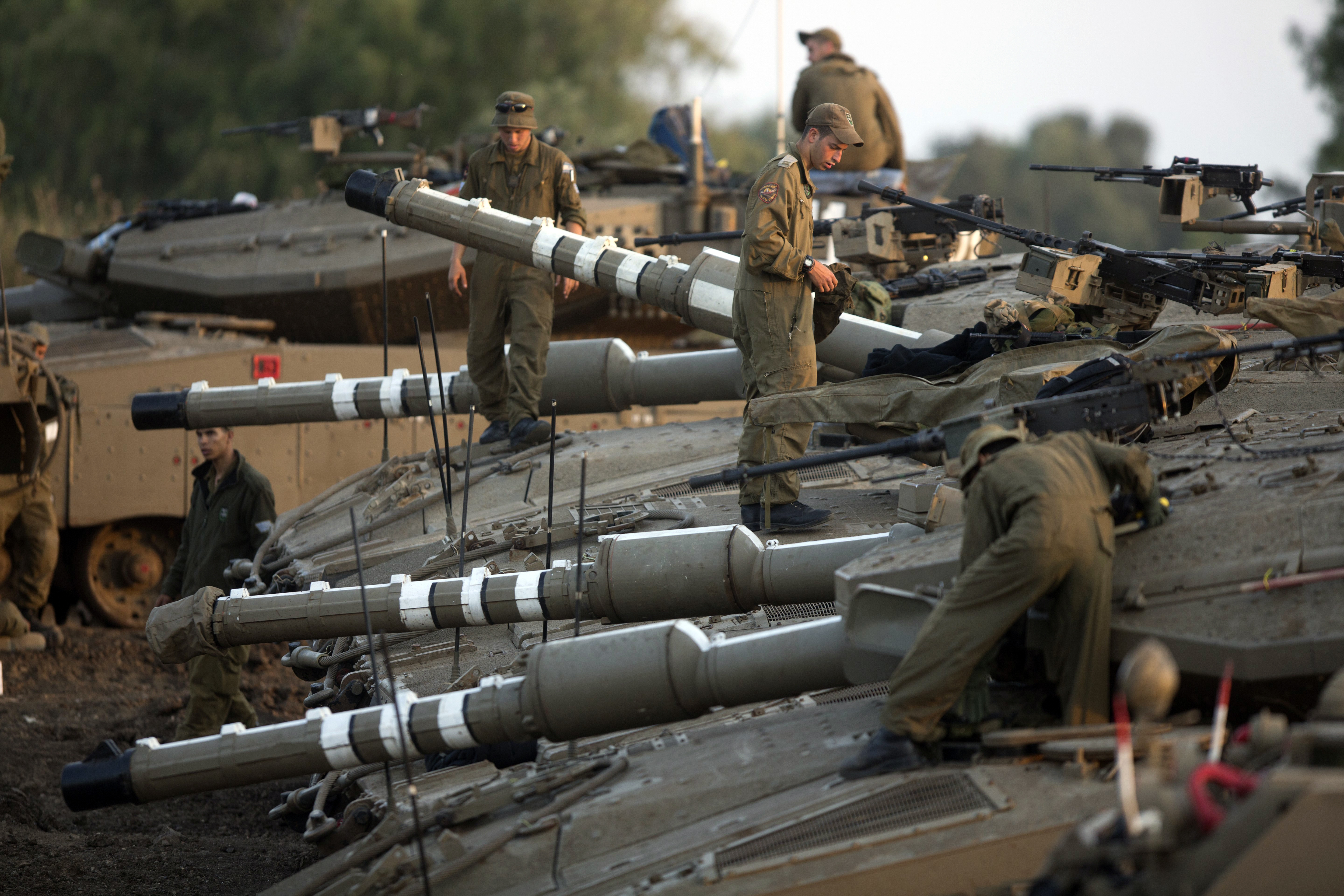
(Photo: Israeli soldiers walk on the top of their Merkava tanks deployed in the Israeli annexed Golan Heights near the border with Syria, on May 6, 2013. UN chief Ban Ki-moon has appealed for restraint after Israeli air strikes on targets near Damascus which prompted Syrian officials to warn ‘missiles are ready’ to retaliate. By Menahem Kahana/AFP/Getty Images)
Marriage Equality Update
The tide keeps coming in: the Minnesota House has now scheduled a floor debate on legalizing civil marriage for gay couples. And the omens look good:
House Speaker Paul Thissen has said that the bill would not be brought to a vote unless they had secured the 68 votes that would be needed to pass the legislation. A number of DFL lawmakers representing districts that supported last fall’s proposed constitutional amendment to ban gay marriage have voiced their support of the marriage equality bill in recent weeks.
The governor has said he will sign the bill and the Senate is regarded as friendlier toward it than the House. Delaware looks set to legalize marriage equality today – following Rhode Island. That would be three more states in a few weeks.
A Keynesian For Now
The economics debate in this country these past few years is almost a microcosm of the problem with  ideological politics. In response to the worst recession since the 1930s, the right immediately rejected Keynes’ core analysis of the Great Depression and turned any idea of stimulus or spending and borrowing to tackle the recession into a gloom-ridden, terrifying harbinger of hyper-inflation and insurmountable debt. The zero House votes for the Obama stimulus reflect that rigid lockdown of the mind. We know where this aversion comes from – the misappropriation of Keynesian emergency economic management as a general theory of full employment and growth in the 1960s and 1970s. And there is a strong argument that misreading Keynes in that era of hubristic liberalism was indeed an error that needed a correction.
But that doesn’t rebut Keynes’ central claim about our current predicament: that in a liquidity trap, austerity is counter-productive and fears of inflation are over-blown. Bartlett:
The core insight of Keynesian economics is that there are very special economic circumstances in which the general rules of economics don’t apply and are, in fact, counterproductive.
This happens when interest rates and inflation are so low that there is no essential difference between money and bonds; money, after all, is simply a bond that pays no interest. When this happens, monetary policy becomes impotent; an increase in the money supply has no stimulative effect because it does not lead to additional spending by consumers or businesses.
This is not an eternal ideology – determined as “on the left” and therefore impermissible on the right or center. It’s a specific analysis of a specific problem, which happens to be where we are now. A true conservative would throw ideology aside and look at the real world. Which is the difference between today’s GOP and a genuine conservative, like Bruce. I’m not a Keynesian for ever. But I am a Keynesian for now.
Is Israel Moderating?
The evidence is both an attempt to patch things up a little with Turkey and a temporary, quiet but still welcome lull in settlement approvals. Obama seems involved in both.
Where No Humans Have Gone Before

The atmospheric carbon dioxide reading taken at the Mauna Loa observatory in Hawaii is expected to reach 400 parts-per-million this week. Andrew Freedman puts that number in its historical context:
The news that CO2 is near 400 ppm for the first time highlights a question that scientists have been investigating using a variety of methods: when was the last time that CO2 levels were this high, and what was the climate like back then? There is no single, agreed-upon answer to those questions as studies show a wide date range from between 800,000 to 15 million years ago. The most direct evidence comes from tiny bubbles of ancient air trapped in the vast ice sheets of Antarctica. By drilling for ice cores and analyzing the air bubbles, scientists have found that, at no point during at least the past 800,000 years have atmospheric CO2 levels been as high as they are now.
That means that in the entire history of human civilization, CO2 levels have never been this high.
This is a new era – in which humanity has the power to change the entire climate of the planet so that it is more clogged with carbon than at any time since homo sapiens took dominion. This is the mark of dystopian science fiction – except that it’s real, and apparently unstoppable. What right does one species have to change the world’s climate so structurally it will destroy countless other life-forms? Greg Laden reminds us nonetheless about the seasonal variations in CO2 levels:
There is a lot more land in the Northern Hemisphere that goes through a dramatic cycle in plant activity, with most plants playing (or even being) dead over the winter and springing to life in the Spring. The Southern Hemisphere has much less land. So a small amount of CO2 moves into the atmosphere over the Northern Hemisphere winter and into spring, and then moves back into newly grown plant tissue during the northern growing season.
So, right now, CO2 should be at a short term peak. The range of this variation is around 8 ppm, so if we hit, say, 401 ppm next week, expect that value to go back below 400 ppm in a few weeks. In other words, we can and should note that we are probably hitting the 400 ppm barrier, but then later when we drop slightly below, temporarily, 400ppm, the climate science denialists will be all over that claiming that there is no global warming. Cuz they’re morons. In a few years … certainly by the end of the present decade …. the low values will be over 400 ppm unless something dramatic happens.
The Euro On Life Support?
One of the currency’s core German founders, Oskar Lafontaine, is getting gloomier:
“The economic situation is worsening from month to month, and unemployment has reached a level that puts democratic structures ever more in doubt … The Germans have not yet realized that southern Europe, including France, will be forced by their current misery to fight back against German hegemony sooner or later.”
The very language speaks of the scale of the problem, as the German economy is now faltering as well. In Britain, the fringe right United Kingdom Independence Party or UKIP just proved in local elections that it is less fringe than David Cameron would like. It won more than 25 percent of the national vote. Cameron recently promised a national referendum on whether to stay in or get out – the first such vote since 1975. This is an excruciating parliamentary exchange.
Now comes Thatcher’s former Chancellor, Tory grandee Nigel Lawson, to argue that Britain should leave the EU entirely:
“I think that, if the thing is on balance good for the economy – which I believe it is; this was not something I just did off the cuff, this was something to which I had given a great deal of thought over a very long time, and I’ve no doubt that it’s good for the economy. If it’s good for the economy, then of course it’s good for jobs.”
The centrifugal forces in Europe now appear stronger than those holding it all together. And with each year of extra austerity, they grow stronger.
Printing Your Own Handgun, Ctd
The first 3-D printed gun, christened “The Liberator” by its developer, Defense Distributed, just debuted:
The weapon is crude and can potentially explode, and it’s still a work in progress, Wilson tells Danger Room at a small workshop in Austin, Texas — the inside mostly taken up by a used $8,000 Stratasys Dimension SST 3-D printer, which produced the gun. “The design is based on two to three features that worked first. We had been testing barrels for almost two months, and we used the barrels and ABS that worked,” he says, referring to the type of thermoplastic material used by the machine. “We used 60 to 70 different springs, not all separate designs, but just trial and error. We cannibalized a spring off a toy on Thingiverse, a wind-up car toy.”
Now come the legal questions:
On Sunday, Sen. Charles Schumer of New York became the most prominent lawmaker to call for banning 3-D printed handguns.
“Guns are made out of plastic, so they would not be detectable by a metal detector at any airport or sporting event,” Schumer told reporters on Sunday. “Only metal part of the gun is the little firing pin and that is too small to be detected by metal detectors, for instance, when you go through an airport.”
The senator also proposed updating the Undetectable Firearms Act of 1988 — which bans guns that can defeat airport security metal detectors — to include printable gun magazines. Defense Distributed has a federal firearms manufacturers license, which Wilson sought after being questioned by the Bureau of Alcohol, Tobacco and Firearms in 2012. That was shortly after a 3-D printer Wilson had rented was seized by its manufacturer over worries he’d violate the Undetectable Firearms Act. The law, which is set to expire this year, exempts licensed manufacturers to produce plastic guns for use as a models and prototypes.
Previous Dish coverage of the printed handgun here and here.
A Neglected High-Risk Group
Pamela Collins, a Director at the National Institute of Mental Health, points to an under-acknowledged fact about HIV:
People with severe mental illnesses have a much higher prevalence HIV infection in the United States. Yet, this is not a population that we usually hear about in public health efforts to prevent HIV and care for people with HIV. But the risk for HIV infection is not solely a high-income country phenomenon. Studies from sub-Saharan Africa also show a high prevalence of HIV infection among people hospitalized in psychiatric facilities. This population also has higher rates of mortality and earlier mortality from non-communicable diseases.
Confessing Through Song, Ctd
A reader writes:
It’s been a long time since I attended a country concert, but when I was growing up in South Carolina, it was standard practice on all country radio and TV shows to sign off with a gospel number. It was just expected. There was a ton of hypocrisy; I know for a fact that a popular local gospel quartet kept its tour bus well stocked with Jack Daniels. This isn’t to put down George Jones; he really was the greatest, and the loss of that voice is a loss indeed. It’s just to point out that there’s a lot of ritual to the Saturday Night/Sunday Morning pattern of country music.
From Ian Crouch’s recent tribute to the country legend:
Jones’s songs lifted country-music aphorisms to a kind of high art, and his life and now death seem to demand aphorism as well, something blunt and simple like: George Jones was an imperfect man with a perfect voice. …
The stories of Jones’s drunken antics are legion, and while their hard-living, hard-loving particulars might inspire a bit of awe (and gave him cred with rock and punk artists), just ask the women in his life what it was like to live with him. Yet, even in some of his lowest personal moments, Jones created great, signature music. He recorded “Bartender’s Blues,” written by James Taylor, in 1978. His rendering of the chorus, with its “four walls around me to hold my life,” may be the best expression of his incredible vocal gifts—despair and joy fighting out their eternal battle.
The recording sessions for “He Stopped Loving Her Today” took a long time, and were contentious. Jones was capricious and unreliable—other words for saying that he was a drunk. He never liked his nicknames. “Possum” disparaged his middling looks. “No Show Jones” impugned his reliability and professionalism. Both were unkind, and both were deserved. He idolized Hank Williams, and it seemed like he was bound to follow him to an early grave. Yet “He Stopped Loving Her Today” was a hit, and three years later, at rock bottom, Jones quit the drinking and drugs, and lived on for three more decades, making music, recording too many albums, lending his golden voice to innumerable duets. He was Nashville royalty, name-checked by every young country singer with any sense.
He’d been married to his fourth wife, Nancy, for those thirty years. In the end, he wasn’t the lonely, regretful man in his most famous song.
“She’s My Rock”, seen above, was released shortly after marrying Nancy. “He Stopped Loving Her Today” can be heard here.

