Corporate Inequality

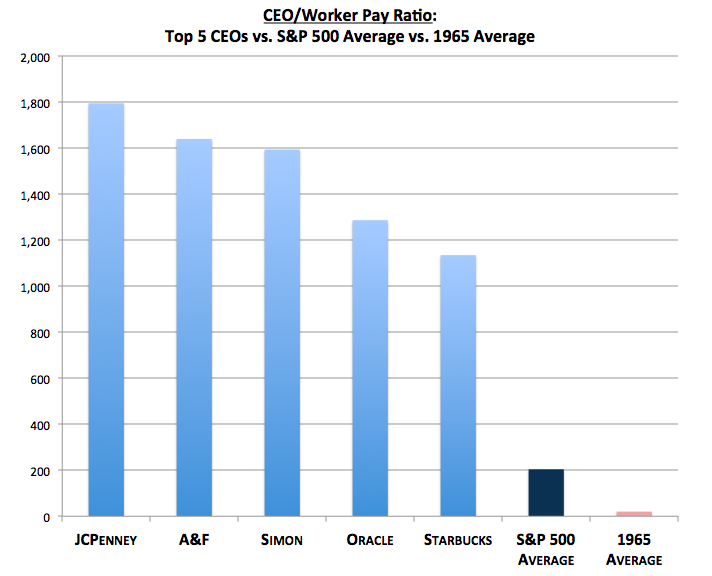
Derek Thompson charts “the five companies with the highest CEO/worker pay ratio compared with the S&P average and the 1965 average among the 350 largest companies”:

CEO Pay

Why the ratio is growing:

First, it’s important to see how the ratio is being stretched on both ends. At the bottom, you have the slowing growth in market wages for middle- and lower-class work (like JC Penney salesperson or Starbucks barista). At the top, you have the acceleration of stock returns for public companies the 1990s and 2000s, which has fattened up executive compensation.

Second, a famous 2005 paper “The Growth of Executive Pay” suggests other reasons to explain why boards of directors are paying CEOs so much. (“Pay has grown much beyond the increase that could be explained by changes in firm size, performance, and industry classification,” they write.) Their most compelling idea is that bull markets don’t merely encourage more equity-based compensation; they also make shareholders less likely to kick and shout when executives pull down one-year pay packages many hundreds of times more than their average workers. In other words, bull markets make CEOs fabulously wealthy, and they make shareholders indifferent to their fabulous wealth.

The Appeal Of “Progressive Libertarianism”

Edward Glaeser notes that “almost 59 percent of air travel is done by those in households earning more than $100,000 a year” and that “these wealthier Americans fly 10 times more than people in households earning about $50,000 annually.” He therefore sees no reason for taxpayer revenue to fund air-travel:

Sometimes we can make society fairer if the public sector spends less, a policy of progressive libertarianism. Making the FAA and TSA independent entities responsible for funding themselves by charging air passengers would reduce the overall deficit and economic inequality simultaneously. Moreover, as last week’s delays suggest, a shift to independent funding could help the passengers themselves, even if they pay higher costs. User fees could be used to reduce congestion in airport lines and to improve the overall flying experience.

The Daily Wrap

heartshoodies

Today on the Dish, Andrew praised Rhode Island’s marriage equality bill for its solid balance of religious and civil liberty, puzzled over the GOP’s ongoing impotence on climate change, and cautiously noted a new report on the Tsarnaev story in the Mail (with good reason). Later on, he scrutinized the racy SEO strategies of digital media, tipped his hat to the NYT in light of their latest numbers, recoiled at Target’s fluorescent dystopia, and went shopping for hockey beards.

In political news and views, Nate Silver illustrated the GOP’s demographic transformation into a regional party while Douthat summed up their beef on healthcare and Sean Trende downplayed the effect of the civil rights era on the South’s Republican turn. Tim Murphy rounded up the local effects of sequestration across the nation, we followed up on the Obama administration’s conflicted stance on Gitmo, and Radley Balko sent a dispatch from a town in Arizona allowing civil unions. We revisited the road not taken on Bush v. Gore, took note of gun adverts geared toward kids, and readers asked Josh Fox if we may need fracking after all.

Elsewhere, Alix Spiegel explored the influence big brothers like Tamerlan Tsarnaev can have on their younger siblings, Mac McClelland examined the state of mental illness treatment in America, and we attempted in vain to untangle contradictory conspiracy theories. We surveyed the Arab world’s feelings on Mideast media and squared Vietnam’s strong record on gay rights with its poor human rights record overall as Charles Kennedy searched for a global income floor. Meanwhile, IBM harnessed cell phone data for a better public transport system and readers sounded off on small town drug addiction.

In assorted coverage, Paul Miller stepped back into the web after a year of self-deportation, we workshopped sex in Palestine, and readers offered their own tips on the subject of condoms and their discontents. We browsed galleries of more Wal-Mart and Target art, picked up on the little quirks of literary greats and spotlighted a barnyard Kickstarter worth your time. Patrick West pined for the album art of old, novelist Ben Greenman praised the paintings of Amy Bennett and Hugo Macdonald wrote in favor of small living space. We questioned the value of keeping cursive, writhed around to some hot, hot hathos and gazed out at a snowy Yankton, South Dakota in the VFYW.

–B.J.

Losing The Language For Sex

An illuminating anecdote from Shereen El Feki, author of Sex and The Citadel:

Safa Tamish, a sex educator who works with Palestinians in Israel, told me that when she runs workshops, participants will use min orali (Hebrew for “oral sex”) and orgazma instead of the respective Arabic terms, jins fammii and nashwa jinsiyya. Even more-basic terminology is problematic; until attending these courses, some participants are unaware that there are, indeed, Arabic words for female genitalia, having been taught to consider such subjects shameful beyond discussion.

This is a far cry from the golden age of Arabic writing on sex. One medieval book, The Language of Fucking, mentions more than 1,000 verbs for having sex.

Previous discussion of the book here.

Vietnam’s Gay Movement

It’s become wildly successful:

Marginalized only a few years ago, the LGBT community is not only finding support in the legal sphere but has been winning broad acceptance in the media and in public life. From Vietnam’s first gay parade last August in Hanoi to an openly transgender contestant on last season’s Vietnam Idol (an American Idol franchise), it’s as if the closet door has exploded off its hinges. International attention grew in February of this year when Vietnamese photographer Maika Elan won a World Press Photo Award for her series The Pink Choice, documenting the lives of Vietnamese gay couples. … Perhaps the best example of the mainstreaming of the LGBT community is the Youtube-based sitcom My Best Gay Friends, which has become a legitimate viral hit in Vietnam, often garnering more than one million views per episode.

Sample of the show seen above. However, the progress for gays in Vietnam is not seeing corresponding progress for human rights in the country:

[I]t’s slightly ironic that a country with an “abysmal human rights record,” according to Human Rights Watch, is simultaneously a leader in the region in advancing gay rights. HRW’s 2013 World Report singles Vietnam out for repression of political dissent, curtailing freedom of expression and religion, and lack of an independent judiciary. It’s a bit like coming home with four Fs and one A+ on your report card. Clearly, gay rights are not seen as a serious threat to anyone in power. Whether the issue remains compartmentalized or if there will be some kind of spillover into other areas of human rights will be interesting to watch. But for now, the march towards LGBT equality is starting to feel inevitable.

Previous Dish coverage of gay rights in Vietnam here.


The Influence Of Culture

Marc Bellamare thinks economists take an overly simplistic view of it:

Economists are generally suspicious of explanations for behavior relying on culture. This likely stems from the fact that individual rationality, whose twin assumptions of completeness and transitivity constitute the cornerstone of economics and of much of modern social science, are not context-dependent. The typical economist’s skepticism regarding culture as an explanation for behavior also stems from the fact that most economists fundamentally believe a human being is a human being the world over, and only economic circumstances change to provide a different set of incentives, which themselves explain variations in behavior.

He disagrees, pointing to a study on UN diplomats and parking violations as evidence:

[B]efore 2002, when UN diplomats did not have to pay their parking tickets, a Bangladeshi diplomat, … acting like a textbook homo economicus, would almost never pay her parking tickets. But surprisingly, a Finnish diplomat, acting completely unlike homo economicus, would almost always pay his parking tickets. In other words, diplomats would “import” their cultural norms vis-à-vis corruption.

The Smell Of Inspiration

schiller

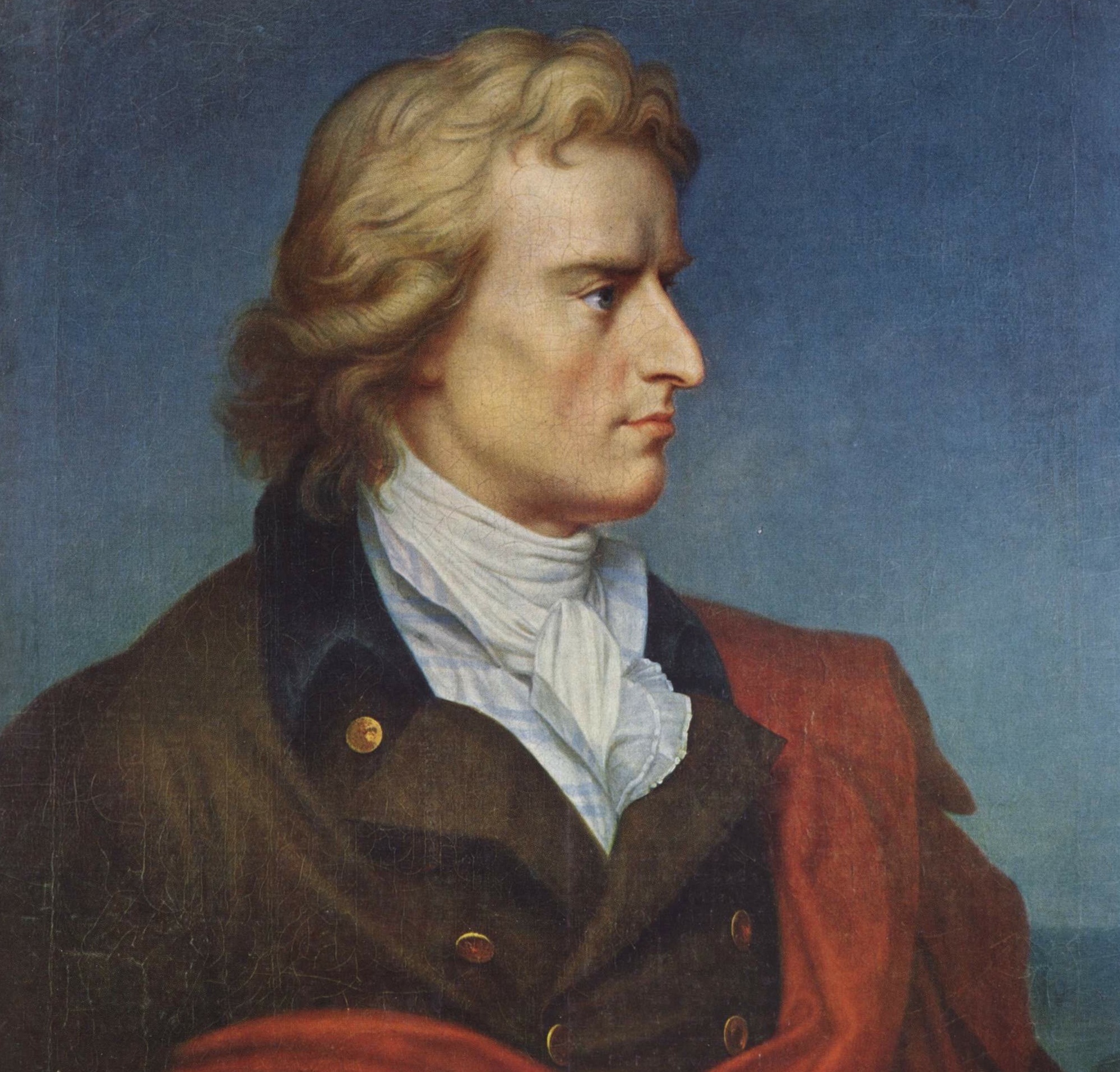
Emily Temple compiles a list of literary figures with strange obsessions. Here’s her entry for the German poet and philosopher Friedrich von Schiller:

Friedrich von Schiller kept fruit flies. Rather, he put rotten apples under his desk to inspire him with memories of the orchards of his youth. When he faltered for the right word, he took a quick sniff, and it materialized.

(Portrait of Schiller by Gerhard von Kügelgen, via Wikimedia Commons)

Should We Kill Cursive?

Morgan Polikoff nods:

Cursive should be allowed to die. In fact, it’s already dying, despite having been taught for decades. Very small proportions of adults use cursive for their day-to-day writing. Much of our communication is done on a keyboard, and the rest is done with print. Additionally, there is little compelling research to suggest the teaching of cursive positively affects other student skills enough to merit its teaching. While both research and common sense indicate students should be taught some form of penmanship, there is simply no need to teach students both print and cursive.

Kate Gladstone is on the same page:

Reading cursive matters, but even children can be taught to read writing that they are not taught to produce. Reading cursive can be taught in just 30 to 60 minutes — even to five- or six-year-olds, once they read ordinary print. Why not teach children to read cursive, along with teaching other vital skills, including a handwriting style typical of effective handwriters?

Off-Grid For A Year

photo

Technology writer Paul Miller returns from a year of self-imposed Internet exile, which was designed to improve his life and initially did the trick:

I lost 15 pounds without really trying. I bought some new clothes. People kept telling me how good I looked, how happy I seemed. In one session, my therapist literally patted himself on the back.

I was a little bored, a little lonely, but I found it a wonderful change of pace. I wrote in August, “It’s the boredom and lack of stimulation that drives me to do things I really care about, like writing and spending time with others.” I was pretty sure I had it all figured out, and told everyone as much. As my head uncluttered, my attention span expanded. In my first month or two, 10 pages of The Odyssey was a slog. Now I can read 100 pages in a sitting, or, if the prose is easy and I’m really enthralled, a few hundred. …

Without the retreat of a smartphone, I was forced to come out of my shell in difficult social situations. Without constant distraction, I found I was more aware of others in the moment. I couldn’t have all my interactions on Twitter anymore; I had to find them in real life. My sister, who has dealt with the frustration of trying to talk to me while I’m half listening, half computing for her entire life, loves the way I talk to her now. She says I’m less detached emotionally, more concerned with her well-being — less of a jerk, basically.

But the catharsis didn’t last:

When I stopped seeing my life in the context of “I don’t use the internet,” the offline existence became mundane, and the worst sides of myself began to emerge.

I would stay at home for days at a time. My phone would die, and nobody could get ahold of me. At some point my parents would get fed up with wondering if I was alive, and send my sister over to my apartment to check on me. On the internet it was easy to assure people I was alive and sane, easy to collaborate with my coworkers, easy to be a relevant part of society. So much ink has been spilled deriding the false concept of a “Facebook friend,” but I can tell you that a “Facebook friend” is better than nothing. My best long-distance friend, one I’d talked to weekly on the phone for years, moved to China this year and I haven’t spoken to him since. My best New York friend simply faded into his work, as I failed to keep up my end of our social plans.

My plan was to leave the internet and therefore find the “real” Paul and get in touch with the “real” world, but the real Paul and the real world are already inextricably linked to the internet. Not to say that my life wasn’t different without the internet, just that it wasn’t real life.