The Tweet Heard Round The Markets

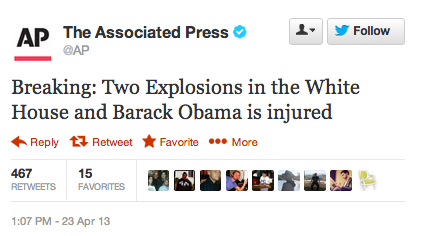
Hackers infiltrated the AP’s account this afternoon and deployed this:

BIjUoKVCAAA9_kO

Supporters of the Syrian dictator have claimed responsibility. While no news outlets took the tweet seriously, Wall Street did momentarily:

U.S. stocks and the dollar briefly plunged Tuesday afternoon and U.S. Treasury bonds and gold prices soared, after a tweet from the Associated Press’s Twitter account claimed that there were two explosions in the White House and that President Barack Obama had been injured.

Screen Shot 2013-04-23 at 3.26.35 PM

Markets quickly swung back after the Associated Press said on its corporate website that its account had been hacked. The White House confirmed that there had been no incident. The Dow Jones Industrial Average dropped 145 points between 1:08 p.m. EDT and 1:10 p.m., following the erroneous tweet. Stocks soon recovered, regaining broad gains that put the major benchmarks on track for a third day of gains.

Observers said the episode highlights the growing use by players in financial markets of social media such as Twitter and Facebook, FB +0.15% and underscores the dangers of security breaches at a time when many investors are quick to trade on news.

Julianne Pepitone zooms out:

News organizations are a particularly attractive target thanks to their reach and influence.

The Twitter accounts of CBS’ (CBS, Fortune 500) 60 Minutes and 48 Hours were compromised over the weekend. In July 2011, News Corp.’s (NWS) Fox News account — followed by more than 2 million people — was hacked and tweeted that President Obama had been assassinated. That same month, eBay’s (EBAY, Fortune 500) PayPal United Kingdom Twitter feed was hacked, and the profile photo was changed to a pile of excrement. Comcast’s (CMCSA) NBC News account was also compromised two months later, falsely tweeting that a plane had crashed into the Ground Zero area of Manhattan. In February of this year, both the Burger King (BKW) and Jeep Twitter accounts were hacked during the same week. …

After years of hacks that typically involved little more than obscene language, Twitter’s subpar security measures have now caused serious real-world consequences. Many hacks happen when account owners use guessable passwords or access Twitter over public Wi-Fi and shared computers. If one person who tweets from a corporate account loses his or her phone, an entire corporation’s Twitter account could be at risk.

(Chart of today’s Dow from Google)

The Cuts Begin To Sting

Jonathan Cohn checks in on the sequester:

The Bipartisan Policy Center has called it a “slow-motion train wreck” that would deprive the economy of about a million jobs over two years. That prediction is broadly consistent with other forecasts, by such independent experts as Macroeconomic Advisers and the experts at the Congressional Budget Office. And it’s not like the recovery is strong enough to absorb such a hit easily.

But will voters link slower growth—and fewer jobs—to the sequester? Will they ask why it’s a better alternative than the budgets President Obama and the Democrats have proposed—budgets that would undo the cuts and make up some of the difference through higher taxes on the wealthy? And will lobbyists for affected industries, from medicine to defense, force Congress to pay attention to them? So far, the answer to all three questions has been “no,” to the surprise of many (including yours truly). That means the sequester cuts going into effect now, for this fiscal year, are likely to stay in place.

Why the political calculus may start to change:

Flights were delayed by up to two hours across the country on Monday, the first weekday that the nation’s air traffic control system operated with 10 percent fewer controllers. Pilots, gate agents and others were quick to blame furloughs caused by mandatory across-the-board budget cuts, but the Federal Aviation Administration said it was too soon to tell.

A Truther For Every Tragedy

Spencer Ackerman notices the instant emergence of claims of the Tsarnaevs’ innocence and a cover-up in Boston:

The #freejahar hashtag on Twitter is about what you’d expect after the most highly publicized manhunt in the country. It’s a mix of conspiracy theories, sympathy for Tsarnaev and skepticism of the official narrative surrounding the 19-year old’s arrest. Much of it is consumed with an effort to crowdsource Tsarnaev’s exoneration, pointing to photos from the scene and speculating about them — similar to what took place on 4Chan and Reddit to hunt the bombing perpetrators.

“He’s fucking innocent. If he were “guilty”, it wouldn’t take this long to fucking prove it, and there would actually be evidence,” says one supporter, although the government has yet to charge the incapacitated, hospitalized Tsarnaev with a crime.

Meanwhile, in contrast, the anti-American extremists are laying low:

[Online extremism researcher Jarret] Brachman and others believe that the unclear motivations of the bomb suspects place a damper on the online jihadi forums’ ability to claim Boston as a success. That’s despite the mystique of the young Tsarnaev nearly escaping a huge Friday manhunt; and, if he is proven to be one of the culprits, the ability to construct bombs that killed three and wounded over 180. But the U.S. government has to be similarly cautious about how to combat any popular mythos, like the hashtags, developing around Tsarnaev.

“We are dealing with conspiratorially minded individuals who don’t believe anything the government says anyway,” says Thomas Hegghammer, a terrorism researcher at Stanford University. “The simplest and most effective strategy is probably to highlight the suffering caused by the bombs. Let them see the injured women and children. The most hardcore extremists won’t care, but some fence-sitters might.”

What Threatens Immigration Reform?

Delays:

Hill staffers involved in the 2007 immigration fight recall the overwhelming consensus that appeared to greet the bill — President George W. Bush and Sen. Ted Kennedy and Sen. John McCain! — and attribute the law’s eventual defeat to the effort, mounted by Sen. Jeff Sessions and others, to slow it down, mobilize the conservative grassroots, and use unpopular or divisive parts to undermine the once-unstoppable whole. That will be the strategy this time, too.

Chait keeps an eye on Boehner:

The main question is whether a bill that passes the Senate, which seems highly probable, can get a vote in the House. If it does, it can probably pass, with mostly Democratic votes and a handful of Republicans. Will Boehner let that bill come to a vote? Costa quotes a Republican insider, who tells him, “All of the conservatives, they think they have frozen Boehner; he’s in their pocket.” On the other hand, the pro-reform contingent thinks he will allow a bipartisan vote. Roll Call reports, “Even while they say there is no explicit commitment from Boehner, members and aides who are part of or close to the bipartisan group seem to have confidence, even cockiness, that Boehner secretly has their back.”

Dismembering Liberal Bullshit On Islam

Bill Maher backs me up. I’m not Islamophobic; I’m trying to tell the truth and understand what happened last week. A reader chimes in:

Here’s a quote from Tocqueville, in Democracy in America:

Muhammad brought down from heaven and put into the Koran not religious doctrines only, but political maxims, criminal and civil laws, and scientific theories. The Gospels, on the other hand, deal only with the general relations between man and God and between man and man. Beyond that, they teach nothing and do not oblige people to believe anything. That alone, among a thousand reasons, is enough to show that Islam will not be able to hold its power long in ages of enlightenment and democracy, while Christianity is destined to reign in such ages, as in all others.

This is a parallel point to the question of violence, or at least Tocqueville is not directly addressing the issue of violence, but it’s not hard to make the connection. Politics is a realm of coercion; the state has a monopoly on violence, as we’re taught in introductory political science courses. Jesus opts out of that whole system. He never sought political power. He never was a law-giver. He founded no political regime. He claimed no direct authority over any land or people. Indeed, he was sacrificed at the hands of the reigning political power.

Tocqueville’s point is that because Jesus was in this sense apolitical (along with not pronouncing on matters of science), Christianity has no intrinsic reason to be in conflict with modernity.

Because Jesus laid down no precise pattern for political order, it need not fear the coming of democracy. Because Jesus taught love, rather than scientific theories, nothing Jesus said contradicts what we know through the advance of science. Followers of Jesus, for Tocqueville, can adapt, can engage the age in which they live with a certain openness, rather than hunker down with rage and suspicion. He thought that this wasn’t the case for Islam, not because it was intrinsically violent (neither he nor you are arguing for that) but because the circumstances of Islam’s founding set in motion certain problems that were bound to be exacerbated by modernity.

It always is difficult, even foolish, to draw a straight line from the origins of a religious tradition to contemporary events. But it also is a mistake to pretend a religion’s point of departure matters not at all. For Christians, however hypocritically or poorly they follow Jesus, the witness of Jesus in the Gospels really is a rebuke to violence and political striving. It always is there as a corrective, and throughout Church history, however corrupt Christian institutions have become, Jesus’s life has inspired movements of renewal and repentance. That is worth noting, as you have. It’s not entirely clear such an unambiguous witness from Islam’s founder exists to perform the same function.

That’s putting it diplomatically.

The Lesbian Closet Opens Much More Easily

Joyner theorizes why lesbian athletes are able to come out with little controversy but gay male athletes are not:

Part of the answer is the intermixture of sexuality and gender are different. We’re just barely at the point where extreme athletic prowess—especially in a body that’s unusually tall or muscular—in a women is compatible with general notions of femininity. Indeed, not all that long ago, women who were particularly strong and engaged in traditionally male activities like basketball were presumed to be lesbians. Conversely, while our notions have thankfully evolved tremendously, there’s still a widespread notion that gay males are less than manly. And, of course, male athletes are considered the height of masculinity. So, there’s a paradox at work for male athletes that doesn’t exist for their female counterparts.

No shit, Sherlock. But there’s also the issue of team sports versus individual sports. Openly gay male athletes are more common in, say, swimming and diving than in football or baseball. The culture of heterosexuality in all-male teams, especially teams united by a common goal of winning games, can be overwhelming – especially given the dynamics Joyner notes. It’s by no means insuperable. It just takes a lot of courage.

(Video: Superstar Brittney Griner in action. Last week, she was selected as the #1 WNBA draft pick and came out as gay.)

Fact Of The Day

“The federal courts can and will sort [the prosecution of Dzhokhar Tsarnaev] out, as they have many times since 9/11. Almost 500 times, to be exact—that’s the number of convictions for terrorism crimes since the attacks on the World Trade Centers. The number of convictions before military commissions, on the other hand, is just seven. (More related myths and facts here, from Human Rights First)” – Emily Bazelon.

Dissents Of The Day

Many readers are upset with this post:

Wow, Andrew. I’ve been with you since 2007, and I can’t recall reading a more blatantly ridiculous statement from you than this one: “And when will they grasp that a religion that does not entirely eschew violence (like the Gospels or Buddhism) will likely produce violence when its extremist loners seek meaning in a bewildering multicultural modern world?”

You know it’s bullshit too. Because otherwise you would’ve said “Christianity” instead of “the Gospels,” keeping it consistent with your blanket characterizations of Buddhism and Islam. But you knew you couldn’t, because of Christianity’s and the Old Testament’s indisputable record of violence, which refutes your narrative that doctrine was the primary cause.

And otherwise you wouldn’t have qualified it with that long modifier of producing violence “when its extremist loners seek meaning in a bewildering multicultural modern world.” How many contingencies do you have to stuff into the interpretation and practice of a religion before you realize those contingencies matter a hell of a lot more than the words in the document everyone’s reading into in whatever way suits their condition? What a logically, linguistically, and sociologically inept attempt to baldly enforce your double standards of religious causation upon your readers.

I do not write things I know are “bullshit.” They may be, but I write in good faith. Perhaps I should have put it this way: All religion, including Christianity, is susceptible to the violence associated with tribalism and fundamentalism. Christianity’s murderousness through the ages is a matter of historical fact, from the Crusades to the Inquisition and beyond.

What distinguishes Islam is that its founder practiced violence, whereas Jesus quite obviously favored the exact opposite – nonviolence to the point of accepting one’s own death. Unlike Christianity, but like Judaism, Islam also claims sacred land, and, along with extremist forms of Judaism, the divine right to repel intruders from it. Religion is dangerous enough. A religion founded by a violent figure, with territorial claims, and whose values are at direct odds with modernity is extra-dangerous. Which other major world religion believes that apostates should be killed? Or regards negative depictions of the Prophet as worthy of a death sentence? As I wrote more than a decade ago now:

The terrorists’ strain of Islam is clearly not shared by most Muslims and is deeply unrepresentative of Islam’s glorious, civilized and peaceful past. But it surely represents a part of Islam — a radical, fundamentalist part — that simply cannot be ignored or denied.

Another reader:

What is “Jihad”? It’s only a religious war in the minds of those who believe that it is. Do we need to broadcast this to people who may be susceptible? Can’t we fight this war without feeding the enemy’s propaganda machine? My worry is that using Jihad/religious war is going to do two things:

1. Help radicalize more people

2. Rev up the right wing into the frenzy we saw post 9-11, which makes us lose our heads and do dumb things, and also reinforcing point No. 1 – it’s a self fulfilling prophecy: “See, the West is after us. Fight the infidels, etc.”

I think this older brother absorbed these radical ideas through osmosis – speaking to a radicalized (but not a member of a radical group) person, all the messaging in the media/Internet, etc., visiting Russia and seeing/experiencing it. But there does not seem to be a direct link to a radical group, where he was directly trained, was meeting with a group, etc. Maybe we just haven’t learned that yet, but until then, we should not jump to conclusions. It seems to me, media outlets calling this a religious war/Jihad are only going to make these people more susceptible to this stuff and give them  greater justification for their feelings and actions.

If I were writing to maximize public safety, I would minimize the religious aspects of this terror attack. But I am writing in order to tell the truth as best I can. Another reader:

It’s terrifying to me that you can write sentences like: “Legally, the case for the presumption of innocence is absolutely right. But come on.”

“But come on” was the animating logic of the drumbeat for war in Iraq. It was the ideological territory of Cheney, Wolfowitz, and Co. It was why Guantánamo Bay and Abu Ghraib happened. “But come on” says, to me: “I know I can’t justify this with reason so I’m going to appeal to a general sense of hysteria.”

But that is precisely why we have these laws and safeguards in the first place. Mirandizing a suspect, presuming innocence and so on were not primarily intended for the low-key cases that take place in America every day. No, they were in large part designed specifically for moments such as this, to prevent a nation in the throes of a huge emotional overreaction (more on that in a moment) from stepping out of bounds. “But come on” represents precisely the arbitrary, emotional desire for overreach that our Constitution and legal system was specifically supposed to neutralize.

If I had simply said the words “come on” and not followed them with a superfluity of evidence, my reader might have a point. But I didn’t.

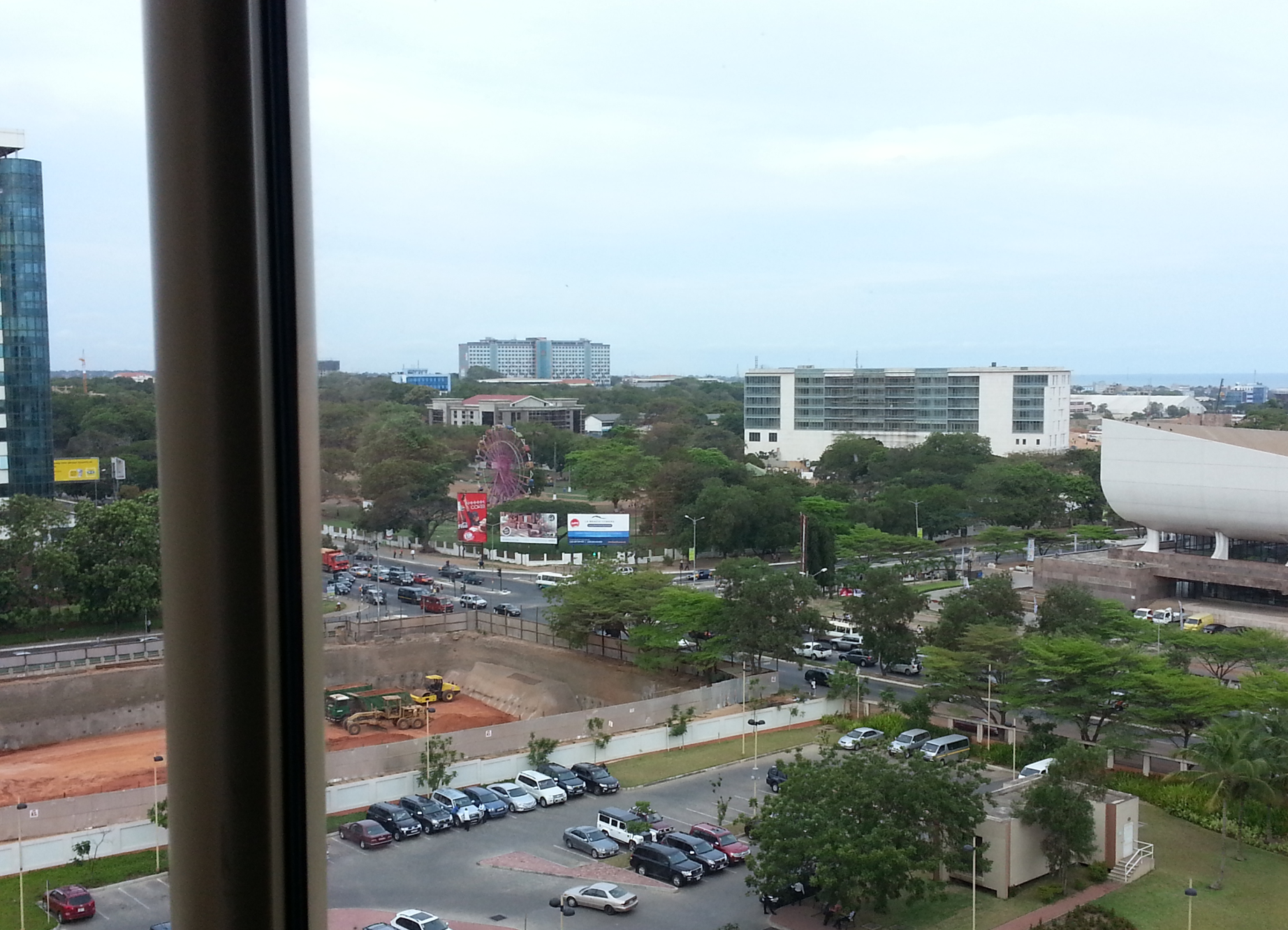
The View From Your Window Contest: Winner #150

Screen Shot 2013-04-20 at 12.22.41 AM

A reader writes:

The presence of the large billboards, bordering this lovely park, Tivoli Gardens, was dismaying to see, when I visited Copenhagen some years ago.  They seem to have proliferated. The juxtaposition is unfortunate. The architectural feature of the building to the right is reminiscent of the ultra-modern museum which was completed less than 10 years ago. The presence of both classical and modern architecture, as can be seen in the photo, is also typical of Copenhagen. The Baltic is in the distance.

Another:

This looks like it was taken from the back of the Prince Hotel & Residence in Kuala Lumpur, Malaysia – quite possibly in one of the restaurants or conference rooms there.  The big clues are (a) the red soil that is so common in SE Asia – especially Malaysia and Thailand; (b) the Japanese SUVs  and (what may be) a few of their drivers hanging out around one of them and (c) the Ferris-wheel with the over the top lighting around it.  I’ve stayed at the Prince before and this looks a lot like it.

Another:

With ten minutes to spare, I’m going to guess Lima, Peru.  The clues I used to make my guess are: primarily Japanese cars, driving on right hand side of road, and coastal billboards appear to have Roman script. I used that to rule out most of Asia, and I thought about countries that have a strong tie to Japan but are not in Asia. I know that there is a strong cultural link between Japan and both Peru and Brazil as many Japanese emigrated to those countries in the 20th century.  I don’t know if a cultural link translates into whether the citizens will buy cars, but I don’t have a lot of time.

Another is on the right track:

Definitely sub Saharan Africa. Cars are driving on the right side of the road, so we can eliminate a lot of the Southeastern countries in Africa. There’s a lot of greenery, so I’ll go with what I imagine is the greenest country in Africa. I’m guessing this is Kinshasa in the Democratic Republic of the Congo. The architecture is so distinct that I know someone is going to get the right window, but here’s hoping I’m at least somewhat close.

Another:

I thought this would be an easy one – how many fancy new buildings could there be that look so much like a bath tub? More than one unfortunately, since a very fancy new museum that looks exactly like a bathtub was just built in Amsterdam, and pictures of it filled every Google image search I could think of. Damn you, Stedelijk! The pink ferris wheel was no more help. But the trees in the lower right look like I imagine sub-saharan Africa, so I’ll say Addis Ababa because a friend hails from there, and I’d like to think it’s as nice a place as the photo seems to depict.

Another:

I flailed around a great deal with this one. I couldn’t find any building that matched the weirdly-shaped one to the right, and I’m sure someone has been there before. I was going to settle on Luanda, Angola, based on the traffic (not much) and the climate. But then I remembered Luanda has been an answer in the past, so I decided to go to the other side of Africa. I can’t find a great match for anything, so I’m just going to shoot for Maputo, specifically the Cardoso Hotel. Hopefully I’m not the dreadest “first guesser” who is always the farthest away!

Another nails the right city:

This is my first time to get one of these!

I knew it had to be Africa, with the acacia trees lining the roads, the wall around the parking lot, and, for some reason, the vertical red billboard. I was going to guess Nairobi, Kenya, because of how green it is (and I love Nairobi), but then I noticed the ocean in the background. Accra, Ghana! It’s got to be! I remember the city shocking me with how modern and western it looked compared with Cotonou, Benin and Lomé, Togo, where I had just spent a summer completing an internship in ethnomusicology.

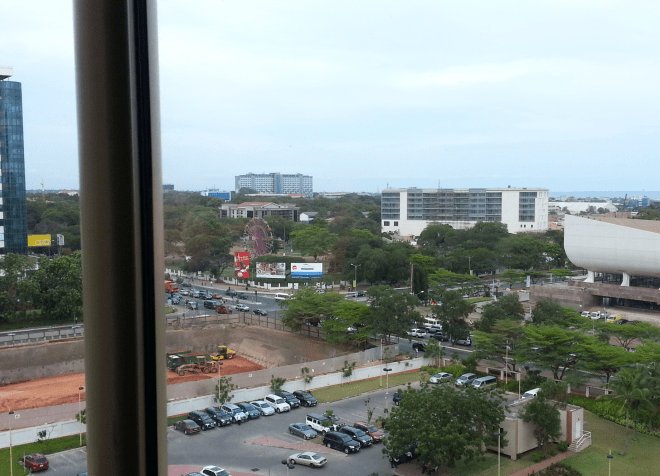
So, it was Accra – I went straight to Osu, which I remember being very built-up, then drifted west toward downtown. Behold, the National Theatre! The shape of that building stood out. The picture is taken from the Mövenpick Hotel, Victoria Borg, Accra, Ghana, looking roughly east-southeast at the intersection of Independence Avenue and Liberia Road. Maybe the 4th floor? The National Theatre is in the right midground of the picture and the Atlantic Ocean is in the background. Woo!

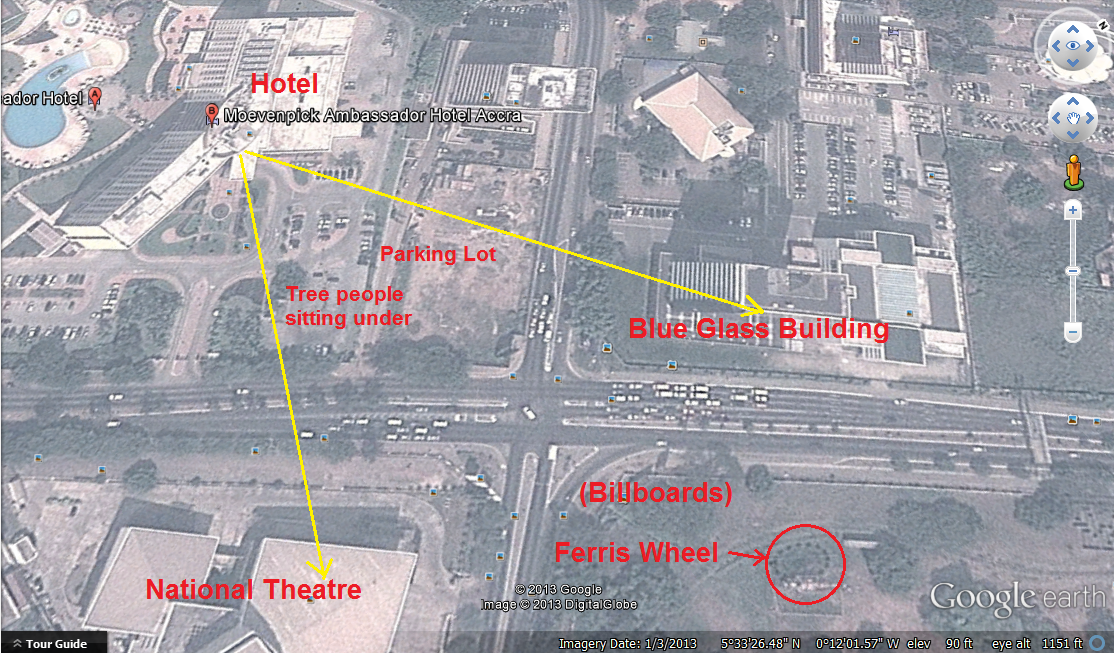
Another sends an aerial view:
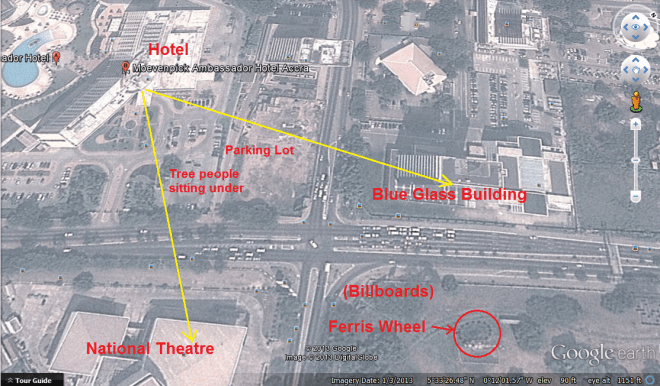
VFYW Accra

Another:

I feel like I am cheating here. This is downtown Accra, Ghana. I recognize it because I am originally from Ghana (presently a graduate student at the University of Virginia).

Another:

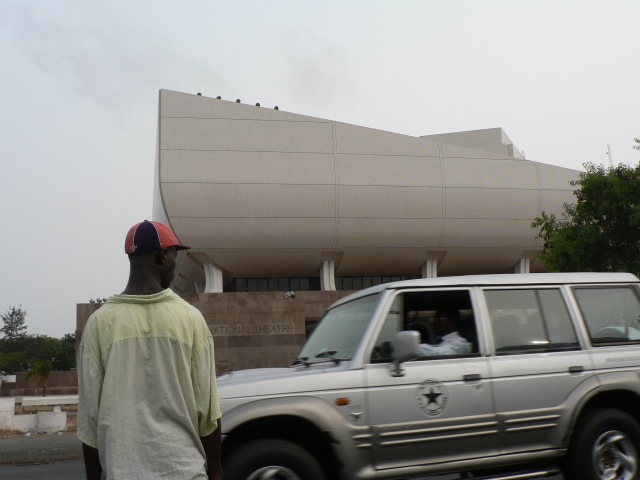
The Möevenpick Ambassador Hotel, Accra, Ghana near the corner of Liberia Rd. and Independence Ave. technically, postal address is PMB CT 343, Cantonments Ridge, Accra, Ghana. GPS: 5.554369,-0.202426. Bonus points for using the umlaut, please. Extra bonus points:  my photo of the National Theater, from 7 years ago, whilst visiting my beautiful daughter on her semester abroad from NYU:
P1020241

Super-bonus points: I lived in Accra as a child, many many moons ago, well before the National Theater was built, as a “gift” from China.

Another:

What a fun feeling to immediately know the view when the picture flashes on the screen! The distinctive building on the right is the National Theatre in Accra (where my wife and I enjoyed a stunning performance by Ismael Lo about 15 years ago); across the way is the new (well, used) Ferris Wheel in the Efua Sutherland Children’s Park (where our daughter had her first ride on a pony even longer ago), and the road in front is Independence Avenue is where we watched armored cars roll in Ghana’s final coup more than 30 years ago.

Thank goodness Ghana is now growing extremely rapidly and is firmly stable (stable enough to have its own controversial supreme court case about the recent presidential election – arguments are being held right now, and everyone is confident that the dispute will be resolved peacefully). The picture is taken from a reasonably high, north-facing room in the gorgeous new Moevenpick Ambassador Hotel (somebody has a nice expense account!). I won’t bother guessing the specific room; I’m sure you’ll get a few who will do the calculation.

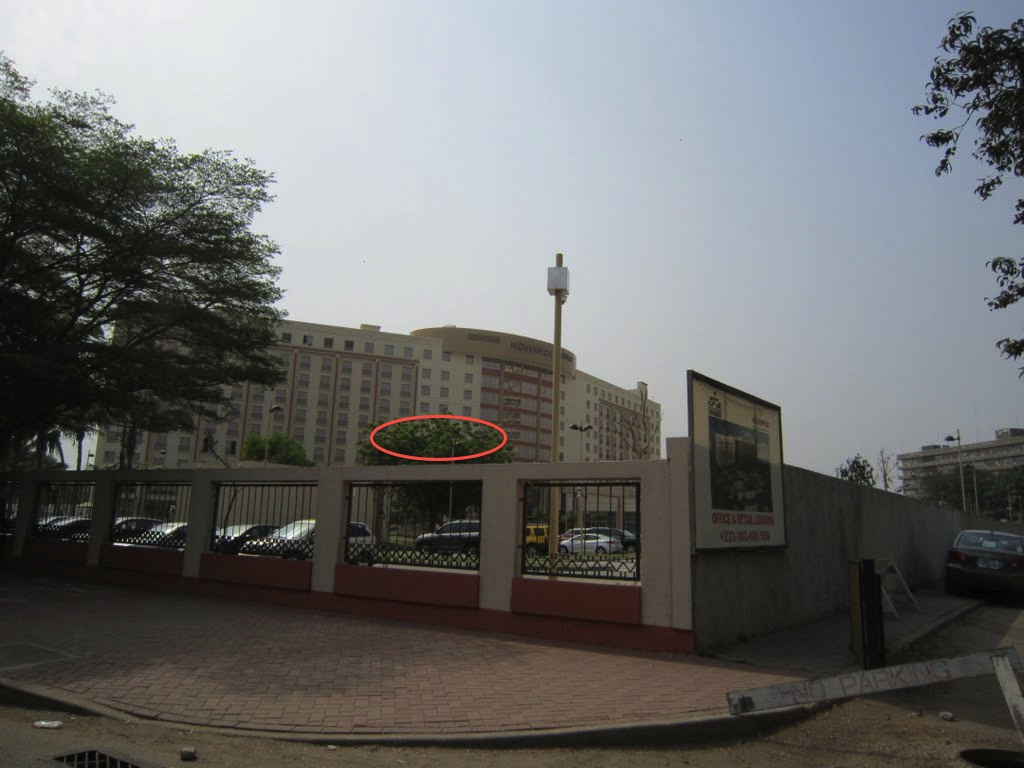
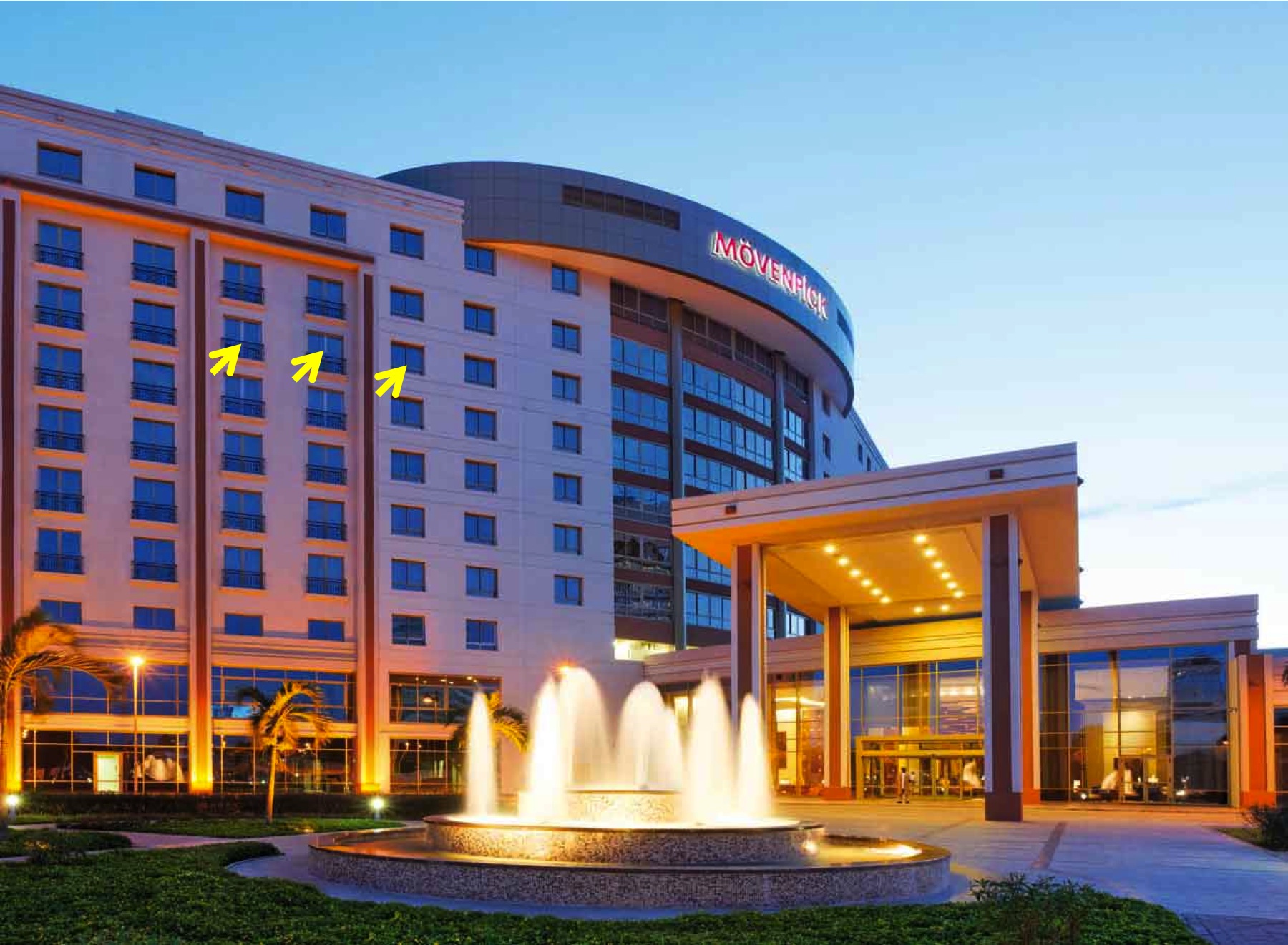
A closer look at the hotel:

Window - Moevenpick Hoteld

Another nails the right floor:

This week’s photo is from the either the 6th or 7th Floor of the Movenpick Ambassador Hotel in Agra, Ghana. If I had to guess it would be the 6th floor, Room 637. This photo is from an odd numbered room, likely one of the ambassador suites (since those are on the upper floors) looking out towards the intersection of Liberia Rd and Independence Avenue. The taller building on the left side of the photo is part of the World Trace Center Complex and the white building on the right side of the image is the National Theatre.

But the winner this week is the most detailed entry among the three readers who correctly guessed the 6th floor:

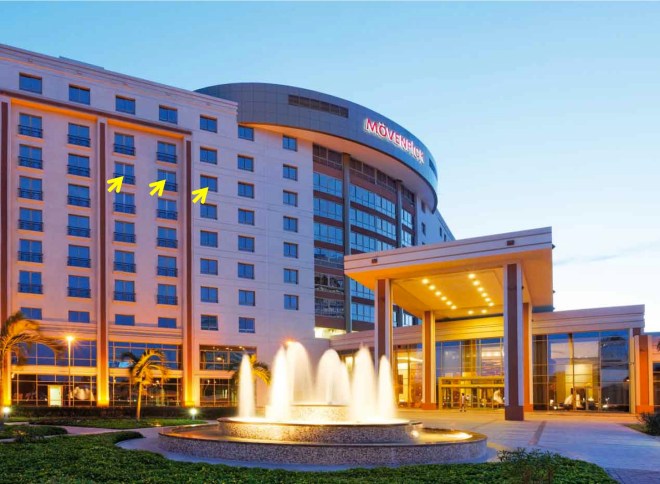
Bam.  This photo was taken from the Movenpick Ambassador Hotel in Accra, Ghana looking south of east. Based on dead eyeball reckoning it was taken from one of the three indicated windows on the 6th floor:
window-arrows

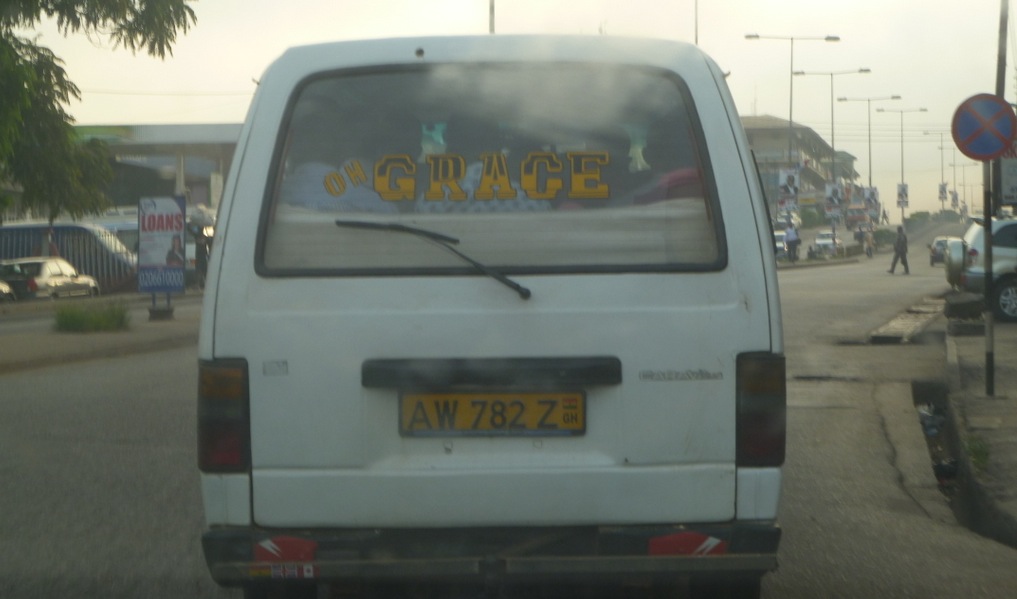
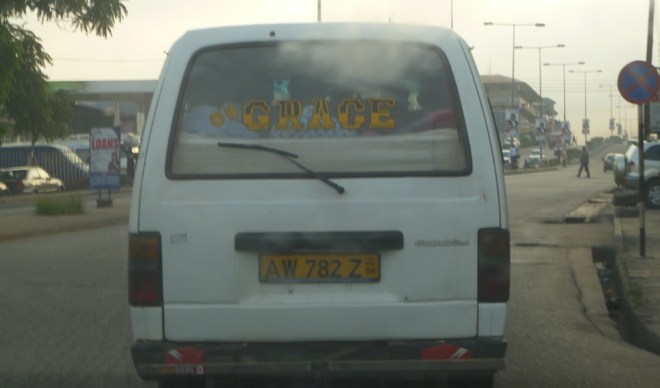
Undoubtedly, others making correct guesses will have recognized the oddly shaped building on the right to be the National Theater of Ghana, stayed at that very (swanky) hotel, or somehow read one of the unreadable advertisements next to the Coke billboard (I Googled ‘comb’ before figuring it out). My clue, however, was the dark green van with a yellow stripe in the road just below that Coke billboard.  It is probably a tro-tro, which are basically large taxis that serve as a bus system in Ghana. The tro-tros, especially how they were always packed and had religious slogans prominently displayed, were among the many things that fascinated me during my recent visit to Ghana:
Oh Grace, please let us reach our destination in one piece!

My brother interns for Global Brigades in Ghana coordinating groups of undergrads that come in to staff medical clinics.  Since he wasn’t going to make it home for either holiday for the first time in our lives, my aunt, a family friend, and I brought the family to him for Thanksgiving.  It was quite an experience seeing him in his element, and also because it was my first time in a developing country.  Thus, the country roads, and I mean country roads, were mortifying, but seeing an elephant take a relaxing dip (in poem form) made the trek worth it.

And to think, the other day I contemplated skipping over the VFYW contests for good.  I shall travel more so that won’t happen again.

From the submitter:

As a previous winner (contest #55 – Luanda, Angola) and a weekly follower of the VFYW contest, I would like to submit this view from my hotel room in Accra, Ghana. The photo was taken from the 6th floor, room 641 of the Movenpick Ambassador Hotel facing east.  This week in Ghana marks the beginning of the Supreme Court hearing in their version of the 2000 U.S. Presidential election dispute. Everywhere I went, the public was glued to their TVs as the case of the disputed Ghanaian presidential election of 2012 was being aired. Ghana is a model for other African countries in terms of respect for democracy and rule of law on one hand, and entrepreneurship and progress on the other hand.

(Archive)