Can The Writer Truly Retire?

Ian Crouch wonders:

Critical opinion is not a statistics-based endeavor, and so we don’t have a graphical curve that tells us when a writer is likely to produce his or her best work. Some writers never match their first novels (Ralph Ellison, Joseph Heller). Others reach their peaks in some middle-career moment, when they have fully developed voices and still retain vigor and health and time to put toward the task. (Roth seems to fit this category, although favorites might be found at the beginning and the end).

Yet there are examples of great writers writing splendidly right until the finish—and even the diminished output of older writers is valuable, if only because it matters how great writers absorb and accept and reject the pains and insights of age. Roth has mentioned that he didn’t want to add mediocre books to the world’s library—and there are many, many examples of great writers perpetrating all kinds of lesser crimes in their advanced age. It seems likely that a novel by, say, Hemingway at seventy would have been among his worst, charting the decline of his output. But who wouldn’t want to read what worlds Hemingway might have made out of being seventy? A quote attributed to him goes like this: “Retirement is the ugliest word in the language.” It seems safe to say that dying is uglier.

Suffering In Verse

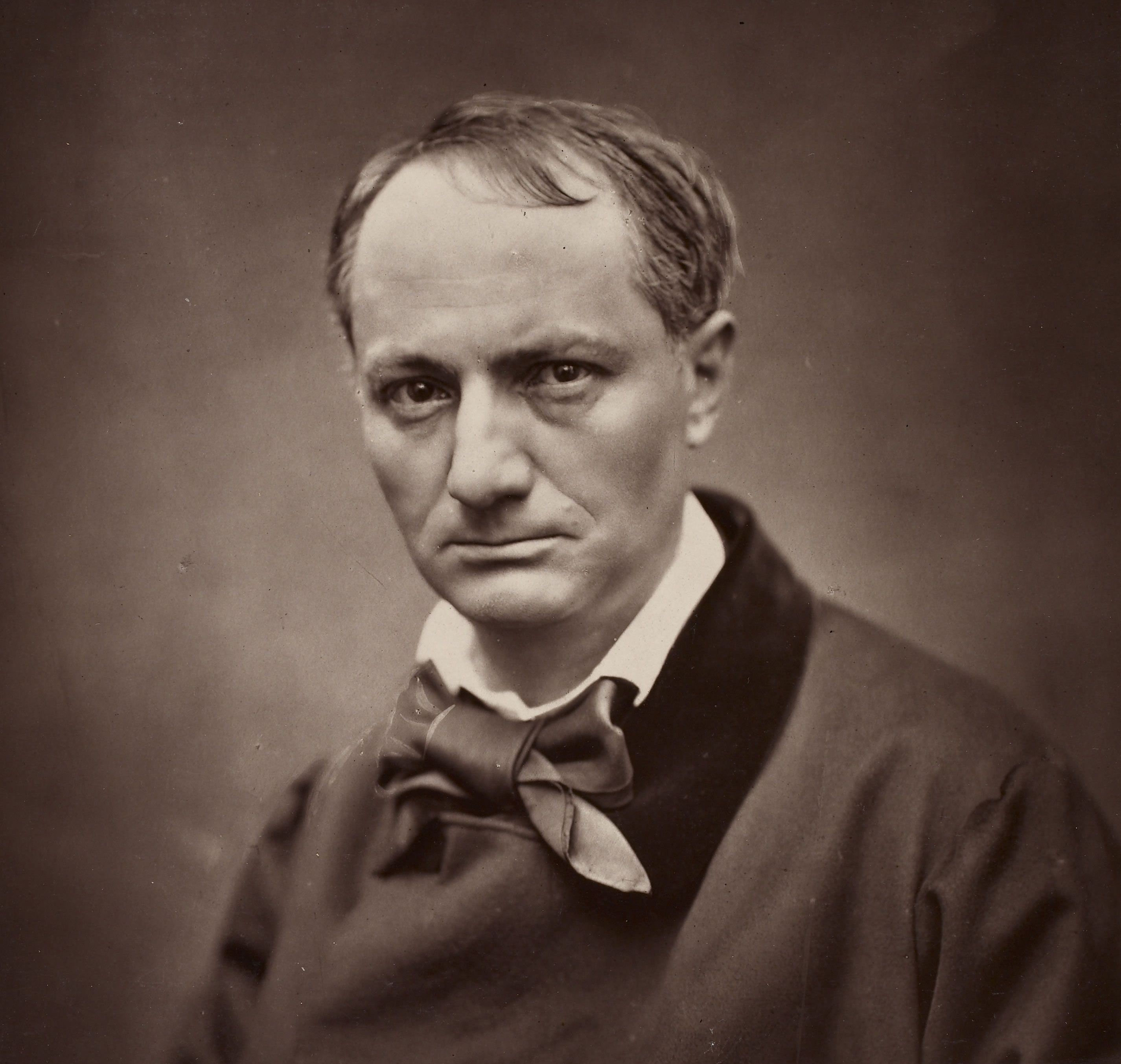
Stephen Akey praises the French poet Baudelaire for confronting our failures:

Like a blasphemous Jesus, he took on our worst sins — pride, sloth, envy, lechery — and turned them into art. T.S. Eliot and others have found in him a profound religious yearning beneath the blasphemy. I, on the contrary, find blasphemy beneath the blasphemy. Baudelaire’s “business” was not, pace Eliot, to “assert the necessity” of Christianity. He asserted, if anything, the necessity of belief in a self that, threatened from forces within and without, might remain whole and integral, if only through the consciousness of its own suffering. Even so, it’s impossible not to be moved by Eliot’s essay on the poet, which concludes not with the expected apportions of praise and censure but, astonishingly, with this prayer: “Baudelaire was man enough for damnation: whether he is damned is, of course, another question, and we are not prevented from praying for his repose.”

Extraordinary as Eliot’s benediction is, Baudelaire didn’t hold out for prayer. He had work to do. Tormented, slothful, and sickly, he managed to produce masterpieces in every genre to which he turned his hand: metrical verse, prose poetry (which he more or less invented), translation, and art criticism. I think of Baudelaire at work much as he depicted his loved and hated city in the last stanza of his magnificent aubade “Twilight: Daybreak” (“Le Crepuscule du Matin”). It’s a Baudelairian dawn. Whores, beggars, the debauched and the dying fitfully awaken to a cold and damp morning — not a promising start to the day. And yet this city will clothe itself in beauty and get to work:

Shivering dawn, in a wisp of pink and green,
Totters slowly across the empty Seine,
and dingy Paris – old drudge rubbing its eyes –
picks up its tools to begin another day.

(Photo of Baudelaire by Étienne Carjat via Wikimedia)

The Great Tech Novel

Lydia Kiesling goes searching for it in San Francisco:

Let no woman say that Tech People — and here I mean the real architects of technological progress–can’t express themselves. Reading Larissa MacFarquhar’s epistolary article about Aaron Swartz in The New Yorker, I was struck, and moved, by how open Swartz and his friends were in their public and private writing. Swartz wrote raw, intensely personal things on his blog; Reddit is full of people expressing themselves in ways that are often shocking. But a novel requires something a little different.

It is my understanding that most writers feel some sense of being outside of things looking in. A good social novel requires a particular balance of alienation and access to be successful. (Tom Wolfe had to get invited to all those dinner parties; the tech novelist has to get invited to the Teach-Up.) Tech, the way it happens in San Francisco at least, seems to present some real deterrents to the access part of the equation. Tech companies, even when they are in the city proper, seem like compounds evoking non-disclosure agreements and badges and loyalty. The buses that ferry the workers from their San Francisco neighborhoods to their Peninsula offices are unmarked. I think these are insular, fortified environments in which it would be hard to achieve the balance of outside and inside status. And when you work twelve hours a day, how would you find the time?

The Kubrick Conspiracies

The documentary Room 237 outlines various interpretations of The Shining – that the film is about the slaughter of Native Americans, the Holocaust, or is Kubrick’s apology for faking the footage of the Apollo 11 moon landing:

Kubrick’s longtime assistant and collaborator Leon Vitali (who played Lord Bullingdon in “Barry Lyndon”) recently said that “Room 237” had him “falling about laughing most of the time” because he knows these ideas are “absolute balderdash.”

Billy Wyman enjoyed the film nonetheless:

What “The Shining” is really about will remain opaque. Beyond child abuse, writer’s block, and insanity is the history of the hotel, which seems to weigh Nicholson down more than anything. One commenter in “Room 237” makes this point: “This is a movie about the past. Not just our past, but ‘pastness’.” This, interestingly, parallels something Pauline Kael wrote in The New Yorker in her original, appreciative but skeptical review: “I hate to say it, but I think the central character of this movie is time itself, or, rather, timelessness.”

Noah Millman points to more underlying themes:

The resort to esoteric, secret meanings behind reality is a psychological comfort when the capriciousness of that reality is too threatening. When we badly need reality to make sense – to be sending us a message – secret codes and vast conspiracy theories provide that sense. So in a way, the existence of “Room 237″ is a testament to the success of “The Shining” in capturing the unassimilable horror of reality. If it weren’t so terrifying, nobody would see the need to tame it by explaining what it’s really about.

A Genius Puts Away Childish Things

Ann Napolitano toured Flannery O’Connor’s childhood home in Savannah. The tour guide emphasized a photo of the author at age three:

41“A little after this point,” he said, “something happened to change this little girl into the Flannery  we recognize. Between the ages of four and six, she started to call her parents Edward and Regina. She began to speak to everyone as if she were an adult. She called her teachers by their first names, and that got her into some trouble at school. Her parents allowed it, though. They were ever after Edward and Regina to her.”

I love this anecdote, because the obvious assumption would be that something sinister had happened to Flannery during that period to alter her, or force her to grow up too quickly. But, as the tour guide assured me, and as I’d learned from my own research, that simply wasn’t the case. Flannery had, on the whole, a happy childhood. She simply did away with the trappings of childhood as soon as possible. She became herself earlier than most of us do. The vision of a fierce five-year Flannery pleases me, but it also rings true. The true Flannery could never be denied, not even by childish impulses.

The View From Your Window Contest

Screen Shot 2013-04-13 at 3.31.10 AM

You have until noon on Tuesday to guess it. City and/or state first, then country. Please put the location in the subject heading, along with any description within the email. If no one guesses the exact location, proximity counts.  Be sure to email entries to contest@andrewsullivan.com. Winner gets a free The View From Your Window book. Have at it.

DVD HIV Testing

Incredible new tech:

Aman Russom, senior lecturer at the School of Biotechnology at KTH Royal Institute of Technology in Stockholm, says that his research team converted a commercial DVD drive into a laser scanning microscope that can analyse blood and perform cellular imaging with one-micrometre resolution. The breakthrough creates the possibility of an inexpensive and simple-to-use tool that could have far-reaching benefits in health care in the developing world.

Ashley Feinberg applauds:

Standard HIV testing already uses a laser-based method called flow cytometry to count the CD4 cells (a low count of which would be an indicator of the disease). But access to these kinds of tests—with machines costing upwards of $30,000—has been highly limited in the developing countries that need it most. By contrast, the Lab-on-DVD units, could be mass-produced and sold for less than $200. Plus, these relics of media yesteryear are far more portable.

Equally amazing is the sheer realization that technology has advanced to the point where, even when on the verge of being outdated in one field, just a few tweaks can redirect it towards an incredible, innovative, and medically astounding task in another.

The Guilt Of The Gentrifier

Evan Hughes looks at the first stirrings of discomfort about New York’s gentrification:

The Hal Ashby film The Landlord, the L. J. Davis novel A Meaningful Life, and the Paula Fox novel Desperate Characters, all dating from 1970 through ’71, paint a strikingly consistent portrait of Brooklyn at a low ebb. Though widely divergent in tone, they all depict the bleak conditions that held sway at the time, despite being set in what are now high-rent districts. Cars are stripped to the axles in minutes, rocks get hurled through windows, and bums heckle passersby from the shadows.

The protagonists in Ashby, Davis, and Fox, who dive into this mess, are the forerunners of contemporary Brooklyn’s bourgeois and bohemian crowd. They’re the shock troops of gentrification, a word that barely existed at the time. They are well-educated newcomers bucking the larger trend of an ongoing middle-class exodus. They are also, notably, all white. Their neighbors, as a rule, are not. It’s odd to reflect on the fact that the writers behind these works had no idea how this social experiment would turn out. About the prospects of the would-be gentrifier, in fact, they seemed decidedly pessimistic.

Hughes, noting that “in 2010, for the first time in a hundred years, Brooklyn was whiter than it had been a decade before,” reflects on the resulting white liberal guilt:

Whatever your intentions, to be a member of the new, more privileged wave of residents in a gentrifying neighborhood is to be a part of a process that is displacing families who have lived there for decades, even generations. You have to be something of a moral idiot not to feel some queasiness about this. Although it is rarely discussed directly, I suspect that for a lot of who are, broadly speaking, on the advantaged side in this turf war, just walking around brings regular stings of class guilt. Obviously it is worse to be on the disadvantaged side; that’s why the advantaged feel bad about feeling bad, and therefore avoid talking about it.

What the advantaged do instead is pick apart all the failings and hypocrisies of our own team. That way we align ourselves, so we imagine, with the other team, the team that seems to have justice on its side: If I’m part of something bad, at least I have the right attitude about it.

Implicated in an uncomfortable reality, we resort to a bit of psychological jujitsu to fight off the shame. Feeling the heat of the spotlight, we swing it on a fellow gentrifier who’s going about it all wrong. I’m white and raised in suburbia, but I don’t wear khakis and clog restaurants with my stroller at brunch. Or perhaps: At least I’m not this guy here on the park bench, with his beanie and flip-flops. I mean, really. Look at this fucking hipster.

Comic Book Diversity

A transgender woman now appears in the pages of DC Comics’ Batgirl:

[Batgirl writer Gail] Simone believes that diversity isn’t just a continuing issue for superhero comics: “It’s the issue for superhero comics. Look, we have a problem most media don’t have, which is that almost all the  Screen Shot 2013-04-11 at 11.36.34 AMtentpoles we build our industry upon were created over a half century ago… at a time where the characters were almost without exception white, cis-gendered, straight, on and on. It’s fine — it’s great that people love those characters. But if we only build around them, then we look like an episode of The Andy Griffith Show for all eternity.”

She added that she thinks most superhero comics readers don’t have a problem with increased diversity, but rather with stories that promote sermonizing over storytelling. Alysia will be “a character, not a public service announcement … being trans is just part of her story. If someone loved her before, and doesn’t love her after, well — that’s a shame, but we can’t let that kind of thinking keep comics in the 1950s forever.”

When Will All Americans Get To Enjoy Havana? Ctd

Jay-Z composes a response to the critics of his trip:

This embed is invalid

Full lyrics here. A reader talks about his trip:

I was a senior in high school in 2001. That year, I was taking a class on Caribbean Civilization, which included a trip to Cuba. September 11th was the second week of school, and all international trips were canceled in its wake. My parents, after realizing how much money they were saving (I was also slated to go on a band trip to Italy), decided that they’d always wanted to go to Cuba. The school trip was legit, with educational visas and all. My parents and I took the easy route: we drove to Canada. From there it was an easy flight to Havana (on Air Cubana, but on a leased Airbus as opposed to, say, a Soviet-era Tupolev). We had a lovely week in Cuba (perhaps not as educational as if I’d gone on an exchange with my class) and certainly broke the travel ban (which is really a spending money ban).

At the time, everything in Cuba was available for US dollars, so we had no issue paying for anything. We were with a tour group, but we were four of the six in the group, so we were able to cajole the driver to let us drop in on state-run stores, fruit stands and the like. We were certainly tourists. But there was something fulfilling to flouting a ludicrous ban.

When we arrived, our passports weren’t stamped, but customs gave us a separate sheet of paper to get stamped (this is SOP for Americans visiting). Coming back in to the States from Canada there was no passport check at the time, and customs in northern Vermont thought we were a family coming back from a week in Quebec. (We were, we just happened to jet south for a few days.) At the time, enforcement of the ban was very sporadic. Apparently, if you were caught, you’d get a letter telling you that you were being fined $11,000. If you ignored it, you’d get a second, strongly-worded letter. If you ignored it, the Feds would go do something more useful – which is, of course, pretty much anything.

Apparently, the Bush administration went and staked out some airports (good use of government resources, guys!) but that has lapsed in the Obama presidency. In fact, there have been efforts to have the fine applied to push the law into the courts (it’s dubious whether it would withstand constitutional scrutiny, especially in the current state where people with family in Cuba are regulated differently than everybody else) but even open flouting has not been punished. And when Forbes is publishing opinion pieces by AEI guys arguing the ban is folly, well, there you go.

In any case, had Jay-Z and Beyonce been caught, they would have been hit with a $55,000 fine. Which I’m sure they could have afforded. Maybe the only way to get rid of the ban is to say that the fine amounts to a tax, and the Republicans in the House will all jump up to vote it down.

Another reader:

I travelled to Cuba almost exactly one year ago, and it was eye-opening. I didn’t need to obtain special permission from my government to travel there because Canada, despite its conservative government’s open opposition to the Castro regime, permits its citizens to freely travel to Cuba.

It’s a beautiful country, and full of natural wealth just waiting to be exploited. (We drove passed several Chinese- and Canadian-run oil wells on the way to Havana.) But its greatest resource is its people. Cuba is a country with a bright future ahead of it, because its people, while poor, are very well-educated. The Communist regime in Cuba does a lot of things wrong, but education is not one of them. Education at all levels is free for everyone in Cuba, and people take advantage of this. Sure they teach a specific version of history etc., but despite the government’s efforts to inculcate loyalty to the Revolution, the young people are just not buying it, much to the chagrin of their elders.

And things are changing. Our tour guide into Havana operated a private taxi company – he owned his taxi and made his own money. He was a fountain of information, actually the main source for most of what I’m writing. He believed that Raul Castro was going to accelerate the pace of change, because unlike Fidel, Raul is not an ideologue. He wants two things; for his regime to survive him, and for Cuba to thrive.

The fact that Raul claims to be stepping down in a few years offers hope that America might finally end its ghastly embargo, which succeeds in doing nothing but keeping Cuba’s educated and industrious population poor and driving a museum of classic cars from the 50s (which is very cool for visitors, but very uncool for them). Our guide claimed that the government just uses the embargo to stay in power anyway – they have the ultimate excuse. Every economic woe can be blamed on the embargo. They even blame natural disasters on the embargo he joked. (Or maybe he wasn’t joking?)

So the embargo is doubly ineffective – it impoverishes Cuba’s population by robbing them of their natural trading partner, and it gives the Communist government a trump card it can always play against all criticism. That’s pretty much a textbook lose-lose.