The Novelization Of TV, Ctd

A reader quotes Alyssa:

“In a book, you can stay within the medium and flip back and forth if you don’t remember who a character is…” She goes on to contend that you can’t stay within medium with a TV show if you need to “remember” something.  I agree to an extent, but people are increasingly moving away from the traditional model of watching a TV show when the network broadcasts it.  Because of HBO’s crazy protection of the product, those unwilling to pay for a year of HBO for one series are going online to view Game of Thrones.  The medium for those folks is not “television” but rather the Internet, complete with wikis and fan pages, etc.  Also, because this particular show is already a popular novel, there is a different medium that is actually inseparable from the TV show.

Another reader:

Novelized TV series on American television are not a new thing.  The best example may be Babylon 5, a sci-fi series that ran for five seasons from 1993 to 1998.  The show’s writer, J. Michael Straczynski (JMS to the show’s fans), planned it as a five-season show from the start, describing it as a “novel for television” with a defined beginning, middle, and end.  It featured the ensemble cast and multiple story arcs that characterize the current generation of novelized TV.

Babylon 5 also pioneered integrating television with what we now call social media.  JMS kept up a continuous dialog with viewers through the pre-web USENET, GEnie, and CompuServe forums.  More than once JMS wrote jokes, names, or other references from these online discussions into the show as a salute to online fans.  It was a very Dish-like participatory atmosphere.

Another:

Japanese anime has been doing things this way for decades.

Most anime TV shows (the good ones anyway) shoot for a single season, maybe two or three, and then proceed to tell an overarching story epic, with episodic digressions strategically paced throughout.  This allows for a story-driven experience over the whole of the series, instead of each episode being self-contained as in many sitcoms and dramas, and creates the same incentives for binge-watching, including being able to keep track of a sprawling, diverse cast (“Fullmetal Alchemist” is a great example).  It also allows the creative minds behind the show to plan ahead for a proper resolution and conclusion to the series, instead of it dying a slow death or being cancelled outright.

Recent American television shows have finally been taking a page from the same book, notably Joss Whedon’s “Firefly” and “Dollhouse,” as well as many of the USA original series, like “Burn Notice” and “White Collar.”

Another:

It’s not clear to me that “Game of Thrones” has so path-breaking a model (not to say that it’s not good, it’s just a question of how new it is). Korean prime-time dramas have been doing it this way since the 1990s anyway, with a series lifetime of from 12 to 24 episodes mostly, generally airing two episodes a week. Prime-time historical biodramas may go into the 150-episode ballpark, airing twice a week, but they have a lot of outlay on sets and costumes to make back. Even their “daily dramas”, comparable to US daytime soap operas, don’t go on “forever” – 100 to 150 episodes is about the range. (Although I remember one that went 350 episodes. But still, that’s not a full two years.) All these dramas including the “daily dramas” generally have a clear dramatic arc.

I’m not familiar with Latin American “telenovelas” but I know that they aren’t “endless” either. Actually I suspect that the old U.S. primetime TV ideal with an “endless” series, a static cast and environment, and episodes that could be aired in any order really – like “Perry Mason” or “The Dick Van Dyke Show” – have been pretty much an exception in the world scene.

Furthermore that model was never really been so universal even in U.S. 3-network TV. Daytime serials had histories, and when the format was transplanted into evenings – “Dallas” or, before that, “Peyton Place” – you started to have to follow the action to know what was going on. There were also the World War II-based dramas like “Combat” and “Gallant Men” – the episodes were pretty self-contained, but you knew they couldn’t slog through France and Italy forever the way Marshal Dillon could police a timeless town. Then there were dramas like “The Fugitive” which at least held out the prospect of “dramatic resolution” of the whole series even though there wasn’t much in the way of story development from one episode to the next, barring the finale.

I suggest that the real path-breaker was “Roots” including the “Next Generation”. The only difference between that and our current series arcs was that its “seasons” were each jammed into a week of intense viewing. The miniseries format went on from there. Meanwhile other more conventional dramas, like “St. Elsewhere” and “Hill St. Blues”, and comedies like “Roseanne” and probably some earlier ones I’m missing, incorporated multi-episode plots and season-long story lines involving the personal lives of their characters. With the thirty-nine-episode season for a drama program now down to 22 for broadcast TV and 12 or fewer for cable, the “series” and the “miniseries” have now sort of converged in the middle.

The Deity Abides

Jeffrey Overstreet contemplates the role of religion in the Coen brothers’ films:

I think the Coens’ work disturbs audiences because it reminds us that, contrary to so many Hollywood messages, “being good” isn’t the answer. Being good is good, but—as Bill Murray says in Wes Anderson’s Moonrise Kingdom—it isn’t enough to fix things. Their movies “ring true” when they remind us that there is a “wrath that’s about to set down,” as Rooster Cogburn says. If that wasn’t true, it wouldn’t strike such a resonant chord in audiences. The Lone Biker of the Apocalypse in Raising Arizona is coming, and there’s something elemental and true about him. We ourselves have unleashed him, as H.I. declares. In No Country, we’re warned that we “can’t stop what’s comin’.” There is a moral code, yes, and we violate it in countless ways. We’re screwed.

But their work doesn’t stop there. It engages and encourages us by leaving us with moments that transcend all of that doom, all of that destruction. Their suggestion of the possibility of grace is not so much a sermon proclamation as a desperate hope. And it wouldn’t move us so deeply if the anticipation of grace weren’t built into us somehow. It moves us because, on some level, we know it’s true.

Facebook For Spies

Robert Beckhausen reports on a 007-worthy addition to the popular photo-sharing platform:

Facebook is a place where you can share pictures of cute animals and fun activities. Now there’s a browser extension that lets you encode those images with secret, hard-to-detect messages. That’s the idea behind Secretbook, a browser extension released this week by 21-year-old Oxford University computer science student and former Google intern Owen-Campbell Moore. With the extension, anyone — you, your sister, a terrorist — could share messages hidden in JPEG images uploaded to Facebook without the prying eyes of the company, the government or anyone else noticing or figuring out what the messages say. The only way to unlock them is through a password you create. …

[It’s] the first time anyone’s managed to figure out how to automate digital steganography — the practice of concealing messages inside computer files — through Facebook, the world’s biggest social media platform. Unlike cryptography, which uses ciphertext to encrypt messages, steganographic messages are simply hidden where no one would think to look.

Thatcher And The Lesbian Widow

Here’s a wonderful little tidbit from Alexander Chancellor in the Spectator’s symposium:

In the middle of dinner on Easter Sunday, she demanded that we all go and stand outside in the cold to see the Hale-Bopp comet as it passed overhead. ‘It reminds me of pheasant,’ she said. ‘Doesn’t it you, Mr Chancellor?’ (It didn’t at all, actually.)

On Easter Monday, a beautiful spring day, Alexander Hesketh brought Margaret and Denis Thatcher over to my house at Stoke Park, where she said another surprising thing to me. Staying there with my late uncle Robin was Jacqueline Hope-Wallace, a great admirer of Margaret Thatcher, having once served under her as a civil servant in the Ministry of Pensions in the early 1960s, who was feeling bereft after the death of her long-term friend C.V. (Veronica) Wedgwood, the historian. I didn’t mention that they had been lovers but must have somehow implied it, for Lady Thatcher grasped the point immediately and said, as a very modern person might, ‘I didn’t realise they were partners.’

When they eventually crossed paths on the lawn, Hope-Wallace started to say, ‘You won’t remember me, but…’ when Lady Thatcher briskly interrupted her: ‘Of course I remember you — you wrote that marvellous report on pension reform…’. She went on to recall the names and personalities of all the other civil servants in that department. She thus made a forlorn old lady very happy.

Doctor Who’s Post-Imperialism

Chris Oates examines the show’s genesis in 1960s England, when the “British empire, like other European empires, was ending”:

In many ways, the show carried on the themes of Victorian youth literature: the Doctor is a fearless traveler; he encounters strange cultures and lands; he is stoic, sophisticated, and not without a few eccentricities. Give him a pith helmet and he could fit in perfectly with the entertainment of the past. Episodic adventure still sold, was still compelling, but with Doctor Who, the creators were confronted with the question of what happens to an empire-builder post-imperially? The question for the show’s creators was how to maintain the lucrative adventure structure of the past without the geopolitical foundation that it had required.

Their answer was to use the traits that were appealing about adventurers and were still permissible in a world where countries are not apportioned on a first-European-come, first-European-served basis. When inviting his companions to join him, he almost always asks if they want to see the universe. The stated mission is travel for its own sake. The Doctor is a tourist.

The GOP’s Demographic Problems Are Very Real

Nate Cohn rebuts various pundits who argue otherwise:

It was frequently observed that a Romney victory would have required a historic performance among white voters, provided that Obama could match his ’08 performance among non-white voters. Bush’s 2004 performance among white voters wouldn’t get it done anymore. In 2016, the math gets even more challenging. If the white share of the electorate declines further, Republicans won’t just need to match their best performance of the last 24 years among white voters, they’ll also need to match their best performance of the last 24 years among non-white voters. If they can’t make the requisite 16-point gain among non-white voters—a tall order, to say the least—then the next Republican candidate will enter truly uncharted territory, potentially needing to win up to 64 percent of the white vote just to break 50 percent of the popular vote.

The Crimefighting Power Of Brown

Ray Fisman dives into research on the effects of Brown v. Board of Education:

A growing body of social science research is now reaching the conclusion that school desegregation should get some direct credit for the drop in black crime. Indeed, as courts have begun overturning these rulings over the past decade, we’ve seen an alarming uptick in crimes by young black men. It turns out that integrating schools wasn’t just a matter of turning them into melting pots or providing equal access to education. It was also an effective way of fighting inner-city crime. …

Berkeley economist Rucker Johnson’s looked at the longer-run effects of desegregation on children of the civil rights era, using a range of methodologies, each of which generates the same set of findings: Desegregation led to higher earnings, better health, and a better chance of staying out of prison for black males. Johnson’s findings on crime echo the results of earlier research, which found that desegregation reduced violent crimes by young (15-24) black men by as much as one-third.

The Bitcoin Bust

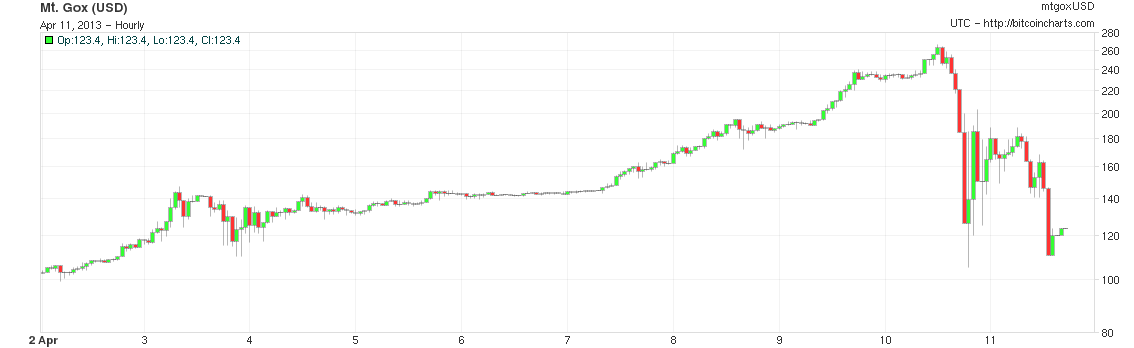
Yesterday, the value of the newfangled currency plummeted 61 percent:

Bitcoin_Chart

Timothy B. Lee points out that Bitcoin has crashed and recovered several times before. Yglesias expects this cycle to continue:

The problem is that if the price of a bitcoin is on a steady upward trajectory, then nobody’s actually going to want to spend a Bitcoin on anything. And if everyone’s hoarding their Bitcoins, then the network is actually useless. Then, since it turns out to be useless, you get a crash. The funny thing is that once the upward spiral comes to an end, then the technological virtues of the Bitcoin platform come to the fore again. If nobody wants to hoard Bitcoins, then Bitcoin-as-platform looks like an attractive alternative to elements of the payment system. But when Bitcoin starts looking attractive again, you should get a renewed hoarding cycle.

Jerry Brito argued recently that Bitcoin’s valuation doesn’t necessarily matter:

Bitcoin will work as a seamless payment system so long as you can get in and out of it quick enough to mitigate volatility. That is largely a technical consideration, but it could also depend on the market’s liquidity, which conceivably could be hurt by speculative hoarding. I haven’t given this much thought yet, but given that bitcoin can be denominated down to eight decimal places, I’m not sure it will be a big problem anytime soon.

Felix Salmon thinks Bitcoin is too volatile to work well for payments:

Currently, it can take an hour for a bitcoin transaction to clear, which means that the value of the transaction when it clears can be radically different from its value at inception. Bitcoin only works for payments if you can be reasonably sure that its value will remain reasonably steady for at least the next hour or so.

McArdle bets that governments will restrict Bitcoin’s growth:

I think that governments can make it so difficult to translate your bitcoins into the real economy that most people simply won’t bother. And the more successful that bitcoins are–the better they become established as an alternate currency–the more likely it is that rich-world governments will swoop in and make it prohibitively difficult to use bitcoins to procure real-world goods in developed countries. At that point you’ve essentially got a novelty currency like greenstamps, which can be exchanged for only a limited supply of goods, and maybe some developing-world travel.

Eric Posner calls the currency a “Ponzi scheme”:

A regular Ponzi scheme collapses when people realize that earlier investors are being paid out of the investments of later investors rather than from the returns on an underlying asset. Bitcoin will collapse when people realize that it can’t survive as a currency because of its built-in deflationary features, or because of the emergence of bytecoins, or both. A real Ponzi scheme takes fraud; bitcoin, by contrast, seems more like a collective delusion.