These days, the art world is large and spread out, happening everywhere at once. A shrinkingfraction of galleries’ business is done when collectors come to a show. Selling happens year-round,at art fairs, auctions, biennials, and big exhibitions, as well as online via JPEG files and even via collector apps. Gallery shows are now just another cog in the global wheel. Many dealers admit that some of their collectors never set foot in their actual physical spaces.
The beloved linchpin of my viewing life is playing a diminished role in the life of art. And I fear that my knowledge of art—and along with it the self-knowledge that comes from looking at art—is shrinking.
Artists and dealers are as passionate as ever about creating good shows, but fewer and fewer people are actually seeing them. Chelsea galleries used to hum with activity; now they’re often eerily empty. Sometimes I’m nearly alone. Even on some weekends, galleries are quiet, and that’s never been true in my 30 years here. (There are exceptions, such as Gagosian’s current blockbuster Basquiat survey.) Fewer ideas are being exchanged, fewer aesthetic arguments initiated. I can’t turn to the woman next to me and ask what she thinks, because there’s nobody there.
Warhol said that an artist is someone who produces things that people don’t need to have. That’s hard to argue with. I need water. I need to exhale after I inhale. But I don’t need to have a painting on my wall. No one does. But a sense of connection, I believe, is something we all need.
And art serves as a way to form those connections—to ourselves, to each other, and to the world. We need galleries for that. We need thoughtfully curated shows, the juxtaposition of wildly different points of view, and—most importantly—access to living, breathing, working artists. We need to see them standing next to their work, enjoying a well-deserved glass of wine.
So let the champagne crowd toss back their bubbly and move on. And let the faceless collectors appraise pixelated shadows projected on the virtual wall. Galleries serve a larger purpose than sales. Beyond their role as a place where work is sold, they are physical spaces that help foster a culture of real, meaningful connection. They are, as Saltz writes, “social spaces, collective seances, and campfires where anyone can gather.”
In an excerpt from his new book, Cass Sunstein defends certain forms of paternalism:
Here’s a simple but striking example of the possibility that paternalism can actually increase people’s welfare. We would ordinarily expect people to be worse off if government makes it more expensive for them to purchase goods that they want. If government tells you that you have to spend more to buy a computer, a lamp, or a pair of shoes, your life will hardly be better. But empirical work suggests that there are exceptions. More specifically, cigarettes taxes appear [pdf] to make smokers happier. To the extent that this is so, it is because smokers tend to be less happy because they smoke. When they are taxed, they smoke less and might even quit, and they are better off as a result.
For various reasons, including its addictive nature, smoking is a highly unusual activity. In light of the risks of error and abuse, we have to be careful in generalizing from it. But the broader point is that in some cases, there can be real space between anticipated welfare and actual experience, leaving room for a paternalism that respects people’s ends.
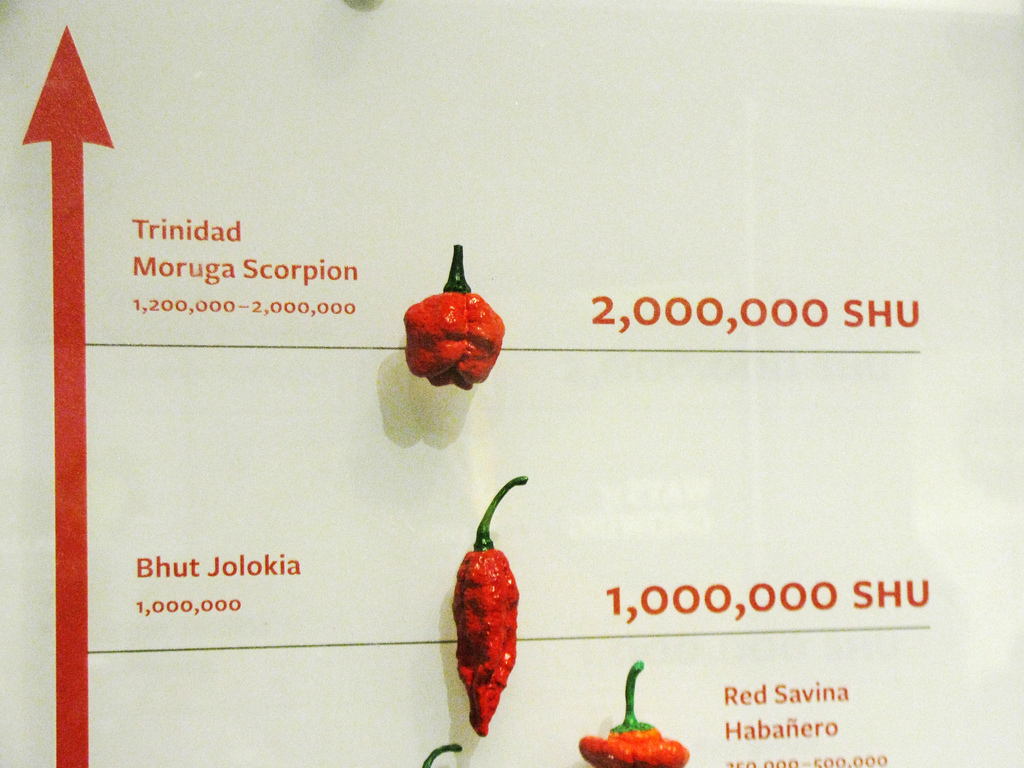
There’s an arms race afoot to grow the hottest pepper in the world. Lessley Anderson tasted a top contender, the Moruga Scorpion:
[U]pon popping the Scorpion into my mouth, the tip of my tongue feels like it’s being jabbed by a hundred needles and there’s a heavy burn rolling toward my tonsils. My salivary glands are in overdrive, drool gushes into my mouth and my nose is running. This all from eating a piece the size of a sesame seed.
The Moruga Scorpion, in fact, is at the same Scoville heat unit (SHU) level as police-grade pepper spray. Yet the market is hungry for the superhots, “with hot sauce just behind social gaming and solar panel manufacturing as one of our fastest growing industries”:
There’s a serious commercial advantage to being the official grower of the official hottest pepper in the world. Superhot seeds aren’t commercially available from large seed companies, so heat freaks wishing to grow their own have to buy them online from small suppliers like Duffy and Currie. Being able to market yourself as the record holder is great advertising. Hot sauce makers, who generally contract with one main grower, sell more sauce with a world-famous chile on the label.
“The Superhot peppers are an extremely valuable commodity,” says Dave DeWitt, an author and chile expert who runs the industry’s biggest event, The National Fiery Foods and Barbecue Show in Albuquerque, New Mexico. A typical Scorpion pepper pod at a farmers’ market will go for one dollar, notes DeWitt. “Think if you had an acre of these things; think how much money you could generate. Behind marijuana, they have the potential to become the second- or third-highest yielding crop per acre monetarily.”
On a topic I touched upon here, Harold Pollack, not a big fan of the Tory prime minister, concedes that “Thatcher-era British policies provided a damning contrast to the Reagan and George H. W. Bush administrations”:
The Thatcher government responded rather effectively and humanely to the HIV/AIDS crisis. Embracing harm reduction measures such as syringe exchange and methadone maintenance, it saved thousands of lives. Indeed the words “harm reduction,” anathema to American drug control policy until the Obama administration, were official watchwords of British drug policy. As Alex Wodak and Leah McLeod summarize this history:
By 1986 the Scottish Home and Health Department concluded that ‘the gravity of the problem is such that on balance the containment of the spread of the virus is a higher priority in management than the prevention of drug misuse.’ and recommended accordingly that ‘on balance, the prevention of spread should take priority over any perceived risk of increased drug use.’ This approach was strengthened by the influential UK Advisory Committee on the Misuse of Drugs asserting in 1988 that ‘the spread of HIV is a greater danger to individual and public health than drug misuse…accordingly, services that aim to minimize HIV risk behaviour by all available means should take precedence in development plans.’
Whitney Mallett looks into the origins and usage of marijuana brand-names:
The demand for all these different strains is relatively recent. Once upon a time, pot was pot and you bought what your dealer down the street was selling. But a new breed of cannabis connoisseur has emerged alongside increasingly nuanced legal restrictions. In the Netherlands in the 1970s, coffee shops dispensing marijuana tolerated by the government started cropping up. For the first time, there were dozens of different strains on the menu. Today medical marijuana dispensaries in North America offer a similar range of choices.
But crops of the same strain can vary:
Marijuana Man [aka Greg Williams] agrees that increased legalization will lead to a more regular product. But he also points out that Mother Nature is still bound to create unpredictability. “Each crop is going to be a little bit different,” he explains. “In Amsterdam, I would go in and buy Haze and then go in again and ask for the same thing, and the guy would say, ‘It’s not as nice this time.’” Just as wine from the same type of grape and the same vineyard varies dramatically year to year, marijuana of the same strain and same growing conditions varies too.
If I live that long, I fancy a retirement to Colorado or Washington or perhaps even Ptown where I can blog as a legal canna-critic. We have wine critics. And food critics. Why not a critic of the thing that makes food and wine even more blessed? By then, the subtleties, the mixes of CBD and THC, the nuances of sativa and indica strains will all be turned by the genius of the free market into something quite marvelous. We will finally have made of this weed what was long made of the simple grape.
And we will all be happier. Which is the point of America, right?
(Photo: Dave Warden, a bud tender at Private Organic Therapy (P.O.T.), a non-profit co-operative medical marijuana dispensary, displays various types of marijuana available to patients on October 19, 2009 in Los Angeles, California. By David McNew/Getty.)
My interview with Vanity Fair‘s John Heilpern is up:
“What have you done for pleasure lately?” I asked.
“You mean apart from the occasional sodomy?” he replied.
We also talked blogging models:
He conducts an ongoing conversation with more than a million people a month about such topics and hobbyhorses as the intransigence of Republicans versus Obama (which he nicknames Wile E. Coyote and the Road Runner); the moral shamefulness of government-sanctioned torture; pedophilia and the lost credibility of the Catholic Church; and Montaigne’s essay on why we bless someone who sneezes.
“Montaigne was an early blogger,” he pointed out, for he wrote about everything under the sun. And doubtless Pascal too—for what else are prototype blogs but spontaneous pensées? Sullivan himself was a born blogger before blogs existed. Among the brightest and best of his Oxford and Harvard generations, he was weaned on the old print media of Fleet Street when he left Oxford to join The Daily Telegraph in 1984—an unapologetic Thatcherite and novice editorial writer among the gilded newspaper palaces along the Street of Shame.
“People forget that we churned out an editorial a day at newspapers. When I went to the Telegraph, the editorial conference took place at 4:30, and there was tea afterward, and gin. They’d already demolished two bottles at lunchtime. Copy was due at seven P.M., and you had to write it on deadline, very concisely, very solid.” He began to laugh. “That’s how I learned how to blog—in the most traditional setting ever.”
Bill McKibben claims “the hardest part of the Keystone pipeline fight has been figuring out what in the world to do about the Democrats.” He acknowledges that, “taken as a whole, they’re better than the Republicans”:
[A]s I turn this problem over and over in my head, I keep coming to the same conclusion: We probably need to think, most of the time, about how to change the country, not the Democrats. If we build a movement strong enough to transform the national mood, then perhaps the trembling leaders of the Democrats will eventually follow. I mean, “evolve.” At which point we’ll get an end to things like the Keystone pipeline, and maybe even a price on carbon. That seems to be the lesson of Stonewall and of Selma. The movement is what matters; the Democrats are, at best, the eventual vehicle for closing the deal.
The greatest error of almost all important social movements is to look for and follow the politicians for success. The politicians are often the last people to get it. That was the underlying principle behind the marriage equality movement – we would change hearts and minds on the ground first. Then after 25 years of that, we have a sudden Senate majority for equality. In a couple of months. That pattern can tell you a lot.
Now that’s an awesome view! It certainly looks like it could be in the Alps somewhere, but I am going with the U.S. because I think we have more of a fondness for fences than Europeans, though I could be wrong about that. The mountains look more like the Rockies than the Sierra Nevada, and a couple of my students mentioned Telluride but then said no to that because the town is more self-contained than what we’re seeing. However, I did notice that on the outskirts of Telluride there is an area called Mountain Village, which is more residential and would have this view overlooking Telluride, which would be just off to the northeast. Sunset in beautiful Mountain Village, CO?
Another looks west:
I’m sure someone will be able to pinpoint the exact hotel, room, and, based on the angle, the probable height, weight, and dietary preferences of the photographer, but it looks a lot like Jackson Hole, Wyoming to me. I’ll go ahead and guess the Grand View Lodge.
Another jumps to Europe:
This looks to me very much like the Alps based on the landscape and chalet style houses; the modern square building in front makes Italy and France less likely, leaving Switzerland, Austria and Liechtenstein. I imagine some readers will spend hours figuring this out – I’ll just guess the western outskirts of Vaduz, Liechtenstein since the mountain range across the valley looks like the one you see from Vaduz.
Another:
Swiss Alps! French Alps! German Alps! Austrian Alps! I have no idea which Alps this view belongs to, but lovely it is. An hour browsing through pictures of the Alps is not an unpleasant hour at all. But I’m reduced to a wild guess: Engelberg, Switzerland. And just for fun, here’s one of the many beautiful Alpine views I came across in my searching. Okay, one more.
Another:
Verbier, Switzerland? I am sure that is not correct. I am not a geolocation wonk but enjoy VFYW for the memories and other connections evoked by the photographs. I spent my 20th birthday in Verbier, over 30 years ago. The view from my window that morning was as peaceful and full of promise as this week’s shot.
Another adds his own view:
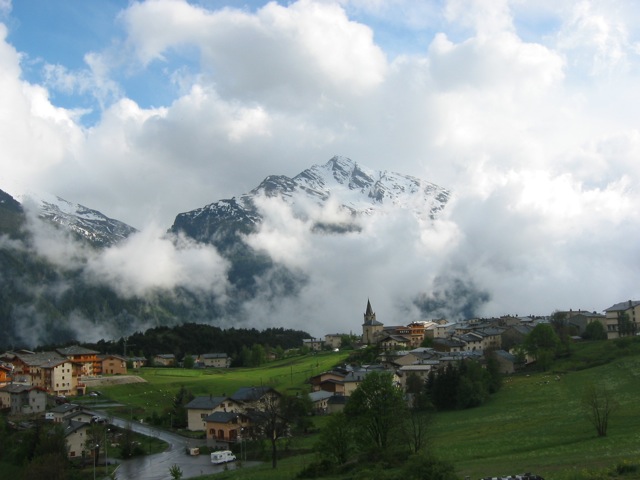
Wow, this week’s contest brought back a strong memory of a conference I went to five years ago in the French Alps. Here’s a picture I took at the time, from the Centre Paul Langevin looking into the village of Aussois:
What a gorgeous location. Pretty similar, huh?
But not quite the same. In the contest photo, there’s no church, and the mountain looks different and more distant. So you’re not going to get the level of detail from me that usually wins these contests, as in “the photo was taken at 7:23 pm from the east-facing window of suite 327 in the Smith building, and assuming the photo was taken by someone standing with the camera at eye level, the photographer was 6 ft. 2 in. tall, with a slight limp and probably dark brown hair and moderate acne.” Heck, I may not even be in the right country. But thanks for the excuse to reminisce and go thru some old pix of mine!
Another gets the right country:
Clearly in the alps, and likely Austria, eastern Switzerland, or perhaps even Lichtenstein if I remember my rooflines right. No time for a search – have to go shovel an half-foot of snow off the driveway for the second time today – so I’m going with a town I visited on a high school ski trip and had some fine fondue chinoise: Lech, Austria.
A previous contest winner nails the exact location:
A few months ago you had a great contest, #139, which featured a German schloss that no one actually found. As time ran out, my failed search for it ended just 40 miles to the south in the vineyards of the Rheingau. When I realized this week’s view was nearby, in the Alps, I saw a chance for redemption. But with weak clues, such as the sun’s angle or the ski tips at lower right, and having never skied in Europe, my only option was to start “trekking” through the mountains. And trek I did. Hour after hour, through every snow peaked massif and ski resort the Alps have to offer. Finally, late on Sunday night, pay-dirt:
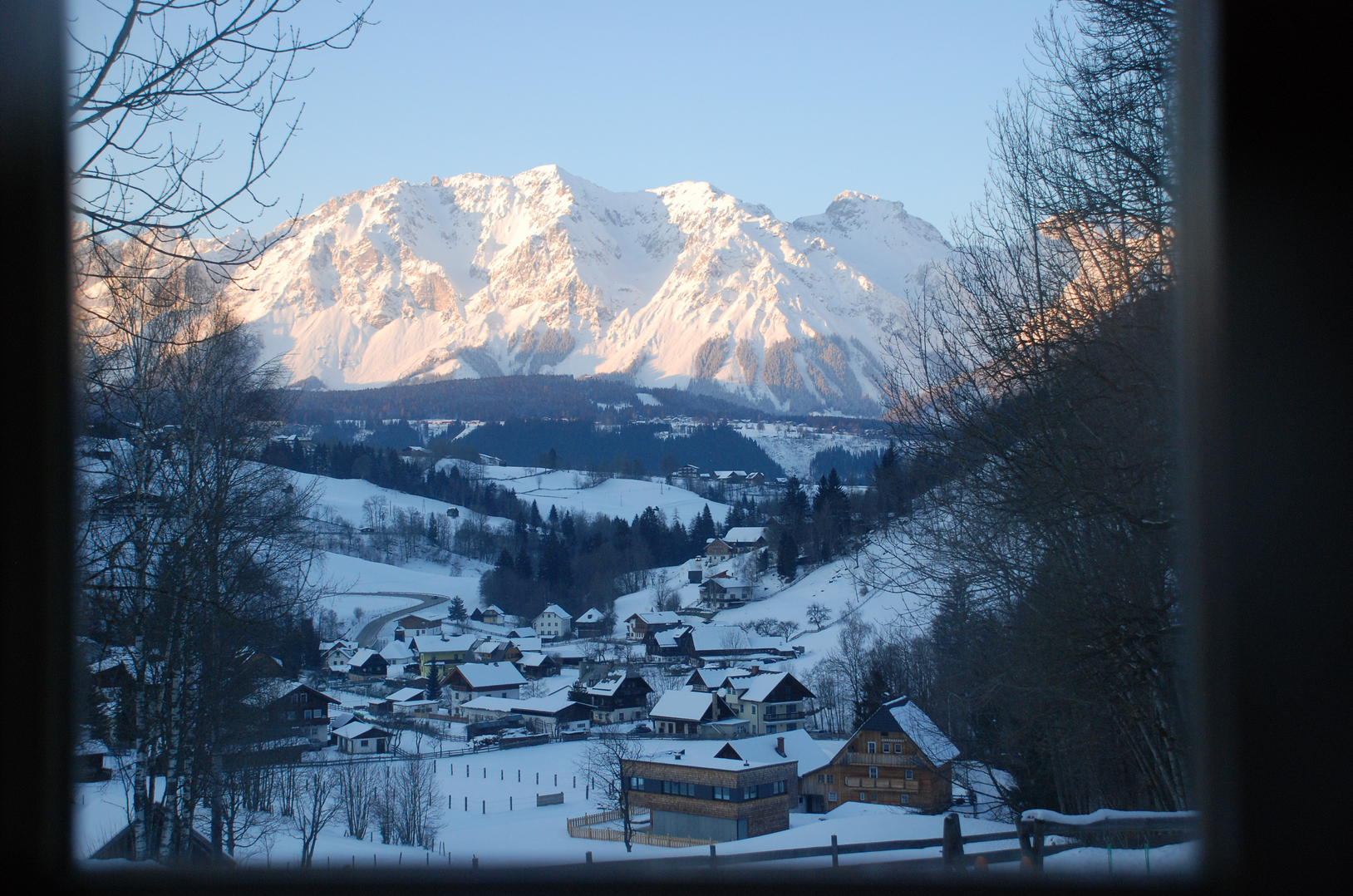
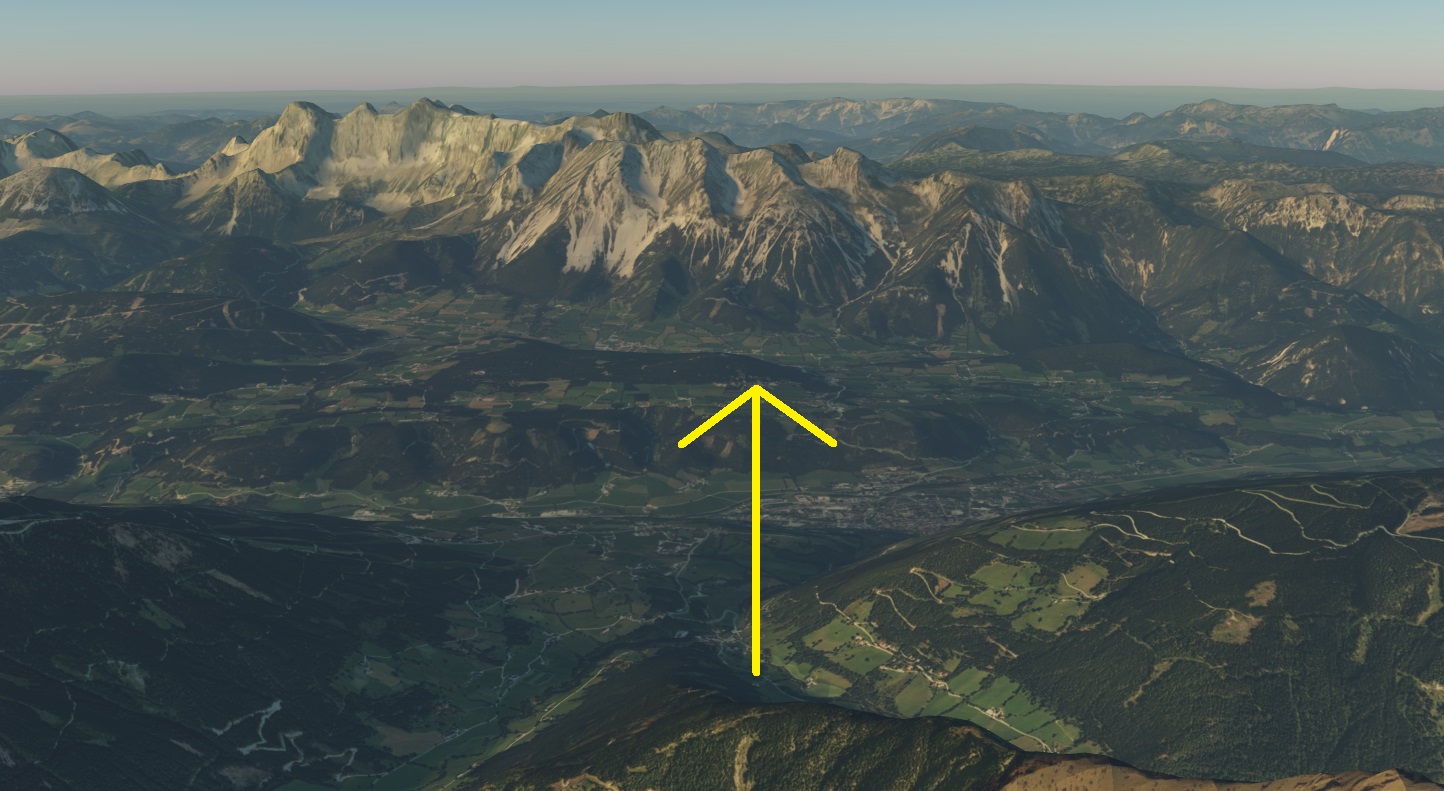
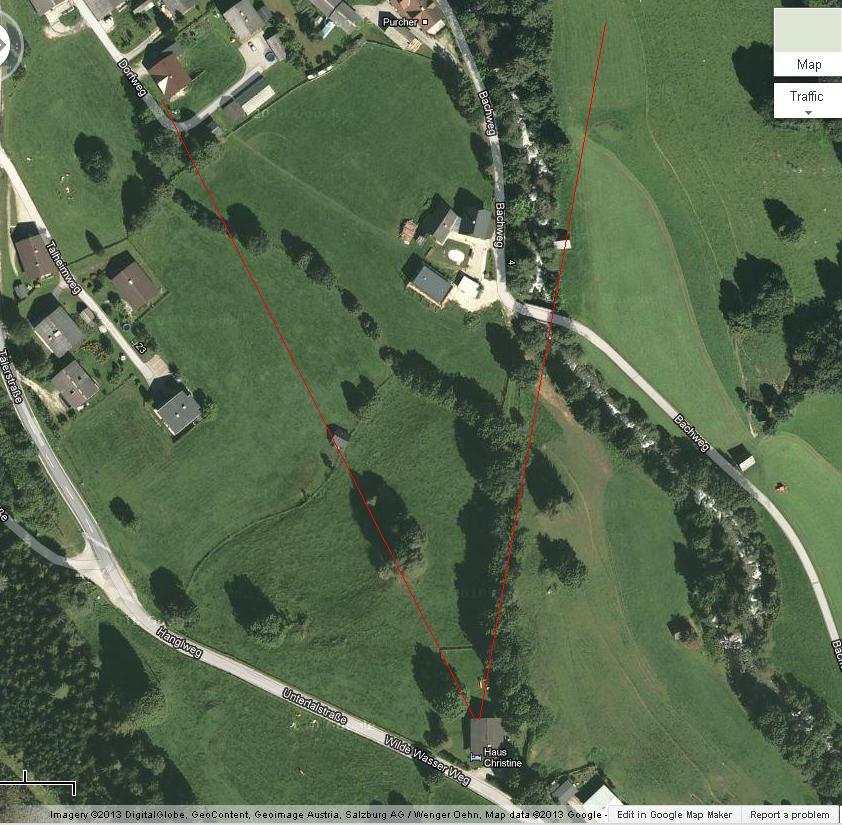
This week’s view comes from the village of Rohrmoos-Untertal, Austria, in the Schladming ski region. The photo was taken by a Dish fan who rented an apartment in a private ski-haus named for its owner, Christine Milalkovits. The house is located at 104 Untertal Strasse, altitude 2,961 feet above sea level, latitude 47.22.04.91 N, longitude 13.40.44.91 E. The view was taken from the first floor and looks nearly due north along a heading of 353.33 degrees towards the Dachstein massif.
Ironically, I thought the orange plastic tips in the lower right of the photo were skis, so I emphasized ski resorts while searching. Turns out, they’re actually the handrails for a child’s slide/swing. So it goes.
Attached is a bird’s eye view which simulates the lighting on February 28, 2013 at 5:07 PM local time (my best of four estimates for time and date):
Lastly, in recent weeks readers have been sending in some pretty nice visuals, so I created something new to try and keep up. Assuming it can be transcoded and uploaded, it’s a video which might as well be titled “The View From (an F-16 doing 400 mph above) Your Window”:
The only other reader to answer the correct village writes:
This view reminded me of Flachau, Austria, where spent some vacations as a child. So I started looking in the right general area right away. Google maps Austria doesn’t have street view, but I think I found the flat-roofed building in the aerial photograph:
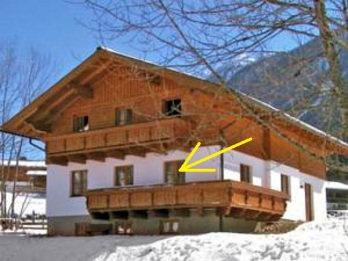
My guess is that the view is from Haus Christine, Untertalstraße 104, 8971 Rohrmoos-Untertal, Austria, looking north over the village of Rohrmoss-Untertal towards the Dachstein mountains from a room in the north-west corner of the house.
Congrats to our reader on the tough win. Details from the submitter:
This picture is taken from one of the first floor bedrooms of the Apartment Christine II in Schladming-Rohrmoos, Austria. The mountains to the north are the Dachstein mountains, a spectacular range covering the Austrian regions of Upper Austria, Styria and Salzburg. There is actually a ski resort at the top (nearly 3000 meters high), accessible only via a Gondola. On our side of the valley you have the ski resorts Fageralm, Reiteralm, Hochwurzen, Planai, and Hauser Kaibling; Rohrmoos is in the valley between Hochwurzen and Planai.
We were here for a week to ski and watch the second half of the FIS World Cup Alpine Championships, held at Planai (Schladming), where the USA did remarkably well despite the early injury of Linsey Vonn. Austrians are bat-shit crazy about skiing; while they were gracious hosts to all racers, they would certainly cheer the 6th place Austrian well above the first place foreigner. We are certainly skiers but not really ski spectators, but it was easy to get caught up in the emotions when you are surrounded by thousands (upwards to 40,000 near the end ofthe week we are told) of fanatical fans.
By the way, you have posted in the past our VFYW shot in Lake Tahoe. At the time I commented that none of the Views ever have children compositions obstructing the otherwise interesting perspectives. In our case it was these same kids (9 and 5-year-old twins, all girls) who brought us to Europe (Salzburg) for a year: my wife is German and our kids were not making as much progress in their command of the German mother tongue as we had hoped, so we have taken the immersion (otherwise known as throwing your kids to the wolves) route. It was in Salzburg that we were introduced to Krampus‘, which I emailed you all about early in December [see photo to the right]. Weird shit.
As with the thousands of others I too am a Dish subscriber and wish you all continued success. I am not gay; not conservative; not Catholic (or religious); and clean shaved, which is why I enjoy the perspectives and am willing to pay them, unreserved.
A lady poses behind a sign displaying the message ‘Ding Dong! The Witch is Dead!’ as she celebrates the death of former British Prime Minister Margaret Thatcher in Brixton on April 8, 2013 in London, England. By by Danny E. Martindale/Getty Images.
year-round,at art fairs, auctions, biennials, and big exhibitions, as well as online via JPEG files and even via collector apps. Gallery shows are now just another cog in the global wheel. Many dealers admit that some of their collectors never set foot in their actual physical spaces.


 This week’s view comes from the village of Rohrmoos-Untertal, Austria, in the Schladming ski region. The photo was taken by a Dish fan who rented an apartment in a private ski-haus named for its owner, Christine Milalkovits. The house is located at 104 Untertal Strasse, altitude 2,961 feet above sea level, latitude 47.22.04.91 N, longitude 13.40.44.91 E. The view was taken from the first floor and looks nearly due north along a heading of 353.33 degrees towards the Dachstein massif.
 By the way, you have posted in the past our


