The Grey Lady Goes Zen

by Zoe Pollock

Justin Ellis applauds a new project from the NYT’s James Harris:

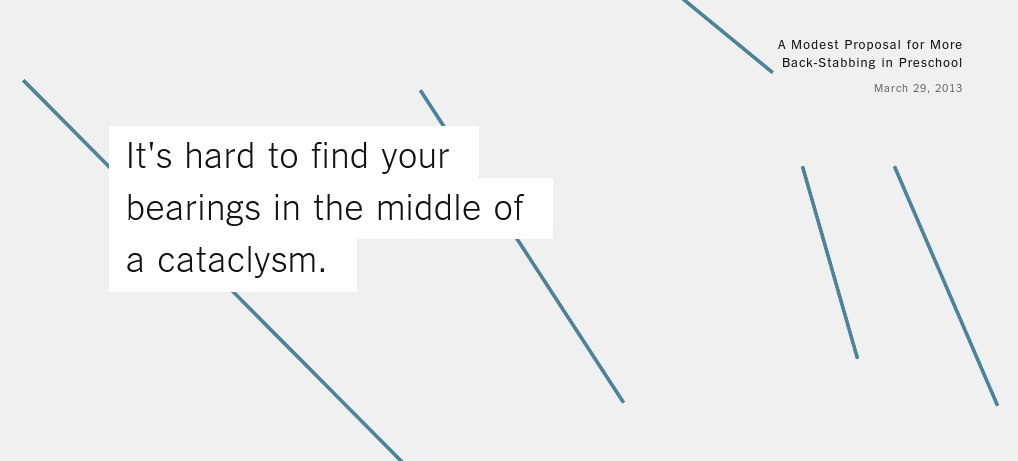
Times Haiku is a collection of what they are calling “serendipitous poetry,” derived from stories that have made the homepage of NYTimes.com. The haiku live on a Tumblr hosted by the Times. Harris built a script that mines stories for haiku-friendly words and then reassembles them into poetry. (For those of you that may have zoned out in class, haiku are comprised of three lines with, in order, five, seven, and five syllables.) The code checks words against an open source pronunciation dictionary, which handily also contains syllable counts.

“Sometimes it can be an ordinary sentence in context, but pulled out of context it has a strange comedy or beauty to it,” Harris said. … The result, much like @nytimes_ebooks, is bizarre, quirky, and kind of zen.

As Harris explains on the About page, it’s not a strict interpretation of the form:

Most of us first encountered haikus in a grade school, when we were taught that they are three-line poems with five syllables on the first line, seven on the second and five on the third. According to the Haiku Society of America, that is not an ironclad rule. A proper haiku should also contain a word that indicates the season, or “kigo,” as well as a juxtaposition of verbal imagery, known as “kireji.” That’s a lot harder to teach an algorithm, though, so we just count syllables like most amateur haiku aficionados do.

But it’s got a solid foundation:

Articles covering sensitive subjects are not scanned for potential haikus, and the bot knows to skip anything with awkward sentence construction. … “Over time we’ve added syllable counts for words like ‘Rihanna‘ or ‘terroir,’” the haiku Tumblr reports. Yesterday, Harris posted on Twitter that he was adding syllable counts for “gewürztraminer, vindaloo, sabermetrics, esoterica, mortarboard, defenestrate, koan, nametag, ceramicist…”

One more cool fact via Ellis: the blue lines behind the haiku are computer generated, based on the meter of the first line of text.

(Image: Times Preschool Haiku)
Faces Of The Day

by Zoe Pollock

Kottke compares beauty across the ages:

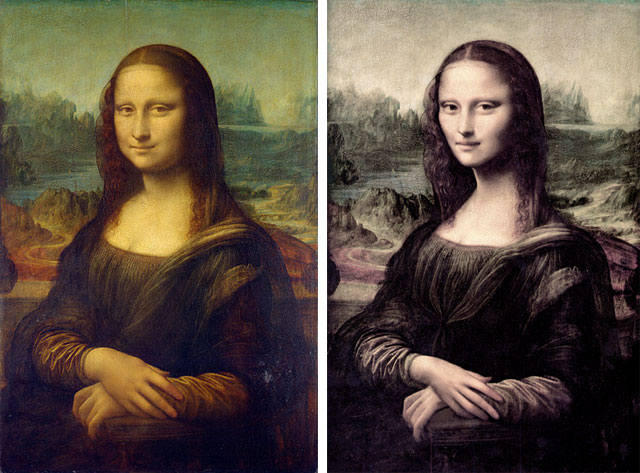
For his Alpha Beauties project, artist Nazareno Crea retouches paintings and sculpture from throughout history, a process which normalizes each period’s ideal of female beauty to that of the present day. That is, much skinnier, with smaller noses, higher cheekbones, and larger breasts.

For a similar eye-opener, check out these webcam workers posing like famous works of art.

Listening To A Picture

by Brendan James

Patrick Feaster found a way to recover the audio of records that have perished using photographs of the discs:

To “hear” the vanished record, Feaster scanned the page into a computer, unwound the lines from their spiral, cleaned up any breaks, and ran the resulting image through software that converted the lines into audio files. (Feaster details the process in more technical terms, with accompanying screenshots, in this blog post.)

The Great American Novelist

by Matthew Sitman

Pivoting off the recent PBS documentary, Philip Roth: Unmasked, Michael Kimmage finds the novelist to be the last of a dying breed:

Writing in American, he stands in a long line of national writers, each of them a living presence in Roth’s own novels: Hermann Melville, William Faulkner (Roth’s Newark resembles Faulkner’s South), Saul Bellow. These writers depended on American novel readers, even if, in Melville’s case, it took a few generations for them to find their way to Moby-Dick. They also depended on the cherished idea of a national literary culture. American novel readers are dwindling, and the ideal of a national literary culture is fading away. It has been passed over by writers, critics, editors, publishers, and academics convinced that, to be good, literature must be global. Accordingly, most contemporary literature vacillates between the island of the self and an ocean of global detail. The national writer, a product of the nineteenth century, is a relic of the past. Yet it was Roth’s calling to be exactly this, to join nation and imagination and to serve his citizen-readers as a writer-citizen, the worthy object of as many monuments as the nation is willing to sponsor.

The View From Your Window Contest

Screen Shot 2013-04-06 at 1.12.11 AM

You have until noon on Tuesday to guess it. City and/or state first, then country. Please put the location in the subject heading, along with any description within the email. If no one guesses the exact location, proximity counts.  Be sure to email entries to contest@andrewsullivan.com. Winner gets a free The View From Your Window book. Have at it.

Where Are The YouTube Politicians?

by Zoe Pollock

Seth Masket wonders:

A century ago, if you wanted to run for office, you needed the backing of a party boss or some major money figure; no one could do it on their own. You needed expertise, infrastructure, and lots of money—more than any one person could amass. Yet today, the thinking goes, it’s possible to put together a campaign by yourself. A charismatic speaker with a bit of money can just hire some people and use some clever marketing tactics (Facebook ads! Viral videos!) and get himself elected. You can probably do it all with an iPhone. Except… it doesn’t actually work that way. No, the party bosses don’t quite work the way they used to, but they’re still there, in one form or another. And people who think they can make it in politics on their own fail far more often than they succeed.

In research for my book, I studied the backgrounds of people involved in local politics in California. It turns out that lawyers and businesspeople, the people we tend to think of as strong potential candidates, have no real advantage in elections—they do about as well as anyone else. The people who do have electoral advantages are those who have worked for officeholders, are related to officeholders, or have ties to political organizations like unions or interest groups.

When CGI Came Of Age

by Brendan James

This embed is invalid


Alexander Huls considers the profound impact of the special effects developed for Spielberg’s Jurassic Park:

[M]oviegoers had yet to accept CGI as anything more than a novelty. As journalist David Morgan observed in 1993, “audiences were always aware that what they were watching was carefully crafted special effects.” Which is why for all of Terminator 2: Judgment Day’s success and technological innovation, its effects didn’t so much sweep audiences away as it did elicit “How did they do that?” reactions. For effects to truly break, their creators had to advance the technology to the point where the seam between illusion and reality completely disappeared.

Jurassic Park did that. Spielberg told Tom Shone (for Blockbuster: How Hollywood Learned to Stop Worrying and Love The Summer) that when he saw Industrial Light and Magic’s first test shots of the dinosaurs, he felt as though he was “watching our future unfolding on the TV screen.” George Lucas, who was also there, recalled “it was like one of those moments in history, like the invention of the light bulb or the first telephone call… A major gap had been crossed and things were never going to be the same.” He was right. In the words of Shone: “Jurassic Park heralded a revolution in movies as profound as the coming of sound in 1927.”

What’s Wrong With Homosexuality?

by Matthew Sitman

In support of his new book, John Corvino has produced a series of video that provide succinct versions of his core arguments. The first tackles a common trope in debates about gay people, “Love the sinner, hate the sin”:

In another installment, he gets to the, uh, bottom of anal sex:

It Ain’t Easy Being Ivy?

by Doug Allen

Yale senior Bijan Stephens is pessimistic about his job prospects after graduation:

[Millennials are] cynical because we have to be. America’s economy is self-destructing, wealth inequality is at historic highs, and there’s a chronic shortage of employment, especially for recent grads. According to a Rasmussen report, released on Feb. 5, only 15% of American adults think that their children will be better off than them. That’s a bleak number. What’s worse are the unemployment rates for recent college graduates, astronomically high rates of underemployment, and the phenomenon of long-term negative economic effects—termed “scarring”—that happen as a consequence of recessions. …

[M]y friends and I all know people who graduated from Yale and haven’t been able to find jobs that pay better than minimum wage afterwards: they work as bartenders and in sandwich shops, doing unpaid internships, living on tips. There are only four weeks of classes left in my college career, and I’m still unemployed. It doesn’t surprise me that we’re a generation of cynics. Do we—the kids—stand a chance?

I just can’t find that much pity for someone with a Yale degree who’s having trouble finding a job. Stephens cites statistics that highlight some very real problems faced by graduating college seniors in this tough economy, but these problems are undoubtedly much worse for the 99.9% of undergraduates who don’t have an Ivy League degree.

As a Stanford graduate myself, I think I can empathize with what Stephens is going through to a certain extent. It can be stressful trying to find the right career path to take, and I’ve noticed a tendency to restlessness among some of my peers who are dissatisfied with what they are doing but worried about leaving their jobs due to the economy. Two years ago, I did that myself, leaving my fairly cushy energy consulting job to go back into academia in a new field. Since then, I’ve had an underlying anxiety about whether I made the right choice and what my job prospects will be when I finish my graduate program. But I have found it important to keep in mind that this anxiety is a result of my own choices, not the result of society stacking the deck against my success.

If you are lucky enough to attend an Ivy League school, you definitely stand a chance. What you do with that chance, however, is up to you.

A Poem For Saturday

by Matthew Sitman

auntclara

Here’s our second poem from Robert Bly, “Something to Do for Aunt Clara”:

There’s something we hold to in the morning. Maybe
It’s just the light, or the way the clock by the bed
Changes slowly, or how wall paintings gradually
Become clear, or the good weight of the eiderdown.
Maybe it’s all the books here in this room.
And the sound of dishes rattling, and the teenagers
Waking up, and a child muttering to herself. Now we have time
For the last few sips of coffee before we go to the funeral.

(From Talking into the Ear of a Donkey © 2011 by Robert Bly. Reprinted with permission of W.W.Norton & Company. Photo by Flickr user oveth)