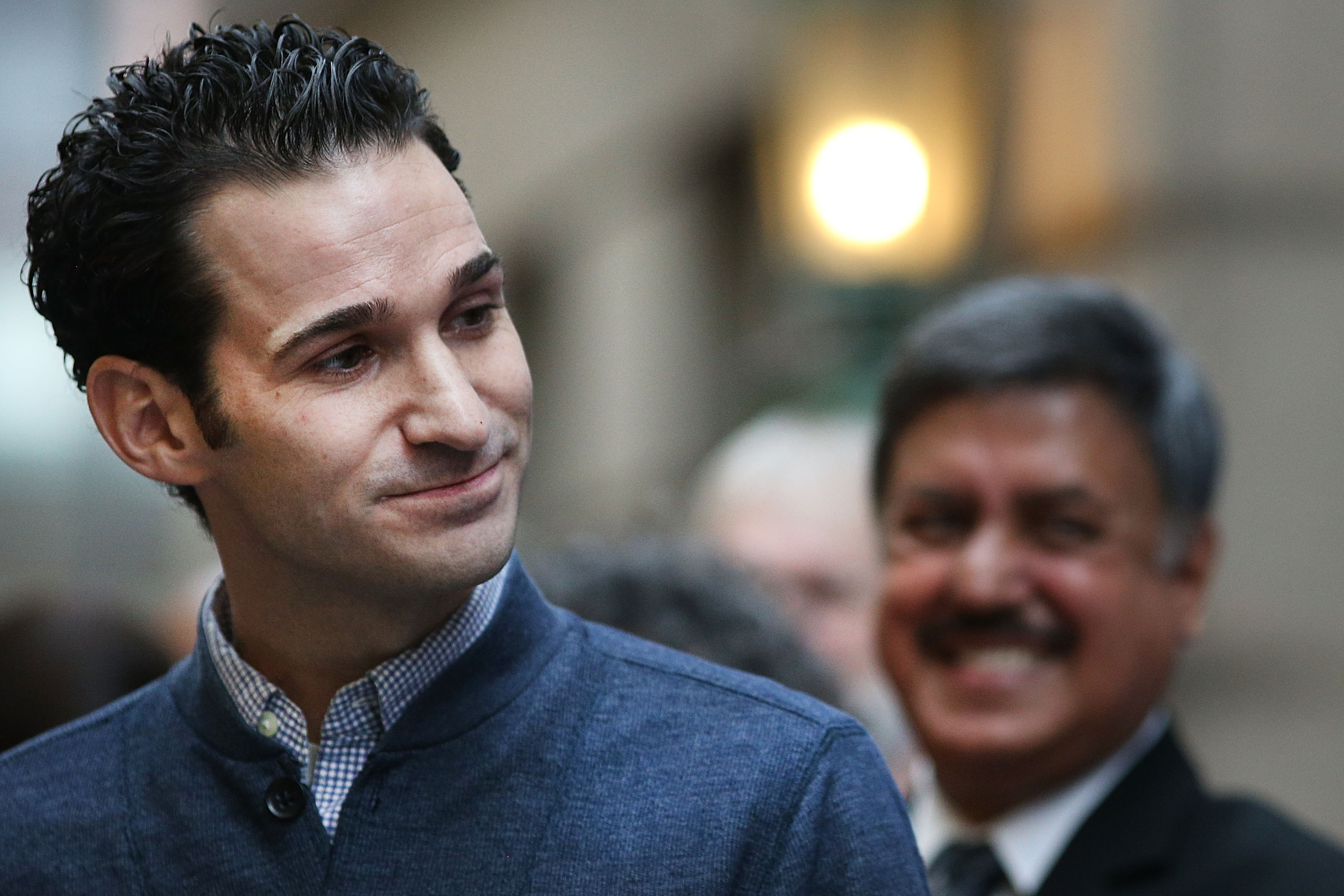
Dr. Craig Spencer, who was diagnosed with Ebola in New York City last month, is viewed at a news conference at New York’s Bellevue Hospital after being declared free of the disease on November 11, 2014. By Spencer Platt/Getty Images.
Dr. Craig Spencer, who was diagnosed with Ebola in New York City last month, is viewed at a news conference at New York’s Bellevue Hospital after being declared free of the disease on November 11, 2014. By Spencer Platt/Getty Images.
Danny Heitman takes a stroll through Shakespeare’s Montaigne, a new edition of John Florio’s 16th-century English translation of the Essays that almost certainly made its way into the playwright’s hands:
Many of the details of Shakespeare’s life are unknown, and how closely he might have read Florio’s Montaigne is unclear. But in a couple of plays, Shakespeare’s debt to Montaigne seems obvious. In “Of the Cannibals,” an essay about people recently discovered in the New World, Montaigne writes admiringly of natives who “hath no kind of traffic, no knowledge of letters, no intelligence of numbers, no name of magistrate, nor of politic superiority.” Very similar language appears in The Tempest, when Gonzalo considers the kind of society he wants to establish on the island where he and others have been shipwrecked. There’s another apparent instance of borrowing in King Lear, which includes a passage that seems cribbed from Montaigne’s observations about the ideal relationship between parents and children.
Beyond that, the question of Montaigne’s influence on Shakespeare becomes more speculative. [In his introduction, scholar Stephen] Greenblatt shrugs at that ambiguity, concluding that whatever the possibilities, the mere existence of these two men was a miracle in itself: “Two of the greatest writers of the Renaissance—two of the greatest writers the world has ever known—were at work almost at the same time, reflecting on the human condition and inventing the stylistic means to register their subtlest perceptions in language.”
An excerpt from Greenblatt’s introduction on the connection between the two great writers, in which he notes that “what is a problem for the scholarly attempt to establish a clear line of influence is, from the perspective of the common reader, a source of deep pleasure”:
And though, as we have noted, they came from sharply differing worlds and worked in distinct genres, they share many of the same features. Both Montaigne and Shakespeare were masters of the disarming gesture, the creation of collusion and intimacy: essays that profess to be “frivolous and vain” (“The Author to the Reader”); plays with titles like As You Like It and Much Ado About Nothing. Both were skilled at seizing upon anything that came their way in the course of wide-ranging reading or observation; both prized the illumination of a brilliant perception over systematic thought; both were masters of quotation and transformation; both were supremely adaptable and variable. Both believed that there was a profound link between language and identity, between what you say and how you say it and what you are. Both were fascinated with ethical meanings in a world that possessed an apparently infinite range of human behaviors. Both perceived and embraced the oscillations and contradictions within individuals, the equivocations and ironies and discontinuities even in those who claimed to be single-minded and single-hearted in pursuit of coherent goals. Montaigne and Shakespeare created works that have for centuries remained tantalizing, equivocal, and elusive, inviting ceaseless speculations and re-creations. In a world that craved fixity and order, each managed to come to terms with strict limits to authorial control, with the unpredictability and instability of texts, with a proliferation of unlimited, uncontrolled meanings.
Veteran Dan Gomez heartily endorses William Broyles’ 1984 essay “Why Men Love War“:
It is the most perfect piece of military writing on the subject of ‘why’ that I have ever come across. It is for me, the ‘big bang’ theory of why we fight.
Broyles’ takes the reader through a fantastically descriptive journey of what war feels like and he gets it down better than anything I’ve ever read or even anything I’ve even seen in film. It’s a long form piece that he wrote more than fifteen years after returning from Vietnam. He had the time to reflect on his experience and the space in the magazine to get it all down. In 6,588 words, he paints the thoughts in his head and the feelings in his heart.
That’s why men in their sixties and seventies sit in their dens and recreation rooms around America and know that nothing in their life will equal the day they parachuted into St. Lo or charged the bunker on Okinawa. That’s why veterans’ reunions are invariably filled with boozy awkwardness, forced camaraderie ending in sadness and tears: you are together again, these are the men who were your brothers, but it’s not the same, can never be the same. That’s why when we returned from Vietnam we moped around, listless, not interested in anything or anyone. Something had gone out of our lives forever, and our behavior on returning was inexplicable except as the behavior of men who had lost a great – perhaps the great – love of their lives, and had no way to tell anyone about it. …
This month marks the thirty-year anniversary of the publication of ‘Why Men Love War.’ It’s no less true today than it was then. I hope that it will be widely read, especially among today’s newest generation of veterans, to give them the peace of mind that what they’re experiencing is not new. If they read with an open mind, they might even come closer to reconciling their feelings on war, and recognize that there is no great answer but the terrible truth. We love war because it’s fun. It’s terrible, reviling, and true. The dirty, nasty thing was a blast, and we know we’re not supposed to think that. We’re especially not supposed to feel that. But we do.
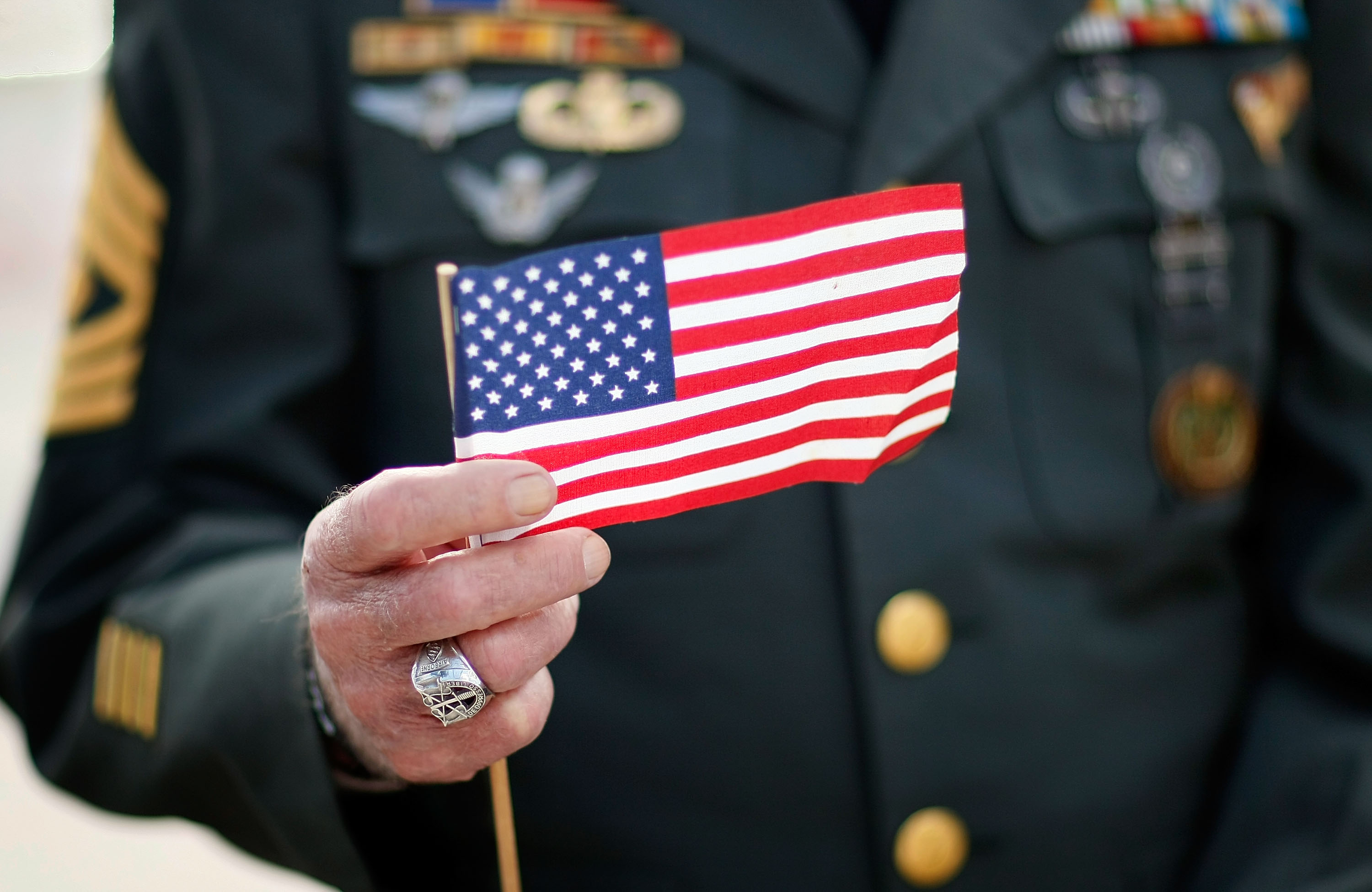
(Photo by Joe Raedle/Getty Images)
Well, do ya?
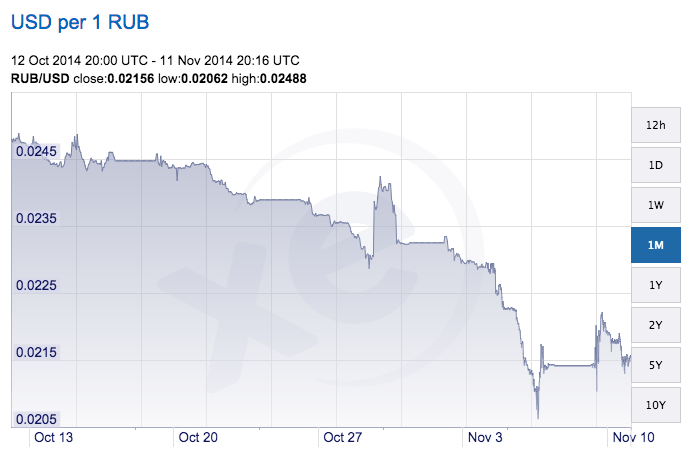
The Russian economy looks like it’s on the verge of a full-fledged meltdown. The central bank projects zero growth next year and barely more than that in 2016, while the ruble’s value has plummeted. Amanda Taub voxplains what the heck is going on:
The fall in the ruble appears to be mainly the result of two factors: a sharp decline in global oil prices and sanctions that Western countries put on Russia in retaliation for invading Ukraine. Those two things might not appear connected, but in a sense one led to the other. Many Russia-watchers believe that, when Russia’s economy began weakening, and, thus, so did Putin’s approval ratings, Putin responded in part by trying to increase his popular support by stirring up nationalism. That is likely one of the reasons why he invaded Ukraine, which also distracted from the poor economy. If that’s right, then that would mean that the sanctions meant to weaken Russia’s economy are also a result of Russia’s weak economy. And that, in turn, should prompt questions about what Putin might do to shore up his support in the face of this new bad economic news.
The Bank of Russia’s usual response to such a slump is to dig into its massive reserves to shore up the currency, but yesterday, the bank announced that it would allow the ruble to float freely:
The bank had been burning through its $400 billion in reserves to cushion the drop of the ruble, spending a reported $30 billion in October alone to support the national currency. The bank statement said the decision to allow the ruble to float freely “did not amount to a total renunciation of any interventions in the currency market, which would be possible in case a threat to financial stability appears.” The ruble had dropped to 48 to the dollar on November 7, but the Russian central bank’s November 10 announcement lifted the ruble to 45 to the dollar. Earlier in day, President Vladimir Putin expressed confidence that the plummeting ruble will stabilize, saying its volatility is not tied to the country’s economy.
Bershidsky analyzes the move:
Putin’s government isn’t interested in a strong ruble now: As low oil prices make it difficult to balance the budget and as exporters, many of them state-controlled, complain about the lack of access to Western capital markets, a devaluation is the first order of business. What Putin doesn’t need is panic among ordinary Russians, which could damage his high approval ratings. As long as the central bank does its job of reducing volatility and deterring speculators, bank insiders will be free to use information about the timing of interventions to make a bit of money on the side. And Russia has a lot of hard currency to burn — $454.2 billion in international reserves at the beginning of November.
That logic, however, only holds if one believes — as Putin does, according to Kremlin insiders — that both the Western sanctions against Russia and, more importantly, the oil price drop are only temporary. If they last longer than a year or two, Russia will be in real, long-term financial trouble and it will be harder for Putin to hold on to unlimited power.
The way Ioffe sees it, the ruble’s decline “is merely a symptom of something much deeper and more worrying”:
This is Putin digging in; this is Putin reinforcing his foxhole and preparing for the long fight ahead. He will not let go of eastern Ukraine, and he is trying to keep the reserves full so that he can survive the long fight ahead. The problem, though, is that the pressure inside the system is rising. Food prices are jumping and, though so far, Russians mostly blame the West for their country’s economic malaise, it’s not clear how long that will last. …The ruble crashing won’t change anything today or tomorrow, but this is just the system starting to eat itself, this is just the system starting to crack. As I’ve written before, historically, economic crisis triggers political crisis in Russia. No one knows when one of those cracks brings the whole thing down, but there’s a growing sense in Moscow that it will happen sooner than we all think. Putin seems intent on it.
(Chart via xe.com)
Several readers attest to blurred lines between traditional gender norms. A straight dude:
Alyssa Rosenberg asked, “How much does masculine culture depend on women and femininity as a reference point?” My response: well, what do you mean be “femininity”? Traditional patriarchal notions about femininity (confined to the domestic sphere, trapped sexually in the Virgin/Whore dynamic, passive, smells nice, cooks good) are part of the problem, and part of the culture that is changing as rapidly as attitudes towards GLBT people. The traditional white masculinity that is so deplorable will never totally go away, as you’ve argued, in part because the traditional femininity that it requires will never go away either. Some women do want to stay home, raise kids, etc. Some women do believe that Good Girls Don’t.
But as women – lesbian and bi, sure, but also straight – get away from these hoary (and whorey) old notions, straight men and their masculinity will shift too. Because straight men do base our identities on relationships with women, those identities change (and already have changed) as more women are co-workers, bosses, team-mates, drinking buddies – you name the non-traditional hetero relationship.
As for Rosenberg’s specific query about action heroes and cheerleaders:
I’m not much for action movies, but give me Joss Whedon’s strong women over most male heroes. And my NFL team hasn’t had cheerleaders since 1986 (it also hasn’t won a championship without them). But I am much more likely to enjoy watching women in roller derby, or WBNA games, or NCAA Lacrosse, or World Cup Soccer, than I am to lament the lack of cheesecake on the sidelines at Soldier Field. Those women athletes and action heroes? Not traditionally feminine, but strong and sexy despite that. Or because of it.
Another guy touches on a racial angle:
As a Hispanic, I am subtly pressured to be a stereotype of the Macho Latino by my friends. I went to a bar where you could dance. I don’t think I dance well, but I think I have more fun than my friends, male or female. I’m less inhibited than they are. But when my friend saw me dance for the first time, she expressed disappointment that I’m worse than the average Hispanic man. I used one of the white men in our group as a reference point because he barely danced. Isn’t that better? It wasn’t to her. I had to dance like a Hispanic man: more skilled, more flamboyant, and more sexual than a white man.
A straight woman writes:
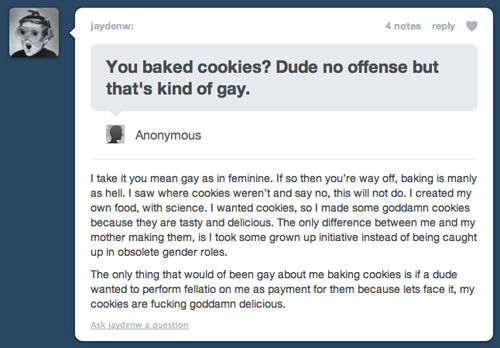
I was frustrated by your reader’s response: “All the things that make me a man, things that I enjoy, are apparently just externally forced cultural norms that I am too dumb and weak to transcend.” Those aren’t the things that make him a man! I am a women and I also enjoy hockey fights! I love the movie Training Day and all the gory violence! I also love sewing my own clothes, baking, using circular saws to build furniture, and eating grilled meats.
I think the destructive thing about “masculine culture” is the idea that being a man PER SE includes liking violent movies and games and EXCLUDES things that are not traditionally considered masculine – like baking. What makes me a woman is my anatomy and, I guess, the fact that I feel pretty at home in that anatomy. A woman who hates makeup and shopping and likes playing basketball doesn’t suddenly become a man. A man who DOESN’T like violence (or women) or sports doesn’t suddenly become not a man.
I’m reminded of this hilarious reddit response to a homophobic comment (I know this thread isn’t about homophobia, but it’s a very slippery slope):
I know I’m kind of mixing issues here, but I think he problems that arise from masculine culture arise, as some readers have said, from a fear of being considered gay or feminine or not a man. But I think (I hope) that our culture in general is moving away from the all or nothingness of boy stuff and girl stuff. I think as culture moves more and more toward recognizing that everyone is their own blend of feminine and masculine and it’s all good, this kind of thing will straighten itself out.
This reader seems to think so:
As a millennial, straight, white, male, feminist, gamer, I think I’d have a good case for being able to make some claims about masculinity. But what really gives me some credibility here is that I used to be the angry, homophobic, misogynistic young man. Over the past decade, I’ve had my mind changed on damn near everything that I once believed. I’ve also come to accept that being masculine doesn’t have one definition.
Plurality may, in fact, be what is so infuriating and terrifying for so many modern males. The idea that Tim Cook, Ron Swanson, Barack Obama, and Ryan Gosling can all be masculine is deeply confusing to anyone looking for an identity to ape. Instead, my generation is being asked to be male and be masculine in a world where that is no longer defined in opposition to the other sex but as a stand alone set of values and behaviors.
As you implied, there is too much biology and cultural inertia at play here to expect masculinity or testosterone-driven male behavior to just evaporate, but I see that one of the great opportunities my generation has been given. I don’t have to be the breadwinner. I don’t have to be outdoorsy. I don’t have to like sports or woodworking. I have a buddy who is a trans man and he is way more stereotypically masculine than I am. Yet we share a mutual admiration for each other because we are masculine in different but complimentary ways. And we both love a good steak and nice whiskey, but so does my one of my very feminine co-workers, so I’m not sure what to make of that.
My point, if there is one here, is that the straight, white, male doesn’t have an obvious definition anymore. As the party of the straight, white, male, the GOP has built itself on a house of sand just as the tide is coming in. I’m not sure what the future holds for either men or the Republican Party, but I’m trying to stay optimistic. My straight male friends and I are far more affectionate with each other (big hugs, genuine “I love you” email sign offs, that sort of thing), open with each other emotionally (crying over Robin Williams), and about our embarrassment over being frustrated about losing traditional roles (a few of us have girlfriends and wives who make more than us).
I don’t know what all that means for the future of masculinity, but I’m optimistic.
Life of Robert James O’Neill, the SEAL who kille… http://t.co/9TGf6I9IzC via @YiannCh | https://t.co/xFzIgmSczf pic.twitter.com/5TgdojUP9e
— Ioannis Chaidoulis (@YiannCh) November 7, 2014
Last week, former Navy SEAL Robert James O’Neill outed himself as the man responsible for killing Osama bin Laden:
O’Neill confirmed to The Washington Post that he was the unnamed SEAL who was first to tumble through the doorway of bin Laden’s bedroom that night, taking aim at the terrorist leader as he stood in darkness behind his youngest wife. In an account later confirmed by two other SEALs, the Montana native described firing the round that hit bin Laden squarely in the forehead, killing him instantly.
However, other sources dispute O’Neill’s account:
Shortly after the Post story went up, Reuters reported that “a source close to another SEAL team member” was contesting O’Neill’s story. The source said two other men entered the room before O’Neill, and one of them fired the fatal shot. According to the Post, O’Neill acknowledged that shots were fired at bin Laden by at least two other SEALs, but he says it was his bullet that killed the terrorist leader.
A former SEAL Team Six member told the New York Times that before tackling the women, the point man managed to wound bin Laden with a shot to his side. … Then there’s the version of events presented in No Easy Day, penned by former SEAL Matt Bissonnette. In the 2012 book, Bissonnette writes that the point man shot bin Laden in the head, and then he and another SEAL fired more shots. “In his death throes, he was still twitching and convulsing,” Bissonnette wrote. “Another assaulter and I trained our lasers on his chest and fired several rounds.”
Mark Thomson shakes his head at the very idea of crediting a single SEAL with the kill:
O’Neill’s and Bissonnette’s decisions to go public with their role violates the SEALs’ tenets and irritates many in the military. These SEALs, in the eyes of the public, become heroes once their stories are told. But the action that warrants such acclaim has been built on the backs, boots and blood of thousands of anonymous troops (not to mention Pentagon civilians). An untold number of them played critical roles in the hunt for bin Laden; remove any one from the chain of success and the mission could have failed, with the loss of O’Neill, Bissonnette and the other SEALs who participated in the raid.…
It is the selfless nature of American troops that makes their work honorable. Both the public and the press seemingly relish identifying such SEALs, and glorifying their exploits, without care for what may be lost in the transaction. If fame, and the fortune it can bring, become part of the allure of signing up with U.S. Special Operations Command, the men and women who actually make those missions possible are going to sour on their private sacrifice. The net result will be a less-capable force.
Juan Thompson claims that voter suppression tactics were at least partly responsible for the turnout trouble among Democrats last week:
In Georgia … nearly 40,000 new voters mysteriously vanished from the rolls, possibly due to scrubbing by a controversial software system known as Crosscheck. Turnout was only 34%, which is down six percentage points from 2010.
Over the past two years Raphael Warnock, leader of Atlanta’s historic Ebenezer Baptist Church, worked with the New Georgia Project to register some 80,000 new and mostly black voters. New Georgia Project’s efforts was the state’s largest voter registration drive in 50 years, according to reports. “It’s a fundamental, basic American right to vote”, Warnock told me. Such thinking explains why he was so angry when half of those new voters failed to appear on the rolls this fall. “The Georgia Secretary of State’s office had no explanation at all as to where those voters went”, Warnock explained.
A person in the Georgia Secretary of State’s office declined comment (after alerting me to the fact that “the election’s over”). But earlier this year, that same office accused the New Georgia Project of voter registration fraud. In the end only 50 questionable forms were found. Georgia, it must also be noted, is one of 27 states using the controversial software Crosscheck to weed out supposed voter fraud.
Wendy Weiser of the Brennan Center for Justice even suggests that new restrictions may have suppressed enough votes to turn some close races:
In the North Carolina Senate race, state house speaker Thom Tillis beat Senator Kay Hagen by a margin of 1.7 percent, or about 48,000 votes. At the same time, North Carolina’s voters were, for the first time, voting under one of the harshest new election laws in the country — a law that Tillis helped to craft. Among other changes, the law slashed seven early voting days, eliminated same-day registration, and prohibited voting outside a voter’s home precinct — all forms of voting especially popular among African Americans. …
Some numbers from recent elections suggest that the magnitude of the problem may not be far from the margin of victory: In the last midterms in 2010, 200,000 voters cast ballots during the early voting days now cut, according to a recent court decision. In 2012, 700,000 voted during those days, including more than a quarter of all African-Americans who voted that year. In 2012, 100,000 North Carolinians, almost a one-third of whom were African-American, voted using same-day registration, which was not available this year. And 7,500 voters cast their ballots outside of their home precincts that year.
Naomi Shavin’s early tally of calls into the Election Protection Hotline also painted a picture of an unusually problematic election:
The hotline handles calls from voters who need to know if they’re registered, find their assigned polling locations, and report difficulties in their attempts to vote. Yesterday, the national hotline had taken over 16,000 calls by 8 p.m., with 3.5 hours to go until polling ended. (By comparison, the hotline received 12,857 calls all day on Election Day in 2010.) Texas, Georgia, and Florida seemed to be experiencing a particularly problematic Election Day. The hotline took roughly 2,000 calls from each of those states. Chris Melody Fields, the manager for legal mobilization and strategic campaigns at Lawyers’ Committee for Civil Rights Under Law, said that the call center received hundreds of calls from Georgia yesterday morning alone—so many, in fact, that calls had to be rerouted to call stations for other states.
Meanwhile, True The Vote’s new fraud-reporting smartphone app only turned up a grand total of 18 reported irregularities and just one claim of voter impersonation in the entire week leading up to the election.
An adorable kind of indoctrination:
“I hope you don’t have friends who recommend Ayn Rand to you. The fiction of Ayn Rand is as low as you can get re fiction. I hope you picked it up off the floor of the subway and threw it in the nearest garbage pail. She makes Mickey Spillane look like Dostoevsky,” – Flannery O’Connor.
 The Dish