Nabokov’s Dirty Lit

Edward Jay Epstein recalls, in the fall of 1954, taking Lit 311: European Literature of the Nineteenth Century – unofficially called “Dirty Lit” for its emphasis on adultery – which was taught by Vladimir Nabokov:

I did not get around to reading any of Anna Karenina before Nabokov sprang a pop quiz. It consisted of an essay question: “Describe the train station in which Anna first met Vronsky.” Initially, I was stymied by this question because, having not yet read the book, I did not know how Tolstoy had portrayed the station. But I did recall the station shown in the 1948 movie starring Vivien Leigh. … Only after the exam did I learn that many of the details I described from the movie were not in the book. Evidently, the director Julien Duvivier had had ideas of his own. Consequently, when Nabokov asked “seat 121” to report to his office after class, I fully expected to be failed, or even thrown out of Dirty Lit.

What I had not taken into account was Nabokov’s theory that great novelists create pictures in the minds of their readers that go far beyond what they describe in the words in their books. In any case, since I was presumably the only one taking the exam to confirm his theory by describing what was not in the book, and since he apparently had no idea of Duvivier’s film, he not only gave me the numerical equivalent of an A, but offered me a one-day-a-week job as an “auxiliary course assistant.”

God From The Machine

Julia Kaganskiy profiles three programmers who are exploring the similarities between scripture and code:

In the gallery, I approached a laptop on a pedestal, flanked by tall white candles and two iPads displaying the project description and samples of the God.js code, both written in Medieval-looking type and flowery language. I was instructed to select my “religion” from a set of three belief systems available in the God.js Chrome plug-in. Each one placed a unique set of constraints on my browsing behavior, doling out punishments for transgressions, such as visiting a page with too many obscenities.

I selected the religion developed by the second developer, Will Brand, and randomly pointed my browser to Gawker. Festering boils filled the page as clipart frogs rained down. Apparently the god behind this religion was not a Nick Denton fan.

Writing The Other Sex

In an interview, the novelist Ben Schrank describes why he’s drawn to female characters:

 I don’t pretend or claim to know or understand women. But writing about men doesn’t interest me as much… The darkness and cruelty in men’s souls is not something I want to dig into. I watch guys on the subway all the time and I’m just not that curious about what they’re up to. I have a general sense and that’s plenty. That stuff doesn’t need to be fleshed out. We still live too much with the damage men do. But the darkness and cruelty in women’s souls? Women are not so easy to read. They wear masked expressions on the subway that are endlessly inscrutable. For me, women are far more provocative.

The Religious Case Against Drones

The Rev. Dr. Paul F.M. Zahl makes it:

Our use of drones are out of “proportion” because it uses the most advanced technology in the world to assassinate people who can basically only throw the equivalent of sticks and stones back at you. Moreover, it gives these people no chance to surrender. It is like capital punishment without an arrest, a charge, a trial, or a right of appeal.

Our use of drones is not humane, because it totally objectifies the enemy by making them into a picture on a screen. There is not the faintest possibility, in the conduct of drone warfare by means of remote control, that you can regard the enemy as a fellow human citizen of the planet.

Addicted To Footnotes

Helen Rittlemeyer explores the similarities between David Foster Wallace and Samuel Coleridge, which range from youthful fame to struggles with addiction. One revealing parallel? Their fascination with footnotes:

Contemporaries were skeptical of Coleridge’s protestations, just as many people today are skeptical Wallace’s, but anyone who criticizes them should first think why it makes sense that a man who overuses footnotes would also become dependent on drugs and alcohol. Coleridge and Wallace were both acknowledged as having immense native brainpower—a friend of DFW’s described him as receiving more frames-per-second than most people—and both of them were great readers with great memories. Coleridge was nearly a child prodigy, reputed to be able to recite long passages from books he’d read only once.

These men could not have a thought without twelve sidebars, citations, and quibbles popping up from their mental recesses. The result: footnotes and digressions. The other result: an overwhelming desire, when the stimulation became too strong, to power down the machine for a while. “He once said to me that he wanted to write to shut up the voices in his head,” Wallace’s best friend told a reporter. “He said when you’re writing well, you establish a voice in your head, and it shuts up the other voices.” And alcohol shuts up all the voices.

A Poem For Sunday

Caravaggio_-_The_Incredulity_of_Saint_Thomas

“Pied Beauty” by Gerard Manley Hopkins (1844-1889):

GLORY be to God for dappled things—
For skies of couple-colour as a brinded cow;
For rose-moles all in stipple upon trout that swim;
Fresh-firecoal chestnut-falls; finches’ wings;
Landscape plotted and pieced—fold, fallow, and plough;
And áll trádes, their gear and tackle and trim.

All things counter, original, spare, strange;
Whatever is fickle, freckled (who knows how?)
With swift, slow; sweet, sour; adazzle, dim;
He fathers-forth whose beauty is past change:
Praise him.

(“The Incredulity of Saint Thomas” by Caravaggio, via Wikimedia Commons)

A Different Conclusion To The Same Book

Danny Nowell recalls the first time he read Walker Percy’s The Moviegoer, describing its last thirty pages as “one of those really out of body reading experiences”:

At the time, I felt as if Walker Percy were reading my diary to me. I was eighteen and prone to seeing the world as tailored to me personally, but even still the novel was a perfect fit. The muted raciness and frustrated lust of it (it is as much about sex as any novel whose most graphic phrase is the supremely unsexy “flesh poor flesh failed us” can be) feels like a beacon to readers at the age where sex still feels like a secret. I recall feeling as if the book were the most perfect and grandest social commentary I’d ever read. I tested the word “prescient” out on my father after I’d finished it.

Five years later he turned to the book again – only to be confounded:

Family, obligation, love and its overlap with lust now populate the pages where once I read something like a neatly trimmed indictment of late capitalism. In the five years since I last read it—the time elapsed between repetitions—five years’ worth of life has accumulated. Reading my chosen terms of “family” and “obligation” as thematic signposts is as obvious a reflection of my present life as “asses” was for my eighteen-year-old self.

A Quote For Easter Sunday

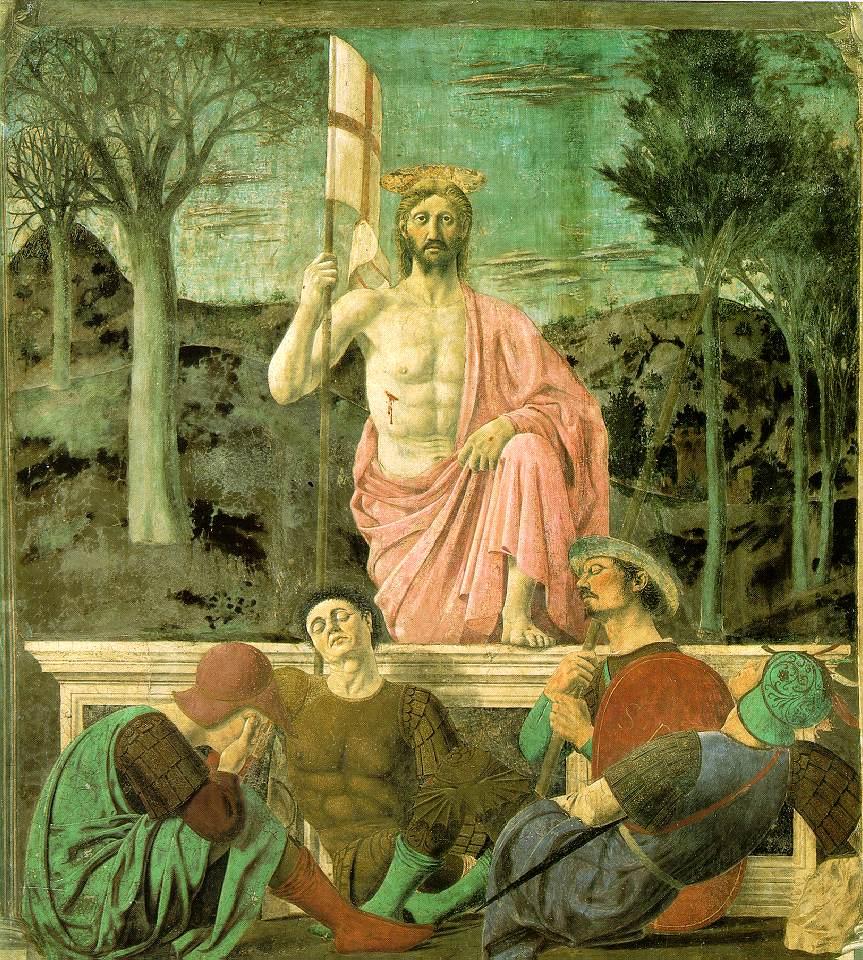
Resurrection

“It seems to me that the intent of the gospel writers is not to make the resurrection seem somehow plausible or credible – this could hardly be done without diminishing its impressiveness as miracle – but instead to heighten its singularity, when, as event, it would seem by no means unexampled. I believe it is usual to say that that the resurrection established who Jesus was and what his presence meant. Perhaps it is truer to say that opposite, that who Jesus was established what his resurrection meant, that he seized upon a narrative familiar or even pervasive and wholly transformed it.

When, in the Gospel of John, weeping Mary Magdalene stoops to look into the tomb and sees angels, they ask her, ‘Woman, why weepest thou?’ The text creates the dreamy impression that the two angels speak together. Then she turns and sees a man standing behind her, Jesus, whom she mistakes for a gardener. He speaks the same words as the angels did, ‘Woman, why weepest thou?’ and he asks, ‘Whom seekest thou?’ Does he see and hear angels, too? Or does he know her thoughts? Or was it his voice she heard in the first place? Mary herself would not have known. Jesus seems to be teasing her toward delight and recognition, ready to enjoy her surprise, in something like the ordinary manner of a friend. The narrative asserts that he is a figure of unutterable holiness, only pausing to speak to Mary before he ascends into heaven, yet it is his very ordinariness that disguises him from her. Splendor is very well for youths and angels, but when Jesus takes up again for a little while the life he had wept to leave, it is the life of a plain man,” – Marilynne Robinson, “Psalm Eight,” from The Death of Adam: Essays on Modern Thought.

(“The Resurrection of Christ,” 1463, by Piero della Francesca, via Wikimedia Commons)