A Grown-Up God

The New Statesman queried thinkers about what atheists can learn from believers. Karen Armstrong’s take is worth your time:

Most of us are introduced to God at about the same time as we hear about Santa Claus, but over the years our views of Santa mature and change, while our notion of God often gets stuck at an infantile level.

As a result, “God” becomes incredible. Despite our scientific and technological brilliance, our religious thinking in the west is often remarkably undeveloped, even primitive, and would make Maimonides and Aquinas turn in their graves. They both insisted that God was not another being and that you could not even say that He (ridiculous pronoun!) existed, because our experience of existence is too limited. God, said Aquinas, is Being itself (esse se ipsum).

The biblical God is a “starter kit”; if we have the inclination and ability, we are meant to move on. Throughout history, however, many people have been content with a personalized deity, yet not because they “believed” in it but because they learned to behave – ritually and ethically – in a way that made it a reality. Religion is a form of practical knowledge, like driving or dancing. You cannot learn to drive by reading the car manual or the Highway Code; you have to get into the vehicle and learn to manipulate the brakes. The rules of a board game sound obscure and dull until you start to play, and then everything falls into place. There are some things that can be learned only by constant, dedicated practice.
Face Of The Day

fotd_3-31

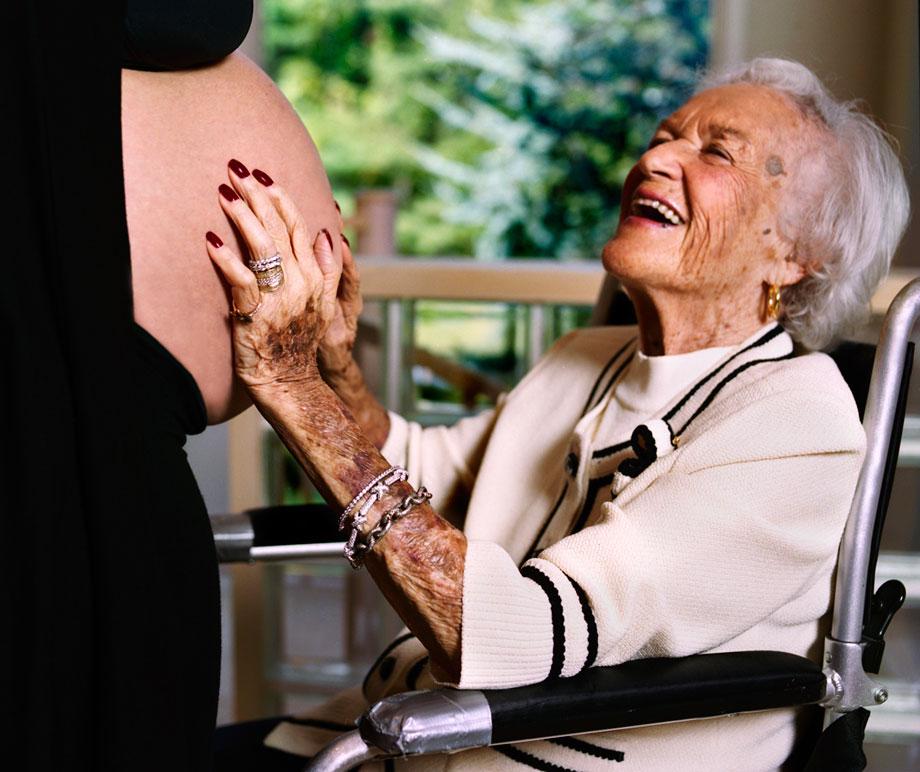
David Rosenberg admires the work of Gillian Laub. From a series documenting her own family:

Although she’s covered hard-hitting stories of life in the Middle East and segregated high-school proms in the South, Laub’s images are often reminiscent of family portraits, with their intimate and deeply personal style. …

“I am very interested in tradition and ritual, so naturally every family holiday and ritual I will be photographing,” Laub wrote. Recently Laub became a mother for the first time and said the experience feels as if everything has come full circle. “I have spent so many years photographing other people’s children, so to now photograph my daughter with my mother and grandmother is pretty amazing.”

(Grandma Feels My Belly, Mamaroneck, N.Y., 2012 by Gillian Laub, courtesy of Bonni Benrubi Gallery)

Reading Like A Child

Alice Bolin fondly remembers the summer she stumbled upon Rudolf Flesch’s The Book of Unusual Quotations and its eclectic passages about religion:

I read attempts to expand the bounds in which God can be encountered: “We can never see Christianity from the catechism,” Ralph Waldo Emerson says, “from the pastures, from a boat in the pond, from amidst the songs of the wood-birds we possibly may.” And attempts to understand how spirituality might work in the absence of God: according to Søren Kierkegaard, “Prayer does not change God, but changes him who prays.” There were also cryptic sayings that mostly served to misdirect, like H. L. Mencken’s cheery epigram, “Every man is his own hell.” At this point in my life, I had never heard of any of these people.

How she now thinks about this random approach to reading:

It is, of course, a childish approach to meaning. As I grew older, I started to understand the importance of insights accumulated and laid over one another, rather than isolated. But I think the teen-age quote fetish is ultimately a good thing. It is evidence of the way a mind is built: randomly, piece by piece, working slowly through the dark with the few truths one finds or has been given. Children are experts on negative capability—in their comfort with what they don’t know, with not seeing the full picture, with moving without knowing what they are moving toward.

Proust’s Young Love

Marcel_Proust_et_Lucien_Daudet

The just released translation of Marcel Proust’s collected poetry includes his first known attempt at verse, “Pederasty,” written when he was 17. Harold Augenbraum, the volume’s editor, notes that it reveals him to be “struggling with his homosexual urges”:

Proust’s sexuality was a matter of public discussion even during his lifetime, but this poem and letters between Proust and Jacques Bizet (the son of Georges Bizet, the composer of Carmen) and Daniel Halévy written at the same time certainly make his interest in homosexuality abundantly clear. In a letter to Bizet, probably written in the spring of 1888, he responds to Bizet’s letter (now lost) that seems to say that Bizet had refused Proust’s advances, Proust saying that he is “not fatuous enough to believe that my body is so precious a treasure that to renounce it required great strength of character… Still, I always find it sad not to pluck the delicious flower that we shall soon be unable to pluck. For then it would be fruit… and forbidden.”

Recent Dish on Proust here.

(Proust, seated, with two companions in 1894, via Wikimedia Commons. The photo is said to have scandalized Proust’s mother.)

Liturgical Liberals

Thomas Holgrave considers the rise of younger Christians who are drawn toward more traditional forms of worship:

Older liberal Christians have assumed that a younger generation of evangelical Christians, who are clearly more liberal politically than their generally Republican parents, will join them on the theologically liberal, desacralizing side of the church. What is actually happening, though, may be more complicated than this. Younger evangelicals who keep the faith are often dissatisfied with elements of their parents’ churches, but they seem to be shifting in a more ’catholic’ direction, toward a more liturgical, roots-oriented Christianity. While their politics may not be those of the Christian Coalition, their religion may actually be more ‘conservative.’

The Decline And Evolution Of Sex Scenes

A very NSFW scene from Game of Thrones, discussed below:

Kate Hakala mourns the decline of steaminess on the big screen:

The zeitgeist favors both family-oriented films and flicks full of special effects and gun violence, which are cheap to produce, over realistic, provocative depictions of human sexuality. Sex scenes require rehearsing, clearing of no-nudity clauses, the development of chemistry, and the hiking of R ratings, whereas CGI takes a computer and some imagination. The latter will time and time again have a wider audience. In 2012, out of the top 20 grossing films of the year, only four included any sex scenes, and only one of those, Ted, was R-rated.

And the resounding trend I see on the internet’s “Best Movie Sex Scenes” lists* is that they all feature movies that are mainly over ten years old. In fact, the last movie to top the box office that included a truly hot and heavy love scene was Titanic (who could forget that smudged hand print on the car window?), but that was a depressingly long sixteen years ago. … We may have now become a culture that feels safer watching a city be bombed to death with their mom than they feel safe watching somebody feeling pleasure next to their mom.

Alison Natasi rounds up actors’ and directors’ opinions on the awkwardness of shooting a sex scene. Jason Kehe tracks the migration of such scenes to television and sees an artistic evolution of the form:

When the adaptation of George R. R. Martin’s fantasy novels first aired in spring 2011, it swelled with sex—par for the course in HBO’s True Blood era. But there was a difference this time: Characters spoke in these scenes. And not just pillow talk, either, but epic discussions of dynasties, subterfuge, and redemption. We learned about the Lannister siblings while a character was downing wine and being serviced by a topless prostitute. Dragon lore got discussed during one extremely NSFW bath. Then the coup de grâce: a major character delivering a five-minute monolog while two women get it on in the background. Even the competition couldn’t hide its admiration. “Nobody gets to talk for two pages about power!” says Julie Plec, executive producer of The Vampire Diaries, CW’s sex-lite answer to True Blood.

So forget sex. It’s “sexposition” now—a way for cable writers to keep your attention while educating you on plot, background, and character.

A Poem For Saturday

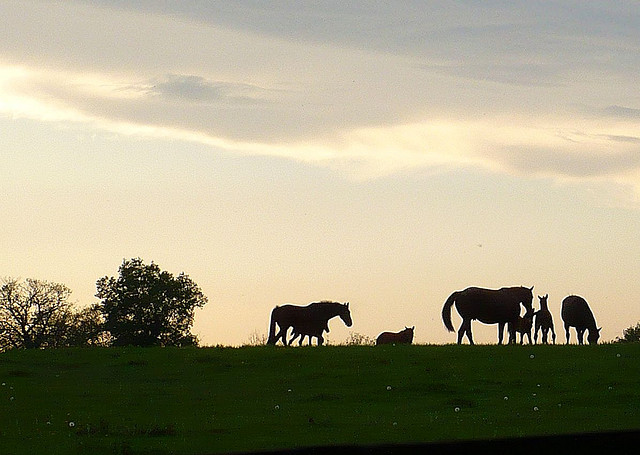
horse2night

“Bluegrass” by Carl Phillips:

And he told me nowhere was a lake that,
any day now, he’d surely drown in. What’s the right
answer to a thing like that?

*

So we just stood there,
the two of us—shaking a bit in the cold,
but pretty still, mostly. Horses in a field of moonlight.

(Forthcoming in Silverchest: Poems by Carl Phillips, to be published April 2nd by Farrar, Straus and Giroux, LLC. Copyright © 2013 by Carl Phillips. All rights reserved. Photo by Flickr user zenera)

Can’t We Get An EZ-Pass For Restaurants?

Tomasky is tired of waiting for his check:

Who among my fellow Americans enjoys this ritual? You ask for the check. The waiter walks away. He brings it. He walks away again. You put your card in the little sleeve. You wait. The waiter picks it up. He walks away again. Eventually, after reciting the specialsat one table and opening a bottle of wine at another, he returns. And finally, 20 minutes after you were ready to leave, the restaurant is ready for you to leave.

Within those 20 minutes is contained not just the customer’s inconvenience, but a national crisis and disgrace. America suffers from a terrifying restaurant technology gap. Throughout much of the world, this tedious ritual has been dispensed with. At tables from London to Istanbul, from Casablanca to French Polynesia, when the diner is ready to leave, the waiter reaches for her or his handheld device, runs the credit card, hands over the receipt, and that’s it. Gone in 60 seconds.

In a follow-up, he continues to kvetch:

My little essay was a plea for the industry to introduce the hand-held credit-card machine that we find…well, basically everywhere in the world except America.

I know many of you think you know the reason, that it has to do with the difference between US and European credit cards, that chip business, which prevents fraud. But that’s bullshit. … The chip business is just an excuse. The fact is that restaurants don’t want to invest in the technology, and they don’t because Americans aren’t clamoring for it. I guess because people at the Cheesecake Factory just like to sit there and sit there after consuming those 5,000-calorie meals. The NRA (not that NRA–the National Restaurant Association!) has polled the question and found out that 52 percent of Americans would avail themselves of table-side check-out. Again, these 48 percent just confuse me to no end. Maybe now that Americans have embraced gay marriage, we can move on to restaurant efficiency.

Dino Style

When it came to sex, dinosaurs had a hard time:

The plated, spiked stegosaurs are perhaps the most perplexing paramours of all. Consider Kentrosaurus, a cousin of the more famous Stegosaurus. This armored dinosaur sported huge spikes on its lower back and hips that must have looked dangerous to males in the mood. I asked my paleontologist friend Heinrich Mallison of the Museum of Natural History in Berlin to evaluate the possibility that Kentrosaurus mated in the leg-over-back position using computer models he had previously developed to study how flexible the animal was. Mallison tested dinosaur sex positions in three dimensions and concluded that the traditional dinosaur sex position did not work for Kentrosaurus. If a male tried to throw his leg over the back of a crouching female, he would castrate himself on her sharp spikes. One hip spike in particular seemed to be placed to strike fear in the hearts of stegosaur suitors.

Recent Dish on the kinks of the animal kingdom here.

Wine In Decline

In France, of all places:

In 1980 more than half of adults were consuming wine on a near-daily basis. Today that figure has fallen to 17%. Meanwhile, the proportion of French people who never drink wine at all has doubled to 38%. In 1965, the amount of wine consumed per head of population was 160 litres a year. In 2010 that had fallen to 57 litres, and will most likely dip to no more than 30 litres in the years ahead.

Climate change is also affecting wine production around the world:

Some whites once renowned for being light and crisp are getting fatter and more floral while medium-bodied reds are morphing into heavyweight bruisers. … Water stress, temperature change, inopportune downpours and frosts are just a few of the variables that have profound effects on the balance of sugar and acidity, the ripeness of tannins, and the palette of aromas. “In Alsace (northeastern France), climate change is already a problem, because it’s changing the aromatic profile, the balance of sugar and acidity. If the consumers accept the changes, it’s not a problem. If they don’t, it is,” said Jean-Marc Touzard, a co-coordinator of ACCAF.