Will We Still Need Marines?

Philippine and US marines aboard a rubbe

Lt. Col. Lloyd Freeman, a Marine infantry officer with three combat tours in Iraq and Afghanistan, argues that the Marine Corps will need to make significant changes if it wants to avoid redundancy:

The Marines are a door-kicking service, designed to breach enemy territory and establish an entry point for the Army’s strategic land capability. But the U.S. military’s development of unmanned aircraft, combined with stealth technology and unmatched [Intelligence, Surveillance and Reconnaissance] capability, makes it almost impossible for an enemy today to significantly impede the landing of U.S. forces on a beach or at a port. Forcible entry no longer requires landing forces — it takes precision strikes, coordinated by special operations forces as needed. But if the door is going to be kicked in by a cruise missile, an unmanned aircraft, or other platform delivering precision munitions, why does the Marine Corps insist on maintaining such a large amphibious forcible entry capability based around the same Marine who stormed ashore at Tarawa? Because to argue that the United States does not need a forcible-entry force would be to question the very necessity of having a Marine Corps. Unfortunately, that is the question the Corps must now answer.

Replacing One Drug Problem With Another

Eliza Ronalds-Hannon describes the unintended consequences of recent law enforcement success in the European war against heroin:

In Norway, users turned to buprenorphine, a semi-synthetic often used to treat heroin addiction, but intoxicating and addictive in higher doses. In Hungary, cathinones gained popularity. That substance – an ingredient in the drug mixes known as “bath salts” in the U.S. – is part stimulant, part opioid. Slovakia, too, went for uppers – there, methamphetamine use surged. In Bulgaria, a mysterious substance known as “white heroin” cropped up; reports vary regarding its makeup. Buprenorphine also swept the country of Georgia, which previously never had much of a heroin problem.

One of the worst replacements is a homemade drug called “Krokodil”:

Krokodil users cook codeine – which can be found in many over-the-counter medicines in Russia – with iodine and other household ingredients to create a powerful homemade high. But the result is so deadly the average life span of a user is under a year. The drug gets its name from the appearance of its addicts; their flesh rots from the inside out, leaving the skin as scaly as a crocodile’s.

“It can totally destroy the nervous system,” said Georgia’s Tamaz Mchedlidze, who explained that in Georgia the Krokodil recipe also includes liquid toilet cleaner, and gasoline. The latter is a controversial ingredient, Mchedlidze noted; “some junkies insist on using Wissol gasoline, while others say you should use Rompetrol,” he said, referring to two brand names of gasoline.

Face Of The Day

Wannsee Lake Opens To Bathers Despite Ongoing Winter

An Easter bunny-shaped snowman stands on the snow-covered Strandbad Wannsee beach during its opening for the year on March 29, 2013 in Berlin, Germany. Despite continued unseasonably cold temperatures in the country, organizers opened the beach for bathers in time for the last weekend of March, when Easter Sunday is expected to be colder than the previous Christmas Day had been. By Adam Berry/Getty Images.

Are Doctors Overpaid? Ctd

Aaron Carroll cringes at a new article that mourns the days when radiology students could expect to make enough money to “graduat[e] from medical school and driv[e] a Porsche”:

It’s always amazing to me that the stories like this are always written about or by radiologists, or anesthesiologists, or orthopedic surgeons. They often feel like they are owed more money. It’s like… an entitlement. You know who else trained for five years? Me. It takes six years to be an neurologist,  an immunologist, a nephrologist, a rheumatologist, or an endocrinologist. Almost none of those specialties expect to have a “$400,000-and-up dream job”. …

If your definition of “struggling” is not driving a Porsche, then it’s time to stop expecting the general public to give you any sympathy. I’ve said it before, and I’ll say it again. Is there any other profession that is as tone deaf as we are when it comes to talking about our livelihood? Is there any other profession that feels so free to complain about making too little, when they objectively make so much compared to so many others?

Previous Dish on doctor salaries here, here and here.

Returning Home After Rape

The government just released a massive study on the factors that influence a soldier’s reintegration into normal life after a deployment to Iraq or Afghanistan. George Zornick focuses on the effects of sexual trauma, reported by 48,100 women and 43,700 men:

The study focuses on what these traumas mean for female veteran’s health: as noted, it concludes that women who have suffered a sexual assault in the military are nine times more likely to develop PTSD than female veterans with no history of sexual abuse. Female victims are also at much greater risk for a wide variety of other problems upon return: anxiety, depression, substance abuse and family troubles.

These results explicitly control for other factors that lead to PTSD. Contrary to many conservative talking points when Obama lifted the restriction on women in combat, the research cited in this study found that women handle combat-related stress just as well as men—military sexual trauma is a singular factor bumping up the prevalence of PTSD among women.

Previous Dish on rape in the military here, here, here and here.

The Most Harmful Drug

Kleiman wants drug policy to focus on alcohol:

All illegal drugs combined are to alcohol as the Mediterranean is to the Pacific. We have our whole navy in the Mediterranean. And that’s true both of the drug policy machinery and those who are fighting the drug war, and of the drug reform movement, which, it seems to me, neglects the problem with the one drug we’ve legalized. Any sentence about drug policy that doesn’t end with “raise alcohol taxes” is an incoherent sentence.

He continues:

Taxation is just about the perfect way to control alcohol use. It’s not complete, because you need controls for the real problem drinkers. But if we tripled the alcohol tax it would reduce homicide by 6 percent. And you’re not putting anybody in jail. But instead we spend our time talking about doing marijuana testing for welfare recipients.

Where There’s Smoke, You’re Fired

The University of Pennsylvania Health System recently announced that they will no longer hire smokers in any of their Pennsylvania facilities. Harald Schmidt, Kristin Voigt, and Ezekiel J. Emanuel argue that policies like this are misguided:

The broader claim that it is fair to exclude smokers because they are responsible for raising health care costs is too simplistic. It ignores the fact that smoking is addictive and therefore not completely voluntary. Among adult daily smokers, 88% began smoking by the time they were 18, before society would consider them fully responsible for their actions. Much of this early smoking is subtly and not so subtly encouraged by cigarette companies. As many as 69% of smokers want to quit, but the addictive properties of tobacco make that exceedingly difficult: only 3 to 5% of unaided cessation attempts succeed. It is therefore wrong to treat smoking as something fully under an individual’s control.

David Asch, Ralph Muller, and Kevin Volpp are more supportive:

[W]e conducted a randomized trial comparing the use of employer-provided financial incentives for smoking cessation, aided by counseling, with an approach in which the same sorts of counseling programs were made available to employees but no incentives were given — effectively comparing enabling choice (rung 3) with guiding choice through incentives (rung 5). In one sense, the results were dramatic: during 12 to 18 months of follow-up, employees in the incentive group had a quit rate that was approximately three times that in the comparison group.5 But in absolute terms, even the incentive group had an 18-month quit rate of only about 9% — meaning that even with an aggressive system of rewards, 91% of employees who wanted to quit could not. We believe that the severe harms of smoking justify moving higher up on the ladder when lower-rung interventions don’t achieve essential public health goals.

A Narrow Definition Of Freedom

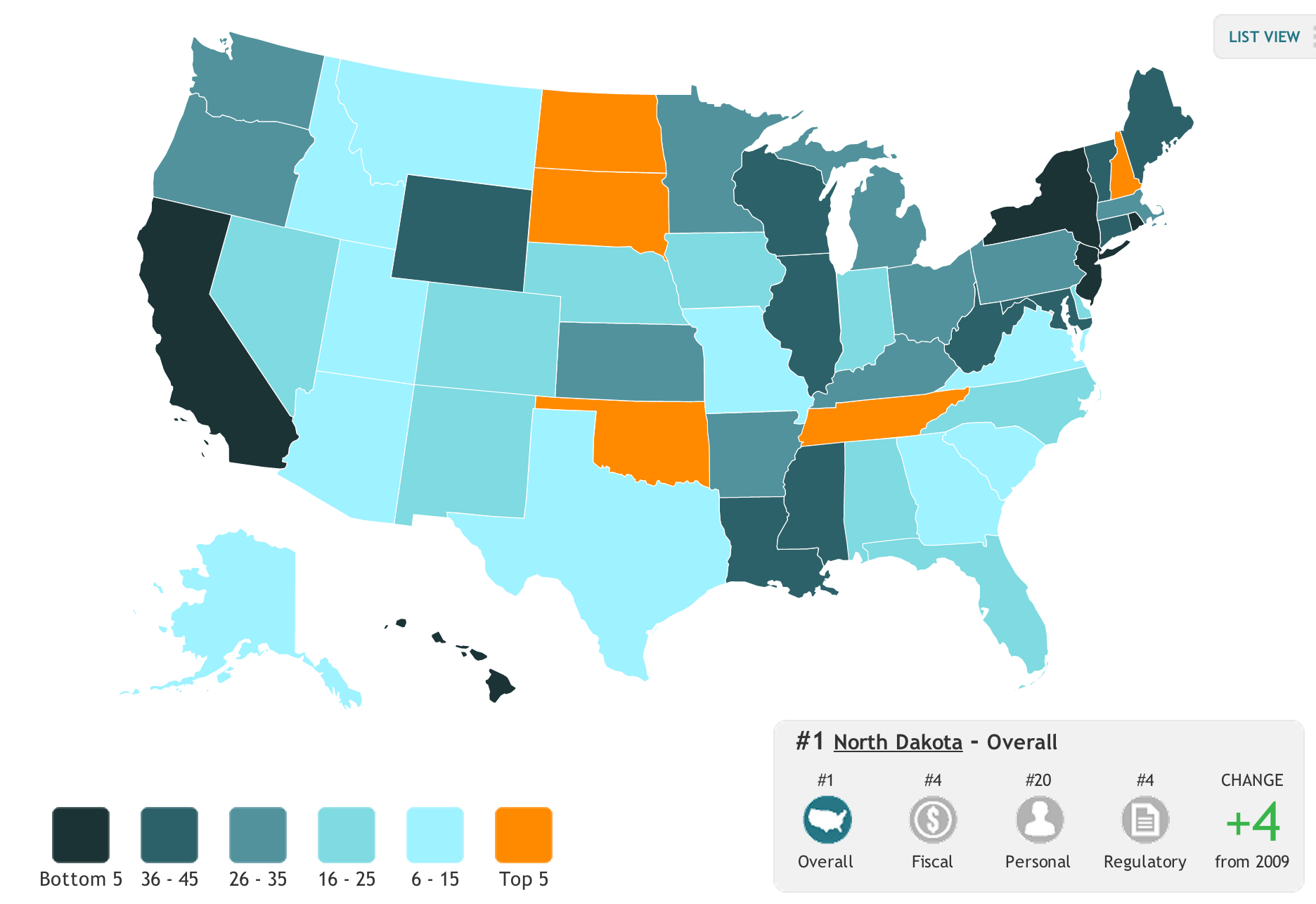
The Mercatus Center, which skews Libertarian, has ranked the 50 states in terms of freedom. The results:

Freedom Map

Timothy B. Lee asks “whether it makes sense to have a political ideology that’s focused on freedom, narrowly defined, to the exclusion of other values”:

There are some obvious problems with Mercatus’s methodology. Theoretically, libertarians are “economically conservative and socially liberal,” but the libertarians at Mercatus have given economic policy more than twice as much weight as “personal freedom.” On top of that, it uses a pretty right-leaning conception of “personal freedom.” The right to smoke is given almost twice as much weight as marriage equality. The right to own a gun is given five times as much weight as the “civil liberties” category, described as a “grab bag of mostly unrelated policies, including raw milk laws, fireworks laws, prostitution laws, physician-assisted suicide laws, religious freedom restoration acts, rules on taking DNA samples from criminal suspects, trans-fat bans, and laws that can be used to prosecute people who audiorecord public officials in the performance of their duties.” Reproductive freedom isn’t taken into account at all. Little surprise that the top of the list is dominated by red states.

Waldman and Pareene add their two cents.

Engineering An Ethical Dilemma

Despite the over-hyped headlines, Will Oremus isn’t worried about Chinese superkids. But he recognizes the issues raised by advances in preimplantation genetic screening for embryos:

[T]he line between screening for disorders and selecting for traits can be blurry. If it’s OK to screen for Down syndrome, is it OK to screen for a genetic predisposition to alcoholism, depression, or obesity? Where do you draw the line between developmental disabilities and low IQ?