Will Perry Be Another Roe? Ctd

Supreme Court Hears Arguments On California's Prop 8 And Defense Of Marriage Act

A reader writes:

I’m sure you are hearing this from else, but to chime in: I’d bet physically large bills that Perry ends up resembling Loving much more than Roe. For those who oppose abortion rights, the sanctity of human life makes it an essential moral issue. There doesn’t seem to be a similar moral imperative to oppose marriage equality. Once it becomes established, it becomes much harder to convince oneself that it is harming anyone. There will always be a rump that objects, but it will end up as influential as the rump that opposes inter-racial marriages.

How another puts it:

After Roe anti-choice advocates could shriek: Now it’s legal to kill babies! If Perry goes favorably for gays, the other side will be able to shriek:  Now the government is treating those horrid gays just like everyone else! Somehow the latter just doesn’t have quite the resonance of the former.

(Photo: Maggie George demonstrates with a picture of her family stuck to her back during a protest in front of the U.S. Supreme Court March 26, 2013 in Washington, DC. By Win McNamee/Getty Images)

Will The Social Cons Rebel?

If the GOP supports marriage equality, Huckabee claims that the party is “going to lose a large part of their base because evangelicals will take a walk.” Allahpundit suspects that, if SCOTUS rules in favor of greater equality, that marriage will be an issue during Republican primaries in 2016:

To keep social conservatives onboard, candidates will be asked to promise (a) that they’ll appoint Supreme Court justices who are committed to overturning any gay-marriage rulings and (b) that they’ll endorse some sort of constitutional amendment that would either ban SSM outright or, at a minimum, return the issue to the states. (The amendment will go nowhere but that’s beside the point here.) Think a prospective nominee won’t do some squirming over whether they should sign on to those propositions, especially given the GOP’s panic over losing young voters? Come 2016, this won’t be just about gay marriage anymore; it’ll be a test of whether social conservatives retain the same influence over the party platform that they’ve had for the last few decades. That’s why Huck’s framing this in apocalyptic “stick with us or we walk” terms. It’s their party, at least on social issues.

Gaming The Deadlock

Supreme Court Hears Arguments On California's Prop 8 And Defense Of Marriage Act

Lyle Denniston gives it the college try:

If the Justices, in the initial vote they will take on this case in private later this week, do not find themselves with a majority on any of the issues they canvassed, then they might well be looking for a way out. One way would be to find that the proponents of Proposition 8 did not have a legal right to be in court to defend it, but even that was a hotly disputed issue on the bench. The other way out was directly suggested by Kennedy, and pursued by him in more than a fleeting way: dismiss this case as one that should not have been accepted. A decision like that, though, could take weeks or months to reach.

(Photo: Plaintiff couple Sandy Steier (L) and Kris Perry hold hands after attending oral arguments at the U.S. Supreme Court on March 26, 2013. By Mark Wilson/Getty Images)

Exchange Of The Day

From Balkin:

JUSTICE SCALIA: When did it become unconstitutional to ban same-sex marriage? Was it 1791? 1868?

TED OLSON: When did it become unconstitutional to ban interracial marriage?

JUSTICE SCALIA: Don’t try to answer my question with your own question.

Scalia has nothing. And he knows it. Update from a reader:

Balkin’s paraphrase is deeply misleading. Here’s the whole exchange, from the transcript:

JUSTICE SCALIA: You — you’ve led me right into a question I was going to ask. The California  Supreme Court decides what the law is. That’s what we  decide, right? We don’t prescribe law for the future.  We — we decide what the law is. I’m curious, when -­ when did — when did it become unconstitutional to  exclude homosexual couples from marriage? 1791? 1868, when the Fourteenth Amendment was adopted? Sometimes — some time after Baker, where we said it didn’t even raise a substantial Federal  question? When — when — when did the law become this?

MR. OLSON: When — may I answer this in the  form of a rhetorical question? When did it become  unconstitutional to prohibit interracial marriages?  When did it become unconstitutional to assign children  to separate schools.

JUSTICE SCALIA: It’s an easy question, I  think, for that one. At — at the time that the Equal  Protection Clause was adopted. That’s absolutely true. But don’t give me a question to my question. (Laughter.)

The argument goes on, that it become unconstitutional when society evolved, making Scalia’s point that there’s no basis in the constitution for this decision.  If we value having a written constitution constraining the court’s veto power over our democracy, this could be an ugly precedent.

Fiscal Conservatives For Marriage Equality

It makes sense, as Josh Barro explains in a must-read:

Even though the cost components are different, the net effect would probably be similar at the state and federal levels: positive, but very small. The Williams Institute at UCLA School of Law has reached this conclusion in fiscal analyses across various states; for example, they estimated in 2009 that legal same-sex marriage in Maine would generate $8 million in annual fiscal benefits for the state, mostly through reductions in Medicaid and other public assistance payments.

The fiscal benefits aren’t a crucial reason to support same-sex marriage, but they do lend support to one of the “conservative” cases for it. Marriage is a structure through which people depend on each other, so they don’t have to depend on the government. For gay men and lesbians to take advantage of that fiscally friendly option, the government has to make it legal for us to marry.

Steady As She Goes

fivethirtyeight-0326-marriage3-blog480

Nate Silver’s tea-leaf reading reaches a solid conclusion:

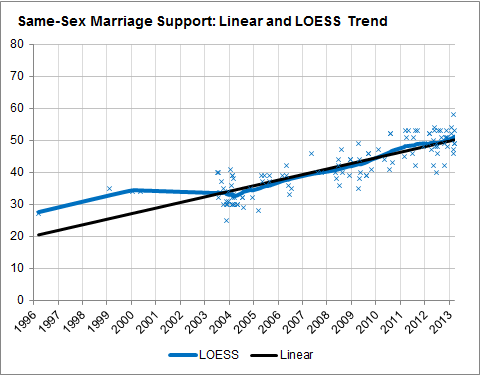
One no longer needs to make optimistic assumptions to conclude that same-sex marriage supporters will probably soon constitute a national majority. Instead, it’s the steadiness of the trend that makes same-sex marriage virtually unique among all major public policy issues, and which might give its supporters more confidence that the numbers will continue to break their way regardless of what the Supreme Court decides.

The Argument For Minimalism

Here’s a succinct and simple case from Cass Sunstein for SCOTUS going small:

In its 1971 decision in Reed v. Reed — its first serious effort to engage the problem of sex discrimination — the court took the path of minimalism. Striking down an odd Iowa law that gave a preference to men over women as administrators of estates, the court declined to issue a broad pronouncement that would immediately threaten all discrimination on the basis of sex.

Instead it began a long series of case-by-case rulings — accompanying, but not pre-empting, democratic judgments — that ultimately produced strong safeguards against such discrimination.

With respect to same-sex marriage, the court might be able to adopt a similar approach. For example, the Justice Department has sketched some ways for the court to rule relatively narrowly, striking down the laws in question while avoiding the broadest pronouncement about marriage equality.

Moderation Triumphs

US-JUSTICE-GAY-MARRIAGE

If Tom Goldstein is correct, then I’m celebrating:

Justice Kennedy seemed very unlikely to provide either side with the fifth vote needed to prevail. He was deeply concerned with the wisdom of acting now when in his view the social science of the effects of same-sex marriage is uncertain because it is so new. He also noted the doubts about the petitioners’ standing. So his suggestion was that the case should be dismissed.

If those features of the oral argument hold up – and I think they will – then the Court’s ruling will take one of two forms. First, a majority (the Chief Justice plus the liberal members of the Court) could decide that the petitioners lack standing. That would vacate the Ninth Circuit’s decision but leave in place the district court decision invalidating Proposition 8. Another case with different petitioners (perhaps a government official who did not want to administer a same-sex marriage) could come to the Supreme Court within two to three years, if the Justices were willing to hear it.

Second, the Court may dismiss the case because of an inability to reach a majority. Justice Kennedy takes that view, and Justice Sotomayor indicated that she might join him. Others on the left may agree. That ruling would leave in place the Ninth Circuit’s decision.

In other words:

(Photo: Jewel Samad/AFP/Getty.)