Breaking: 1st update- #prop8 unlikely to be upheld; either struck down or #scotus won’t decide case. More in 30 mins.
— SCOTUSblog (@SCOTUSblog) March 26, 2013
Will Perry Be Another Roe?
Stephen Presser claims that, if “the Supreme Court rules that the federal Constitution requires gay marriage, the political uproar that will ensue may well make the reaction to the court’s Roe v. Wade decision look tame.” David Fontana disagrees:
We know that a Court decision about an issue intensifies opinions about that issue; there is evidence that state court gay marriage decisions have done exactly this. But there is reason to think that the reaction of an intense minority might not be quite so significant. One reason: Just as there has been a shift in preferences about gay marriage over the past two decades, there has also been the shift in the intensity of these preferences. It used to be the case that opponents felt much more strongly than supporters. It was easy to organize state ballot initiatives banning gay marriage because so many opponents of marriage equality were motivated to go door-to-door, solicit signatures, and organize rallies. These days, supporters of gay marriage care more deeply than foes, with one poll indicating that only about one-third of Americans are strongly opposed to gay marriage. There might not be enough strong opponents enough to create the political or social momentum to do something about an unfavorable Court ruling, even in a small number of states.
The Cure For Earworms
Science is here to help:
We humans — cognitively, at least — like to finish what we’ve started. So even when our conscious minds move on to a new thing, our unconscious minds can still be preoccupied with our unfinished business, leading to dissonance. … To defeat an earworm, [researchers at Western Washington University] suggest, you just have to fool your brain into solving another puzzle — a non-musical puzzle. The best way to do that? Give it actual puzzles to concentrate on. Do a quick crossword. Tackle an anagram. Spend a few minutes, even, reading a novel. Replace the earworm with another worm, tricking your mind out of its need to finish what it started by giving it something else — something simple, but not too simple — to focus on.
Taped-Delayed SCOTUS Live-Blogging
SCOTUS will release the audio from the Prop 8 oral arguments no later than 1 pm today. As soon as the audio is released, I’m gonna live-blog my thoughts as I listen. I’ll do the same thing on Wednesday with the DOMA oral arguments audio, which SCOTUS has promised to release by 2 pm tomorrow. After mulling over the real options, that seemed like the best compromise.
I had a chance to be there, if only huddled in a corridor, unable to see the Justices, and like other reporters, barred from using my laptop to live-blog. So I figured I’d listen to the arguments in delayed real time and give my impressions. At this point, while I would have loved just to be there for the day, I have a job to do.
The Smartphone Theft Epidemic
Some startling statistics:
Cell phone theft in major cities has become a national criminal epidemic, like the car stereo crime wave of the 1990s. In San Francisco, about half of all robberies now involve mobile phones, and in New York there was a 40% increase in mobile thefts in 2012. One recent Harris poll of phone owners found that nearly 10% of cellular users said their phone had been stolen at one point.
The reason is simple: The black market resale value of the devices, like car radios two decades ago, is high. “Your mobile phone is probably the most expensive thing you carry around with you,” says Kevin Maheffey, co-founder of Lookout, a mobile security company. “It’s like holding $400 up to your head.”
Chart Of The Day
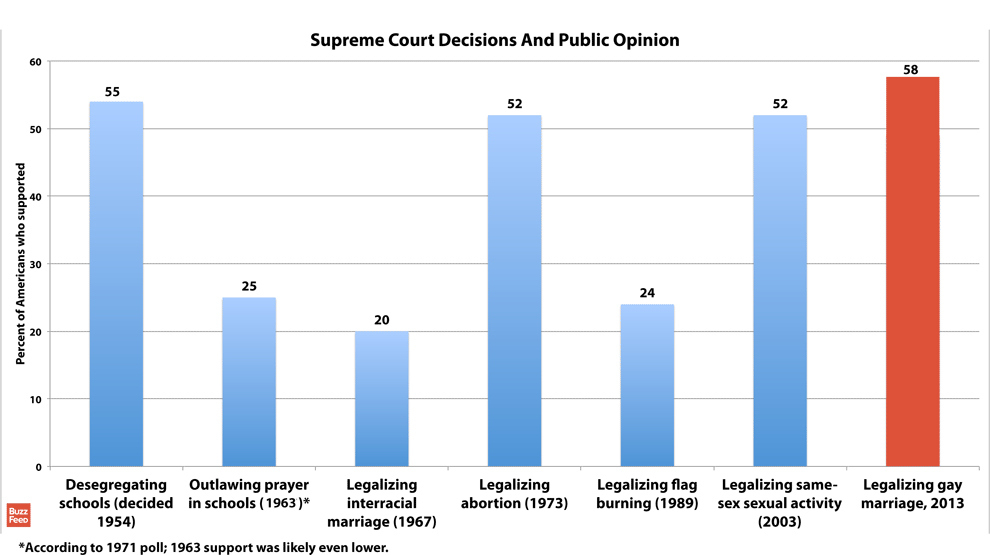
SCOTUS often doesn’t do what’s popular:
In the cases of Loving v. Virginia, which struck down state laws banning interracial marriage; Abington School District v. Schempp, which declared Bible reading in public schools unconstitutional; and Texas v. Johnson, which found flag-burning to be constitutionally protected, large majorities of Americans at the time disagreed with the Supreme Court’s decision. On interracial marriage, public opinion is now aligned with the Court’s decision — on flag-burning and prayer in schools it’s not, though it may be moving in that direction.
The Smart Watch Cometh, Ctd
Freddie dismisses the hype:
[W]ith tech in particular, I merely continue to observe constantly repeated human nature: many of us become convinced, over and over again, that there is one missing element of our lives, and often it’s a better phone or a new computer or our first tablet. We salivate over it, we wait for it, and it arrives, and for maybe a couple days we get the expected rush of endorphins as we play with it. And then, somehow, our lives are still just our lives– hectic, harried, incomplete, vaguely dissatisfying. Then we decide we need a new product, or a new service (once I use Evernote I will be unstoppable!), and the cycle continues. And we never, ever learn. It just seems that the tech heads are the most likely to engage in unlikely flights of fancy about how cool their lives are going to be, and the most susceptible for falling for their own hype. Brian Ries’s revolutionary, life-changing Pebble watch is a couple of months from being the slow pain in the ass that he feels obligated to wear and is tired of talking about.
Training Neighborhood Narcs

Police and anti-crime group Crimestoppers are distributing cannabis “scratch and sniff” cards in Britain:
The cards, which replicate the distinct smell of growing marijuana, will be mailed to homes in 13 areas throughout the country, in the hope that they will help people to identify cannabis factories in their communities.
Alex Moore sighs:
The weird thing is that they got this idea from the Netherlands, where the cards seemed to have actually worked despite weed consumption being legal—and you’d think widely familiar—there. (Growing pot is still illegal there.) After sending out 30,000 cops in the Netherlands were able to bust “hundreds” of cannabis production facilities, according to Time. Good job, Europeans—you just created more work for Mexican drug cartels.
(Image, via NPR, from Crimestoppers)
TNC In Paris
In the deep end, yet again:
But I was in the pâtisserie thinking of of my wife, who beat me here by seven wise years because she is a woman whose vision sends me to sonnage. I have always been a simple man, and left to my devices, my guiding principles would revolve around warm snugglies, World of Warcraft and intravenous pizza. Except that I have never really walked alone. Instead I’ve been surrounded by people who insisted upon other languages. When I was nine my mother remanded to the tender clutches of a man who taught swimming out in the county in his back yard. On the first day I learned to hold my breath. On the second I floated. On the third I front crawled. On the fourth, I cried as he tossed me into the deep end over and over. And on the fifth, I crawled in the deep end, and it was all I ever wanted.
Money Madness
The New Yorker drafted a prediction “in which the biggest spender always wins” the NCAA basketball tournament:
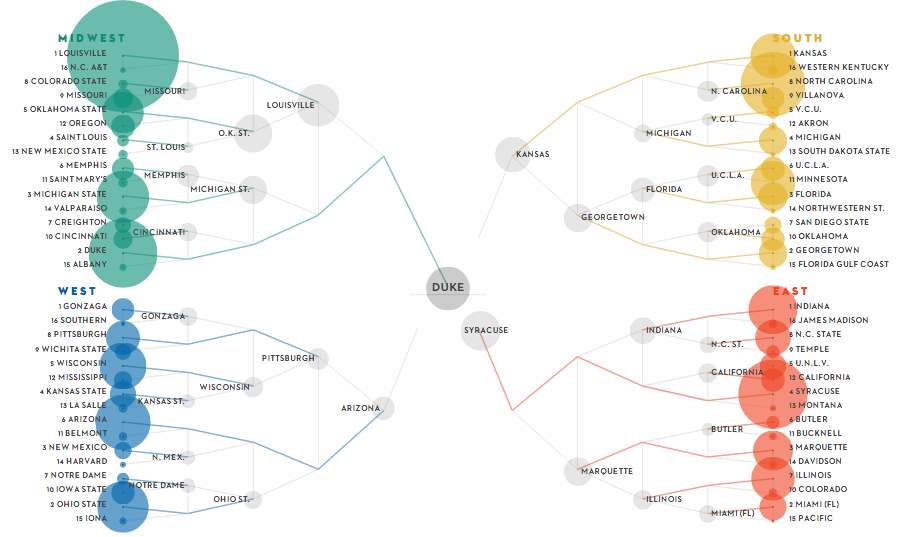
Go here to interact with the brackets yourself. Meanwhile, a Freakonomics/Marketplace podcast crunched the ad numbers for the annual tourney:
[Kantar Media researcher Jon Swallen] tells us that two years ago, CBS and Turner may have lost money on March Madness, as they pay roughly $770 million a year for broadcast rights but took in only $728 million in TV ad revenue. But last year, Swallen says, CBS and Turner — which broadcast ever single game in the tourney — took in more than $1 billion. This makes March Madness “the most lucrative sports TV franchise in the country in terms of advertising revenue,” Swallen told us, “bigger than the Super Bowl, bigger than the entire NFL playoffs, and larger than the combined revenue that’s brought in from the Major League Baseball playoffs, plus the NBA, plus the National Hockey League.”
With that sort of windfall in mind, Dave Barri doesn’t think that giving scholarships to players is adequate compensation:
To illustrate, consider the Indiana Hoosiers this season. An examination of the player statistics reveals that Victor Oladipo produced 7.37 wins for Indiana (the Wins Produced calculation for college basketball was similar – in fact, amazingly similar — to what has been done for the NBA). We are working on the economic value of a win in college basketball, but a conservative estimate is that a win is worth at least $100,000 for a program like Indiana. Given the number of wins Oladipo produced and the conservative value of a win, Oladipo’s production was worth (i.e. his Marginal Revenue Product) about $737,000 (and again, this is a crude and conservative estimate).
A scholarship to Indiana is valued at less than $30,000. So at least nine of these players were exploited (which simply means they were paid less than their Marginal Revenue Product).
He argues for a “free-market approach to college sports.” The Dish has debated the topic at length.

