The Situation In Cyprus

CYPRUS - FINANCE-PUBLIC-DEBT-EU-EUROZONE-DEMO

Ezra zooms out from it:

A half dozen [EU] countries have unemployment in the 15 to 25 percent range, with youth unemployment in the 30 to 60 percent range. Politics isn’t stable amidst that sort of pain — particularly when there’s a perception that some of the pain is being forced upon the country by richer, wealthier outsiders.

That’s what’s happening now. Christopher Pissarides, a Cypriot economist, won the Nobel prize in economics in 2010. But in an interview with BusinessWeek, his fury at the more powerful countries in the euro zone was sparklingly clear. “Small countries, be warned when joining the euro zone,” he said. “You could be bullied any time by your big brothers if it suits their political objectives.”

And that, again, is the view from Cyprus’s Nobel-prize-in-economics contingent. The man on the street, it’s safe to say, is even angrier.

Drum puts the Cyprus negotiations in perspective:

[T]he EU/IMF plan requires Cyprus to come up with about $7.5 billion as its share of the bailout. That’s roughly a third of their GDP. To put that into local terms, it would be as if the United States were being asked to pony up $5 trillion. This is about equal to all government spending—federal, state, and local—for an entire year.

Yglesias adds his two cents.

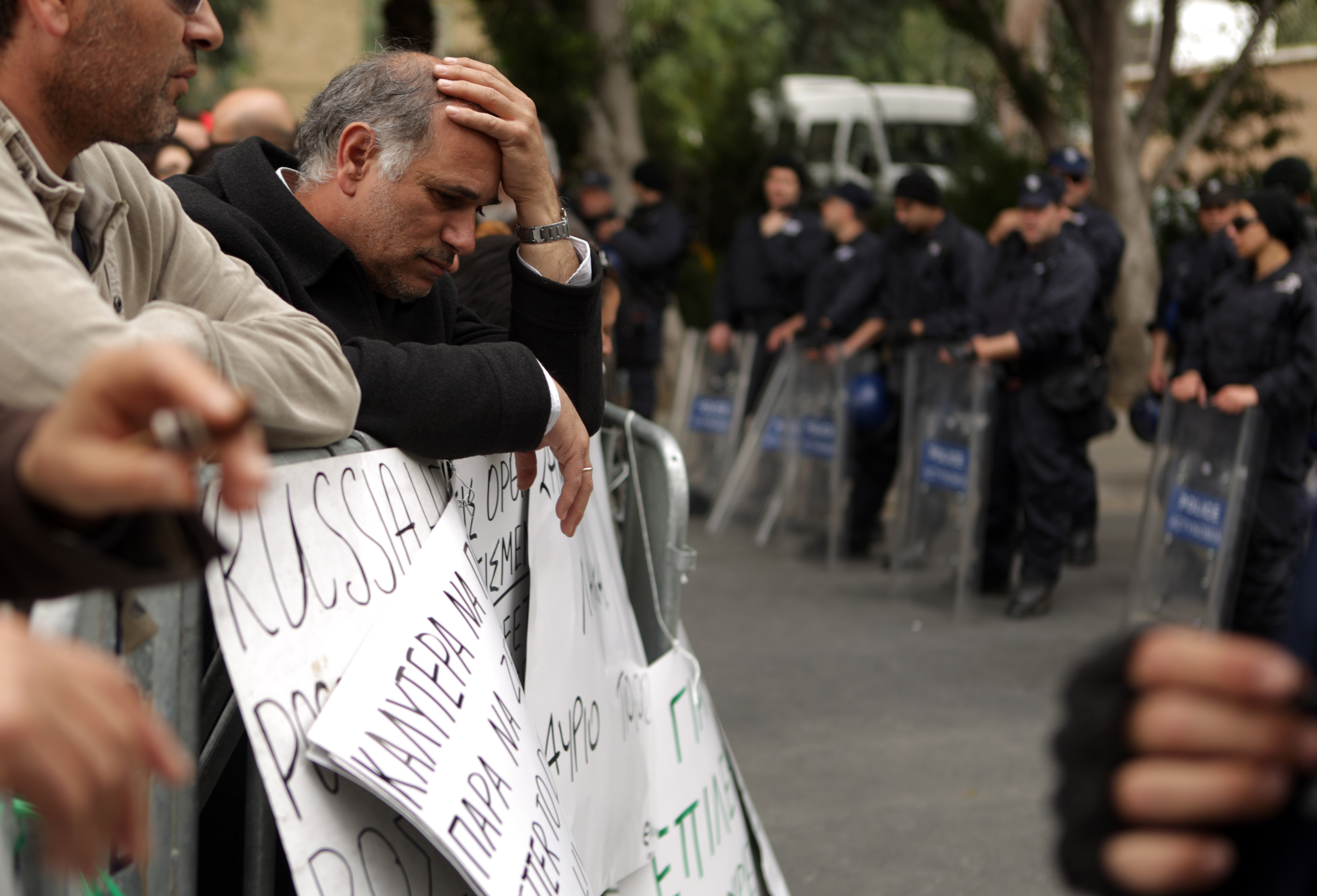
(Photo: An employee of Cyprus Laiki (Popular) Bank reacts as he takes part in a protest outside the parliament in Nicosia on March 22, 2013. Cyprus is locked in ‘hard negotiations’ with a troika of lenders to save the eurozone member’s banking system and economy in general from ruin, government spokesman Christos Stylianides said. By Patrick Baz/AFP/Getty Images)

Will Obama’s Israel Speech Matter?

Judis doesn’t expect the speech to do much good:

First, Israeli Prime Minister Benjamin Netanyahu’s narrow ruling coalition can’t survive without the support of Naftali Bennett’s Habayit Hayehudi party, which controls twelve seats in the Knesset. Bennett’s party is opposed to a two-state solution and exacted an agreement from Netanyahu that it would be part of a special super-committee that would oversee any negotiations with the Palestinians. Except for Tzipi Livni’s Hatnuah party, none of Netanyahu’s coalition partners, and few of the members of Netanyahu’s own Likud-Beiteinu party, favor meaningful negotiations with the Palestinians. Avigdor Lieberman’s Yisrael Beiteinu party, for instance, favors creating a two-state solution based on denying citizenship to Israel’s Arabs.

Second, the Palestinians do not appear ready for negotiations. Mahmoud Abbas has not proven to be the kind of strong political leader that could sell an agreement to his people. Hamas, which controls Gaza, and still has supporters in the West Bank, has said it will accede to an agreement along the lines of the 1967 borders, but it’s not clear that Abbas can get, and that Netanyahu will accept, an agreement along those lines. In the meantime, the Palestinian leadership remains deeply divided, which makes fruitful negotiations difficult.

Greening The Papacy

After the Pope’s inauguration on Tuesday, Alessandro Speciale notes Francis’ focus on the environment:

The pope’s homily was striking for its repeated references to environmental protection, highlighting what is likely to be a central theme of his papacy and setting up the 76-year-old pope as a leading activist against climate change.

When mankind fails to care for creation and for the weak, “the way is opened to destruction and hearts are hardened. Tragically, in every period of history there are ‘Herods’ who plot death, wreak havoc, and mar the countenance of men and women.” Francis addressed himself to “all those who have positions of responsibility in economic, political and social life,” asking them to be “’protectors of creation, protectors of God’s plan inscribed in nature, protectors of one another and of the environment.”

Maybe not a surprising stance from a fan of public transportation. And certainly not from a man who took the name Francis. In my view, the Church has a key role to play in defending creation from frenzied exploitation, in advancing the value of stewardship of nature, in seeing the protection of the planet not as a right or left issue, but as a sacred human duty, a reminder that this speck in a galaxy in an expanding universe is not ours alone, that our species’ dominion over it must always be balanced by care and love.

Boris For Britain?

Massie examines the growing possibility for London’s eccentric mayor to replace David Cameron as Tory leader:

[M]any Tories still consider Boris the Clown Prince Across the Water. This despite a record of achievement that is, by objective standards, negligible. Boris has performed adequately as mayor of the capital city, but even his staunchest admirers are hard-pressed to produce any lengthy list of achievements he has to his name. London’s mayor has relatively few powers. Like being governor of Texas, it sounds a weightier position than it really is. There is a fear that, just as the United States was lumbered with George W. Bush, so Britain could be stuck with Boris. Like Bush — whom Boris once described as a “cross-eyed Texan warmonger” — Johnson’s appeal is as much a matter of style as substance. He talks “Real Tory.” From his euroscepticism to his enthusiasm for lower taxes, Boris tickles the Tory party’s erogenous zones. And he does so in a fashion that seems to entertain the public.

I knew Boris when we were both late teenagers at Oxford and did what little I could to help him succeed me as president of the Union. He was then a natural – utterly unembarrassed by his privileged background, wallowing in his plummy upper crust accent, rushing around everywhere with that mop of blond hair. In subsequent years, he has had more sex scandals than one can easily recall, and as Alex notes, is basically a figurehead as mayor of London. I suspect he has found the perfect perch for his populist skills.

But Cameron is flailing. His austerity program has not delivered growth; his party is languishing in the polls against a jejune Labour leader, Ed Miliband; his relative moderation toward Europe has allowed a rival far-right party, UKIP, to grow like the Tea Party (without the fundamentalism). Last week, in another chaotic, incompetent move, Cameron even signed on to a Royal Charter, backed by what Hugh Grant has called a “dab of statute” to regulate press conduct, an unforgivable dismissal of the long British tradition of a free and raucous press.

When Boris became mayor of London, I was gob-smacked. But he has defied categories before and may again. He possesses charm in bucket-loads. He’s an instinctual Tory. His sense of humor – arguably the most important virtue in the British psyche, is priceless. He won re-election handily as London mayor and the Olympics were clearly another personal triumph. BoJo could win any Tory seat offered him – and immediately overshadow many cabinet members.

And Britain has had some truly dull but effective prime ministers – my faves are Baldwin and Major. But it is also the party that gave us Benjamin Disraeli and Margaret Thatcher. There is a radical streak in British conservatism that every now and again provides a truly memorable leader who reshapes the culture as well as politics. I never thought Boris could pull that off. Increasingly, I suspect he might.

Barack Obama vs George Washington, Ctd

President Obama's State Visit To Israel And The West Bank Day Three

Just how “eternal” and “unbreakable” is our alliance with Israel? Rashid Khalidi explores as much in his new book Brokers of Deceit: How the U.S. Has Undermined Peace in the Middle East. Scott Horton asked Khalidi “what, precisely, was dishonest about the American role” in the peace process:

The United States claimed not only to be an honest broker between Palestinians and Israelis — Condoleezza Rice uses precisely these words in a document I quote in the book — it also claimed to be working for peace between them. Neither claim was true. The United States has been bound by a 1975 memorandum of understanding to the prior coordination of its positions on this issue with Israel, which it has faithfully done ever since then. This has been interpreted in practice to mean that Israel has effective veto power on what the United States can propose regarding the Palestine issue.

And since Camp David in 1978, the United States has allowed Israel to dictate the low ceiling for what the Palestinians can aspire to. This ceiling was established by Menachem Begin in 1978, as laid out in documents I cite in the book, and that has not changed since: Israel will never accept a fully sovereign Palestinian state; it will never stop expanding its settlements or give up control of land, water, or Jerusalem. And every deal brokered by the United States since then, and indeed the status quo that emerged from the Oslo Accords and that we are living with today, is completely consonant with Begin’s schema. That is neither honest, nor for that matter brokering: It is acting as “Israel’s lawyer,” as Aaron David Miller accurately put it, quoting Henry Kissinger.

There was a moment when Obama first took office when the US regaining the role of an actual honest broker seemed possible again. For the first time, a West Bank Palestinian leadership really had emerged that helped Israel’s security and governed with relative efficiency. For the first time, we had an American president with real and new credibility to reset relations with the Arab and Muslim world, after a decade of dangerous polarization. Netanyahu and the American Jewish Establishment, Democrats and Republicans, deliberately and strategically killed that moment and if it had been possible, would have ended Obama’s presidency in four years to send a message that no US president dare do such a thing in future. They sure spent enough money trying to accomplish that. But having failed to end his presidency, they still managed to neuter it on this question.

And that, it seems to me, became the premise of the visit to Israel.

An American president, having tried to meet the Palestinians and Israelis at the mid-point, is now doing what he actually has to do, given that Israel controls US foreign policy in the Middle East. He has to beg, flatter, charm and seduce the Israeli people as his only way of having any impact on that part of the world. He has to accede to Netanyahu’s conditions for talks, which is the continuation and acceleration of settlements in ways that make a two-state solution impossible. He has to give up reaching out to the Muslim world in a new way in a new era. Israel and its lobby succeeded in spectacular fashion, out-maneuvering and humiliating the US president, and erasing any credibility he had with the Arab and Muslim world. In the last four years, despite an historic opportunity for proactive change, they made sure no US president could jeopardize, or do more than mildly delay, the permanent establishment of the real project: a Jewish state in line with fundamentalist principles rather than present realities, a Jewish state that in practice is wiping Palestine – and its Arab inhabitants – off the map.

Obama’s rhetorical skills are all he has left. That he has used them to such effect in Israel is a testament, it seems to me, that he has not given up and feels a core duty to his own country not to give up on the single most important issue rendering the US’s relationship with the Muslim and Arab world eternally toxic. This is a president, re-capitalized by a re-election, trying again, knowing, as he surely must, that he will fail again. His role now will be to act as cover for another pre-emptive war against alleged weapons of mass destruction.

I admire Obama’s perseverance. I admire the audacity of his hope. I admire those Israelis and Americans, Jewish and Gentile, who understand why he is right about the settlements and right about a two-state solution. I share his admiration for the state of Israel, its extraordinary achievements, its raucous democracy, its economic renaissance. I supported Israel for as long as I felt it had no real partner for peace. But I have learned the hard way that none of this really means anything or can lead to anything. As long as the settler movement has rock-solid overwhelming support in the US Congress, which, whatever platitudes are uttered, it de facto does, and the project of Greater Israel is also backed by a large swathe of fundamentalist America, we are past the point of no return. The facts on the ground have achieved what they were designed to achieve: wiping the entire idea of Palestine off the map.

Maybe secretary of state Kerry believes he can thread this needle. My view, arrived at through exhaustion and despair these last four years, is that the needle has already been threaded. And Greater Israel will be as “unbreakable” as America’s support for it; and the president who ran against dumb wars will be forced to start a new one because of it. He has now done what his conscience and unfathomable optimism requires of him, and mercifully erased the smear that he is somehow hostile to Zionism or to the Jewish people. He is sane enough not to try much more. If someone is intent on hanging himself, even the best of friends cannot prevent it.

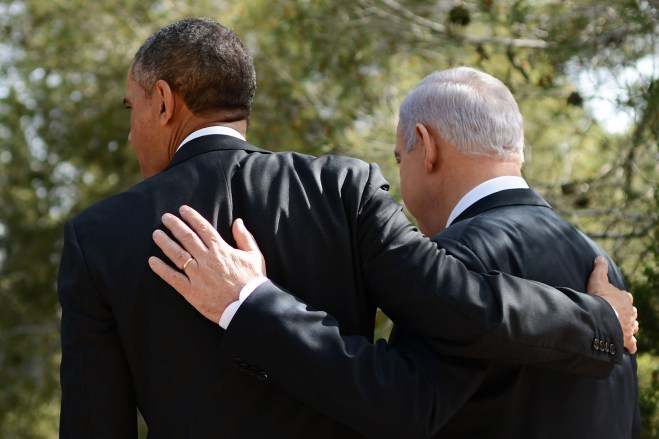
(Photo: In this handout photograph supplied by the Government Press Office of Israel (GPO), U.S. President Barack Obama and Israel’s Prime Minister Benjamin Netanyahu place their arms around each other during a visit to Mount Herzl on March 22, 2013 in Jerusalem, Israel. By Kobi Gideon/GPO via Getty Images)
Should Trans Surgery Be Covered? Ctd

Readers continue to debate the topic:

Private insurance companies will fight tooth and nail to deny any surgery performed by a plastic surgeon. I just put down $8,000 of my own and raised $4,500 from friends and family to pay for a breast reduction that I’ve been denied three times in 10 years by three different insurance companies. And ask parents how hard cleft palate surgeries are to get covered. In a time where skyrocketing costs are cutting into insurance profits, they will do whatever they can get away with to reduce their payments to providers. If they can call it cosmetic (in my case this determination was done with no transparency by a board of non-physicians) they can deny it, and the popular opinion of plastic surgery gives them cover.

Personally I think it all comes back to how fucked up our health paradigm is. We treat illness instead of treating for wellness. We ask whether you are sick enough to need intervention instead of asking what wellness would look like for you and trying to get there. Plastic surgeons don’t really fit the paradigm, with one notable exception: reconstruction after mastectomy. Unpack that one alongside trans top surgery and tell me you don’t see a double standard.

Another has a very different perspective:

Andrew, I find it hard to believe you (a conservative?) could even remotely consider transgender surgery a “health condition” that society should consider worthy of financial support. Never mind the lazy (but valid) arguments about where the trans justification leads us: “I really feel that I was born a big dick kind of guy; unfortunately, my testosterone levels were a bit low during puberty. My HMO should pay for my enlargement surgery.” We need to narrow the definition of healthcare, not expand it, in order to ensure basic coverage for everyone.

The Cardinal Whose Lovers Finally Had Enough

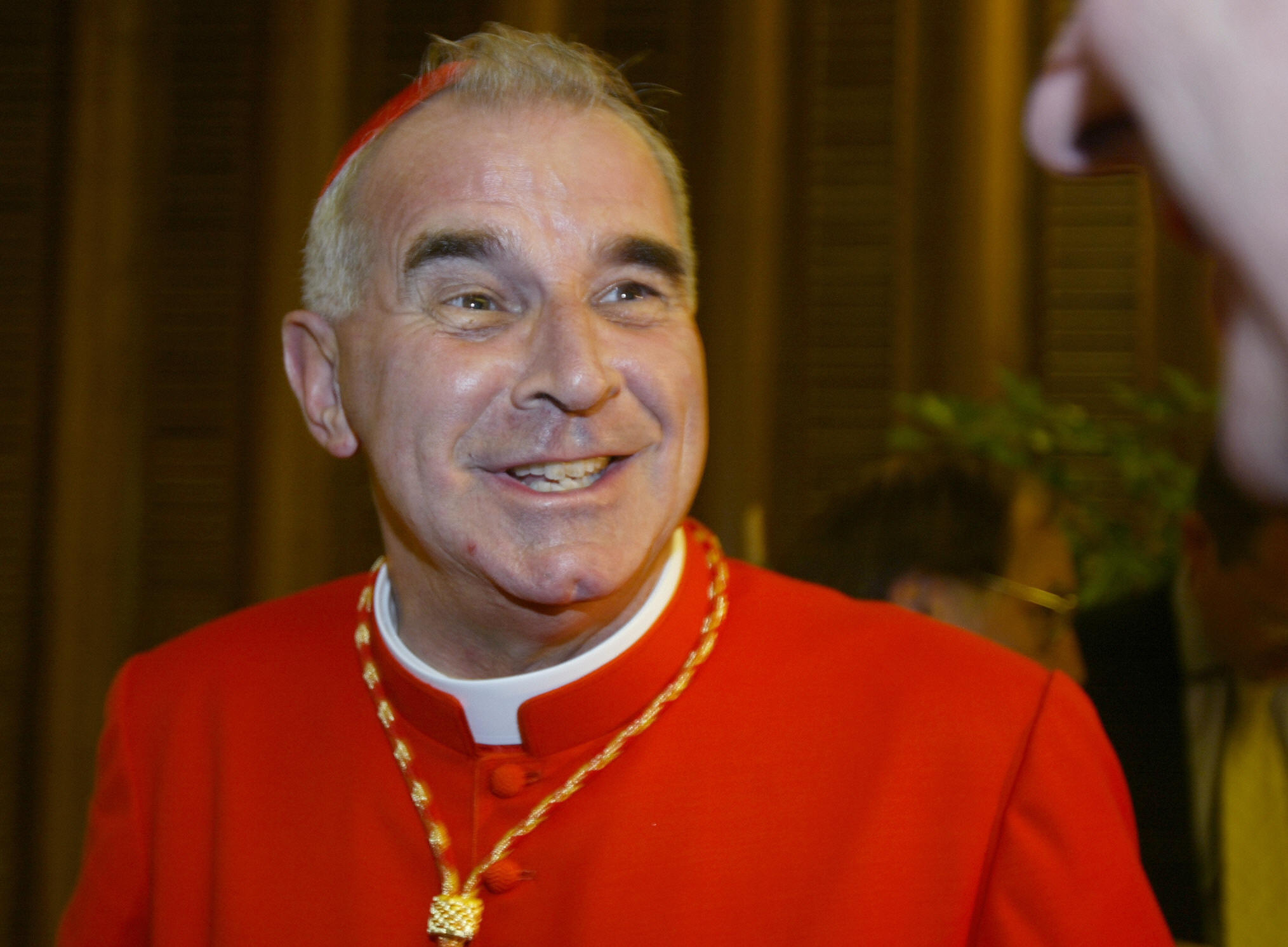
Portrait of newly appointed cardinal Kei

Here’s more detail of a fascinating story on the breakdown of the clerical gay closet. The men who exposed Scotland’s highest Roman Catholic figure had been aware of his orientation for years. One was very close:

Cardinal Keith O’Brien had a long-standing physical relationship with one of the men whose complaints about his behaviour sparked his downfall as leader of the Catholic Church in Scotland. The man left the priesthood in the middle of the last decade but rejoined and is living on the continent in a post the cardinal helped him secure. The complainant is known to have been in regular telephone contact with Cardinal O’Brien until recently and was a frequent visitor to St Benets, his official residence in Edinburgh’s Morningside.

So a cardinal in a same-sex relationship who publicly declared the idea of marriage equality as “madness” finally saw his elaborate house of cards collapse under the weight of massive hypocrisy:

Another source said: “These guys, we now know, were part of an inner circle. In the 30 years since these allegations took place there’s been ample time to complain. The Cardinal has had a huge profile for the past decade. But the door wasn’t just shut on them, it was bolted in the past 18 months.

“I believe they wanted to silence O’Brien – as he’s about to do another conclave, and make a huge deal of it. As he’s retiring, a decision’s been taken to go public and take him down.” Another said: “If you’re asking me to describe what this is about in one word, it’s revenge. I’ve no doubt the allegations did take place in the 1980s but they’ve come out to – destroy O’Brien.”

It’s a crack in the Catholic clerical closet – but look how long the news took to break and how egregious the hypocrisy had to be in order for the truth to come out. I’m against outing people in public life. But there are cases of such extreme hypocrisy, where such a vast gulf between private beliefs and public rhetoric almost requires people of conscience to speak out.

Quote For The Day

“When a broadcasting executive gets out of bed in the morning, before his foot hits the floor, his thoughts are ratings. ‘What are my ratings?’ Not unlike Wall Street people, who get their—and CEOs, their first thought is the price of their stock,” – Phil Donahue, reflecting on his firing from MSNBC for being too anti-war.

An Experiment With An Expiration Date? Ctd

Like Fallows, Ezra is afraid to get invested in products that Google might kill. In response, Drum identifies why Google’s failed products are particularly disruptive:

Ever since the birth of the PC, you’ve taken a risk when you buy a new product. If it succeeds, it’ll be around for a long time. If it doesn’t, it will die. Google isn’t breaking any new ground here.

What’s different is that Google’s products are all cloud-based. When Google Reader goes away on July 1, that’s it. It’s gone. If it were an ordinary bit of software that I’d installed on my PC, this wouldn’t be a problem. It would keep on working for years even if it never got another update. I’d need to replace it eventually—because of an OS upgrade or a desire for new features that finally got too strong—but I’d probably have years to work that out.

What Iraq Should Have Taught Us

Marc Lynch notes that Iraq War retrospectives “have almost exclusively been written by Americans, talking about Americans, for Americans.” The problem with this American-centric commentary:

The real story of the American departure is how little it mattered. That’s in part because the United States was never as necessary or wanted as Americans liked to believe. There’s no question that U.S. Ambassador to Iraq Ryan Crocker, for one, made himself indispensible to Iraqi politics through his tireless and effective diplomatic efforts. But as Charles De Gaulle famously (if apocryphally) said, the graveyards are full of indispensible men. Outside players can marginally affect faraway countries for a short time and through tremendous exertion, but their efforts are always refracted through local politics and rarely last. …

Here’s what we should have taken away from the Iraq withdrawal: The U.S. departure just didn’t change very much, and the United States keeping its troops there longer wouldn’t have made much difference. But such a lesson is incompatible with our deeply ingrained strategic narcissism, and thus will not likely be learned.