Portrait Of A Drone

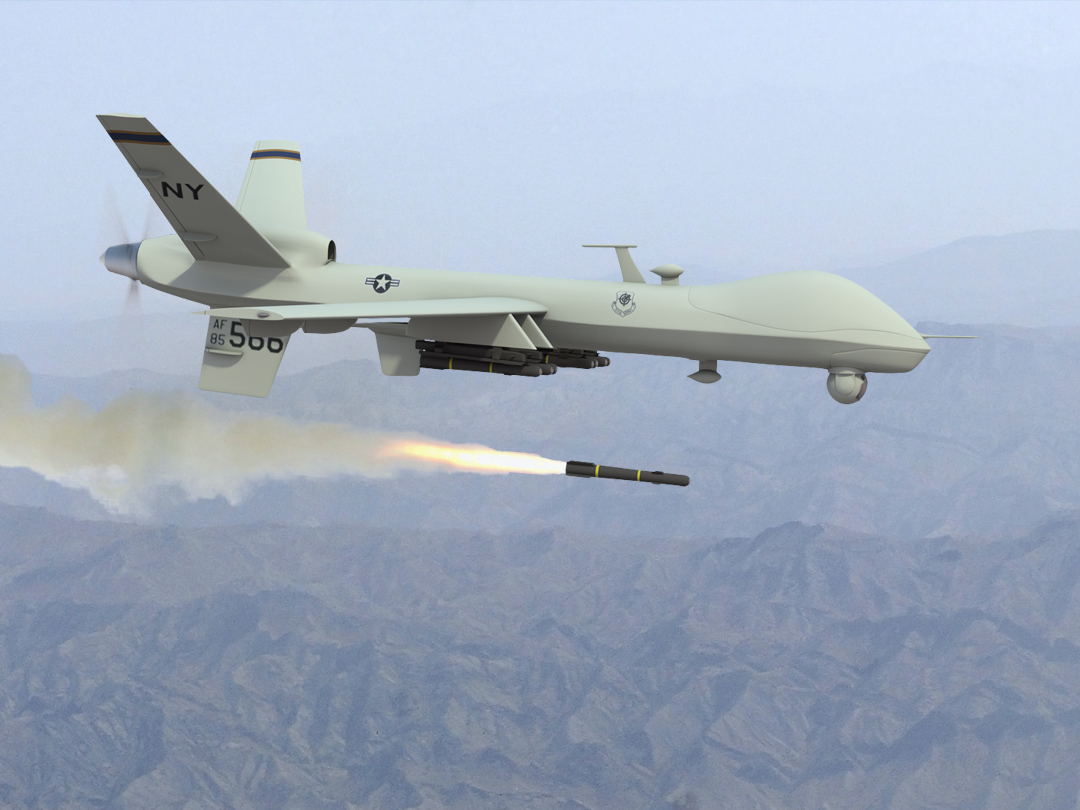
James Bridle was captivated by the ubiquitous image of a drone seen above, which happens to be the first Google image result for “drone”. But he became suspicious of the picture’s origins:

The level of detail is too low: missing hatches on the cockpit and tail, the shape of the air intake, the greebling on the fins and body. That ‘NY’ on the tail: it’s not aligned properly, it’s a photoshop. Finally, the Canon Drone’s serial, partly obscured, appears to be 85-566. The first two numbers of USAF serials refer to the year an aircraft entered service: there were no Reapers back in 1985 (development didn’t even begin until 2001). The Canon Drone does not exist, it never has. It is computer generated rendering of a drone, a fiction.

Alexis tracked down the image’s creator, Michael Hahn, who had posted it to a forum devoted to 3D modeling in 2009. Why it caught on:

“I had never seen an image of a drone actually firing a missile so that is what I decided to create,” he said. And suddenly, everyone else, who also had never seen a drone actually firing a missile, had a way of seeing with their own eyes.

The Evolving Business Of Books

In a wide-ranging essay on the history and future of publishing, Richard Nash illustrates how literature has always been subject to the whims of the market:

Books not only are part and parcel of consumer capitalism, they virtually began it. They are part of the fuel that drives it. The growth of the chain model in books offered everyone the opportunity to decry the groceryfication of the bookstore, utterly belying the reality, as [Ted] Striphas outlines in his excellent The Late Age of Print, that the bookstore is in fact the model for the supermarket:

In the history of shop design, it is bookstores, strangely enough, that were the precursors of supermarkets. They, alone of all types of shop, made use of shelves that were not behind counters, with the goods arranged for casual browsing, and for what was not yet called self-service. Also, when brand name goods and their accompanying packages were non-existent or rare in the sale of food, books had covers that were designed at once to protect the contents and to entice the purchaser; they were proprietary products with identifiable authors and new titles.

Meanwhile, Betsy Morais investigates digital publishers:

The world of digital publishing start-ups brings to mind blogging in its nascent stages. The guiding principle seems to be: if anyone can scribble on the Internet’s wall, anyone can become an author, and any text can become a book. Online, a book’s form warps into something more malleable, and fired-up digital publishers are trying to figure out how to turn that into a business—even if it means a proliferation of books that might as well have been blog posts.

She spoke with Peter Armstrong, who runs a serialized book company called Leanpub:

Armstrong suggests that a book and a start-up are each “a risky, highly creative endeavor undertaken by a small team, with low probability of success.” In either case, he says, you can go into “stealth mode”—which, he contends, will easily result in creating something that nobody wants. “To say you’re going to go off in a room and write the perfect thing without getting feedback from anybody is—I don’t want to say ‘arrogant’—but I couldn’t do it.” Editors, he adds, “function as a good proxy for readers”—but are not as effective as readers themselves. And so, it follows that the solution is to begin a project—in this case, a book—and let the people have at it. He calls this Lean Publishing, or “the act of publishing an in-progress book using lightweight tools and many iterations to get reader feedback, pivot until you have the right book and build traction once you do.”

Go here if you missed readers’ recent praise for Amazon’s digital business and its empowering of independent authors.
The Daily Wrap

President Obama's Official Visit To Israel And The West Bank Day One

Today on the Dish, Andrew struggled to come to terms with his support for the Iraq War, distinguished between Syria under Assad and Iraq under Us control criticized our marginalizing sectarianism in Iraq before the war, and waited for the NYT to come clean on their own role in the march to war. He viewed Obama’s Israel visit through the prism of Washington’s Farewell Address and could find no middle ground on Israeli settlements. Elsewhere, he called out closeted gays for their dereliction of duty and gave readers one more shot at picking Ask Me Anything questions.

In political punditry, Mark Kleiman removed the cultural divide from the marijuana debate while the NYPD wasted time on small-scale arrests. Seth Masket characterized party platforms as capable of evolution but not revolution, Ralph Reed separated doctrine from politics, and the White House threw out a red herring drone policy. A reader provided the mitigating context for Elizabeth Warren’s Moore Award Nomination as we weighed Rand Paul’s upside and updated nuclear policy for the post-Cold War era. In our continuing look back at the Iraq War, Karrar Habeeb chose not to memorialize the beginning of the failed Iraq War, while Richard Perle refused to look back and David Rieff rebuked those stuck in the neocon mindset. Overseas, Obama spread on the charm in Israel and Cyprus rejected the EU’s bailout deal.

In assorted coverage, opinion dominated the cable airwaves while CNN missed the point on the Steubenville rapists. Readers added some thoughts on fracking’s impact, Schneier pivoted from security to resilience. The Simpsons integrated itself into the fabric of our society, Reddit dumbed down complicated issues on YouTube, and Maureen O’Connor committed Netflix infidelity.

We polled readers on adopting a spouse’s last name as women bore the lion’s share of responsibility for messy houses, and Rajiv Srinivasan argued that veterans have it better now than ever before. Maurice Sendak penned his last book for lifelong fans, but David Cameron’s plagiarizing subterfuge was old news. We dug up the first Hathos Alert from the archives and backed our way through the MHB, an Angela Merkel effigy burned in the FOTD, and fog shrouded Santa Monica from view in the VFYW.

– D.A.

(Photo by Marc Israel Sellem-Pool/Getty Images)

One Last Bedtime Story

Avi Steinberg praises Maurice Sendak’s final work, My Brother’s Book, as his only book designed explicitly “for those adults who had grown up with his stories”:

In dedicating this last story to us, his once-children readers, he is Brothers_Book_03 marking the passage of time in our lives. He’s dated us. When I pick up this new book, I am reminded, as if I needed to be reminded, that I am no longer the ferocious, hyper-absorbed, small wonder of a Sendak reader I once was—nor, I’m guessing, are you. Had Sendak created another “Where the Wild Things Are” for us, would we even be able to appreciate it? For us obsolete children, as Theodor Geisel dubbed adults, it would be beside the point.

What makes this last book special is that Sendak is willing to meet his former-children readers where they are now in their lives—on the condition that they meet him where he was at the end of his. [Sendak friend Tony] Kushner told me that he saw Sendak, toward the end of his life, eyes dimmed, hunched over his studio desk, pressing his face so close to the drafts that his dear nose was almost touching them. For his devoted readers, this tender proximity—this intimacy—may be the most affecting part of “My Brother’s Book.” The supple details are Sendak’s way of physically drawing us in, closer and closer, until we tap the page with our own noses: one last kiss goodnight.

Liz Rosenberg was similarly moved:

Sendak claimed to have been terrified of death all his life. He had the kind of sickly childhood that tends to form great artists. (Robert Louis Stevenson was another, along with Edvard Munch, Toulouse-Lautrec, and Proust.) Small wonder that so many of his young heroes and heroines face death, whether they laugh in its face or flee. Max terrifies and rules the Wild Things that menace him. Ida rescues her baby brother from the ice goblins of Outside Over There, and Pierre, who famously “doesn’t care,” lightly flings himself into the lion’s mouth. This is not new territory for Sendak, but he newly mints it in the absolute conviction with which he throws himself into his eternal themes. If there is a message to the book it is that some things are worth dying for, including love.

Previous Dish on Sendak’s final book here.

(Copyright © 2013 by the Estate of Maurice Sendak. Used by permission of the Estate of Maurice Sendak/Michael di Capua Books/HarperCollins Publishers.)

A Million Hours Fighting Marijuana

What a waste:

New York City police spent an estimated one million hours in staff time making low level marijuana possession arrests between the years 2002 and 2012, according to the findings of a study released today by the Marijuana Arrest Research Project and the Drug Policy Alliance.

Authors of the study report that City law enforcement personnel engaged in approximately one million hours of police officer time to make 440,000 marijuana possession arrests over the past 11 years. Authors further estimated that those arrested for marijuana possession in New York City have spent five million hours in police custody over the last decade.

Authors concluded: “[I]t is clear that the marijuana arrests have taken police off the street and away from other crime-fighting activities for a significant amount of time.”

Will Drone Reform Make A Difference?

US-POLITICS-CONGRESS-DRONE

Daniel Klaidman reports that the White House is ready to transfer control of the drone program from Langley to the Pentagon:

The proposed plan would unify the command and control structure of targeted killings and create a uniform set of rules and procedures. The CIA would maintain a role, but the military would have operational control over targeting. Lethal missions would take place under Title 10 of the U.S. Code, which governs military operations, rather than Title 50, which sets out the legal authorities for intelligence activities and covert operations.

But it probably won’t satisfy critics of the program’s secrecy:

For one thing, targeted killing operations will likely be run by the highly secretive Joint Special Operations Command, the umbrella organization for shadow warriors like the Navy SEALs and Delta Force. And while they run clandestine, rather than covert operations, JSOC is not known for its eagerness to advertise its operations with the press or Congress.

In fact, there’s at least a chance that the change could mean less congressional oversight rather than more. There’s nothing in the law that says the military has to brief congressional committees about its lethal activities. The CIA, on the other hand, is compelled under Title 50 to notify Congress of its intelligence activities.

Dashiell Bennett has more on those legal distinctions. Ackerman suggests that the new policy is a red herring:

What matters more than which bureaucratic entity operates the drones is what the politicians ostensibly in charge of those bureaucracies want to do with them. Sen. Rand Paul (R-Kentucky)’s 13-hour filibuster earlier this month vented congressional dissatisfaction with the secrecy, scope and intensity of the global targeted-killing program. It remains to be seen if Paul and his colleagues wish to trim the edges of that lethal program or constrain it more substantially. Congress has been more bellicose than the Obama administration.

(Photo: Committee ranking member US Senator Chuck Grassley (L) and Senator Dianne Feinstein (R) listen as committee chairman Senator Patrick Leahy (C) speaks during a hearing of the Senate Judiciary Committee on Capitol Hill, March 20, 2013 in Washington, DC. The committee called drone industry experts to testify about the future use of drones in law enforcement. By Brendan Smialowski/AFP/Getty Images)

How Many Nukes Do We Need?

Tom Nichols urges the US to think small:

The Cold War mission of deterring another nuclear superpower by preparing for global nuclear combat, insofar as that idea ever made sense, is now a part of history and should be left behind. The new mission for U.S. nuclear weapons for at least for the next two decades, if not longer, should be one of minimum deterrence, meaning the prevention of a major nuclear attack on America with a small nuclear force — perhaps as low as 300 strategic weapons — targeted only for retaliation for the attempted destruction of the United States and nothing else.

This is not a radical proposal: some American military and civilian leaders gravitated to the idea of a minimum deterrent as early as the 1950s.

Along the same lines, Tom Jacobs flags a recent paper (pdf) that tested how willing Americans are to use nuclear weapons:

“We initially set up the study assuming there would be a strong aversion to using nuclear weapons,” he said in an interview. “The design was created to determine how strong an incentive to use (nukes) do we have to create before people reluctantly sign on. How much of a military advantage would the nuclear option have to give above the conventional option before people would say, ‘We have to do this’?

“We found you barely have to put a finger on the scale.”

Face Of The Day

Las Fallas Festival In Valencia

A ‘Ninot’ (puppet) depicting German Cancellor Angela Merkel burns during the last day of the Las Fallas Festival on March 20, 2013 in Valencia, Spain. The Fallas festival, which runs from March 15 until March 19, celebrates the arrival of spring with fireworks, fiestas and bonfires made by large puppets named Ninots. By David Ramos/Getty Images.

More on the Falles and ninots from Wiki:

Formerly, much time would be spent by the Casal faller preparing the ninots (Valencian for puppets or dolls). During the four days leading up to 19 March, each group takes its ninot out for a grand parade, and then mounts it, each on its own elaborate firecracker-filled cardboard and paper-mâché artistic monument in a street of the given neighbourhood. This whole assembly is a falla.

The ninots and their falles are constructed according to an agreed upon theme that has traditionally been, and continues to be, a satirical jab at anything or anyone who draws the attention of the critical eyes of the falleros—the celebrants themselves. In modern times, the whole two week long festival has spawned a huge local industry, to the point that an entire suburban area has been designated the City of Falles – Ciutat fallera. Here, crews of artists and artisans, sculptors, painters, and many others all spend months producing elaborate constructions of paper and wax, wood and styrofoam tableaux towering up to five stories, composed of fanciful figures in outrageous poses arranged in gravity-defying architecture, each produced at the direction of the many individual neighbourhood Casals faller who vie with each other to attract the best artists, and then to create the most outrageous monument to their target.

An Unoriginal Act Of Plagiarism

Fiction writer David Cameron attempted to expose the unfairness of literary journals by submitting to them an already published New Yorker story under guise of a fake, unpublished writer. The journals all rejected the story. David Haglund yawns:

Many other writers have indulged in this silly exercise before. There was the guy who sent Jane Austen novels to several U.K. publishers five years ago, as if it made sense to write 19th-century-style fiction in 2007. (Even assuming that some of the publishers did not recognize, e.g., Pride and Prejudice—which I doubt—it would still read like pastiche, and not very interesting pastiche.) There was the other guy who sent part of a lesser Jerzy Kosinski novel around. That same guy (and they are all, for some reason, guys) submitted the script of Casablanca to a bunch of movie agents—as if the movie business had not changed a whit since 1942, and those agents who were foolish enough not to recognize the classic dialogue were proving some point about how the people at the top have no idea what they’re doing.

Whitewashing Rape

Fallows highlights this video, which is sympathetic to the Steubenville rapists, as an extreme example of false equivalence:

A petition asking CNN to apologize, as of this writing, has over 245,000 signatures. Elias Isquith analyzes:

Basically what I think happened is that the people who run these shows are overworked. They get sloppy. And lazy. If we consider that the victim’s anonymity made it exceedingly difficult to run he-said/she-said coverage, it’s kind of a no-brainer that we’d end up with reports that have much more in common with one of those unbearably maudlin SportsCenter “stories” about athletes triumphing in the face of adversity than they do with actual news.

The weeping rapists were right there. TV gold. And the girl? She didn’t even give us a single little tear! No Casey Anthony, her.

The Onion’s take on the subject here.