The Iraq War Isn’t Over

Civilian Deaths

For Iraqis:

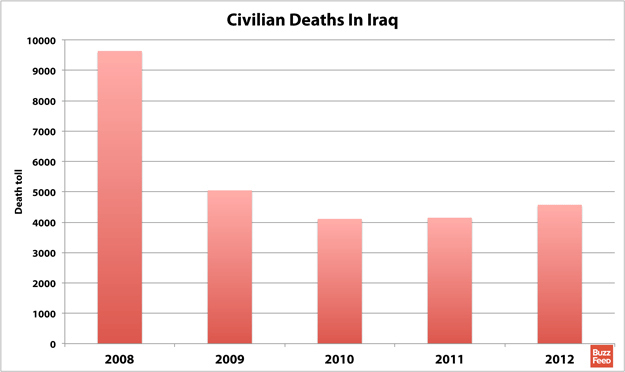
Tuesday marks the ten-year anniversary of the Iraq War, and while that war officially ended for the United States in December of 2011, life for Iraqi civilians — while better than it was at the bloody height of the insurgency — is still something short of peace. 4,573 Iraqi citizens were killed in 2012, up from 4,147 in 2011.

Just today:

Insurgents sent a bloody message on the eve of the 10th anniversary of the U.S.-led invasion, carrying out a wave of bombings across the country Tuesday that killed at least 65 people in the deadliest day in Iraq this year. The nearly 20 attacks, most of them in and around Baghdad, demonstrated in stark terms how dangerously divided Iraq remains more than a year after American troops withdrew. More than 240 people were reported wounded. It was Iraq’s bloodiest day since Sept. 9, when an onslaught of bombings and shootings killed 92.

The End Of Nation Building

Iraqi police are no longer getting US training:

It was the last major non-military project of the war of choice the U.S. launched 10 years ago: an ambitious, expensive post-withdrawal effort to strengthen the Iraqi police. But quietly, the Obama administration has pulled the plug on the much-criticized training program, leaving some 400,000 Iraqi cops without U.S. mentorship.

The State Department confirms to Danger Room that it pulled its final adviser out of the project, called the Police Development Program, on March 1. The move kills the training effort less than two years after the Pentagon handed it over, and after State spent at least $700 million on it.

Iraq War Vantage Points

Nada Bokos, a CIA analyst in the lead-up to the war, recalls how, at “the CIA’s Iraq Branch in the Counterterrorism Center, we didn’t think Saddam had any substantial ties to al-Qaida”:

On Sunday, March 16, 2003, I watched Cheney on “Meet The Press” contradict our assessment publicly. “We know that he [Saddam] has a long-standing relationship with various terrorist groups,” Cheney said, “including the al-Qaeda organization.” I was basically watching Cheney field-test arguments that we would have to anticipate — and rebut — at CIA. Except instead of asking us questions behind closed doors, Cheney was asserting to the public as fact something that we found to be anything but. I found myself yelling at the TV like I was contesting a ref’s blown call in a football game.

Meanwhile, George Packer recalls reporting in Iraq and the friends he had in the country:

Spending a lot of time in Iraq did not make you more keenly aware of America’s larger strategic interests. It rendered you less likely to ask the essential questions about the inception of the war. It was in some ways a narrow, blinkered position. People who had no personal connection to Iraq, however well- or ill-informed, were readier to think that it was all inevitable—that the past decade was a footnote to the main event—that the tenth anniversary of the war would look exactly like this.

Faces Of The Day

People Pay Their Respects To The Country's War Dead At Arlington National Cemetery's Section 60

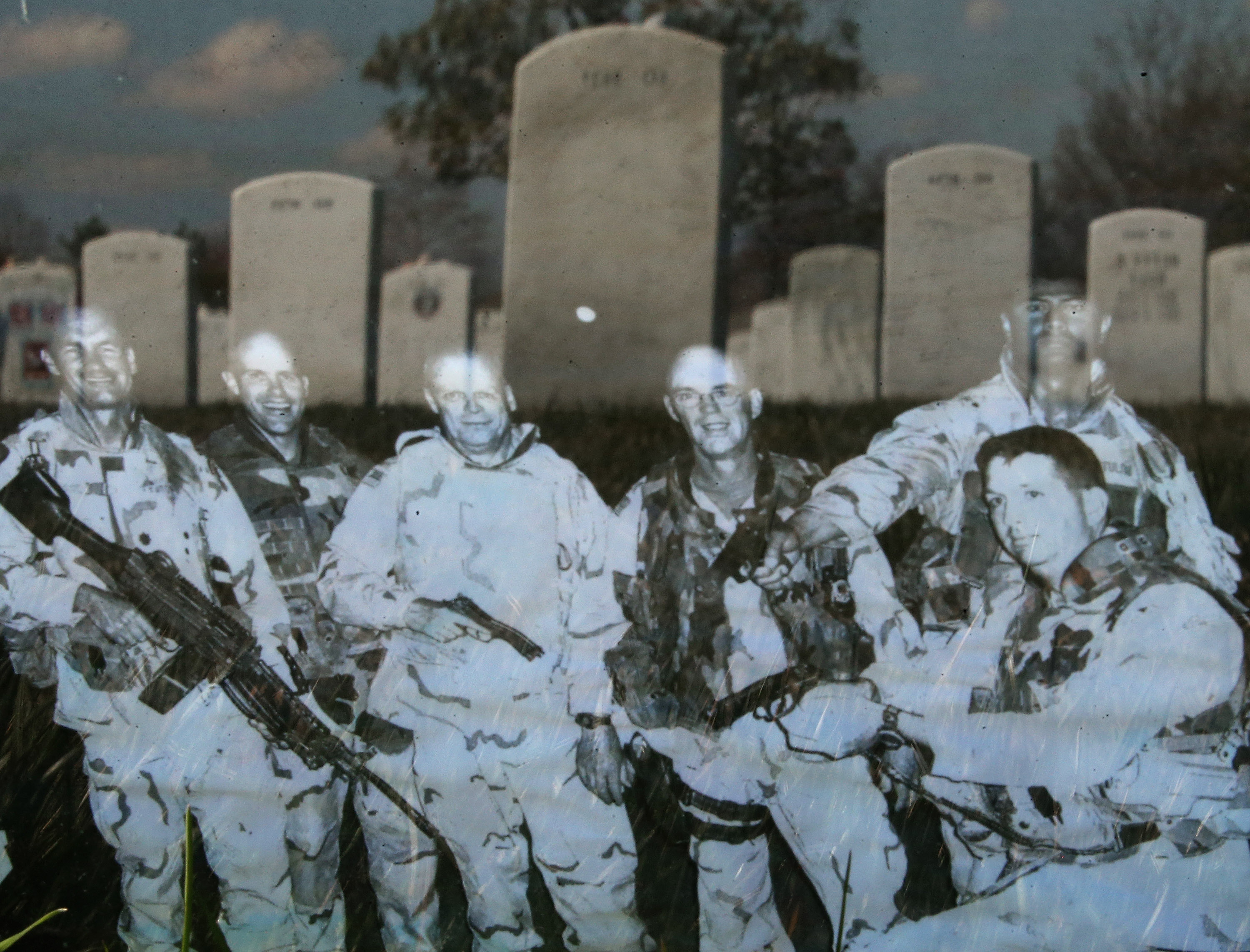
Headstones are reflected in a photograph that is leaning against the headstone for Iraq war casualty U.S. Army Master Sgt. Tulsa Tulaga Tuliau on the 10th anniversary of the beginning of the war in Iraq at Arlington National Cemetery March 19, 2013 in Arlington, Virginia. Tuliau was killed when an improvised explosive device detonated near his Humvee during combat operations near Rustimayah, Iraq on September 26, 2005. By Chip Somodevilla/Getty Images.

Crowdsourcing On Steroids, Ctd

Readers keep the popular thread going:

I think most people who “donate” on Kickstarter think of themselves as something like small-scale patrons of the arts. I know it sounds silly when applied to a TV show instead of a symphony or museum, but people with less money and low(er)brow tastes are allowed to donate some of their money towards art too. I agree there are issues here with respect to Warner Bros being a corporate interest that stands to make money off of this, but that’s not really enough in my mind to condem the entire thing. Everyone who donated already knew that.

Another is more skeptical of the movie corporations:

I think supporters of the Veronica Mars Kickstarter campaign are missing what a dangerous precedent it sets. If the studios realize they can mitigate financial risk simply by crowdsourcing funds from the fans of established properties, what’s to stop them doing it for more and more, larger and larger productions? And why stop at production expenses? “Oh no, Firefly fans! We got the new movie made, but we can’t afford to distribute it to theaters! Donate $50 and you get a deluxe Blu-ray!” While I’m sure Veronica Mars creator Rob Thomas is not being cynical in this situation, one should never doubt the power of Hollywood studios to cynically manipulate consumers if it means they can save a buck.

Rob Thomas emails the Dish and, in part, addresses our readers’ concerns over corporate influence:

The least important thing I’ll say is this. I am thrilled this debate is happening. I am an avid reader and early subscriber to The Dish. I live on this site. Before we launched the Kickstarter drive, I wondered if there would be a Dish debate about the auspices of the Veronica Mars movie. I am so pleased that there is.

I have likewise followed with great interest the way you handled the transition on the Dish to subscriber service. I knew that they were similar appeals in that both projects have such a community feel to them. We’re very different products, but the people who follow us are devoted. I paid for the subscription for the content, yes, but also because I really wanted it to be successful. I know there’s probably quite a bit of that with our Kickstarter as well.

Other people have made the case effectively that we’re not asking for charity. We’re not asking for people to donate for the greater good. I understand why it is totally appropriate for public television to offer a $5 tote bag for a $100 donation, but it would be unseemly for our project to do that. We’re not. We’re offering great rewards for the pledges.

A script, a T-shirt and a download of the movie for $35? That’s a helluva deal. What we’re doing here is pre-selling the movie. You can think of the Kickstarter page as a store. If you like the product we’re selling, buy in; if not, don’t. What Veronica Mars fans are doing is taking the risk out of making the movie by showing Warner Brothers there is demand for the product. I think everyone wins here. The fans get to see a movie they wouldn’t see otherwise. Kristen Bell and I get to finally make our passion project, and, God-willing, it’s profitable and Warner Brothers makes more movies this way and we get to see more of our favorite titles get a second life.

The other important point I want to make – the studio people I am working with on this? They are not chomping on cigars and demanding to see balance sheets. They want to make this movie. They’re fans of the show. They’re fans of movies in general, and they’re excited about opening up an avenue that could allow them to make more cool projects. There’s actually a lot of bravery on the part of the executives who pushed to make this happen. The easiest thing at a big corporation is to say no. They knew there would be a vigorous debate about this model. They said yes because they believe, at the end of the day, the consensus will be that everyone benefited.

Hey, if Freaks and Geeks follows our model, I will happily pledge whatever I can to make that movie happen.
Today In Counterfactual History

A combo shows (L): Iraqi ringing a rope

Bobby Ghosh believes that Saddam would have survived the Arab Spring:

Saddam forbade satellite dishes, and economic sanctions–in place since his troops were kicked out of Kuwait in 1991–meant Iraqis could have neither personal computers nor cell phones. That meant no Facebook, no Twitter, not even text messages. And no al-Jazeera to spread the word from Baghdad to other cities. Unlike Ben Ali and Mubarak, Saddam would have had no compunction ordering a general slaughter of revolutionaries; and unlike the Tunisian and Egyptian military brass, the Iraqi generals would swiftly have complied. They had already demonstrated this by killing tens of thousands of Shi’ites who rose against the dictator after his Kuwaiti misadventure.

Max Fisher thinks that possibly “the most apt comparison for how Saddam Hussein’s Iraq would fare in the Arab Spring isn’t Syria, but Algeria”:

Though Algeria is ruled by an authoritarian, nationalist, military-aligned government, and though popular discontent appears high, there has been no revolution. There are many theories for why this might be, but one of the most persuasive comes down to uprising exhaustion. The county endured an awful civil war from 1991 to about 1999, which the regime won. In the thinking of some Algeria analysts, the legacy of that conflict has left the would-be protesters too tired, too wary of bloodshed and too weak to rise up again. In this thinking, the case for Hussein’s survival isn’t that he would crush an uprising, but that the uprising, like in Algeria, would never really happen.

(Photo: A combo shows (L): Iraqi ringing a rope around a giant bronze statue of toppled Iraqi president Saddam Hussein in Baghdad’s al-Fardous (paradise) square on April 9, 2003. (R): Iraqi women sitting under the newly erected ‘Statue of Hope’ at the square that has taken the place of the former statue of Saddam. By Ramzi Haidar (L) and Timothy A. Clary (R) /AFP/Getty Images)

Dreaming Of An Online Utopia

Discussing his new book, Evgeny Morozov takes aim at Silicon Valley’s culture of “solutionism”:

“Solutionism” for me is, above all, an unthinking pursuit of perfection—by means of technology—without coming to grips with the fact that imperfection is an essential feature of liberal democracy. As I point out in the book, there have been many “solutionist” impulses in the past—lots of other authors have addressed it, albeit under different names (like “rationalism” or “high modernism,” for example). What makes today different is that the overall excitement about “the Internet”—I find this concept so sickening and suffocating that I use it in scare quotes throughout the book—makes us blind to the pitfalls of solutionism and justifies many silly interventions and reform agendas.

Previous Dish coverage of Morozov’s book here.

A History Of Plaudits

Megan Garber looks back at “how we liked things before we Liked things”:

Before telephones allowed for Gallop-style surveys, before SMS allowed for real-time voting, before the Web allowed for “buy” buttons and cookies, Roman leaders were gathering data about people by listening to their applause. And they were, being humans and politicians at the same time, comparing their results to other people’s polls — to the applause inspired by their fellow performers. After an actor received more favorable plaudits than he did, the emperor Caligula (while clutching, it’s nice to imagine, his sword) remarked, “I wish that the Roman people had one neck.”

(Image by Tom B from the blog Thumbs and Ammo, which replaces guns with some positive reinforcement)

A Free Education Until Employment

App Academy “offers a 9-week, 90-hours-a-week boot camp to turn programming novices into code jockeys.” Students don’t pay tuition until they get a job:

“We don’t want to charge up front because we feel pretty strongly about tying the payment to the outcome,” says [co-founder Kush] Patel. “If they can’t find a job, we’ve screwed up somehow.”

In tech hubs like Silicon Valley, he’s not wrong. Qualified programmers in cities like San Francisco and New York fend off recruiters as multiple companies bid for their services. New recruits signing up for App Academy promise to pay 15 percent of what they earn during their first year on the job, payable over the first six months after they start working. For the school, the math isn’t too shabby if they succeed at placing their students. If 15 students get jobs at $80,000 salaries, that works out to a $180,000 commission.