The Right And Marriage Equality: A Tipping Point?

Kilgore wonders whether Portman’s flip on marriage will have a ripple effect:

Portman’s move could trigger a wave of conversions in the Republican ranks, and that in turn could break down legal resistance to same-sex marriage. Already we’ve seen most conservatives abandon the “traditional marriage” cause as a backlash generator and vote mobilizer. Now we’ll see if votes change in state legislatures, and the walls come tumbling down.

I’ll point out the way that Marco Rubio addressed the question at CPAC:

Just because I believe that states should have the right to define marriage in a traditional way does not make me a bigot.

Indeed. But that’s a defense of federalism, not an attack on marriage equality per se. I know I’m splitting hairs here – but my main worry is that over-reach by SCOTUS this June might hand the advantage on this issue back to the right, just after it appears to being settled in the court of public opinion in the states. I’m also struck by Jennifer Rubin’s account of a marriage equality event at CPAC last night:

The event featured, among others, GOProud Executive Director Jimmy LaSalvia. Former CEI chairman Fred Smith moderated the panel, which included Jonah Goldberg, GOProud and Freedom To Marry adviser Liz Mair, GOProud board member and author Margaret Hoover, and me. To his credit, NRA weddingaislepresident and CPAC board member David Keene attended…

LaSalvia made the conservative case for gay marriage (“We should want everyone to settle down, be monogamous, get married and be happy – even gay people”) and for the GOP to shed the image of intolerance toward gays, which “contributes more to conservatives’ image problem than any other, because it’s an issue that cuts across all demographic groups.” And he spoke more generally about the need “to seriously examine and recalibrate our movement to build a new coalition that can win,” one built around a common understanding of the centrality of liberty but one that allows for differences …

LaSalvia received a boisterous ovation. There were polite differences among the panelists, with Goldberg encouraging federalism and Hoover making the case that marriage is a “fundamental right” recognized in a host of Supreme Court decisions. But there was widespread agreement that support for gay marriage is consistent with modern conservatism and that opposition to it is a barrier to political success for the GOP.

That’s a huge shift – in line with the British Tories. One small hat tip: Liz Mair has done amazing work on this for years, and I personally want to thank her. Nonetheless, Jonathan Bernstein bets that the 2016 GOP nomination won’t feature a serious debate over marriage:

I’m still guessing that Portman will remain the exception, and that opponents of marriage will still maintain a solid veto over the presidential nomination in the 2016 cycle. To some extent, that’s because public opinion within the GOP, and presumably especially among the presidential primary electorate, still runs overwhelmingly against marriage equality. It’s possible that could change, especially if GOP elite opinion continues to change, but right now it’s hard to see a same-sex marriage supporter benefiting even in a large field in which staking out a minority position could have some advantages.

We’ll see, won’t we? But this change is accelerating, not losing steam.

The Invisible Ideology of House Of Cards?

Bhaskar Sunkara, in a leftist reading of the hit series, derides its lack of ideological kick:

After Obama’s election, liberals tried to make over Washington in The West Wing’s image—post-political, free of legislative rancor, fixed to the will of a single charismatic president. But they’ve run into a roadblock, an obstructionist Congress unbound by Sorkin–style civility. No wonder so many liberals eat up the seediness in House of Cards. Underwood is a leading member of the House of Representatives, an institution beset for decades by low approval ratings and lurid scandals. It’s not just legislative policy that is called into question by House of Cards, but the motivations of those doing the legislating. …

But easy cynicism shouldn’t be mistaken for considered political critique. House of Cards’ message is simple: Bad men and women inhabit Capitol Hill. It’s superficially progressive. Like the series’ creators, liberals have a tendency to see the structures of American political life—our Constitution, for example—as being inherently sound instruments of the popular will, rather than systems meant to protect against mob rule.

I have two episodes to go. I don’t look at this inspired miniseries as ideological. It has some clumsy compressions, some melodrama, and a main character so close to Shakespeare’s Richard III I wonder whether Kevin Spacey’s breaking the fourth wall isn’t some sly reference to Richard’s chillingly fun soliloquies to the audience. Robin Wright is like adding Lady MacBeth to Richard III.

But in general, it captures the Washington I know better than almost any movie I have seen. From the power struggle between old and new media to the wonderful humanity of Peter Russo and the subtle but pervasive influence of lobbyists and whom they represent, it takes its time to re-create reality.

My one criticism is that it is too cynical.

Washington is full of the characters you see in the series, but it is also full of people trying to make the world a little better, trying to maneuver their way through the avenues of power without accumulating too many scalps, believers and dreamers and genuinely hard-working folk doing their best. They’re a minority, of course. This is politics. But they are there – and not only among the ranks of the non-profit martyr of Claire’s charity. And there are bloggers more ethical than Zoe Barnes. But her ambition is of an Ezra Klein magnitude.

I like the fact that Underwood is a Southern Democrat. The show’s head writer explains his reasoning behind the choice:

The broader point of “House of Cards” is that anyone is fair game, no matter what side of the aisle they are on. You could easily write this story about a Republican congressman as well, but we wanted to dramatize the fact that these sort of creatures live on either side of the aisle. The things people will find objectionable about Underwood will be about deeper ethical belief systems that transcend political affiliation. If you look at Underwood and what he’s actually doing, he is not someone who binds himself to any particular ideology. His ideology is quicksand, and he would say that the only way to truly survive in Washington and to be effective is to be adaptable.

And he would be right. Which is why the GOP, if it does not mellow its ideological rigidity, is in trouble.

Google Isn’t A Public Utility

Manjoo wonders which money-losing product the company will kill next:

[H]ow about Google Scholar, the academic papers search engine? Sure, this extremely useful service is in keeping with Google’s larger mission to make the world’s knowledge universally accessible. But Google does not display any ads in Scholar, and I can’t think of any other way it’s padding Google’s bottom line. So might it, too, disappear some day?

Joshua Gans hopes not:

If Google killed off Scholar next year, there would be no easy substitute. Discovery of academic research would fall back into the hands of major publishers. I remember that regime and, put simply, it was costly and often not worthwhile to search. Scholar changed all of that.

When The Personal Becomes Political

Allahpundit ponders Portman’s reversal on marriage equality:

I’m loath to scold the guy for his reasoning given that I agree with him and that he’s taking on a bit of political risk in doing this, but why did he need his son to come out to get him to look at this issue from the perspective of someone who’s gay? He’s been a professional legislator for years; he’s supposed to consider all sides of an issue when deciding which policy to support. That’s a surprisingly parochial approach to a national debate that’s been rolling around for a solid decade now. Makes me wonder if his feelings on the subject really did change recently or if he’s always quietly been open to gay marriage but only felt politically safe to announce it once he discovered his son’s orientation. Conservative primary voters may be less likely to hold it against him if they think it’s a decision driven by fatherly love for his son.

Chait is more blunt:

Portman ought to be able to recognize that, even if he changed his mind on gay marriage owing to personal experience, the logic stands irrespective of it: Support for gay marriage would be right even if he didn’t have a gay son. There’s little sign that any such reasoning has crossed his mind.

Drum is forgiving:

I do wish conservatives could demonstrate a little empathy even for people and causes that don’t directly affect their own lives, but it’s not as if this is an exclusively conservative thing. It’s a human thing. Personal experience always touches us more deeply than facts and figures, and in the case of gay marriage we all knew this was how progress would be made. People would see gay characters on TV and shed a little bit of their discomfort. They’d learn that old friends are gay and decide they wanted to stay friends anyway. They’d learn their children are gay, and decide that they still wanted the best for them, even if that means supporting same-sex marriage.

And Yglesias asks, “if Portman can turn around on one issue once he realizes how it touches his family personally, shouldn’t he take some time to think about he might feel about other issues that don’t happen to touch him personally?”:

Senators basically never have poor kids. That’s something members of congress should think about. Especially members of congress who know personally well that realizing an issue affects their own children changes their thinking.

My thoughts here.

The Frontrunner, By A Mile

Micah Cohen puts Hillary’s 2016 early-polling lead in historical context:

Her lead in the polls we have so far exceeds that of any other candidate — of either party — in any election cycle in our sample. Many observers have pointed out that Mrs. Clinton also had a large lead in early polls of 2008 and yet lost that race. But her 2016 lead over Mr. Biden (33 percentage points) exceeds even her 2008 lead over Mr. Obama (22 percentage points). And she may benefit from the sense of being “the next in line,” having been the runner-up in her party’s last open contest — a dynamic seen in several recent Republican primaries.

Is RSS On The Way Out?

Buzzfeed_Reader

Felix Salmon fears so:

RSS has been dying for years — that’s why Google killed Reader. It was a lovely open format; it has sadly been replaced with proprietary feeds like the ones we get from Twitter and Facebook. That’s not an improvement, but it is reality. Google, with Reader, was really providing the life-support mechanism for RSS. Once Reader is gone, I fear that RSS won’t last much longer.

That would be a sad coda to the death of Aaron Swartz, who at the age of 14 was part of the team that invented RSS. The end of Google Reader, and RSS more generally, could also hurt blog traffic. Buzzfeed provides the above chart:

According to data from the BuzzFeed Network, a set of tracked partner sites that collectively have over 300 million users, Google Reader is still a significant source of traffic for news — and a much larger one than Google+. The above chart, created by BuzzFeed’s data team, represents data collected from August 2012 to [yesterday].

Defense Isn’t Untouchable Anymore?

Josh Green unpacks the politics of the sequester’s defense cuts:

Anti-tax activists steamrolled the defense crowd. Why? The answer probably lies in the composition of the Republican caucus, especially in the House: Nearly half its members—48 percent—were elected in 2010 or after. These Republicans are genetically different from those who held power in the 1980s and ’90s.

They came of age during a period of two failed wars in the Middle East and exploding budget deficits. “This is a group that got elected to rein in spending, not to protect Cold War-era defense,” says David Wasserman, House editor for the nonpartisan Cook Political Report.

But individual Republicans are starting to complain about sequester cuts that impact their districts.

The Pope On The Bus

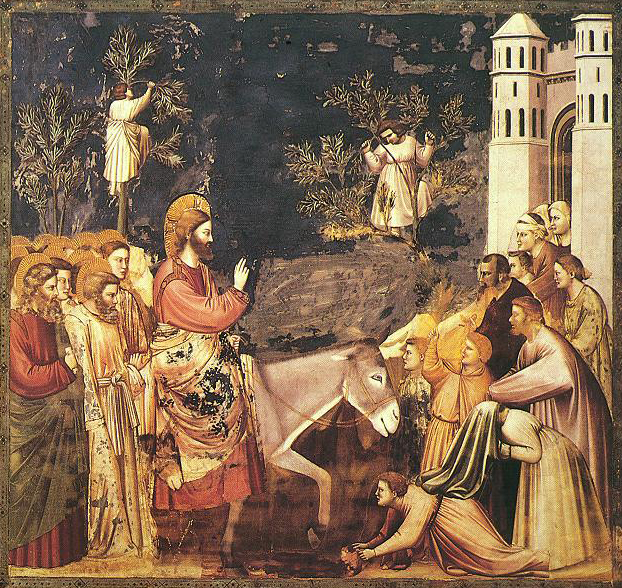
Giotto_-_Scrovegni_-_-26-_-_Entry_into_Jerusalem2

Of course that detail has resonance. The implicit rebuke to the Liberace of Popes, Benedict XVI, is somehow not disrespectful, yet obvious. Saint Francis refused to ride on a horse. It gave him, as far as he was concerned, too much haughtiness, too much power over others, too much visibility. He would walk, and if he needed a way to transport things with him, he used a donkey. For a while, Franciscans followed this stricture carefully, while eventually the norm became that Franciscans could ride on donkeys, never horses, if they really couldn’t walk. And the legend has it that on his death-bed, Francis thanked his donkey for his long service and that the donkey wept.

Jesus’ celebrated arrival in Jerusalem, when the crowds that would soon call for him to be tortured to death were throwing palm fronds at his feet, was on a donkey. Here we had the Son of God insisting on making a paradoxical entrance – on the lowliest creature. “Lowly Yet Chosen” as Pope Francis put it in his first statement. And so we hear more and more stories of his insistence on an absence of pomp, of not placing the priesthood or even the papacy on a lofty pedestal, getting on the same bus as is fellow cardinals, paying his own bills at a local hotel, telling his fellow Cardinals to wear black rather than Benedict’s fabulous scarlet near-burlesque.

For much of my time in high school, I rode the public bus every day. I went to what Americans would call a “magnet school” which was a long way, in an English sense, from my home. For close to seven years, I spent two and a half hours a day on that lumbering vehicle, wending its way with painful slowness through the darkness of the English winter or the absurd green orgasm of every spring. And I think there is something valuable about that simple public exposure, day after day, that reminder that you are not better than anyone else, that if there’s no seat available, you stand, that if an old or infirm or pregnant person gets on the bus, you offer them your seat, that the strangers you stare at have lives you will never fully know – unless a conversation happens to begin, or a stranger on the same bus every day becomes a kind of unknowable friend. I can still close my eyes and see faces I would see at various stops along the way. We were English so mere nods of recognition sufficed.

This is one reason I love Catholicism: its human and cultural catholicity.

The parishes I’m drawn toward are sprawling, diverse, different congregations. I never wanted to go to a gay mass, although I respect those who choose to. For me, it was the lack of uniformity that grabbed me. To walk to communion behind a student or a construction worker or a Latino immigrant or a pregnant mother or a gay senior or an old lady in a veil is to experience the sheer, glorious wounded mess of humanity – walking to be healed by the Body of Christ. I deeply believe this is integral to Christianity – a lack of hierarchy, an insistence that what the world elevates is not what matters, that the first shall be last, and the last first. Letting go of the notion that you are worth more or less than anyone else, accepting your physical fate as dust, and embracing humanity without borders or labels – as the Samaritan did in the parable, as Francis did with lepers, as Mychal Judge and Jorge Bergoglio did in washing the feet of people with AIDS – this is Christianity.

It wounds me to see so many young people think of it as the opposite (and not without reason). A hierarchy determined to defend its privilege and prestige even at the expense of raped children, a Pope almost disappeared in his own regalia, a stream of statements ostracizing a group of human beings – gays – and refusing even to listen to the perspective of half of humanity, women: this is what Francis inherited, and he was not free of it. But the new name gives new hope and points in a new direction.

Perhaps the answer is to get back on the bus again. And in one of her most poignant posts yet, Judith O’Reilly responded to the new Pope by doing just that:

Why did I feel I had to ride this bus this morning? Because I wanted to know why a cardinal did not ride in a leather-seated, tinted-windowed limo though the streets of Buenos Aires, but chose instead to travel among the faithful and less-than-faithful, bumping and swaying, the wheels on the bus going round and round. What did Jorge Mario Bergoglio get from those bus-rides around the city? Stories? Comfort? Warmth? An understanding what it is to work hard, to be tired, to be lonely, to have to stand when you want to sit, to know you are going home or going far away? Maybe too, I wanted to get on the bus, any bus, because we are on our own journeys and right now at least so far as faith goes, I don’t know where I am heading. Maybe, I thought, if I catch a bus like a Pope, I’ll arrive at a destination called Faith.

And maybe we will.

(Painting: Jesus’ arrival in Jerusalem, Giotto).

Bergoglio And Torture, Ctd

One of those kidnapped and tortured Jesuits priests who some argue were abandoned by Pope Francis during the dirty war has come to the defense of the new Pope:

“It was only years later that we had the opportunity to talk with Father Bergoglio … to discuss the events,” Jalics said Friday in his first known comments about the kidnapping, which occurred when the new pope was the leader of Argentina’s Jesuits. “Following that, we celebrated Mass publicly together and hugged solemnly. I am reconciled to the events and consider the matter to be closed,” he said.

That doesn’t exactly exonerate Bergoglio on the facts but when the victim has reconciled with the alleged violator, and considers the matter closed, we can look forward rather than back.

It Gets Better

Senator Rob Portman, prompted to rethink the issue after finding out that his son is gay, has announced that he supports marriage equality:

British Prime Minister David Cameron has said he supports allowing gay couples to marry because he is a conservative, not in spite of it. I feel the same way. We conservatives believe in personal liberty and minimal government interference in people’s lives. We also consider the family unit to be the fundamental building block of society. We should encourage people to make long-term commitments to each other and build families, so as to foster strong, stable communities and promote personal responsibility.

One way to look at it is that gay couples’ desire to marry doesn’t amount to a threat but rather a tribute to marriage, and a potential source of renewed strength for the institution.

Weigel puts this in perspective:

Up to now, a lot of the Republicans making bold strides toward gay marriage were consultants (whose corporate work would benefit from the stance) or retired pols. Portman is one of the acknowledged thought leaders of the congressional party.

Timothy Kincaid thinks Portman’s change of heart “is a bit risky”:

Ohio Republicans are a different breed from the New Hampshire strain. But I’m going to hazard a guess that this wont much hurt Portman. It might even help him.

For my part, I’m thrilled by his acknowledgment of the equal humanity and citizenship of his own son. We hear a lot about “family values” from the GOP, but we rarely see them in action as clearly as we do in Portman’s reversal. And the clarity of his essentially conservative argument for marriage equality – the same one I made two and a half decades ago – has to resonate. No conservative not in thrall to religious fundamentalism can regard this reform as somehow anti-family. It is pro-family; it is socially integrative; it heals wounds, rather than opening them; it helps create more marriages that act as a critical civil society that keeps government at bay. Now I have a husband, I have a First Responder to all the crises of life. I have less need of government help, if I have a spouse’s help first.

Some will wonder why Republicans only seem to get this question when they have a gay member of their family.

And you can indeed argue that conservatives tend to embrace social justice only when they are directly affected. I’d prefer to look at it the other way round. These Republicans, unlike some others, have actually confronted the issue face to face – and the good ones immediately become some of the strongest supporters of marriage equality. Once they see us as them, they realize the hurt and pain and cruelty of ostracizing from civil society core members of that society and full members of their own families. Ask yourself: how many out gay Republicans actually oppose marriage equality? Almost none that I know of. When a community’s entire right wing and entire left wing back a reform, when their families back it, it becomes not a matter of left and right. It’s really a matter of right and wrong.

Sometimes, reforms threaten conservatives, as they should. Conservatism, properly understood, remains an important restraint on our utopian impulses or our certainty about anything. It asks us of to consider unforeseen consequences of reform, to consider carefully the pluses and minuses, to prefer federalism to sudden, national decisions. As this process has taken place, even as religious fundamentalism has swept the GOP, those capable of adjustment, those who understand that to preserve the vitality of a social institution, you sometimes have to change it a little: they are coming around.