Starting World War III or a second Korean War would not serve any of Pyongyang’s interests. Whether or not it deploys its small but legitimately scary nuclear arsenal, North Korea could indeed cause substantial mayhem in the South, whose capital is mere miles from the border. But the North Korean military is antiquated and inferior; it wouldn’t last long against a U.S.-led counterattack. No matter how badly such a war would go for South Korea or the United States, it would almost certainly end with the regime’s total destruction.
Still, provocations and threats do serve Pyongyang’s interests, even if no one takes those threats very seriously. It helps to rally North Koreans, particularly the all-important military, behind the leader who has done so much to impoverish them. It also helps Pyongyang to control the regional politics that should otherwise be so hostile to its interests.
The Suburbia Genre
Ian Stansel wonders why his own experience in the suburbs didn’t match the portraits found in the novels of Richard Yates, John Updike and Richard Ford:
My streets in my suburbs were less affluent. There were many single parents. There were large minority and recent immigrant populations. There was frequent turnover in those rental townhouses and apartments, people moving either up or down the socioeconomic ladder, holding fast to what they had and hoping for better days ahead. There weren’t a lot of cocktail parties in my suburbs.
This is all to say that while I love these books, when I look at the genre of suburban fiction—particularly the suburban novel—I find a significant lacuna. The fact is that the American suburbs are diverse and complex in ways that contemporary novels rarely acknowledge. According to 2010 census data, the suburbs are home to more minorities, especially Hispanics and African-Americans, than ever. The ‘burbs are also older, as baby boomers age and remain in place while their children move to the cities.
And perhaps most significantly, the median income for families in the suburbs has dropped. According to the Brookings Institute, even before the housing/economic crisis of 2008, the percentage of suburbanites considered poor has grown by 25% just since the turn of the 21st century, which makes suburban areas home to a greater increase in poverty than cities.
The source of the disconnect:
When we talk about the suburban novel we are usually talking about books about suburbia, rather than about the actual suburbs. This seems to be an important distinction to keep in mind. The suburbs evolve. They grow and shrink. Their populations change, and with these changes so do the cultures of these towns. The suburbs are full of people.
Suburbia, on the other hand, is a static construct. It is more idea than place. It is populated by notions and types. It is homogenous and, generally, economically secure. And it is only when a book works on some level as a reaction to this construct of suburbia that we tend to think of it as a suburban novel. Suburbia has been frozen in time, so the settings of these volumes resemble more the suburbs of past decades than those of today.
Who Reads Fan Fiction?
Pretty much who you’d guess:
According to FFN Research, the average user of FanFiction.Net in 2010 was a 15.8-year-old girl from the United States who didn’t write fan fiction herself. Not to say that 45-year-old mothers and adolescent boys don’t also read it, or that fan fiction is only written in English; but the odds are not good. And with a community that is 80 per cent teenage and 80 per cent female, with three-quarters signing in from Britain or one of its former colonies, can it be a surprise that the Harry Potter books have such a dedicated following?
Update from a few readers:
While I don’t doubt that the majority of fan fiction readers are teen-aged girls, the flawed methodology of the referenced study seriously undermines its conclusions.
The web site doesn’t require registered users to provides age/gender information, and the analysis is based solely on the small minority (10% or less) of users that voluntarily offer that data. It is not unreasonable to believe that younger facebook-generation readers are more willing to reveal their ages, or that boys might be less likely to fess up to reading fan fiction than girls. And while there are three times as many Harry Potter stories on the site than the second-most popular fandom (Twilight), the study was based on readers who registered in 2010 … after the peak of Pottermania. Those signing up in 2010 were far more likely interested in mindless-stories featuring angsty vampires.
The other:
As a longtime author and longer-time reader of fanfiction, I would submit that those statistics don’t show you who reads fanfiction so much as it shows you who reads fanfiction as a registered user at fanfiction.net. FF.net, despite its size and visibility, has had for years the (apparently well-deserved) reputation amongst the fanfic community of being entirely given over to giggling sixteen-year-old girls. Fanfiction.net is merely one of many archives, along with the collections at livejournal.com, on tumblr, at archiveofourown.org (the home site of the Organization for Transformative Works) and at innumerable fandom-specific sites.
And, honestly, I would suspect that getting any kind of accurate data on the true nature of the readership would be tricky: fanfiction is still Not Entirely Respectable, as hobbies go. I’ve been a fanfic author for years – and am proud of what I’ve written – but as far as my family and meatspace friends are concerned, I am so far in the fanfic-writing closet that I can see Narnia from here.
South Bye Southwest, Ctd

A reader backs up Swensson:
I am the talent buyer and promoter at a couple of Chicago music venues, and this week I’ll be attending my 13th straight SXSW – which will also be my last. The attached photo (yes, that is a giant Doritos vending machine) from last year’s fest was when it officially jumped the shark for me and I vowed not to return this year. However, the city of Austin and the face time with agents, managers and other promoters that SXSW provides drew me back one last time. From here on out, I plan to get that face time by attending the many other festivals that take place throughout the U.S. Maybe I’ll start with next year’s XOXO in Portland.
The Onion is on the ground in Austin:
While attending the fourth day of this year’s SXSW conference, Chicago-based marketing associate Tim Danner told reporters today that the music, film, and interactive festival is just about as cool, as alternative, and as real as it gets. “The great thing about South By is that practically everyone here is talking about the newest cutting-edge ideas, but the whole scene still has this super-chill underground vibe,” said the 33-year-old who went to business school, makes a six-figure salary, and develops marketing strategies for a living. “What I like most of all is that it’s not in New York or Los Angeles, but in Austin, which is like this cool little artsy town. That’s so awesome and so authentic, you know?
GigaOM’s Eliza Kern rounds up photos of “some of the weirdest marketing gimmicks we saw at SXSW.”
Another Iraq War Fallacy

This one – part of Jim Fallows’ series of posts – is one I really should never have held. But I did. I prided myself on a conservatism that understood that democratic norms are only built from within cultures through centuries of conflict and compromise. You cannot remake that overnight. Partly, I was overly influenced by the new democracies of Central Europe – but I should never have listened to the apolitical utopianism of the neocon right or the liberal hawks, even though many of them may have meant well. I sure did. But moral certainty combined with historical ignorance is not a prudential position. Here’s Fred Kaplan telling it like it is:
Ten years later, it’s clear that the Iraq war cast “a very large shadow” indeed, but it was a much darker shadow than the fantasists who ran American foreign policy back then foresaw. Bush believed that freedom was humanity’s natural state: Blow away the manhole-cover that a tyrant pressed down on his people, and freedom would gush forth like a geyser. Yet when Saddam Hussein was toppled, the main thing liberated was the blood hatred that decades of dictatorship had suppressed beneath the surface.
As we see in Syria and Iraq, the imperial borders of the region make a mockery of thinking of it as post-Soviet Europe, and the intervention was bound to unsettle things further. Back to Kaplan:
The question is how far this unraveling goes. Will civil wars erupt in one artificial state after another? That is, will the path of Syria be followed by Lebanon, then Jordan, then (hard as it may be to imagine) Saudi Arabia? Will Sunnis or Shiites, or both, take their sectarian fights across the borders to the point where the borders themselves collapse? If so, will new borders be drawn up at some point, conforming to some historically “natural” sectarian divisions? There have been many such alternative-maps proposed over the years, none of them quite alike, which raises the possibility that the definition of “natural” borders may itself be a contentious matter, likely to set off its own disputes or wars. Will these new borders conform to the results of these new battles? (Borders, like histories, are usually drafted by the winners.)
Or will it simply unleash a new round of warfare and ethnic conflict? The Iraq war, in retrospect, may be seen as breaking more than a country, but an entire region. As someone once put it:
Those who in the Elysian fields would dwell.
Do but extend the boundaries of hell.
(Photo: An Iraqi searches for body parts in a pool of blood and sewage at the site of a powerful car bomb which exploded in a Baghdad market, 06 May 2007. The blast sent shrapnel scything through a crowd in the Bayaa neighbourhood, a mainly Shiite district lying on one of the city’s many dangerous sectarian faultlines, killing at least 20 people and wounding 45 more. By Ahmad Al-Rubaye/AFP/Getty.)
Mental Health Break
Wealth That Doesn’t Trickle Down
Bruce Bartlett explains why the rising stock market has had a limited impact on the rest of the economy:
The latest research – by the economists Karl E. Case, John M. Quigley and Robert J. Shiller – shows a $1 decline in housing wealth reduces consumption by 10 cents per year, whereas a $1 increase in housing wealth raises spending just 3.2 cents. This suggests that homeowners will spend $500 billion less this year than they would if home prices were at their 2006 level.
By contrast, changes in stock-market wealth have a much smaller effect on spending. Consumption rises or falls about 2.5 cents for each $1 change in stock market wealth. Therefore, the $4 trillion increase in financial wealth from 2011 to 2012 will add only about $100 billion to spending this year.
The View From Your Window
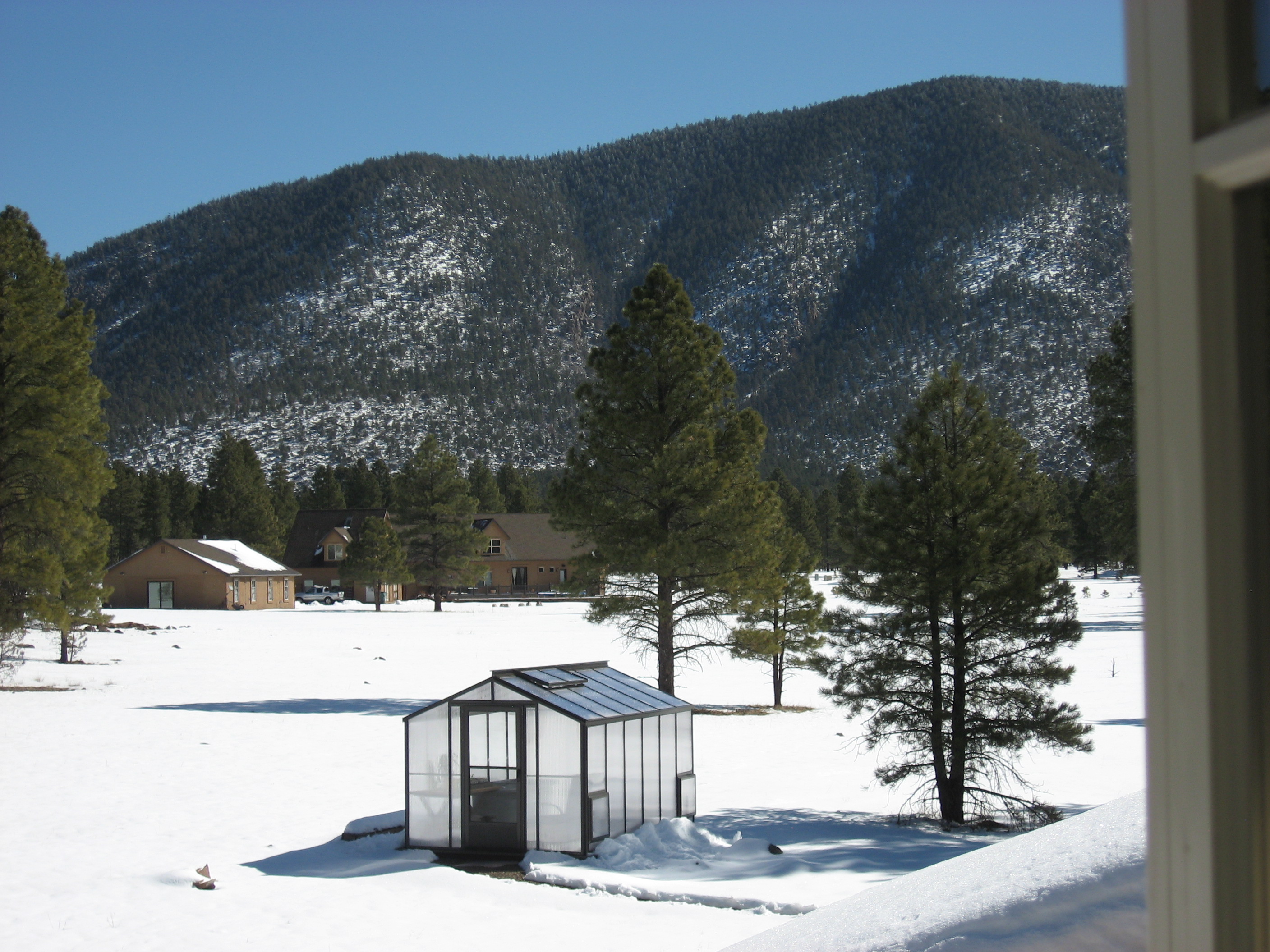
Flagstaff, Arizona, 10.05 am
Sarah Palin’s New Book On Christmas
Well, if anyone’s an expert on miraculous births …
Marginalizing Neocons
Glenn Beck’s new attempt at serious “Sixty Minutes”-style reporting gets its debut this week. It doesn’t seem like Breitbart or Daily Caller fabulism. But its examination of the relentless growth of the national security state echoes Rand Paul’s constitutional concerns about unfettered executive power in a forever war with no geographical boundaries. Some of us were on this case when the abuse was much greater – under Bush. But the secrecy seems to have become close to hermetic under Obama and the CIA still seems a government unto itself – above the law, above accountability, even permitted to destroy evidence of war crimes with impunity.
What if the libertarian right begins more and more to realize that the neoconservative vision is incompatible with constitutional freedoms? What if this stops being a “fringe” idea and starts to reintegrate into its natural home: American conservatism. The wild card? Israel, of course, where Christianists believe theology should dictate foreign policy. But we could end military aid, couldn’t we? And I’m beginning to see the strong chance that if the neocons get close to their next war on Iran, the GOP might not be unanimously behind it.

