The Partisan News Population

Partisan News

It’s relatively tiny:

What percentage of Americans watches cable news for 10 minutes or more per day?  Only about 10-15%, if you simply add up the audiences for Fox News, CNN, and MSNBC.  This is based on calculations by political scientist Markus Prior, drawing on detailed data about what people actually watch and not what they report in a survey. Survey reports of news consumption are often highly inaccurate.

The Conclave’s Blind Spots

Anthony Judge examines the cardinals’ educational backgrounds. Tom Jacobs wishes for more diversity:

Theology is the most popular subject by some distance, with philosophy taking a solid second place. Of the handful of other disciplines, only four of the cardinals have studied psychology, and only one economics.

While on one level, this isn’t at all surprising, it’s worth contemplating. These men—and one of them in particular—will be handing down decisions that spell out ethical rules impacting a variety of fields, including medicine. Wouldn’t it be nice if the group included some voices that could explain the latest scientific understanding of the workings of mind and body?

It would indeed. But the kind of priesthood that would include that kind of experience would not insist on celibacy. If women and married priests were admitted, the range of skills, backgrounds and experience would definitely help the church convey its message more effectively. A reclusive, effeminate theologian like Benedict XVI is almost guaranteed to lack the worldly skills needed – just in rooting out corruption in the Vatican. But this self-selected group – almost all appointed by Wojtila and Ratzinger – are unlikely to see that. It’s the blind leading the blind.

Remote Control Colleagues

The Economist reports on “telepresence robots”:

Several start-ups are introducing new telepresence robots this year, and sales are growing as costs fall. RoboDynamics of Santa Monica, California, for example, has sold more than 100 of its $10,000 TiLR robots since 2008; its sleeker Luna model went on sale in January for $3,000, and its proposed 2015 model is expected to cost less than $1,000. Businesses commonly buy telepresence robots to inexpensively bring distant employees back “into the fold” at the office, says Fred Nikgohar, the company’s boss. Later this year a Pennsylvania start-up called Bossa Nova Robotics will start selling a 1.37-metre-tall telepresence “ballbot” called mObi that rolls around on a football-sized sphere, a design which enables it to weave through cluttered offices and turn on a dime.

Tom Simonite, who test drives a telepresence robot in the above video, reported on the technology a few years ago. We should reiterate that, unlike the Atlantic’s cover-story on IBM’s robots, we have not run oodles of sponsored content from the company that makes the robot.

“Never Forget That They Were All Wrong” Ctd

A reader quotes me:

“I’m not excusing my confirmation bias, my broad brush against opponents of the war (although I refuse to accept that they were all skeptical of the WMDs’ existence; many were just anti-Bush and anti-war), or my violation of just war doctrine.”

I find your casual dismissal of the many who voiced concerns over the Iraq war rather small-minded.  Many in the intelligence communities around the world were skeptical about the WMD claim, including in the US.  The real reason was that many concluded that it lacked a factual basis, not because individuals were “anti-Bush” or “anti-war.”  The key source of the WMD claim came from Iraqi refuge/informant Curveball, who was interviewed by German intelligence, not the US.  Leading up to the Iraq war, German foreign minister Joschka Fischer publicly addressed the WMD claim, stating: “Excuse me, I am not convinced.”  Germany was far from the only US ally who refrained from participating in the invasion of Iraq on similar grounds.  Their position was also consistent with the findings of the UN weapons inspectors at that time, led by Hans Blix.  Instead of speculating as to why some were skeptical of the WMD claim, why don’t you ask yourself why you were not?

How do you go from my criticism of my own “broad brush” in describing the Iraq War opposition to an inference that I am casually dismissing the serious critics and skeptics of the WMD argument? I was doing the exact opposite. I was distinguishing between those I should have listened to and those who were blindly against the war, fueled by the simmering resentments of the 2000 election. As to why my skepticism was completely AWOL, I’ve said I was terrorized by 9/11 and fear overwhelmed doubt. I was also marinated in a DC culture that saw Saddam’s WMDs as a bipartisan matter, backed by the Clintons and Bush. And I genuinely believed that Saddam was such a monster and so convinced of US military skill that the moral question seemed clear. I was wrong on every count. But I was wrong in good, if nearly-blind, faith. And the opposition shouldn’t be painted with a virtuous broad brush either. I went to the anti-war marches. You think ANSWER was animated by the WMD question? Another writes:

I remain fascinated not so much by why commentators I otherwise respect got the Iraq war wrong, but by why even they – in their mea culpas – so rarely mention those who got the war right (except, perhaps Barack Obama) and it ties into one of most tiresome excuses people in the Bush Administration give for not finding WMD “Everyone got it wrong.” Except, that’s not true.

Look at how you dismissed Chirac. Was he less a man of honor than, say, Dick Cheney?

One thing that I noticed during the Bush administration about the Republicans’ (and news media’s) attitude towards France was how rarely we were reminded that the French not only had better sense than to join us in Iraq, but they also foiled a jet-into-tower attack before 9/11. Bush really didn’t want people to think too much about how some leaders managed to hear and follow up on their nation’s intelligence services while he opted to go fishing. Chirac did see the kinds of intelligence of our leaders saw. He and his government must surely have subjected it to some analysis. There’s no reason to believe that a nation with that many not-fully-acculturated Muslim citizens and immigrants would have been indifferent to any probable detonation of dirty bombs or nuclear bombs by Islamists.

Another:

I was 21 when we invaded, and a few years later I was in Iraq. I watched Colin Powell give his presentation on television. I was an early skeptic of this war – why are we moving on when we haven’t found bin Laden and Afghanistan is still a mess? And why does Saddam need to go, now, when this evidence is so sketchy?. But I had tremendous respect for Powell. I also knew that he wouldn’t go before the UN without real evidence. He had too much integrity. I was ready to be persuaded.

And then he stood there before the world, and tap-danced. This was the moment for the US to show its hand, and we had nothing. And Powell knew it. He wasn’t convinced. You could see it in his face. I felt embarrassed for him and terrified for the country and ashamed that someone with such integrity would  peddle something he almost certainly knew was a lie with such disastrous consequences.

To this day, more than anything else, it is Powell’s presentation I think back to when I try (and fail) to understand why so many people supported the war with such smug confidence, and such disdain for those who raised truly reasonable objections. And to read things like this now, 10 years later, after so much blood, and after the violent deaths of so many – of some I knew – makes me nauseous.

Another:

For my mea culpa, one name is burned into my brain: Judith Miller. I trusted her. I expect the government to lie to me. But I did not expect a NY Times reporter to lie like the most corrupt politician, an absolute snake in the grass. The Times carries a heavy burden of responsibility for that war.

Another:

I think you (and many others) miss a huge detail of how we got into the mess in Iraq. One of your posts highlighted how Clinton made it US policy to force regime change in Iraq … but this misses a big back story.  I wrote my masters thesis on the phenomenon of foreign lobbying as a kind of covert action, both by states and non-state actors. One of my case studies was Chalabi and his efforts to push for the passage of the Iraqi Liberation Act of 1998 (which is the act that made it US policy to promote regime change in Iraq). In short, I think in many ways the United States government and media were the targets of a very shrewd effort by a foreign entity, i.e. Chalabi and the Iraqi National Congress, to change US policy to its needs. It was able to do so in large part because of the lack of enforcement of US laws regulating foreign lobbying.

So beat yourself up all you want, but remember that there was a definite propaganda effort being pushed there, with a lot of help from trained intelligence professionals and professional lobbyists in Washington.  The sad thing is that much of this was revealed after the WMD commission was completed, so Chalabi’s role is largely forgotten in the official history of the lead up to Iraq War.

Read the whole recent Iraq thread here.

Q Tips On OCD

Kent Sepkowitz applauds how the latest episode of Girls depicts Hannah’s Obsessive Compulsive Disorder:

She inserts a Q-tip into one ear and traumatizes it, causing a bloody mess and giving the episode its great line (“I heard hissing” after the puncture). Then comes the requisite sitcom schlemiel-like ER visit with a doctor and some drops and some close-ups. But in the episode’s last scene, she grabs the difficult third rail of mental illness once again, showing us Hannah placing a new Q-tip into the other ear. And counting.

With this scene, it appears Dunham is willing to portray real OCD, not the scrubbed and kinda fun version where people are cleaning their hands at inopportune times or else hopping over cracks in the sidewalk. She is trying—I hope—to pull the mental illness away from the lighthearted and silly, and show it as the anguishing compulsion that requires immediate attention and a rain-dance-like repetitive activity to maintain the ordered rows and columns necessary to assure that true darkness remains way over there. The depiction seems promising enough that Dunhamalready has gotten thumbs-up from people involved with OCD treatment and research.

Relatedly, William Brennan advises never putting Q-Tips in your ears:

The problem with removing earwax (by Q-Tip or any other home remedy) is that earwax serves important functions: It is a lubricant, a defense against foreign objects, and even a natural antibiotic. Earwax becomes a problem when it is packed into the canal and hardens, causing “impaction” (or blockage), and evidence shows that Q-Tips can cause impaction.

Dissent Of The Day

A reader writes:

As the fine arts book buyer and assistant manager for an independent bookstore [seen above] in your newly-adopted city, I am disheartened to learn that you’re continuing to make affiliate revenue from Amazon, a corporation hell-bent on destroying print culture and, along with it, my job. From their loss-leading book pricing to their vile price-check app, Amazon has made itself the scourge of small booksellers everywhere.

You may not have much love for the publishing industry, but, like it or not, we need traditional book publishers to sift through endless submissions, just as we need highly-literate booksellers to promote exceptional new works to the public. I’m just not convinced digital self-publishing on its own can sustain literary fiction and scholarly nonfiction written by little-known authors. I have enormous respect for publishers like Farrar, Strauss and Giroux and Twelve Books that continue to release amazing new books each year. (Twelve Books published Hitchen’s superb memoir, incidentally.) I’m at a loss to understand how such “dead-tree” publishers have incurred your wrath.

I don’t deny e-books have their benefits, but they also have many drawbacks.

The books you buy for your Kindle aren’t covered under the first sale doctrine. You don’t technically own them and you certainly can’t resell them. E-books are not collectable, cannot truly be signed by authors, and, unlike printed books, make for lousy gifts. And forget about finding most illustrated books on art, photography, design, or architecture on you Kindle. And that goes for graphic novels, atlases, and children’s books, too.

Besides illustrated content, printed books themselves can be beautiful objects. Do we really want to entirely replace the tactile qualities of paper and cloth, along with their pleasing cover design, with pixels on a screen? More importantly, do we want to live in a world without bookshops?

In the past, you’ve linked to printed books when the e-book version is unavailable. Noel Malcolm’s edition of Hobbes’s Leviathan isn’t available on Kindle, for instance. You may not have noticed that Amazon user reviews for all previous editions of Leviathan appear on the same page, as if they were indistinguishable. This is just one of many indications of how Amazon sees selling books as no different than selling baby formula or toaster ovens.

It’s wonderful that you provide healthcare for your interns, but I had hoped the revenue from subscriptions would have covered this. Maybe I’m overstepping my bounds, but I’d love to see you link to indie bookstores like Strand, McNally Jackson, or Community Bookstore in the future. Not only would you be helping local businesses in your city, you’d also be taking the right (and, dare I say, conservative) stand.

The View From Your Window Contest: Winner #144

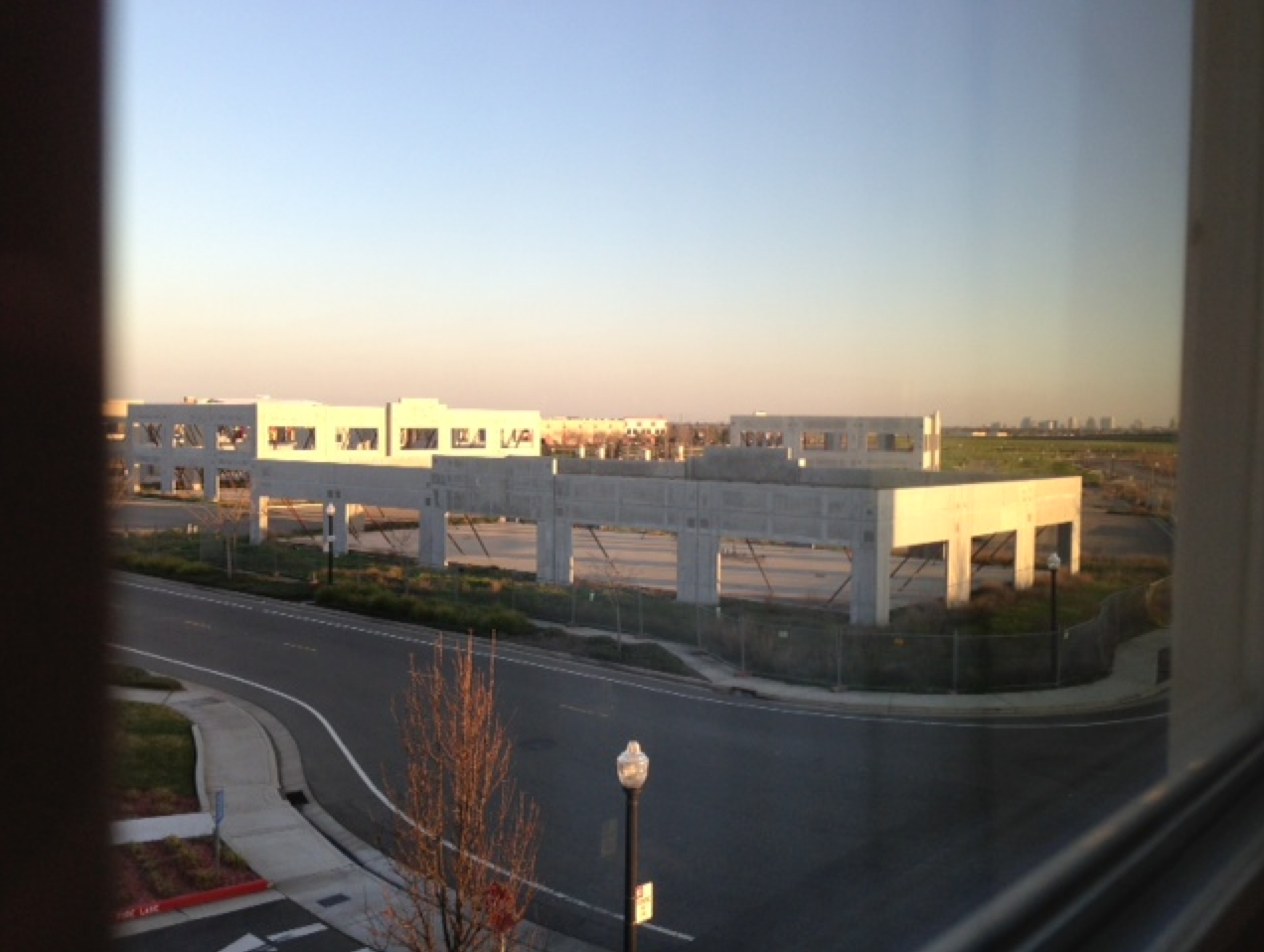
Screen Shot 2013-03-08 at 8.13.47 PM

A reader writes:

I see we’re going back to harder contests after the hundreds of winners in the previous weeks. The street light, no standing sign, and fire lane tell me that this view is definitely somewhere in the US. The haze in the distance kind of reminds me of the exurban areas of Los Angeles. So I’ll guess Riverside, California, and leave it at that. I don’t think 10 hours of internet searching would get me any closer. Perhaps this is one of those construction projects that stopped mid-recession and never got started again?

Another:

Has to be Las Vegas! All the tells are there: the American “no parking” sign and lamppost; flat barren landscape, the big city buildings in the distance.  This must be some of the construction that surrounds Las Vegas, started in the boom times and stopped suddenly when everything crashed.  As you fly into Las Vegas you can see how the outskirts of the city were once being developed, housing subdivisions that have streets and sidewalks, but no houses (or even worse, one or two houses in an otherwise empty development).  I’d give 10:1 odds that I’m correct!

Another:

Tough one. I was going to guess Fargo, North Dakota, because the land is dead-flat and there’s so much new construction going on there, but there’s no snow. That skyline in the background looks a little like Tulsa, and that’s what I’m going with.

Another:

Just a wild guess mostly, but it is obviously a picture next to a decent, but not overly large, city.  The skyscrapers are tall enough to give a good view from ~5-10 miles away.  The signs are English, and the climate seems to be similar to that of Texas, warm and relatively dry.  Since it doesn’t seem the downtown is either dense, or large, enough for Houston or Dallas that leaves San Antonio.  Now to see the e-mail from someone who picks the exact window.

Another:

SXSW started this week, and as I have no clue where in the world this is, why not guess Austin, Texas?

Another:

This picture feels like the Meadowlands area.  The long expanse of undeveloped. swampy-looking land leading up to a series of nondescript urban buildings.  A Google image search suggested this hunch might be correct (e.g. see attached – source here).  Other clues: the “fire lane” marking puts us in an English-speaking country, and that no parking sign looks like the ones in the NYT metro area.  the town that the Meadowlands are in is called East Rutherford, and a Google Maps search of it shows certain sections that appear isolated and with long windy roads.

Another:

I would rate this one as nearly impossible. A flat area in the US.  It’s a new office park, or something similar, so perhaps a growing area. A few medium sized buildings in the background. I’ll take a wild stab and guess Lincoln, Nebraska, somewhere near I-80 and Hwy 77.

A reader nails the right city:

I immediately thought “Sacramento, CA” when I saw this photo. Unlike most of America at this time of year, California’s Central Valley is green. My wife and I lived in Sacramento for two years, and we would visit Davis, CA as often as we could (they have a great Farmer’s Market). From the east side of Davis, you can often see Sacramento in the distance; so I’m going with Davis, CA, near El Macero Estates.

Another:

For the first time ever, I think I recognize the location. It looks like it was taken in Elk Grove, California, a suburb south of Sacramento. That looks remarkably like the half-finished, abandoned mall at the south end of the city limits. But I don’t recall there being any buildings near that lovely wasteland that are actually occupied as residences or businesses. Still, it does look like Sacramento’s petite skyline in the background. Unfortunately, there are probably several places around here that would allow a view such as this, and around the country as well. At least I finally have a guess based on more than intuition.

Another:

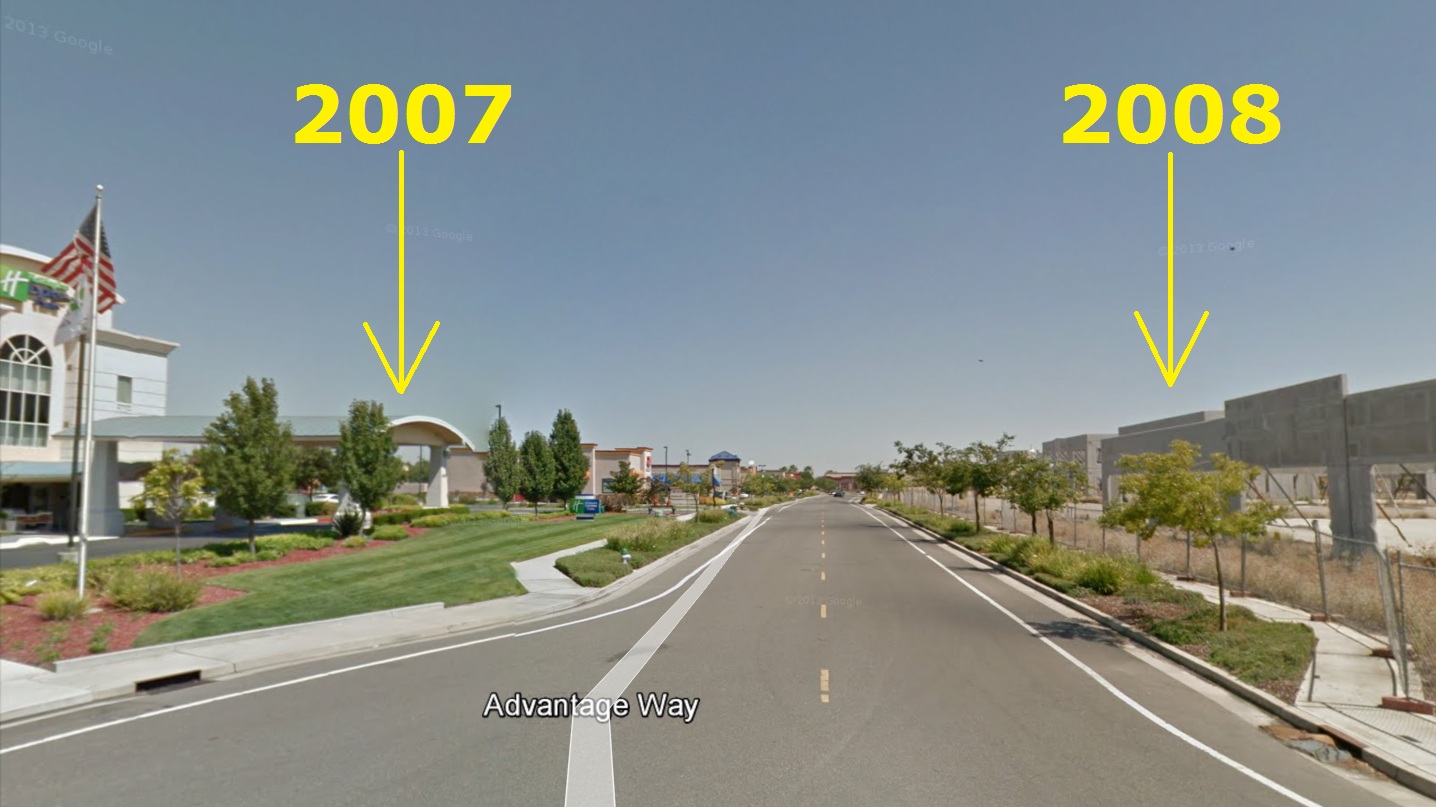
Around Sacramento stalled developments were a common site. Though many of the housing projects have started up again, check out this similar pre-ruin south east of Natomas in Elk Grove:

Screen shot 2013-03-09 at 10.18.24 AM

Neither project has moved an inch since the financial crisis.

Another gets the right part of Sacramento:

This area is called Natomas and the hotels serve the Sacramento International airport near by. Two doors down is a hot dog place with late night drive through. For years these building skeletons have waited for real estate to turn around. The blocks are sketched out and the cement sides raised but there hasn’t been the money to finish them. I’ve stopped there at dusk before to look at them. To the north are the rice fields of the Sacramento valley. Natomas grew from the fields in a few decades and the effect, along with the half constructed buildings has always brought Caffa to mind- the outpost remade by Venice and then the first to collapse under the plague.

Another adds, “The empty development is locally known as “Stonehenge,” or sometimes, “Natomas Stonehenge.” Another:

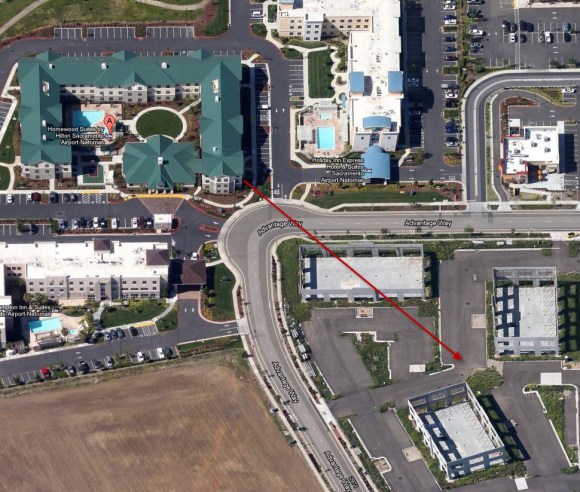
First-time participant here, I never thought I would be able to correctly guess a VFYW contest. The picture was taken at the Homewood Suites in Sacramento, CA. I will try to be as specific as possible since I am sure anybody who stayed there might remember the location: the second floor, on the southeast side of the hotel indicated by the arrow in the attached picture:
SMF

I stayed there a couple of years ago on a business trip and I remember jogging around the area.

So very close – it’s actually the third floor. About a half-dozen readers correctly guessed that floor, but none of them have guessed a difficult window view in the past (“difficult” defined by only ten or less correct answers), so breaking the tie is tough again this week. But the following entry was the most detailed and proactive of all:

Since I live in an eastern suburb of Sacramento, my first reaction was, “Wow, there are dozens of these abandoned developments all over the Sac region; there’s even an entire mall.” Then I noticed that the city skyline looked familiar, the tree was budding, grass/weeds growing; plus the No Parking sign eliminated a large chunk of the world. So Sacramento in early March seemed like a possibility.

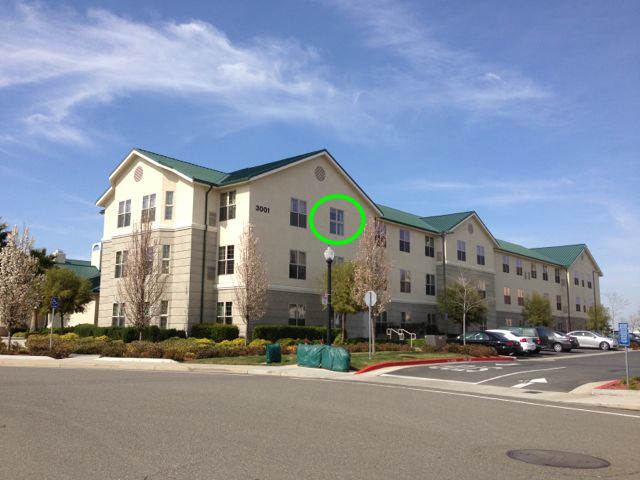
A quick scan of Google Earth and a comparison to various skyline images confirmed that the image must have been shot from the north toward downtown (sunset shadows and open space were clues). After a few more minutes map-scanning, I was confident I had it thanks to the sidewalk design, driveway arrows and landscaping. So it’s Homewood Suites (a hotel) at 3001 Advantage Way in Sacramento, CA. And my hunch was that it was taken from a window on the 3rd floor:
VtoYW Sacramento

You might find it interesting that the commercial structures mask a view of one of our many housing failures in the region. An entire neighborhood of streets, utilities, house foundations overgrown by weeds, and most striking – a small community center and swimming pool that’s abandoned and deteriorating. Looks like the developer sold five townhomes before shutting down; they appear occupied, so I hope the owners aren’t paying HOA fees for that pool.

By the way, my 3- and 6-year-old daughters and I (ok, mostly me) decided to make an adventure of it and attempt to see “The View TO Your Window.” We didn’t expect to replicate the view FROM, but fortunately, this is a window in an open-space hallway on the 3rd floor, just outside of room 301 (and the hotel staff were very friendly):

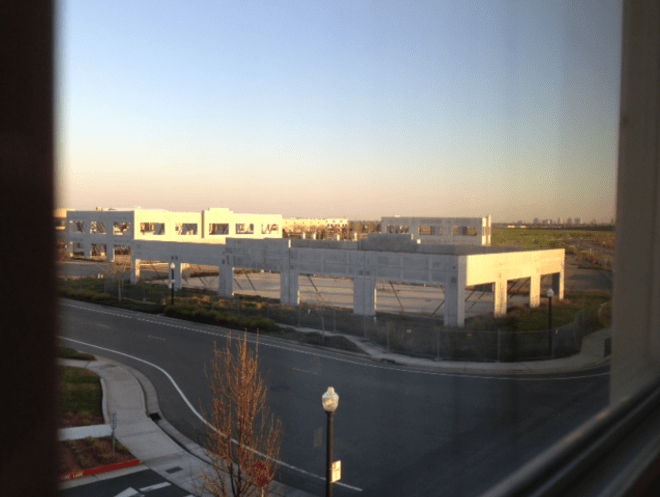
VFYW Sacramento recreated

My 6 year old, comparing the original image on my phone to the actual view, thought it was amazing that “we found the match.” Then she immediately asked, “What will we do if the next picture is in China? Will we go there?”

Thanks for spawning a fun excursion for the three of us. (Mom thought we were crazy.)

Congrats, we’ll get a book prize to you soon. One of the contest’s most consistent winners adds:

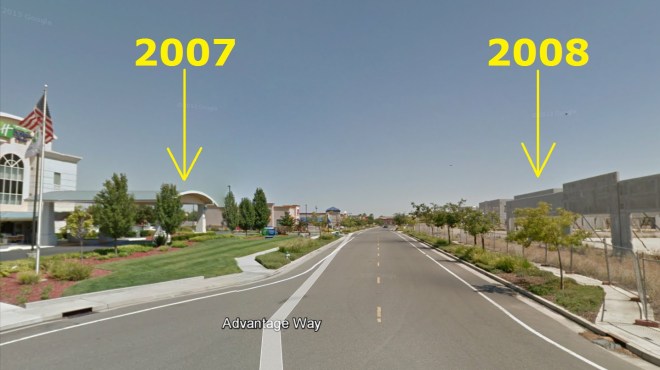
The site is probably familiar to local basketball fans, as Arco Arena, home court of the Sacramento Kings, is visible rising behind the unfinished buildings on the left. Because the Kings will likely be sold this year, the city is actively working on development plans for the surrounding area. As for the unfinished buildings, they were originally supposed to house a TGI Friday’s, a Sonic Drive In and healthcare buildings, but the recession drove the developer into bankruptcy.
VFYW Sacramento Recession Marked - Copy(1)

Could there be a better monument to the last decade than the half completed shells of suburban chain restaurants and medical offices? The street in front of your viewer’s hotel is named Advantage Way, but it’s really the high-water mark of an entire era.

The photo submitter’s entry, for the record:

Sacramento, California, 5pm on 2/13. Looking from 3rd floor of the Homewood Suites in Natomas. Someone had great plans for a development in this area – foundations are laid, streets have names, but it apparently came to a crashing halt. I’ve been coming here on business for 7 months and it’s been like this since then. You can see the slightest sliver of the (hilariously named) Sleep Train Arena, home of the threatening-to-move-to-Seattle Sacramento Kings.

Update from the submitter:

The guy who won was exactly on target: I took that photo from the hallway window near room 301 of the Homewood Suites. I’m delighted to hear that he went there with his daughters. I’ll be back in that hotel on Monday and will let the staff (who know me by now) know how this all came about. Extra fun – thanks!

(Archive)
How Racism Was Made, Ctd

Slave-ship

Jamelle Bouie parries my argument:

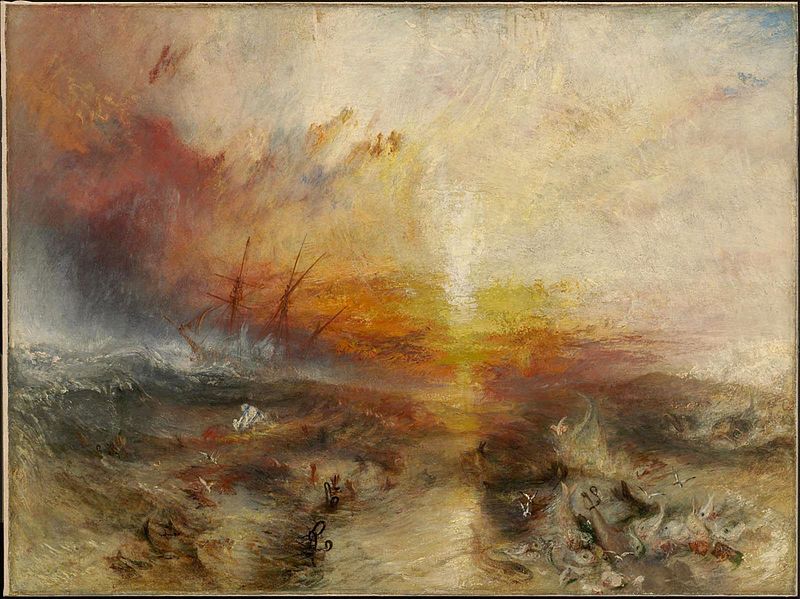
Sullivan is right to throw water on the idea that the law can “create racism any more than it can create lust or greed or envy or hatred.” But Coates is making a more precise claim: That there’s nothing natural about the black/white divide that has defined American history. White Europeans had contact with black Africans well before the trans-Atlantic slave trade without the emergence of an anti-black racism. It took particular choices made by particular people—in this case, plantation owners in colonial Virginia—to make black skin a stigma, to make the “one drop rule” a defining feature of American life for more than a hundred years. By enslaving African indentured servants and allowing their white counterparts a chance for upward mobility, colonial landowners began the process that would make white supremacy the ideology of America. The position of slavery generated a stigma that then justified continued enslavement—blacks are lowly, therefore we must keep them as slaves.

I don’t dispute this, but equally, the slave trade itself, along with colonialism everywhere, presumed a racial inferiority before the Southern states codified it so precisely along Nuremberg lines. And it endures in the human soul as long as sin does.

(Painting: Slavers throwing overboard the Dead and Dying — Typhoon coming on “The Slave Ship” by JMW Turner, 1840. )

About That Washington Clubbiness

I know I’m late on this but I was reading the latest issues of TNR and even read a dispassionate if not terribly ground-breaking cover-story on the Israel-Palestine question. That in itself is a huge change. From Leon Wieseltier’s rancid bile toward any critic of Israel to a serious piece that holds all sides accountable and says what must be said – that a democratic Israel is no longer viable – is a big improvement. Then there’s a profile of Ezra Klein. This made me throw up a little in my mouth:

Klein now says that he will not write a negative book review. “Because if you’ve gone through the trouble to write a book? And I just don’t think it’s that good?” Klein told me, breaking into his occasional habit of lilting at the end of each clause. “I’m not going to shit on your work. I just won’t review it. This is a rule James Fallows has that I’ve adopted. Whom I really respect, by the way.”