The Vatican’s Very Convenient Gay Bathhouse

I kid you not. Recall that they covered up the rape of children because of fear of “scandal”. But right in the same building as the Congregation for the Evangelisation of Peoples is the Europa Multiclub – not just any bathhouse, but the alleged Number One in Italy! The Beeb has some fun with a future event:

Also on offer are “bear parties”, which are advertised on its website with a video of a man stripping down before donning clerical attire. Bruno, “a hairy, overweight pastor of souls, is free to the music of his clergyman, remaining in a thong, because he wants to expose body and soul”, the website says.

But they seem a rather responsible joint from this page. And the club’s statement helps unpack why the Vatican would not be that uncomfortable sharing a building (which the Vatican bought for $26 million):

Behind this door an exciting, funny and comfortable world is waiting for you… A place created by males and for males only.

Let the Conclave begin! And after that, we can all go and “evangelize some peoples”.

The Literary Humblebrag

Noreen Malone rolls her eyes at the lengthy and self-aggrandizing “Acknowledgements” page of Sheryl Sandberg’s new book and complains about what the practice has become:

While Sandberg is the latest egregious example, she’s in good company. E.J. Dionne, a master of the form, tends to include just about every famous person he has ever met in his end pages. “[I]f these acknowledgments are a bit long, I hope the reader will forgive me. It’s because I have a lot of debts to pay,” he writes at the close of Why Americans Hate Politics. (The list is actually very useful in that it offers a much more concise evocation of why Americans hate politics than the book itself: Look no farther than his lengthy list to be reminded of Washington’s much-maligned clubbiness.)

Chelsea Clinton was recently thanked in the acknowledgments of Andrew Solomon’s Far From the Tree, and also scattered faux-carelessly amidst the long list of Brooklyn writer types who’d read drafts of Gideon Lewis-Kraus’s A Sense of Direction, suggesting either that Ms. Clinton has a particular interest in highbrow modes of self-discovery, or that those interested in highbrow modes of self-discovery have a particular interest in her.

David Haglund counters:

“Perhaps readers already know that book publishing is an insular, back-scratching industry,” [Sam] Sacks says, “but does it have to be revealed quite so openly?” Why wouldn’t we want it to be? The real inspiration for a work of literary art may be mysterious, but the process by which that work reaches us should not be. Transparency is good. And so is gratitude.

But there’s gratitude and then there’s the literary equivalent of fellating every conceivable human being who had anything even faintly to do with the project. It’s a bit unfair to pick on EJ – revealing my own Washington clubbiness – because I bet he’s just a Catholic making sure he is not being ungracious. But he’s the exception to the rule.

There is, of course, the hathetic response: a gleeful examination of the author’s network of influential friends and literary connections. They tell you something about an author.

The Next Pope Will Probably Be Dreadful

Ron Fournier zeroes in on how the press covers transitions of power, from the papacy to business to politics:

I read this sentence in The New York Times’s outstanding analysis of papal politics:

“The next pontiff must unite an increasingly globalized church paralyzed by scandal and mismanagement under the spotlight in a fast-moving media age.”

Let’s play Mad Libs with that sentence: For “church,” substitute the name of almost any U.S. institution and for “pontiff” substitute practically any institutional leader. For example:

“The next governor must unite an increasingly globalized state paralyzed by scandal and mismanagement under the spotlight in a fast-moving media age.” …

As a practicing Catholic, I want the next pope to use this inflection point to eliminate corruption (particularly the unforgivable protection of sexual predators) and to breathe transparency into Vatican banking and governing practices. But there is nothing in the Church’s past to suggest a better future. It is the same in politics and business and charity and sports and virtually all walks of life. We are promised, and promise ourselves, that the next leader will change things and make things work.

I had a day-dream that one day the last Pope would resign – as a sign of the entire church’s renunciation of its recent corruption and long existence as a global conspiracy to rape and abuse minors and teens. Then we’d have the mass resignation of the Curia after the election of a new Pope with a new humility and a new outreach to the world. Ha!

But I’m not as gloomy as Fournier. Because this is the Church. Without hope, it cannot exist. And the thing with Popes is the same thing as with Supreme Court Justices. You never know. No one predicted Vatican II. For my part, I’ve long since decoupled my faith life from the papacy or the hierarchy. I focus on prayer, the sacraments, Mass and the Gospels. The church does not draw its ultimate strength from the powerful; it draws its real strength from the weak.

Establishing Rand’s Bona Fides, Ctd

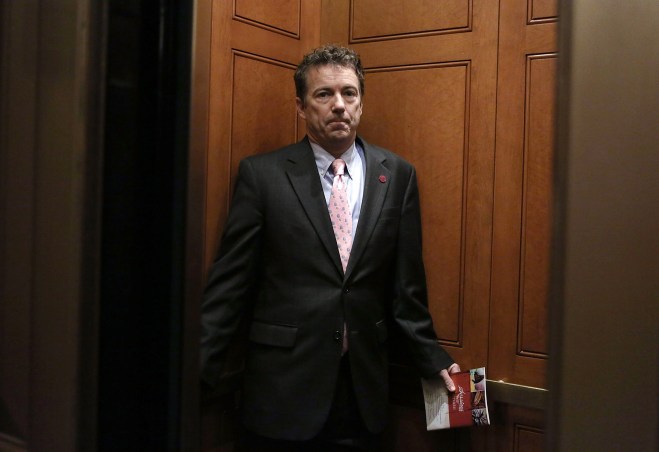
Senators Gather To Caucus Over Hagel Nomination

In what might – or might not  – be a real shift among Republicans about the disastrous consequences – fiscally and strategically – of neoconservatism, Limbaugh backs Paul. Conor – ever alert to twitches in right-wing posturing – notices a fascinating if rather endless monologue when Limbaugh treats Paul as a serious contender, unlike his dad, Ron. Limbaugh thinks inside the heads of the GOPers dining with the president as Rand filibusters the Senate:

He’s a freshman.

And he’s a wacko!

“Ron Paul’s his dad. He’s an absolute nutcase Libertarian, and he’s talking about drones? Nobody wants to drop a drone on the American people. What the hell is this?” But he has the nation captivated. It’s caused a real reversal. Not a reversal, but the whole structure of things has now been upset, and it’s got a lot of people concerned, and it has legs. It does have legs. So I think it’s fascinating to behold, and once again it illustrates that these guys going to dinner with Obama, they were not challenging him.

They were not. People think this country is falling apart. People think that this country’s on its last legs as they know it, as it was founded. People in this country are really scared. There is a despondency among the population, a majority of the population. This isn’t just politics-as-usual. As far as the population the country’s concerned, the opposition party still doesn’t get it to the point that they’re not even the opposition party! Well, Rand Paul appeared to be the opposition, and he had the guts and the courage to stand up and demand that they explain something to him. And not only is he alive to tell about it, he’s not being called names.

He’s a hero to people.

I will leave alone the fact that the claims of the Bush administration for untrammeled executive power to kill, seize and torture anyone in the world at will, including US citizens, were dismissed out of hand by the Limbaugh right. Some of us on the right objected strenuously. We were cut off, called wackos, anti-Semites and the usual Trotskyite crap from an originally Trotskyite movement. Partisanship seems to be doing the trick.

Which is both encouraging but also deeply depressing at the same time.

(Photo: U.S. Senator Rand Paul leaves after a caucus meeting at the Capitol February 14, 2013 on Capitol Hill in Washington, DC.By Alex Wong/Getty Images)


Paused Paternalism

Less than 24 hours before it was scheduled to go into effect, a judge struck down Bloomberg’s ban on large sodas as “arbitrary and capricious.” The mayor’s response:

Rick Hills, observing that the ban was struck down for being too narrow rather than too broad, is uneasy with the judge’s ruling:

How can it make sense to force the Health Department into such a judicially tailored straitjacket, requiring bureaucrats to pursue an all-or-nothing policy whenever they implement a law? Is Justice Tingling really demanding that agencies jettison consideration of cost, administrative feasibility, personal privacy, or financial feasibility when they pursue their primary mandate? Such reasoning is not unprecedented: Recall FDA v. Brown & Williamson‘s argument that the FDA would have to ban cigarettes entirely if they were an unsafe “medical device” and not merely regulate cigarettes’ advertisements.

Frum considers the broader implications:

The serving ban obviously had problems. It represented an experiment that might or might not have achieved results. But if incremental – sorry, “arbitrary and capricious” – steps are not permissible, what is? Or is the plan that government can do nothing about the obesity problem except continue to defray through Medicare and Medicaid the large and rising costs of the super-sizing of the American population?

And Alex Koppelman wonders whether Bloomberg’s successor will support the ban:

Tingling’s ruling could well be overturned at the appellate level—the ban was widely expected to survive legal challenges without too much trouble—but that can only happen if the case gets that far. Bloomberg’s administration will go to a higher court, of course, but he’ll be out of office next year, and not everyone who’s vying to replace him supports the ban. The issue was bound to surface during the upcoming election; now it’s all but certain to, and the key question to the candidates will be whether they’ll continue the court fight if they’re elected, or if they’ll simply let it drop.

Negotiating With NIMBY

Bruce Barcott argues that America needs a safe place to store its nuclear waste. Some tips on getting a community to support the construction of a nuclear waste site:

“With an issue like this, explicit cash payments make people very uncomfortable,” says Michael O’Hare [a professor of public policy at the University of California at Berkeley who has studied Not In My BackYard problems for more than thirty years]. “They feel that this is not the kind of thing that ought to be traded in money.” When people consider a NIMBY project, whether it’s an airport, a prison, or a nuclear waste site, they impute a moral content to their behavior. Compensation sullies their motivation. “Crudely caricatured,” he wrote in a recent report, “a compensation offer can appear to ask, ‘How much do we have to pay you to give your children cancer?’”

Towns that entertain the thought of a nearby nuclear waste dump often have an economic rationale for doing so, but they’re also wary of being bought off. The key, O’Hare said, is to find indirect ways of compensating the local community that builds on a sense of pride in the facility.

White Smoke And Mirrors

The latest from the Papal betting markets:

Pope Odds

Andrea Tornielli previews Conclave, which begins today:

[W]hen the 115 voters will shut themselves in the Sistine Chapel for the election, a fair number of votes (some mentioned 35, others 40) should go to the Archbishop of Milan, Angelo Scola, who has the support of various European cardinals and a few Americans. If he is elected, the papacy will become Italian again, thirty-five years after the election of John Paul I. Another candidate who should gather a fair amount of consensus is the Archbishop of São Paulo, Odilo Pedro Scherer, a Brazilian with a long experience in the Curia.

Unconfirmed reports on the eve of the Conclave – which of course need to be taken with a pinch of salt – suggest the Brazilian could get 25 votes. A third candidate who might stand out from the beginning is the Canadian Marc Ouellet, Prefect of the Congregation for Bishops who is believed to be able to draw to himself twelve votes from South America and the United States.

Rocco Palmo dismisses the horserace mentality:

The road to a Conclave never begins with a slate of “contenders,” but the discernment of issues and exchange of ideas – in this instance, 115 slates of experiences, philosophies, priorities and concerns on what’s needed most at this moment in history, all weighing a mix of skill-set, background, personal qualities and, yes, image, plus the sliding scale of sending a message to the wider world while, internally, providing the optimal substance of leadership.

In short, the path begins with a question in each elector’s mind: “What is the situation of the church?”  It ends with which melding of those answers in human form can make it to 77.

A Needed Change Of Heart

Alice Park spoke to David Jones about his new book, Broken Hearts: The Tangled History of Cardiac Care, and the reasons why bypass surgery and angioplasty aren’t all they’re cracked up to be:

Each intervention, promising lifesaving relief, was embraced with enthusiasm by cardiologists and cardiac surgeons—and both techniques often do provide rapid, dramatic reduction of the alarming pain associated with angina. Yet, as Jones painstakingly explains, it took years to show whether the procedures prolonged lives; in both cases, subsequent research deflated those early hopes. The interventions—major procedures, with potentially significant side effects—provided little or no improvement in survival rates over standard medical and lifestyle treatment except in the very sickest patients. …

“There’ve been focus groups with prospective patients who have stunningly exaggerated expectations of efficacy. Some believed that angioplasty would extend their life expectancy by 10 years! Angioplasty can save the lives of heart-attack patients. But for patients with stable coronary disease, who comprise a large share of angioplasty patients? It has not been shown to extend life expectancy by a day, let alone 10 years—and it’s done a million times a year in this country.”

Kevin Hartnett outlines the reasons we continue to use the procedures:

First, “one of the little dirty secrets of cardiac care” is that until the 1970s, “heart experts could not agree on what was causing heart attacks.” Today, cardiologists believe that “invisible lesions” in the heart vessels—not major artery blockages—are primarily responsible for causing heart attacks. So, in a sense, bypass and angioplasty were grandfathered in as treatments from an era when we didn’t really understand why heart attacks happen.

Second, the popularity of bypass surgery and angioplasty reflects a larger cultural issue with medicine: We overtest and overtreat. Doctors and patients tend to think, “Well, if this procedure could help, let’s do it.” But every surgery comes with risks, of infection, and, in the specific case of bypass surgery, of long-term neurological complications. “It’s important not to do everything that could be done,” Jones told Park.

Art For Government’s Sake

Audrea Lim examines the unusual art scene in the burgeoning city of Chongqing, China:

On its main stretch, Tuya Street, ten-story apartment blocks with shops and eateries on the ground floor have been painted over with cartoon aliens. A three-eyed monster towers over a pharmacy, its mouth full of fangs. A monkey-man in muscle shirt squints down at hipster art students spilling into the road from the side of a building. Another is dotted with black-rimmed, menacing blobs. Down the street, a Lisa Frank-style unicorn poses, five stories tall, amid rainbows and clouds.

“Tuya” means “graffiti” in Chinese—the name is recent—and this street, three-quarters of a mile long, may be the longest stretch of public art in the world. It’s also a government-sanctioned “art district,” centered around the Sichuan Fine Arts Institute, which was established in 1940. Huangjueping has been a natural gathering place for Chongqing’s artists ever since, and thanks to its remoteness from Beijing, it has a reputation for producing artists independent of the art establishment.

But as Lim learns, “cheap rent came with non-negotiable obligations, like participating in government-run exhibitions unrelated to their work.” Lim’s conclusion:

It was art propped up by the state in order to burnish the state’s credentials, and fill its coffers—art not for art’s sake, but for the sake of urban development.

(Photo by Drew Bates)

When Big Brother Follows You

The Physics arXiv Blog summarizes a fascinating study of censorship on the Chinese microblogging site Weibo – quite a task given that 70,000 messages are sent per minute:

[Researchers Dan Wallach and company] say that in their data set about 5 percent of the deletions occur within 8 minutes of posting and around 30 percent within 0 minutes. In total, 90 percent of deletions occur within a day, although at times deletions can occur several days later. Those are impressive numbers given the popularity of the microblogging service. How does Weibo manages this task?

Wallach and co say their data point to a number of hypotheses about what’s going on. Since the highest volume of deletions occur within 5-10 minutes of posting, Weibo must be censoring them in near real time. If an average censor can scan around 50 posts a minute, that would require some 1400 censors at any instant to handle the 70,000 posts pouring in. And if they work 8 hour shifts, that’s a total of 4200 censors on the payroll each day.

But automated censorship tools may reduce the number censors. Caitlin Dewey further unpacks the study:

Among the keywords that could trigger a deletion? “Support Syrian rebels,” “lying of government” and “Beijing rainstorms,” the study reports. (The full list does not look thematically different from a list of terms used to filter the Chinese Internet overall, obtained by the Post in 2006.) The rainstorms caused widespread destruction and anti-government outrage in July 2012, and China officially supports the Syrian regime.