Uncle Sam’s Sister

Garance Franke-Ruta hails Columbia, “the feminine historic personification of the United States of America, who has since the 1920s largely fallen out of view”:

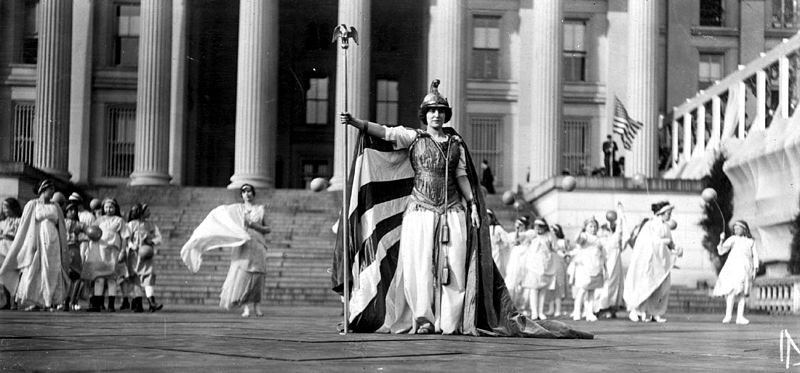
[S]he was as recognizable to Americans of yesteryear as the man in the top-hat and tails remains today, and when the suffragettes donned robes and armor, they garbed themselves in her rebel warrior’s spirit. From the 18th century until the early decades of the 20th, Columbia was the gem of the ocean, a mythical and majestic personage whose corsets or breast-plates curved out of her striped or starred or swirling skirts with all the majesty of a shield. She was honored from the birth of the nation — “Hail, Columbia!”, whose score was first composed for the inauguration of President Washington, was an unofficial anthem until the “Star-Spangled Banner” displaced it as the official national one in 1931 — to the birth of the recording and film industries, which is why we have had Columbia Records and Columbia Pictures. Yes, that lady with the torch at the start of the movies isn’t just some period-costume-wearing chick — she is a relic of this earlier personification of America, immortalized forever by the most American of industries.

America was Columbia in the same way that England was Britannia and France was Marianne. America’s capital is the District of Columbia; New York City’s great early private university was Columbia College (now University).

Why did her star fade? Garance’s view: “Female national personifications in general fell out of vogue as women took on a growing role as emancipated citizens.”

(Photo: A suffrage pageant in 1913 via Wikimedia Commons)

The French Suck At English

David Sessions investigates why. Among other reasons:

[A]lmost all foreign-language television and many Hollywood films are dubbed, rather than subtitled, in France. The practice is driven both by popular demand and by the French state’s attempts to block invasion by foreign languages, especially English. While what the government calls the “cultural exception” —that French culture won’t be left to the ravages of the market—is certainly understandable, it can have unintended side effects, like insulating the French population from linguistic awareness they need in a world increasingly dominated by English.

Ronald Reagan, RINO

As the usual suspects flay Jeb Bush alive for daring to argue that a Grand Bargain would include both entitlement cuts and perhaps some tax reform that would add to revenue, Pete Wehner sighs. For one thing, Ronald Reagan would not be invited to CPAC in 2013:

Let’s consider Bush’s record as governor. While Bush never signed an anti-tax pledge, he never raised taxes. In fact, he cut taxes every year he was governor (covering eight years and totaling $20 billion).

Ronald Reagan, by contrast, signed into law what his biographer Lou Cannon called “the largest tax hike ever proposed by any governor in the history of the United States”–one four times as large as the previous record set by Governor Pat Brown–as well as the nation’s first no-fault divorce law and legislation liberalizing California’s abortion laws, which even people sympathetic to Reagan concede “led to an explosion of abortions in the nation’s largest state.” (Reagan didn’t anticipate the consequences of the law and deeply regretted his action.)

Now imagine the Norquist and Shirley standard being applied to Reagan in the 1970s.

The Prison As Opera House

DL_Haarlem

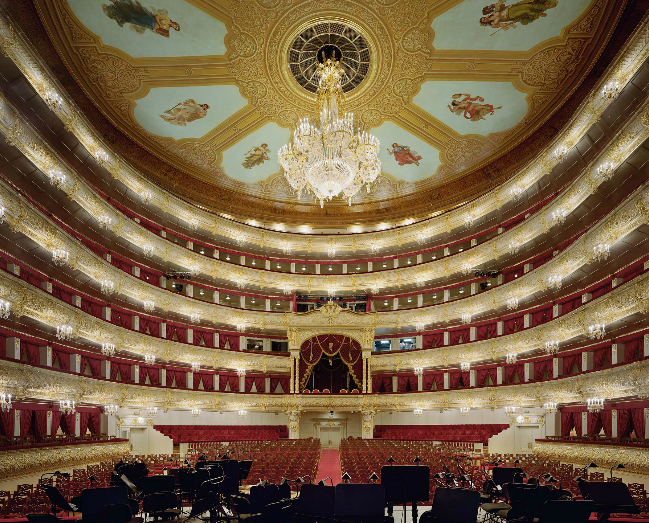
David Leventi photographed world famous opera houses and Dutch roundhouse prisons, “a study in contrasts between beauty and squalor, opulence and poverty, serenity and cacophony”. And yet the domed structures have some eerie similarities as well:

Screen shot 2013-03-11 at 2.27.29 PM

From an interview with the photographer:

Domed prisons are the closest examples of Jeremy Bentham’s Panopticon model of mass surveillance prison design – a central guard tower with a complete view of surrounding prison cells. This concept was designed so a central observer could monitor all of the prisoners at once, without any particular prisoner being able to feel under inspection. The domed prisons have the same architectural structure as an opera house (without the opulence), but the difference is in who is observing whom. In an opera house, the audience of many is observing a few. In these domed prisons, it’s the reverse.

He was struck by the relative barbarism of US prisons compared with those in Holland:

Prisoners in Stateville prison [in Illinois] are treated like animals… It is loud. The warden at Stateville gave me assurances. But he also told me not to show any fear. One prisoners was running against the bars the entire time I was there. Bang. Bang. Bang. Endlessly. It was shocking. Everything at Stateville was the complete opposite to what I experienced in the Netherlands…  I have always had stage fright. Photographing from the center of a round prison causes anxiety. The inmates are all yelling, jeering, talking, in cacophony. You become the center of attention, and taking the photograph becomes a performance in itself. At first I was intimidated, but then I blanked everything out and focused on photographing. It must be the same for the performer.

(Photo: Haarlem Prison, Netherlands, and the Bolshoi Opera House, Moscow, by David Leventi)

Obama’s Betrayal On Transparency

On national security, it gets worse and worse:

In a year of intense public interest over deadly U.S. drones, the raid that killed Osama bin Laden, terror threats and more, the government cited national security to withhold information at least 5,223 times – a jump over 4,243 such cases in 2011 and 3,805 cases in Obama’s first year in office. The secretive CIA last year became even more secretive: Nearly 60 percent of 3,586 requests for files were withheld or censored for that reason last year, compared with 49 percent a year earlier.

Videogame Journalism

Nick Holdstock reviews Game The News. Its creators call themselves “the world’s first news correspondents who cover global events as games”. I thought that’s what cable news does already. But no:

In Endgame: Syria, for example, you guide the political and military actions of ‘the rebels in their military_phasestruggle’. Political events such as ‘Libya has recognised the Syrian National Council’ lead to changes in support for the rebels; troop deployments against the regime’s forces affect the levels of civilian casualties. At the end of each week there’s an instructive epigram: e.g. ‘Only the dead have seen the end of war,’ misattributed to Plato (it was George Santayana). The game ends with one or other side winning, or a peace agreement.

Simplistic and partial it may be, but no more so perhaps than many other news sources. More troubling is the way it apes regular combat games: in the ‘military phase’, you’re informed of new civilian casualties to the accompaniment of exciting explosions (then again, the TV news has been doing that for years too).

(Screenshot from the game Endgame: Syria)

How Racism Was Made

TNC mulls it over, after his illuminating NYT column:

Last night I had the luxury of sitting and talking with the brilliant historian Barbara Fields. One point she makes that very few Americans understand is that racism is a creation. You read Edmund Morgan’s work and actually see racism being inscribed in the law and the country changing as a result.

If we accept that racism is a creation, then we must then accept that it can be destroyed. And if we accept that it can be destroyed, we must then accept that it can be destroyed by us and that it likely must be destroyed by methods kin to creation. Racism was created by policy. It will likely only be ultimately destroyed by policy.

I do not see how one can remove from the human psyche the deep evolutionary urge to determine friend from enemy. Group loyalty is deep in our DNA. It was integral to our survival for over 200,000 years. The meek did not inherit the earth. They were killed by bigots.

And in fact, we have only really had a few centuries of real multi-racial and multi-cultural societies which have not explicitly adhered to codes of “us” and “them”. I don’t think group hatred will ever end in human consciousness, because I think the law reflects our original sin, and cannot erase it. I think, for example, that there will always be homophobia – even if we lived in an idea left-liberal world in which the government policed our statements and indoctrinated us effectively in schools. Gay kids – simply because they are different – will be targeted by other kids for ridicule, exclusion and bullying. We should do what we can to protect them – but lying to them by saying that homophobia will one day disappear does not seem to me to be giving them any favors.

In other words, I don’t believe the law created racism any more than it can create lust or greed or envy or hatred. It can encourage or mitigate these profound aspects of human psychology – it can create racist structures as in the Jim Crow South or Greater Israel. But it can no more end these things that it can create them. A complementary strategy is finding ways for the targets of such hatred to become inured to them, to let the slurs sting less until they sting not at all. Not easy. But a more manageable goal than TNC’s utopianism.