Venezuela After Chávez, Ctd

SPAIN-VENEZUELA-POLITICS-CHAVEZ

Michael Moynihan waves goodbye to the strongman:

His was a poisonous influence on the region, one rah-rahed by radical fools who desired to see a thumb jammed in America’s eye, while not caring a lick for its effect on ordinary Venezuelans. In his terrific new book (fortuitously timed to publish this week) Comandante: Hugo Chávez’s Venezuela, The Guardian’s Rory Carroll summed up the legacy of Chávez’s Venezuela as “a land of power cuts, broken escalators, shortages, queues, insecurity, bureaucracy, unreturned calls, unfilled holes, uncollected garbage.” One could add to that list grinding poverty, massive corruption, censorship, and intimidation.

William J. Dobson doubts Chávez’s brand of politics will survive him:

Chavismo served only to showcase the man who propounded it. A man whose humble origins and charismatic personality helped forge a connection with the country’s poor, a population who had long been excluded from politics. A man whose style, voice, and methods were so unpredictable that it took his opponents more than a decade to even understand whom they were opposing.

Jennifer Cyr isn’t so sure:

The chavistas … could remain a political and social tour de force in the country for some time. After fourteen years in office, Chávez leaves behind an institutional, social, and international legacy that will be difficult to overcome. Perhaps just as important, his memory will surely live on among those Venezuelans who fell under his spell, declaring that they love Hugo Chávez (“yo lo amo”). Whether his closest confidants can continue to fuel that love after his death is an open question. (His refusal to cultivate any sort of progeny to succeed him, as well as potentially conflicting interests within Chavez’s coalition of support, help very little in this endeavor.)

Francisco Toro looks at how Chávez spent Venezuela’s oil wealth:

Where Chávez was able to transcend the Cuban model, it was largely due to the advantages of life at the receiving end of an unprecedented petrodollar flood. By some estimates, Venezuela sold over $1 trillion worth of oil during his tenure, and so his was government by hyperconsumption, not rationing. The petroboom allowed Chávez to substitute the checkbook for the gulag; marginalizing his opponents via popular spending programs rather than rounding them up and throwing them in jail. Rather than declaring all out-war on business, he co-opted them. Rather than abolish civil society, he created a parallel civil society, complete with pro-government unions, universities, radio stations and community councils. Such enhancements were tried before by left-wing populists in Latin America, but always failed because they ran out of money.

The Economist adds:

A majority of Venezuelans may eventually come to see that Mr Chávez squandered an extraordinary opportunity for his country, to use an unprecedented oil boom to equip it with world-class infrastructure and to provide the best education and health services money can buy. But this lesson will come the hard way, and there is no guarantee that it will be learned.

Diego von Vacano argues that Chávez’s form of government wasn’t populist but “democratic Caesarism”:

This term, unlike ‘populism,’ describes a regime that seeks to use constitutional, juridical, and legal procedures to institutionalize reforms aimed at ameliorating the plight of poor and working-class citizens. While populist regimes such as that of Perón and Getúlio Vargas in Brazil relied on demagoguery to stay in power, democratic-Caesarist regimes rely on constitutional and public-law mechanisms to legitimate the authority of a form of republicanism with a strong executive that possesses a martial, anti-imperial component.

Gideon Rachman sees few countries are following Venezuela’s example:

The contrast with former President Luiz Inácio Lula da Silva in Brazil is striking. Although Chávez was a military man and Lula was a trade-unionist, both leaders espoused radical, left-wing ideas in their early careers. The difference is that Lula was much more pragmatic in office. This does not mean that he sold out. On the contrary, like Chávez’s Venezuela, Lula’s Brazil placed a heavy emphasis on redistributive policies that favoured the poor. Lula was also happy, on occasion, to play to the gallery with some anti-imperialist rhetoric. But he was also prepared to make his peace with big business and with the United States. Brazil has become a favoured destination for foreign investors.

And Massie insists that Chávez “didn’t matter that much”:

In truth, Chavez was vastly over-estimated by Washington. Listening to bone-headed Republicans you could have been forgiven for supposing this bullshitting caudillo was a Latin American Stalin. Chavez never represented much more than a modest threat to mainstream American interests. It suited both sides to flatter Chavez and over-estimate his influence.

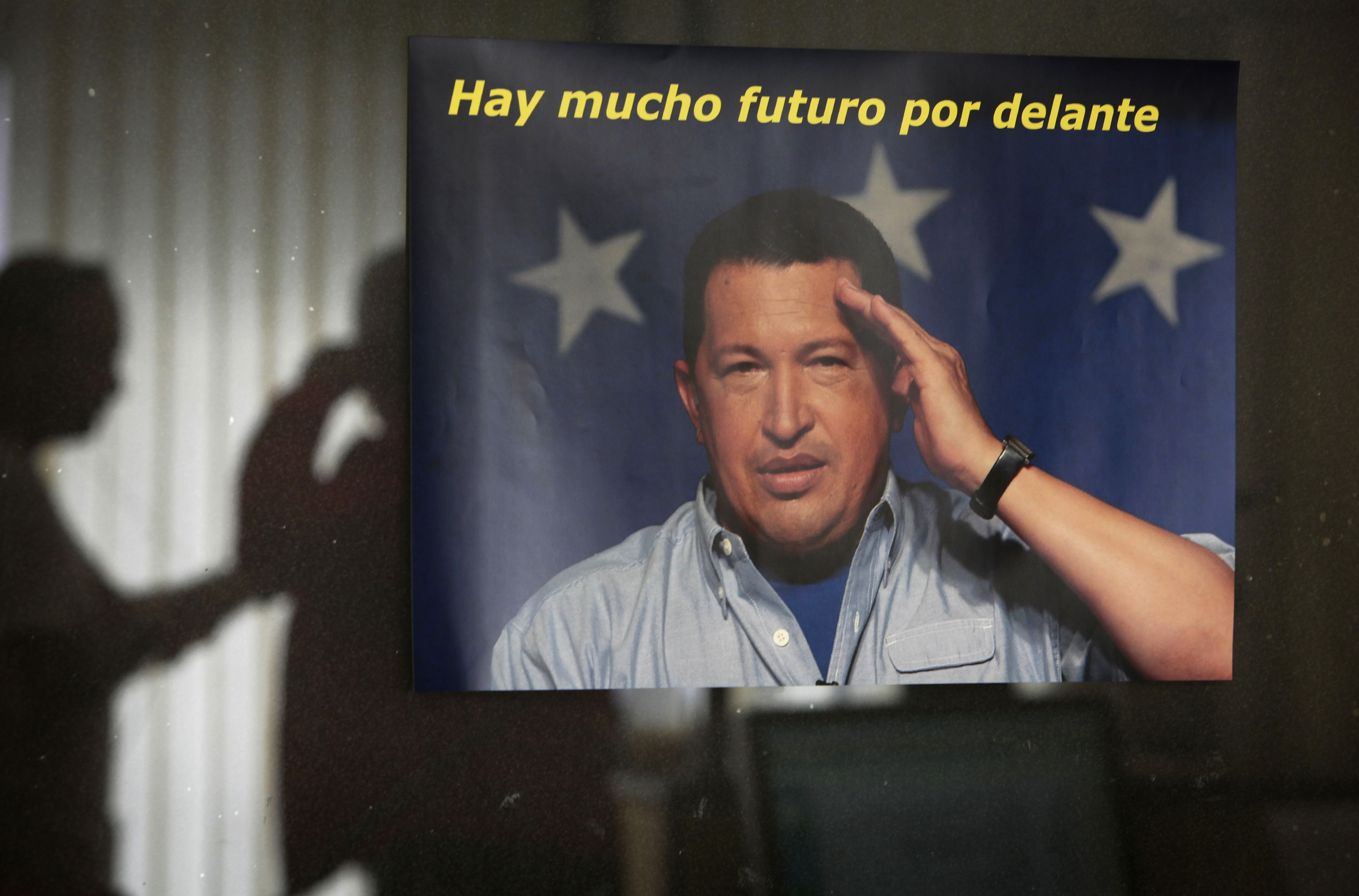
(Photo: A poster of President Hugo Chavez reading ‘There is a great future ahead’ is seen at the consulate of Venezuela of Santa Cruz de Tenerife on March 6, 2013. By Desiree Martin/AFP/Getty Images)
The Nation-Building Money Pit

Ackerman reports on reconstruction funds ill-spent in Iraq:

It turns out there wasn’t just one way to waste all that money. Some projects got started and never finished, like a prison in Diyala province … that languishes unbuilt nearly nine years after the government spent $40 million to build it. Other contracts went to cronies: the top contracting officer in Hilla awarded $8.6 million to a contractor, Philip Bloom, in exchange for “bribes and kickbacks, expensive vehicles, business-class airline tickets, computers, jewelry, and other items.” Still others got needless cash infusions: one unspecified school requested $10,000 for refurbishments and got $70,000. Government contracting databases didn’t even have “an information management system that keeps track of everything built,” [Stuart Bowen, the Special Inspector General for Iraq Reconstruction,] recounts.

Funny how Republicans are not appalled by this waste of public money. If the waste is on weaponry, they’re indifferent. If it’s in healthcare for the poor, vigilance is the watchword. Until they manage to show that they are fiscal conservatives with no obvious exceptions for their favored constituencies – the financial sector, the Pentagon, the health insurance industry – they will rightly be viewed with skepticism.

Chart Of The Day

UN Voting

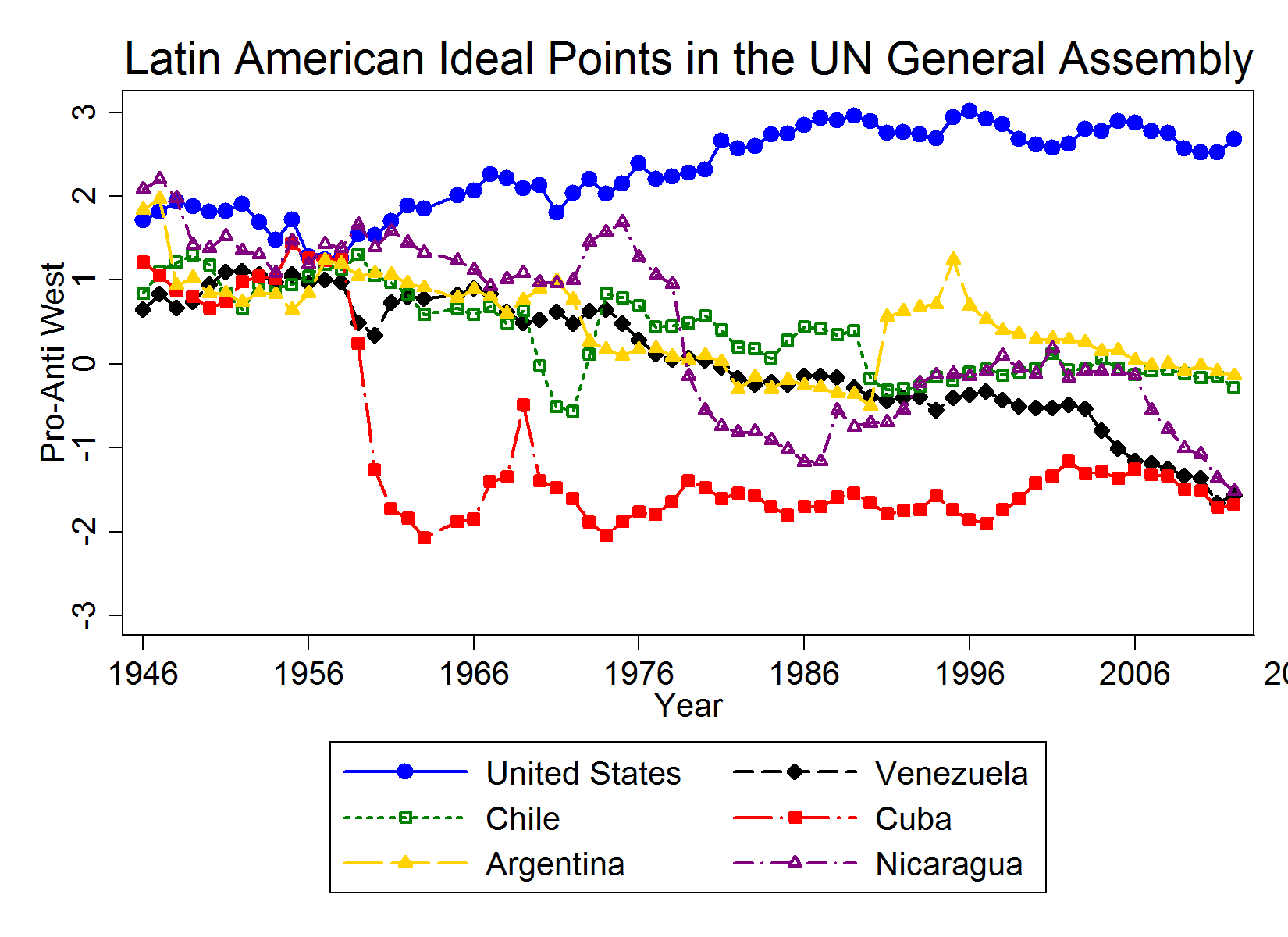
Using votes from the United Nations, Erik Voeten tracks Latin America’s agreement with the US over time:

In the early days of the UN, Latin American states were reliable allies of the U.S. Most Latin America states gradually moved away from the U.S. with the exception of Cuba, which shifted abruptly after its revolution. Hugo Chavez moved very quickly towards Cuba’s ideal point after taking power in 1998. He was joined there by Nicaragua (after the Sandinista came to power) and also Bolivia (not shown). This has created a somewhat bi-polar situation within Latin America; with some countries (like Argentina and Chile) quite a bit closer to the U.S. than others.

Hitch And Sully: A Christian Dissent

Christ_Taking_Leave_of_the_Apostles

A reader writes:

I’ve enthusiastically followed your conversations about religion with Christopher Hitchens. But this latest part of the conversation provoked me like none of the others.

Nothing Hitchens said bothered me, a practicing, but non-fundamentalist Christian, in the least. His objections seem aimed at a faith that bore no resemblance to mine. Even more, his arguments curiously parallel those of religious fundamentalists. Everything is to be taken literally – even, most weirdly, the parables of Jesus and notoriously difficult passages like the Sermon on the Mount. For instance, Jesus’s saying that we should “take no thought for tomorrow” is rendered by Hitchens as “moral advice” to be treated as a simple command. Treated as such, he calls it “wicked” and “evil” because, understood literally, that means Jesus is telling parents to neglect their children and for individuals and communities to make sure they starve by abandoning the slightest trace of prudence. Reading this teaching of Jesus this way genuinely is not very careful or intelligent. I honestly can’t believe that’s really what Hitchens thought it means, that Jesus was commanding his listeners to harm others, let alone children.

You note at one point that commands like this are “impossible.” I agree. And maybe that’s the point. That Jesus is not so much (to continue with the above example) commanding parents to harm their children, but exposing our hearts – showing us that our attachments, our search for mastery and control, our lust for money, that all these strivings are futile and the enemies of living in a genuinely compassionate and peaceful way. That trying to take the future and impose our will on it leads to destruction, both of ourselves and others. Hitchens treats Jesus like a hucksterish advice columnist for first century Palestine.

Do this, do that, follow these simple directions. My example isn’t fanciful – he reads the Gospels with about as much nuance as I do the morning paper. Instead, why not read the Gospels by treating Jesus, among much else, as a masterful psychologist, a prophet who strips away all the strongholds of our egos, our achievements, our delusional belief in our own self-sufficiency. Isn’t this what Jesus is getting at when he tells us, in Matthew 15, that out of the heart proceeds a whole array of sins and misdeeds. Jesus never settles on the exterior, but is a penetrating analyst of our interior lives – our thoughts, our desires, our “hearts.” This fact alone, that Jesus finds the chief faults of the world come from within each of us, means that by necessity interpreting his words cannot be done in the simplistic, hyper-literal way Hitchens does. We must, like Jesus did with every person he encountered, dig beneath the surface to the inner logic of his commands, move from the letter to the spirit, to what his commands expose about our hearts. We should read Jesus, to deploy an over-used word, “existentially.”

Ultimately, Jesus was not a giver of “moral advice” or the purveyor of a checklist of commands. He was both teaching and enacting a way of being in the world, a way of life, a way radically discontinuous with our natural instincts. At every turn, he took the wisdom of the world, our expectations of what we, left to our own striving and tendencies, should do to solve our problems, and showed their futility. Looking at the world around us, might we not think, if but for a moment, that there was more to this strange, wandering teacher than Hitchens is willing to concede?

(Painting: “Christ Taking Leave of the Apostles” by Duccio, between 1308 and 1311.)

How Did Cheney Get Iraq So Wrong?

Frum’s answer:

How could they have been so cocksure in the face of so much contrary opinion from seemingly well qualified people? They had good reason for their self-confidence. Over the previous quarter century, the group around George W. Bush – famously nick-named “the Vulcans” – had joined battles over the Cold War and over the Gulf War against many of the same people who would later oppose the Iraq War. The Vulcans had proved right; their opponents had proved wrong.

And those of us who followed and supported the Vulcans fully expected that history would repeat itself in Iraq: boldness would win.

I remember vividly a conversation I had in my gym’s locker room with a Republican friend just before the war started. I had begun to worry – with the Turks balking, Rumsfeld posturing and the war plan nebulous and quite possibly under-manned. His response was simple (paraphrasing from memory): our military is so great these days they can accomplish anything. That tells you the impact of the post-Cold War triumphalism that had slowly replaced strategic thinking in our late-imperial phase. For my part, I remember reassuring a non-political skeptic the following (same paraphrase) on the eve of the war: You wait. We’ll find bunkers crammed with chemical weapons and possibly nuclear weapons that could end up in al Qaeda’s hands and in our cities. I promise you they’re there.

I trusted Colin Powell. I’d never seen a military intervention fail, except in Somalia. I’d seen new democracies spring from barren soil in post-Soviet Europe. Saddam was a monster and could never be removed peacefully. I became convinced by my own conviction. Here is my late April 2003 post clinging to the idea that Saddam and al Qaeda were in contact (a shady story in the Sunday Telegraph):

We know that Saddam had elaborate designs to make chemical and biological weapons. No serious person doubts that – although whether he tried to destroy evidence before the war, how extensive it was, what exactly it amounted to, are still questions in search of good answers. (But we’re getting warmer, it seems.) So what does a free country do when confronted with an enemy state, with WMDs, that we strongly suspect is in league with terrorists like al Qaeda, but cannot prove without invading? It’s tough. My view is that, after 9/11, we have little option but to launch a pre-emptive strike and hope for retroactive justification. But I understand why people demand proof before such action. This new finding – and I bet there will be more like it – strengthens my position, I think. The threat was not the weapons as such; it was the regime, its capacity to make and use such weapons and its potential or actual alliance with al Qaeda.

Looking back, the key phrase in the following sentence is pretty clear:

My view is that, after 9/11, we have little option but to launch a pre-emptive strike and hope for retroactive justification.

I’m not excusing my confirmation bias, my broad brush against opponents of the war (although I refuse to accept that they were all skeptical of the WMDs’ existence; many were just anti-Bush and anti-war), or my violation of just war doctrine. But the truth is: 9/11 worked. It terrorized me and it terrorized a lot of people. When you are in a state of terror, the odds of future terror seem much greater and the risks of inaction graver. Yes, I was excitable and over-reacted. The only solace is that I was a pillar of calm and prudence compared with the people running the country.

Must The GOP Change?

TO GO WITH AFP STORY By Otto Bakano -- T

Frank Rich (remember him?) thinks the status quo is likely to persist:

These days, the GOP has no new Reagan as yet waiting in the wings. It faces a demographic cliff that may take far longer than two years to scale, no matter how many blind mountain climbers deliver pep talks—especially if Republicans in Congress can’t even mobilize on immigration reform this year. But the party controls far more of American governance, federal and local, than it did after Goldwater’s defeat …  A cosmetic face-lift would fool no one. Its current leaders are more faithful than ever—more faithful than Nixon, Ford, and both George Bushes ever were—to the principles laid down by Goldwater and Reagan. In the end, the party’s best bet may be not to do something but just stand there until history cycles back to it once more.

PM Carpenter counters:

The least convincing aspect of Rich’s scenario is that in the immediate post-Goldwater era the GOP had essentially the same American electorate to cycle back to in four years or 16. Today’s GOP won’t. By 2020, even Texas will have turned a rather deep purple through browning, and other one-time GOP strongholds, such as Virginia and even Georgia, are bluing, demographically, by the day.

And it does seem to me that on immigration reform and marriage equality, there has been an adjustment to public opinion and demographic reality.

Release The Torture Report!

Abu_Ghraib_56

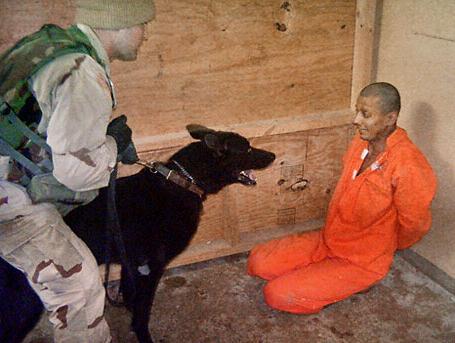
Jane Mayer notes that the government has produced the definitive report on the Bush-Cheney torture program. It was a long process to get to the truth and past the CIA’s self-serving bullshit, so effectively conveyed to Mark Boal and Kathryn Bigelow. You and I paid for this:

Working often seven days a week in catacomb-like basement offices, they have culled through some six million pages of nearly indecipherable internal intelligence documents in search of the truth. From this research, they have compiled a six-thousand-plus-page report with something like thirty-five thousand footnotes. To make it more digestible, they have boiled this down to a three-hundred-page summary…

More to the point, in his hearings for CIA director, John Brennan, formerly ambiguous about the war crimes of some of his CIA colleagues, we discovered this:

Brennan had claimed publicly in 2007 that the C.I.A.’s treatment of terror suspects had produced valuable intelligence, and perhaps even saved lives. But after reading the report, Brennan acknowledged under oath that he now doubts this.

In response to a question from Saxby Chambliss, the Republican vice-chairman of the Intelligence Committee, Brennan said, “I must tell you, Senator, that reading this report from the committee raises questions about the information that I was given at the time, the impression I had at the time.”

The only logical inference from this is that the CIA lied to Congress and even perhaps the Bush-Cheney administration about the nature of the evidence produced by using the torture methods of the Gestapo and the Chinese Communists.

But, of course, the CIA is somehow a separate government all itself and now is busy redacting, editing and presumably pruning the Senate Intelligence Committee’s report. Senator Feinstein gave the CIA six months to finish the job. The deadline has passed.

It seems to me that the pro-torture case or the anti-torture case would be greatly enhanced by a deeper and better understanding of what actually happened under the rogue vice-presidency of Dick Cheney. There will never be a more definitive report than this one. There should be no question that it be released immediately – to us, the general public, so we may better understand the scale, nature and results of torture, and thereby assess the public defenses of the torturers.

Why is this report not available yet? Why is the CIA allowed to see, let alone, doctor the Senate Intelligence Committee report? And where is the president? He promised us a more transparent presidency. Yet on the gravest matter imaginable – the evidence that senior government officials authorized war crimes – a comprehensive report is still bottled up and kept from us. The US has already taken a huge blow to its moral standing because of the psychotic ego of Dick Cheney. The only way to try to reverse this is at least to be honest about what this country did. And the principles it betrayed. And the bad intelligence it may or may not have acquired.

Why, in other words, have we been debating a movie “based on true events” when we have the truth to debate … and our own government is withholding it from us?

Busting The Daily Caller

This is a pretty definitive exposure of a total fabrication in the Daily Caller. But along with its sister propaganda sheet, Breitbart, what defines this new form of hackery is not that it makes shit up, but that even when it is busted, it keeps up the Baghdad Bob routine. Its imperviousness to truth even when it is presented with it. The detachment from reality – the strongest feature of today’s degenerate Republicanism – is embedded in its own fabricated media. That’s partly why they were living in never-never-land even on election day last November. Another piece detailing the Caller being a party to a con, concludes, after ABC News destroyed the lies:

The ABC News story isn’t a game changer; it’s a game ender.

Not if you live in what’s left of Tucker Carlson’s brain.

Quote For The Day

“Chávez is very close to the climactic moment when he will announce that he is a poached egg and that he requires a very large piece of buttered toast so that he can lie down and take a soothing nap,” – Hitch, eerily republished today in Slate.

It’s a hilarious piece. He doesn’t mean to take down Sean Penn – but what are you gonna do?

Congress Evolves On Marriage

DOMAs

We recently marveled at the dramatic shift in public opinion in California over the past few decades. Ian Thompson notes a similar shift in Congress:

On Friday, 212 members of Congress, 172 representatives and 40 senators, filed an historic brief in support of Edie Windsor’s challenge to the discriminatory and unconstitutional so-called Defense of Marriage Act’s (DOMA) exclusion of married same-sex couples from marriage-based federal responsibilities and rights. This amicus brief stands in dramatic contrast to the overwhelming support for DOMA when it was passed by Congress in 1996. DOMA passed the House with 342 votes (with 67 members voting no) and the Senate with 85 votes (14 members voted no). Obviously much has changed in the years since DOMA was signed into law by President Clinton, most notably the fact that gay people could not marry anywhere in the country (or world) in 1996 and today can do so in nine states as well as the District of Columbia.

And how did marriage equality affect civil marriage and divorce in the last decade as it became reality in several states and was on the front-burner of public discussion? Between 2000 and 2009, divorce rates dropped nationally from 4.1 percent to 3.4 percent. The lowest divorce rate? 2.2 percent – in the state that first legislated marriage equality, Massachusetts. This argument is essentially over as an empirical and civil matter.

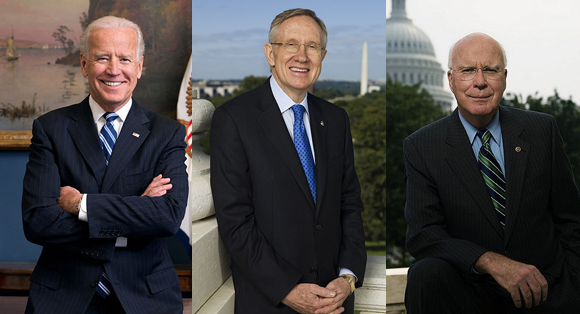
(Above: President of the Senate Joe Biden, Senate Majority Leader Harry Reid, and Senate Judiciary Chairman Pat Leahy all voted in favor of DOMA in 1996. The latter just two signed the aforementioned amicus brief while Biden is now an outspoken supporter of marriage equality. Portraits taken from their respective Wiki pages.)