Marcel’s Marginalia

proust-exhibit

Colm Tóibín appraises a new exhibit of Proust’s manuscripts, notebooks and letters at the Morgan Library, detecting in one letter the novelist’s readiness “for trouble of the most sweet and tender and pleasurable kind”:

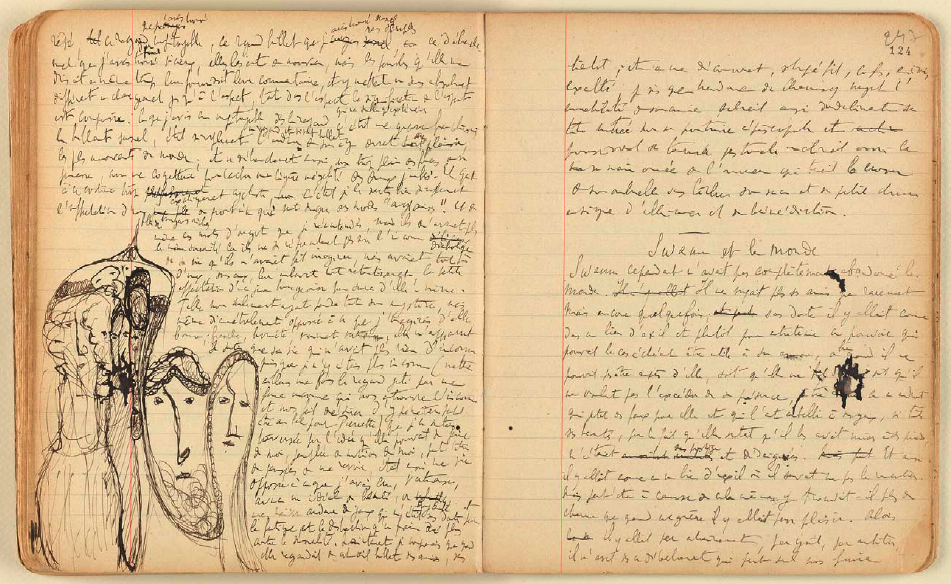
Proust’s handwriting is bad; it is the handwriting of a novelist rather than a dandy, and visitors who can read French will have much fun making out the words and the many untidy emendations on the pages of the manuscript. In a letter to a publisher, as Proust seeks to explain what his novel is about, one word, however, stands alone and is written with a rare exactitude. In a letter to Alfred Vallette, editor of Le Mecure de France, in 1909 Proust described his work-in-progress: it “is a genuine novel and an indecent one in places. One of the principal characters is a homosexual.” The handwriting is that of a man in a hurry. Most of the words can be made out because of the context. But the word “homosexual,” as it is written in his hand here, stands alone; it is very clearly written, each letter perfectly made and totally legible. There is a feeling as you look at it that it was a word Proust did not often write, or that perhaps he enjoyed writing, or that it was a term he now wanted to take his time over, and he needed Vallette to be able to see it clearly.

(Photo of one of Marcel Proust’s notebooks on display. Cahier 12, 1909 NAF 16652. Bibliothèque nationale de France (BnF), Paris, France © BnF, Dist. RMN-Grand Palais)


Educating Colleges On Climate Change

Bill McKibben continues his crusade against fossil fuels, making the case for divestment at college campuses:

In the 1980s, 156 colleges divested from companies that did business in apartheid South Africa, a stand that Nelson Mandela credited with providing a great boost to the liberation struggle. “I remember those days well,” says James Powell, who served as president of Oberlin, Franklin and Marshall, and Reed College. “Trustees at first said our only job was to maximize returns, that we don’t do anything else.  They had to be persuaded there were some practices colleges simply shouldn’t be associated with, things that involved the oppression of people.” Since then, colleges have taken stances with their endowments on issues from Sudan to sweatshops. When Harvard divested from tobacco stocks in 1990, then-president Derek Bok said the university did not want “to be associated with companies whose products create a substantial and unjustifiable risk of harm to other human beings.”

Given that the most recent data indicates fossil fuel pollution could kill 100 million by 2030, the coal, oil and gas industry would seem to pass that test pretty easily; it’s also on the edge of setting off the 6th great extinction crisis, so everyone over in the biology lab studying non-human beings has a stake too.

Christian Parenti believes that divestment is only a first step:

“If you actually look at the details of previous struggles you will see that symbolic power [of divestment] has to eventually crystallize as government action,” Parenti tells In These Times. “Take tobacco. The moral spectacle of dumping tobacco stock was itself not economically painful. But once that moral power was crystallized as legal power in the form of anti-tobacco laws, then consumption of tobacco and tobacco profits began to decline.”

Watch McKibben’s video series on the Dish here.

And Emerson Wept

The Atlantic‘s new sponsored prose:

Just as the current marketing environment is driving a culture of customer centricity and personalized interaction, a cultural shift is required inside the organization as well. Closing the gap between marketing requirements and IT capabilities requires a culture of collaboration in which the CMO and CIO work towards a set of agreed-upon goals that factor in both marketing and IT interests.

The Fog Of Gun Violence

Maggie Koerth-Baker tries to untangle some very incomplete data sets:

People may or may not call the cops to report domestic violence or an assault by someone they know. If the cops are called, the situation may or may not be taken seriously enough that it’s logged in any meaningful way. And if the violent incident in question isn’t technically a crime – shooting yourself in the foot, for instance, or drunkenly blowing a hole in your mother-in-law’s garage on the 4th of July – there’s no reason why that information would be reported to the FBI’s Uniform Crime Report, to begin with.

All those things matter very much to the people who are trying to figure out how guns are used in our society and how gun use changes over time. But there’s not really a solid, nation-wide, uniform way of tracking any of it. So what we say we know about gun violence is almost always just a synonym for what we know about gun murders.

On a related note, This American Life recently aired Part Two of a series on gun violence in one Chicago high school. Kottke conveys the situation there:

Here are some of the rules students live by at Harper High School in Chicago: Know your geography (whether you join a gang or not, you’re in one). Never walk by yourself. Never walk with someone else. If someone shoots, don’t run. These are just a few of the exhausting complexities that face the kids at Harper High, where 29 current and former students were shot last year.

The Obama Wave

Obama Campaigns In Richmond And Cleveland On Second Day Of Campaign Tour

Ta-Nehisi sees Obama’s reelection, and the massive turnout among minorities, as evidence of a bigger shift:

The history of black citizenship had, until now, been dominated by violence, terrorism, and legal maneuvering designed to strip African Americans of as many privileges—jury service, gun ownership, land ownership, voting—as possible. Obama’s reelection repudiates that history, and shows the power of a fully vested black citizenry. Martin Luther King Jr. did not create the civil-rights movement any more than Malcolm X created black pride. And the wave that brought Obama to power precedes him: the black-white voting gap narrowed substantially back in 1996, before he was even a state legislator. The narrowing gap is not the work of black messiahs, but of many black individuals.

Person by person. Soul by soul.

(Photo: U.S. President Barack Obama and Senator Mark Warner (D-VA) wave to a crowd of about 15,000 supporters during a campaign rally at Byrd Park October 25, 2012 in Richmond, Virginia. By Chip Somodevilla/Getty Images)

Chart Of The Day

Marriage_Estimates

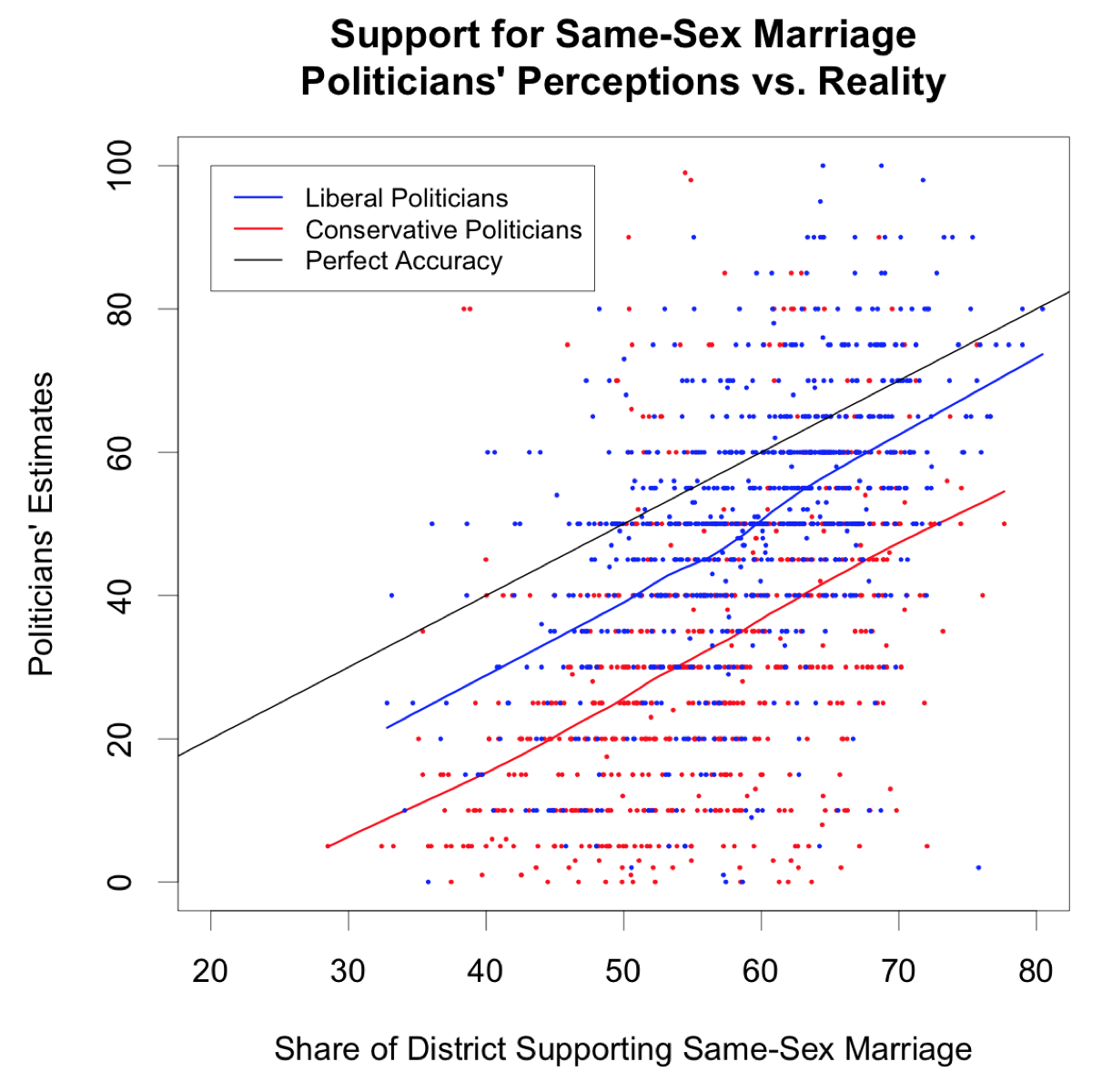
Dylan Matthews flags a new working paper (pdf) by David Broockman and Christopher Skovron:

Broockman and Skovron find that all legislators consistently believe their constituents are more conservative than they actually are. This includes Republicans and Democrats, liberals and conservatives. But conservative legislators generally overestimate the conservatism of their constituents by 20 points. “This difference is so large that nearly half of conservative politicians appear to believe that they represent a district that is more conservative on these issues than is the most conservative district in the entire country,” Broockman and Skovron write. This finding held up across a range of issues.

How Bad Is BPA?

Austin Considine highlights recent studies on disorders possibly connected to Bisphenol A exposure. Why understanding the effects of the chemical is important:

BPA exposure is nearly ubiquitous. In a wide-ranging study conducted by the Centers for Disease Control and Prevention in 2003-2004, researchers found detectable levels of BPA in 93 percent of subjects six years and older. The FDA recognizes something is wrong: It banned BPA from baby bottles and children’s sippy cups just last year.