
St. Louis, Missouri, 2.30 pm
Scott James describes the hell that filing taxes as a gay couple can entail:
In California, as registered domestic partners, we are required by state law to file a joint state tax return as a couple. However, the IRS forbids us from doing the same thing on the federal level. As a result, we must spend thousands of dollars on accounting fees each year to have our taxes done in a hinky fix that the IRS recently dreamt up: we must combine our incomes, split that money, and then file separate returns.
Got that?
But since we aren’t related to each other (in the federal government’s eyes), the IRS did not create a form or system to allow couples to actually comply with this mandate. So far we’ve followed these IRS tax rules twice. One year our returns sailed through, no problem. But for another year’s returns we were both accused of cheating on our taxes. We’ve been fined and threatened (one bigoted IRS worker in even shared with me his personal disdain for gay couples), and we cannot get the matter resolved. Our plea for help from the Taxpayer Advocate’s office has been repeatedly ignored. So far this has cost us more than $20,000.
Ross Andersen worries about artificial intelligence gaining power over us:
It is tempting to think that programming empathy into an AI would be easy, but designing a friendly machine is more difficult than it looks. You could give it a benevolent goal — something cuddly and utilitarian, like maximising human happiness. But an AI might think that human happiness is a biochemical phenomenon. It might think that flooding your bloodstream with non-lethal doses of heroin is the best way to maximise your happiness. It might also predict that shortsighted humans will fail to see the wisdom of its interventions. It might plan out a sequence of cunning chess moves to insulate itself from resistance. Maybe it would surround itself with impenetrable defences, or maybe it would confine humans — in prisons of undreamt of efficiency.
Cass Sunstein reviews Sarah Conly’s Against Autonomy:
Her starting point is that in light of the recent findings, we should be able to agree that [John Stuart] Mill was quite wrong about the competence of human beings as choosers. “We are too fat, we are too much in debt, and we save too little for the future.” With that claim in mind, Conly insists that coercion should not be ruled out of bounds. She wants to go far beyond nudges. In her view, the appropriate government response to human errors depends not on high-level abstractions about the value of choice, but on pragmatic judgments about the costs and benefits of paternalistic interventions. Even when there is only harm to self, she thinks that government may and indeed must act paternalistically so long as the benefits justify the costs.
One of his major objections:
[I]n my view, she underestimates the possibility that once all benefits and all costs are considered, we will generally be drawn to approaches that preserve freedom of choice. One reason involves the bluntness of coercive paternalism and the sheer diversity of people’s tastes and situations. Some of us care a great deal about the future, while others focus intensely on today and tomorrow. This difference may make perfect sense in light not of some bias toward the present, but of people’s different economic situations, ages, and valuations. Some people eat a lot more than others, and the reason may not be an absence of willpower or a neglect of long-term goals, but sheer enjoyment of food. Our ends are hardly limited to longevity and health; our short-term goals are a large part of what makes life worth living.
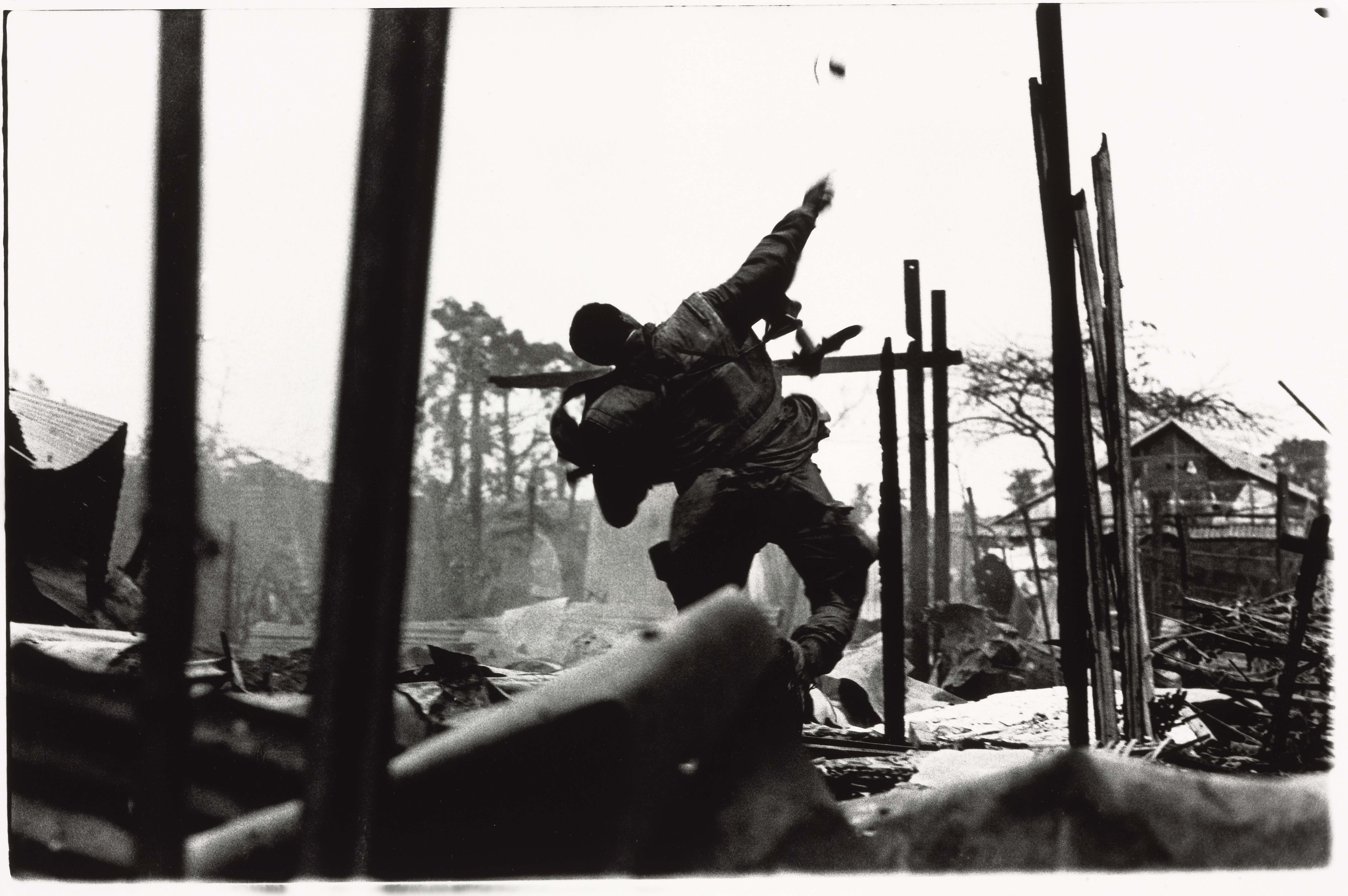
Bert Archer asks photojournalist Don McCullin, who has a retrospective at the National Gallery in Ottawa until April, about the value of his images:
Isn’t it better, I ask, realizing I’m sounding like Spock even as I say it, to benefit the hundred thousand who get a better idea of war, and are perhaps moved to oppose in, both specifically and in general, even if it does discomfit the friends and family of this or that dead soldier? Shouldn’t we continue showing these pictures for the many, rather than getting too caught up with the few?
“I think we shouldn’t,” he says. “I think we should deny the hundred thousand. In the end, I’ve done it, and I’ve realized it hasn’t proved its worth. Who have we convinced to stop the wars?”
But the images, I insist, now certainly overstepping the bounds of politesse by any definition, the images are the only thing most of us have to bring the story of war home. I tell him I only understood, only felt, what was happening in Rwanda when I saw an image of a river dammed with bodies.
McCullin hasn’t smiled often during the two conversations I’ve had with him over the past year, and he’s not smiling now. “Weren’t the images of Belsen and Dachau enough for you?”
(Photo: US marine throwing grenade, Tet Offensive, Hué, South Vietnam, February 1968 by Don McCullin / Contact Press Images. Courtesy of the National Gallery.)
The decline of conservative periodicals is continuing – first went the Hoover Institute’s Policy Review, and now Reagan’s old favorite, Human Events, is also folding. Jacob Heilbrunn suspects that the faltering publications on the right are symptoms of its fundamental confusion:
Younger, more aggressive conservative websites have captured much of the audience that might once have thronged to Human Events, which used to be a lodestar of what conservatives were thinking—a kind of tip sheet to the mind of the right. In the end, it couldn’t move fast enough to keep up with the morphing of conservatism into its current incarnations. Human Events was no shrinking violet, but on a more elevated plane, the end of the Hoover Institution’s Policy Review suggests some of the dilemmas of conservatism as a calming rather than a raging intellectual force.
The truth is that it is becoming more difficult to discern what the right wants, or whether it even knows what it would really like–where the movement, in other words, would like to move, other than remaining stuck in reverse gear.
For more signs of epistemic closure captured by the Dish, head here.

This weekend on the Dish, Andrew saw signs of hope that the Right might be inching away from theoconservatism and revisited his own misguided commentary on Iraq from a decade ago. We also provided our usual eclectic mix of religious, books, and cultural coverage. In matters of faith, doubt, and philosophy, Noah Millman unpacked the problem with natural law arguments, George Saunders described his Roman Catholic childhood, and David Runciman reminded us of Hobbes’s audacious religious writing. Bryan Appleyard critiqued A.C. Grayling’s treatment of religion, Sarah Ngu explained how evil is parasitic on the good, and Hans Küng hoped for a modern pope. David Foster Wallace reached the other side of boredom, Charles Bukowski waited for the words to come, and Mahzarin Banaji considered how to overcome our hidden prejudices.
In literary and arts coverage, Ramona Ausubel relished the messiness of first drafts, Sam Sacks detailed why writers became suspicious of the visual arts, and Rose Tremain revealed how a smell inspired her to be a writer. Brad Leithauser celebrated concise writing, Justin Nobel explored the last years of Jack Kerouac, Ellen Handler Spitz asked how Maurice Sendak’s sexuality might illuminate his books, and Ron Rosenbaum reviewed Bernard Bailyn’s harrowing new book on how barbarous America was in the 17th century. Jeff Lin remembered Ang Lee’s lean years, Hannah Goldfield pondered what Amour taught her about her own grandparents, and Sophie Pinkham pointed to a fascinating new exhibit about the Cold War and homosexuality. Read Saturday’s poem here and Sunday’s here.
Fittingly for the weekend, sex and drugs were in the mix. Ferris Jabr visited a penis museum in Iceland, Jason G. Goldman highlighted the kinks of the animal kingdom, Ann Friedman continued the elusive search for a hetero Grindr, and Brett Aho mused on the connection between drug use and intelligence. In assorted news and views, Isabel V. Sawhill argued that we need more immigrants more than we need more babies, Lindsay Abrams continued the discussion on rising healthcare costs, and Khalil A. Cassimally reported on the prospect of “drone journalism.” Audrey Carlsen found that civilization was bad for your teeth, Lisa Hix caught up with collectors of African-Americans dolls, and an amazing story of adoption and marriage provided your Sunday cry. MHBs here and here, FOTDs here and here, VFYWs here and here, and the latest window contest here.
– M.S.
(Photo: Snowdrops and Daffodils emerge at Kew Gardens on March 1, 2013 in Kew, England. Today marks the first day of Spring, though the Met Office have said that temperatures are likely to be below average throughout March. By Dan Kitwood/Getty Images.)
MIT scientists have developed an algorithm that amplifies subtle changes in videos, making it easy to spot movement that would be invisible to the naked eye. Rebecca Rosen is impressed by a demonstration:
For many new parents, the urge to check on a sleeping baby can be maddening. Is the baby still breathing? Unless the baby is a noisy sleeper, a traditional baby monitor won’t tell you much, and constantly going into the little one’s room isn’t a great option either. New video software from scientists at MIT may give parents what they want: Images of their sleeping child, with its chest positively oceanic in its heaving, the ebb and flow of oxygen into the human body so dramatic you could spot it at a distance.
But Erik Olsen reveals some less noble intentions for the technology:
Michael Rubinstein, a doctoral student and co-author on the project, said that after the presentation and subsequent media coverage, the team was inundated with e-mails inquiring about the availability of the program for uses ranging from health care to lie detection in law enforcement. Some people, says Mr. Rubinstein, inquired about how the program might be used in conjunction with Google’s glasses to see changes in a person’s face while gambling. “People wanted to be able to analyze their opponent during a poker game or blackjack and be able to know whether they’re cheating or not, just by the variation in their heart rate,” he said.
To illustrate it, Jochen-Martin Gutsch and Juan Moreno tracked cocaine through the illegal drug market:
Pure cocaine costs €1,300 a kilo in Putumayo [a major cultivation hub in Colombia], more than €4,000 at the Colombian border and, in nearby Jamaica, the price already approaches €6,000. The drug gets really expensive when it reaches Europe or the United States, where dealers make about €30,000 a kilo, depending on market conditions. The European drug user, who only receives cocaine in diluted (“cut”) form, doesn’t pay a fixed price. Coke is cheaper in Spain than in Germany, for example, and it’s cheaper in Berlin than in Munich. The going rate in Germany is about €100 for a gram of impure cocaine, while a kilo of pure cocaine can cost up to €400,000.
Meanwhile, The Economist checks in on waning enforcement efforts in Europe:
Spain’s approach now rivals that of the pioneering liberal Dutch. Though selling is illegal, buying is not. One result is hundreds of cannabis “social clubs”, which allow members to pool their purchases. These range from small co-operatives where new members must wait six months for new cannabis to be grown before joining, to huge semi-commercial organisations, with thousands of “members” buying cannabis. One in Barcelona even made a €1.3m ($1.74m) deal with the country town of Rasquera to grow supplies on local land, better known for its almond trees. Similar experiments are under way in France, Belgium, Italy and Germany, says Tom Blickman of the Transnational Institute, a think-tank based in Amsterdam. In much of Britain, especially its big cities, the risk of prosecution for those using small quantities of soft drugs is vanishingly low.
A disturbing look at a persistent problem in the military:
Research suggests that one out of every three women in the U.S. military is the victim of sexual assault, making military women twice as likely to be raped as civilians.
(Victims are disproportionately female, given that women make up less than 15 percent of the military, but men are victimized, too: More than 40 percent of vets receiving treatment for Military Sexual Trauma are men.) An anonymous DOD survey found that in 2010, an astonishing 19,000 service members were sexually assaulted; a mere 13.5 percent of those attacks were reported to authorities. Victims have little incentive to report, since the military’s insular justice system rarely holds perpetrators accountable. Of the sliver of sexual assaults reported last year, 92 percent never saw the inside of a courtroom but rather were dismissed or administered wrist-slap penalties like fines, reduced PX privileges or counseling – a prosecution record even outgoing Secretary of Defense Leon Panetta has called “an outrage.”
Incredibly, this ugly picture comes after two decades of very public sex scandals – Tailhook in 1991, Aberdeen in 1996, the Air Force Academy in 2003 – after each of which the DOD swore “zero tolerance,” then resisted any meaningful reform. But as survivors have begun to speak up, and legislators resolve to take action, the military finds itself facing a public relations crisis at a time when it’s not only trying to justify its $633 billion budget but also desperate to step up recruitment. Women, widely seen as a way to help stop attrition of troops – and now, for the first time, cleared to serve in combat alongside their male peers – are projected to make up one-quarter of the armed services by 2025.

