Illustrating With Words Alone

Sam Sacks details the turn against illustrated stories and novels among early 20th century writers, including Henry James and Virginia Woolf, who were suspicious of what visuals did to the integrity of their art:

So writers somewhat defensively cleaved to this division: pictures were about superficial titillation; prose was about essences. And over time the opinion hardened that the old custom of accompanying illustration was a form of aesthetic corruption. There were many great twentieth-century exceptions, naturally—Reginald Marsh’s vivid sketches for Dos Passos’s “U.S.A.,” Noel Sickles’s splendid drawings for Hemingway’s “The Old Man and the Sea” in Life magazine (though not the published book), the entire magnificent run of the Limited Editions Club—but these usually had an air of nostalgia and collectibility about them.

Increasingly, drawn portraits of characters appeared only in the pulps. Literary fiction, even on its dust covers, turned to images of static objects or abstract symbols or, sometimes, of nothing at all. Such ideological stringency reached its apogee when J. D. Salinger designed the paperback edition of “The Catcher in the Rye,” eschewing the lively drawing of a carousel horse that had adorned the hardcover for the starkly imageless “maroon-colored edifice” (in his biographer’s words), which immediately became iconic among high-schoolers and serial killers alike.

Sacks’ conclusion? Writers who stick to this dichotomy are missing out, especially in the age of e-readers that “allow you to read text, look at pictures, and watch videos on the same device.”

A Nasty New World

800px-1622_massacre_jamestown_de_Bry

Ron Rosenbaum reviews Bernard Bailyn The Barbarous Years, which details the “little-remembered” brutality of life in the American colonies during the 17th century:

Bailyn has not painted a pretty picture. Little wonder he calls it The Barbarous Years and spares us no details of the terror, desperation, degradation and widespread torture—do you really know what being “flayed alive” means? (The skin is torn from the face and head and the prisoner is disemboweled while still alive.)

And yet somehow amid the merciless massacres were elements that gave birth to the rudiments of civilization—or in Bailyn’s evocative phrase, the fragile “integument of civility”—that would evolve 100 years later into a virtual Renaissance culture, a bustling string of self-governing, self-sufficient, defiantly expansionist colonies alive with an increasingly sophisticated and literate political and intellectual culture that would coalesce into the rationale for the birth of American independence. All the while shaping, and sometimes misshaping, the American character. It’s a grand drama in which the glimmers of enlightenment barely survive the savagery, what Yeats called “the blood-dimmed tide,” the brutal establishment of slavery, the race wars with the original inhabitants that Bailyn is not afraid to call “genocidal,” the full, horrifying details of which have virtually been erased.

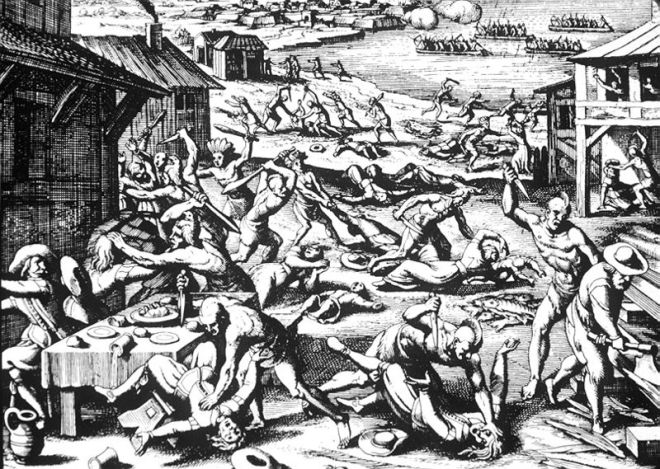
Above image from the Wiki entry for the Indian Massacre of 1622:

Captain John Smith, though he had not been in Virginia since 1609 and was thus not a firsthand eyewitness, related in his History of Virginia that braves of the Powhatan Confederacy “came unarmed into our houses with deer, turkeys, fish, fruits, and other provisions to sell us”. Suddenly the Powhatan grabbed any tools or weapons available to them and killed any English settlers who were in sight, including men, women and children of all ages. Chief Opechancanough led a coordinated series of surprise attacks of the Powhatan Confederacy that killed 347 people, a quarter of the English population of Jamestown.

Update from a historian in Virginia:

I want to provide a bit more context for your readers about the so-called Indian Massacre of 1622. If, as the reviewer of Bailyn’s book suggests, the details of this period “have virtually been erased,” the image and accompanying Wikipedia information you provide doesn’t much help the effort to un-erase it.

Of course, the 1622 attack was a massacre only from the perspective of the English settlers, who had, in previous years, razed Indian towns, looted religious temples, and stolen or destroyed whole fields of maze. Many of the English military men had fought in Ireland and happily repurposed for Virginia the terror tactics developed in those wars. For instance, according to an account by George Percy, English soldiers captured an Indian chief’s wife and two children and confined them aboard ship. This was in the spring of 1610. Annoyed that their superior, Percy, might show the Indians mercy, the soldiers instead threw the children overboard and shot “owtt their Braynes in the water.” The chief’s wife was later put to the sword.

The “Powhatan Confederacy,” meanwhile, was not a voluntary alliance as the word “confederacy,” used in the Wikipedia entry, suggests. In 1608, for instance, the paramount chief Powhatan surrounded and attacked a member group, the Piankatank Indians. For all intents and purposes, he wiped them out and moved another group of Indians into their newly emptied town. According to William Strachey, Powhatan then collected the dead warriors’ scalps and hung them on a line between two trees – in full view of English visitors, Strachey among them.

The attack of 1622 killed about a quarter of Virginia’s English settlers and a report drawn up for the Virginia Company of London suggested that the “Viperous” and “wicked” Indians, rather than be Christianized and civilized, ought now to be completely destroyed: “by force, by surprize, by famine.” “Conquering them is much more easie then of civilizing them by faire meanes,” the writer concluded, “for they are a rude, barbarous, and naked people.”

And yet what’s interesting is that the deaths caused by Opechancanough‘s attack were a drop in the bucket compared to deaths caused by disease and by what some investors in the Virginia Company described as mismanagement. One such investor was Samuel Wrote. In the wake of the attack he decided to crunch some numbers. He estimated that Virginia’s population in 1619, when the company’s current leadership had taken over, was 700. Another 3,570 men, women, and children had entered Virginia in the subsequent three years, adding up to a population of 4,270. But after Opechancanough’s attacks, and the deaths of 347 colonists, only 1,240 settlers remained. What had happened, Wrote demanded, to the other 2,683?

The barbarous years, in other words, involved much more than war, scalps, and flaying. But so also was it more complicated than a conflict between—as one Virginia history textbook puts it—the “obnoxious” John Smith and Powhatan, “a ruler of great spiritual, mental, and physical strength.”

A Poem For Saturday

younghorse

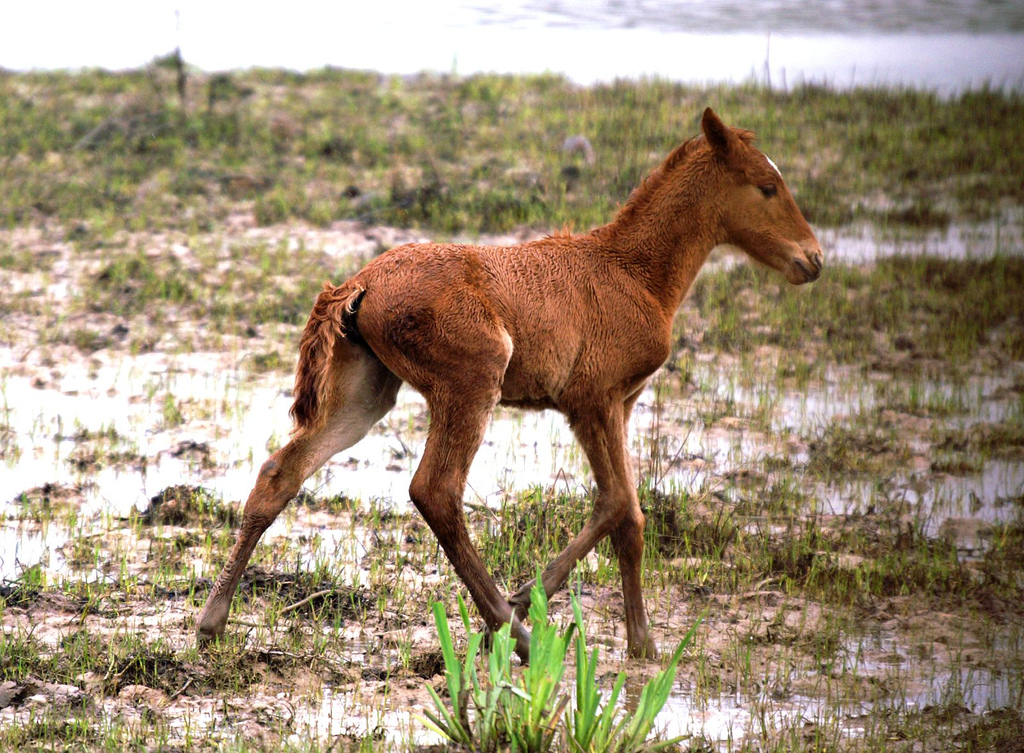
“Gus Speaks” by Maxine Kumin

I was the last of my line,
farm-raised, chesty, and bold.
Not one of your flawless show-world
forty-five pound Dalmatians.
I ran with the horses, my darlings.

I loped at their heels, mile
for mile, swam rivers they forded
wet to the belly. I guarded
them grazing, haloed in flies.
Their smell became my smell.

Joyous I ate their manure.
Its undigested oats
still sweet, kept me fit.
I slept curled at the flank
of the fiercest bloodmare.

We lay, a study in snores
ear flicks and farts in her stall
until she came to the brink,
the birth hour of her foal.
Then, she shunned me cruelly.

Spring and fall I erred over
and over. Skunks were my folly.
Then, I was nobody’s lover.
I rolled in dung and sand.
When my heart burst in the pond,

my body sank and then rose
like a birch log, a blaze
of white against spring green.
Now I lie under the grasses
they crop, my own swift horses

who start up and spook in the rain
without me, the warm summer rain

(From Where I Live: New & Selected Poems 1990-2010 by Maxine Kumin © Maxine Kumin. Used by permission of W.W.Norton & Company. Photo by Flickr user ferran pestaña)

The View From Your Window Contest

vfyw-contest_3-2

You have until noon on Tuesday to guess it. City and/or state first, then country. Please put the location in the subject heading, along with any description within the email. If no one guesses the exact location, proximity counts.  Be sure to email entries to contest@andrewsullivan.com (the old address still works as well). Winner gets a free The View From Your Window book. Have at it.

Mucking It Up

Edan Lepucki, who runs an advice column for writers at The Millions, was recently asked about how to approach first drafts. She turned to various novelists for their thoughts. Here’s Ramona Ausubel:

For me, the first draft is really just a big mud-rolling, dust-kicking, mess-making time in which my only job is to find the story’s heartbeat.  I allow myself to invent characters without warning, drop them if they prove to be uninteresting, change the setting in the middle, experiment with point of view, etc.  I figure that the body will grow up around the heart, that it’s always possible to bring all the various elements up and down, sculpt and polish, as long as I’ve got something that matters to me. The second draft (and the 3rd through 20th, Lord help me) involves getting out the tool belt and thinking like a carpenter.  But the first draft is all dirt and water and seeds and, hopefully, a little magic.

Of course, this method means that my first draft is almost unreadable.  Maybe someday I’ll invent a way of making a slightly cleaner mess, but until then, I try to enjoy the muck.

Remote-Controlled Reporters

Khalil A. Cassimally reports on the prospects of “drone journalism”:

Journalists can use drones to report on disasters such as hurricanes, tornadoes and wildfires. Having an above-the-ground view may give journalists a better perspective of the extent of a disaster. By making use of sensors attached to drones, journalists can measure numerous parameters such as radiation levels in inaccessible areas. An environment journalist may also be keen to use drones to collect specimen such as polluted water samples while an exploring nature journalist can use them as communication relays so that they can touch base when reporting from remote areas.

Drone journalism appears to make so much sense that two universities in the US have already incorporated drone use in their journalism programs. The Drone Journalism Lab at the University of Nebraska and the Missouri Drone Journalism Program at the University of Missouri both teach journalism students how to make the most of what drones have to offer when reporting a story. They also teach students how to fly drones, the Federal Aviation Administration (FAA) regulations and ethics. … [O]perating drones for commercial purposes, which includes journalistic purposes, will probably become legal as early as 2015.

The Lean Years Of Ang Lee

Recalling an interview he did with the director in 1993, Jeff Lin ponders what the two-time Oscar winner endured until fame finally arrived:

From age 30 to 36, he’s living in an apartment in White Plains, NY trying to get something — anything — going, while his wife Jane supports the family of four (they also had two young children) on her modest salary as a85th Annual Academy Awards - Press Room microbiologist. He spends every day at home, working on scripts, raising the kids, doing the cooking. That’s a six-year span — six years! — filled with dashed hopes and disappointments. “There was nothing,” he told The New York Times. “I sent in script after script. Most were turned down. Then there would be interest, I’d rewrite, hurry up, turn it in and wait weeks and weeks, just waiting. That was the toughest time for Jane and me. She didn’t know what a film career was like and neither did I.” It got so discouraging that Lee reportedly contemplated learning computer science so he could find a job during this time, but was scolded by his wife when she found out, telling him to keep his focus.

Put yourself in his shoes. Imagine starting something now, this year, that you felt you were pretty good at, having won some student awards, devoting yourself to it full time…and then getting rejected over and over until 2019. That’s the middle of the term of the next President of the United States. Can you imagine working that long, not knowing if anything would come of it? Facing the inevitable “So how’s that film thing going?” question for the fifth consecutive Thanksgiving dinner; explaining for the umpteeth time this time it’s different to parents that had hoped that film study meant you wanted to be a professor of film at a university.

The lesson Lin draws:

If you’re an aspiring author, director, musician, startup founder, these long stretches of nothing are a huge reason why it’s important to pick something personally meaningful, something that you actually love to do…

(Photo: Ang Lee poses at the 85th Annual Academy Awards at Dolby Theatre on February 24, 2013 in Hollywood, California. By Steve Granitz/WireImage)

Civilization Is Bad For Your Teeth

At least that’s what Audrey Carlsen finds:

Prehistoric humans didn’t have toothbrushes. They didn’t have floss or toothpaste, and they certainly didn’t have Listerine. Yet somehow, their mouths were a lot healthier than ours are today. “Hunter-gatherers had really good teeth,” says Alan Cooper, director of the Australian Centre for Ancient DNA. “[But] as soon as you get to farming populations, you see this massive change. Huge amounts of gum disease. And cavities start cropping up.” And thousands of years later, we’re still waging, and often losing, our war against oral disease.

Giving up the “paleo diet” is probably to blame:

[T]he researchers found that as prehistoric humans transitioned from hunting and gathering to farming, certain types of disease-causing bacteria that were particularly efficient at using carbohydrates started to win out over other types of “friendly” bacteria in human mouths. The addition of processed flour and sugar during the Industrial Revolution only made matters worse.

What’s The Better Source Of American Vitality?

In response to Jonathan Last’s What to Expect When No One’s Expecting, Isabel V. Sawhill argues that “we don’t need more babies; we just need more immigrants”:

Expecting women to rededicate themselves to producing children is not in the cards, even with the kind of family-friendly policies that Last and some others support. One only has to look at what is going on in Europe where such policies have been tried at great expense to see that they are not likely to be very effective.

Last counters:

I go to great lengths in the book to detail how vital immigration has been, and continues to be, to our demographic profile. I also discuss its limits. For instance, while immigration provides a great deal of demographic relief it is, as an objective technical matter, inferior to baby-making in that it does not provide the same rejuvenation effect on a society’s age profile. For a deeper exploration of the math on this, I’d point readers to Carl Schmertmann’s work. I would have thought that Sawhill might at least acknowledge some of these limitations in the course of making her broader argument.