Our Melting Planet

Due to declining ice coverage in the Arctic, the NOAA is being forced to quickly generate maps of previously uncharted Arctic waters for commercial vessels. Meanwhile, John Timmer talks to geologist Richard Alley about glacial melt in the Antarctic:

The key thing that regulates the flow of these glaciers is what’s called a “grounding line,” or the place where the glacier’s end is in contact both with the ocean floor and with the ocean itself (this is in contrast to the floating ice that sometimes spreads past this site). While a glacier is on the grounding line, Alley said there are a lot of feedbacks that tend to keep it there. … The problem is that, when the feedbacks are finally overcome, the grounding line fails catastrophically, and the ice tends to retreat rapidly to the next potential grounding line.

Alley identifies areas in which this effect could “raise sea levels by two meters”, faster than we would be able to adapt. Unfortunately, worldwide concern about the need for action on climate change is fading:

Despite years of studies showing the impact of global warming on the planet, only 49 per cent of people now consider climate change a very serious issue – far fewer than at the beginning of the worldwide financial crisis in 2009. Worries about climate change first dropped in industrialised nations but they have now also fallen in developing economies including Brazil and China, according to the survey by GlobeScan Radar.

Hating On Hathaway, Ctd

Ann Friedman ponders dislike of Anne Hathaway and our feelings towards celebrities more generally:

What does it really mean when we say an actress “annoys the shit” out of us, anyway? That we hate the roles she chooses? The paparazzi’d version of her life we see in US Weekly? Her insufficiently funny quips on the red carpet? Or, as Salon asked today, is it her face? In some ways, the point of sitting on the bleachers of celebrity culture is the thrill of judging with impunity. Unlike our neighbors or co-workers, we convince ourselves that famous actors, by dint of making their living entertaining us, have chosen to be judged. And judge we do. (This isn’t just a byproduct of our Twitter-enforced instapundit culture, either: “Let’s get Entertainment Weekly and play my favorite new game: Love Her/Hate Him,” exclaims Will in a 1999 episode of Will & Grace.)

Sasha Weiss theorizes that certain people detest Hathaway because “she represents the archetype of the happy girl, which is one that many people resist.” TNC chips in his two cents:

I recognize that there is an entire publicity industry designed to get us to “like” people whom we essentially pay to see work. And perhaps it’s fair to judge whether or not that industry has been effective in making you think you know Hathaway in a way that you probably do not. But the fact remains that you don’t really know any of these people.

Earlier Dish on Hathaway here.

From The Cutting Room Floor

Keith Phipps finds that watching deleted scenes can radically alter interpretations of a film:

Take Blue Velvet: When David Lynch’s landmark 1986 film was released on Blu-ray 25 years later it contained nearly an hour of previously lost footage. That’s nearly half the running time of the final film, which allows for plenty of room for perception-altering scenes, even one in which the film’s hero Jeffrey (Kyle MacLachlan) watches and initially fails to stop an apparent date rape, a moment that, as Bill Wyman noted in Slate “would have made Blue Velvet a different movie.”

On the one hand, I’m not sorry I watched that scene or the other lost Blue Velvet footage. They’re examples of a filmmaker working at the height of his powers. On the other hand, I wish I had the ability both to watch those scenes and forget it. I’ve seen Blue Velvet many times over the years and I’m sure my next viewing will find me attempting to plug what I’ve seen into the narrative. So that’s what the college Jeffrey’s left to take care of his ailing father looked like [here]. And who knew he dated Megan Mullally while there? [above]

No More Phoning It In, Ctd

Readers sound off on Yahoo’s new policy:

I am a software developer at an interactive agency, I work from home, and I have two insights on Mayer’s decision to eliminate telecommuting. First, our company employs talented people all over the world, because it is very difficult to find enough skilled technology workers; to insist that they also physically live in the same vicinity as your company headquarters is a certain kind of madness. This is slightly less of a problem for companies headquartered in technology hubs like SV or major cities, but it’s a problem nonetheless, so it’s not uncommon to see companies in smaller markets who welcome telecommuters. (As an aside, the synergistic effects of physical interaction and “water cooler time” is offset by all manner of unproductive office distractions. Have you ever been to a meeting? They’re awful.)

Second, I’ve interviewed at Yahoo’s Silicon Valley campus recently.

What I observed was surprising (to me): there are a relatively small number of engineers and designers among an ocean of employees. What do these non-technical people do for Yahoo? I’m not really sure. But there are crowds of them, and Yahoo could probably cut their numbers by a third and never notice the difference. It may be that Mayer is trying to do just that.

Another elaborates on that theory:

Have folks considered that this is just a layoff by another name? Of course Mayer knows that great things are possible with remote workers, and that many Yahoo employees were hired with the understanding of various levels of flexibility. And of course there were alternative approaches of having leaders ask individual teams to come together when brainstorming on new product ideas. But certainly a result of this move is some will leave Yahoo. And maybe that’s needed. Compare it to a conventional layoff, which has some negative publicity (fear of a ‘downward spiral’ of future rounds) but managers get to get rid of the less productive workers (in their eyes). In this case it is likely that some of the more creative folks may attrit.

The Dish of course no longer has an office, but even when we did, we only occasionally went into it. The intense editing of the site is actually far more efficient when we are solo in our blog caves or coffee shops. And naturally the new Dish’s uncertain budget greatly benefits from not having to pay for office space.

Chart Of The Day II

Black Males College

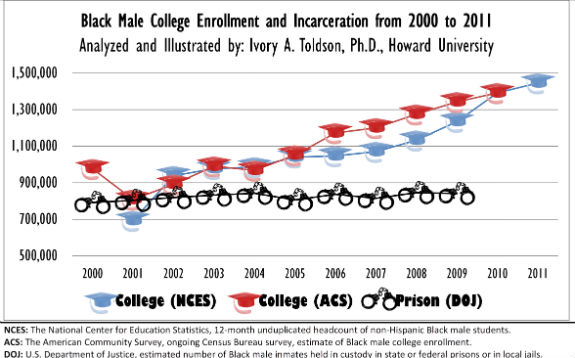
Ivory Toldson discovers that, contrary to popular belief, there are far more black males in college than prison. He thinks the myth has perverse effects:

Consider this: If all 1,127,170 black males who were enrolled in undergraduate programs in 2010 eventually graduated, the total number of black males with college degrees would increase by 71 percent, nearly achieving parity with white males. However, we will not sufficiently support black male college students — nor college-bound students — if we simply keep perpetuating the myth that juxtaposes their needs with those of black males in the criminal-justice system.

(Hat tip: Bouie)

Who Dares Run Against Hillary?

Kornacki wonders:

I would say there’s a decent chance Clinton actually could clear the field and face no serious opposition for the nomination. Not a good chance, but a decent one. This has never happened for a non-incumbent in the modern era, but then again, it’s not like we’re dealing with a huge data set here. And Clinton really is approaching the ’16 race with a set of advantages we’ve never before seen for a non-incumbent. Yes, there’s plenty of time between now and Iowa – time for Clinton to stumble or take a pass on the race, time for Obama to really step in it, time for a real split to open up within the Democratic Party. I’m not calling Clinton a shoo-in for the nomination, or even predicting she’ll run. I’m just arguing that if she does, she could break the mold for non-incumbent candidates of the modern era.

Face Of The Day

Pope Benedict XVI Steps Down And Officially Retires From The Papal Office

Pilgrims wait for Pope Benedict XVI to wave, for the last time as head of the Catholic Church, from the window of Castel Gandolfo where he will start his retirement today on February 28, 2013 in Castel Gandolfo, Italy. Pope Benedict XVI has been the leader of the Catholic Church for eight years and is the first Pope to retire since 1415. He will stay at the Papal Summer residence of Castel Gandolfo until renovations are complete at a monastery in the grounds of the Vatican and will be known as Emeritus Pope. By Oli Scarff/Getty Images.

Damming The Stream

Benjamin Lennett sees trouble on the horizon for streaming services like Netflix and Pandora:

First, they came for unlimited data on our smartphones. Now capped plans and usage-based pricing are likely coming to a cable provider near you (and indeed, they’re already here for some). The cable industry claims the move is about fairness: a fair return on their investment and fair pricing. But the egalitarian rhetoric is designed to obscure their more self-interested aims: increasing profits and thwarting competition from online video. …

The large cable companies are determined to prevent mass movement to cord-cutting, in which users give up their cable TV subscriptions and substitute with services like Netflix. How do you prevent this from happening? Data caps and usage-based pricing.

He puts the proposed caps in perspective:

How many hours of online video per month could a user watch with Time Warner’s 5 GB capped plan? About five for a high-quality stream, barely two for HD. By comparison, Nielsen estimated that in 2010, the average household watched 143 hours of television a month. Cord cutting families might be in for some very interesting dinner table conversations regarding dividing up the cable data plan.

The Internet’s Linguistic Borders

nyc-language-tweets

Robin Sloan laments the lack of translation in web culture:

Consider a webcomic like xkcd. It’s a touchstone of internet culture, and yet it’s presented only in English. (There are a handful of unofficial translation sites, but they seem to be spotty at best, abandoned at worst.) You could argue that xkcd’s core audience of programmers, scientists, and students all speak English, wherever they are… but I don’t know. I think there must be a few hundred thousand internet users out of China’s half-billion who would absolutely love the comic—who would feel, as so many xkcd readers do, that it’s somehow speaking to them directly—but whose English isn’t up to snuff. What a thing that would be, to make this bit of culture available to them!

We, the internet culture makers: we don’t translate enough. We don’t push hard enough against these linguistic and social borders. Instead, we pat each other on the back for our elegant file-format choices. Instead, we talk mostly to ourselves.

(Above: Map of the Twitter languages of Manhattan, captured in 8.5 million tweets, between January 2010 and February 2013 by Ed Manley. Interactive version here.)

Bob Woodward, Demonstrable Liar

Screen shot 2013-02-28 at 4.04.09 PM

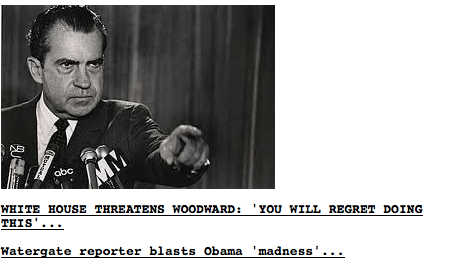
This pioneering journalist has apparently been ominously threatened by the White House for daring to disagree with them. It must have been a harrowing experience. Last night he complained to his fellow stenographers, Mike Allen and Jim VandeHei, about living under this horrifying intimidation:

Digging into one of his famous folders, Woodward said the tirade [from a White House official] was followed by a page-long email from the aide, one of the four or five administration officials most closely involved in the fiscal negotiations with the Hill. “I apologize for raising my voice in our conversation today,” the official typed. “You’re focusing on a few specific trees that give a very wrong impression of the forest. But perhaps we will just not see eye to eye here. … I think you will regret staking out that claim.”

Woodward repeated the last sentence, making clear he saw it as a veiled threat. “ ‘You’ll regret.’ Come on,” he said. “I think if Obama himself saw the way they’re dealing with some of this, he would say, ‘Whoa, we don’t tell any reporter ‘you’re going to regret challenging us.’”

Woodward has called the president guilty of “madness” and of moving the goal-posts by suggesting that the threat of the sequester was designed to facilitate a grand bargain – tax hikes, entitlement and defense cuts combined with tax reform. But that was the point of the sequester; it was a deadly instrument designed to force both parties to compromise – one on taxes, the other on spending cuts. Woodward’s op-ed was untrue, it seems to me, plainly untrue. More to the point he accused the president of madness, even though he has offered a compromise that includes cuts to Medicare as serious as those in Bowles-Simpson, while the Republicans insist on only spending cuts.

Yes, the sequester idea originated with Jack Lew in the Obama administration but was quickly embraced by the GOP and became a rare moment of bipartisan agreement, after the brinksmanship of the debt ceiling battle in 2011. Odd, isn’t it, that Woodward did not, to my knowledge, describe the GOP’s successful and completely unnecessary downgrade of this country’s credit rating as “madness.”

Still the accusation of a threat against Woodward was troubling enough that I was eager to see it substantiated. And here – in the midst of a heated but completely conventional back-and-forth between source and journalist – it is:

I do truly believe you should rethink your comment about saying that Potus asking for revenues is moving the goal post. I know you may not believe this, but as a friend, I think you will regret staking out that claim.

This is what Woodward was claiming was a chilling threat to press freedom! I mean, seriously. What exactly is the threat? This is the final email Woodward sent to Sperling:

Gene: You do not ever have to apologize to me. You get wound up because you are making your points and you believe them. This is all part of a serious discussion. I for one welcome a little heat; there should more given the importance. I also welcome your personal advice. I am listening. I know you lived all this.

Does this read like a man writing to someone threatening him with anything? He even says: “I for one welcome a little heat.” He describes Sperling’s “threat” as “personal advice” as a friend, which it plainly was. Then he goes whining to CNN and Politico that he is victim of government threats for his reporting. That’s a lie, and Woodward has now been exposed as a liar.

Excuse me, but given his reputation as a journalist, that is “madness.”