Bless them:
[youtube http://www.youtube.com/watch?feature=player_embedded&v=LspJN_1R27Q#!]A Green Lining To Sequestration?
Mike Riggs finds one:
The automatic budget cuts set to take place this Friday might have government contractors on edge, but they could also bring sweet relief for medical marijuana dispensary owners fearful of government crackdowns. According to the OMB’s report to Congress, the Drug Enforcement Administration will lose $166 million from its $2.02 billion staffing and appropriations budget, reducing its funding to 2002-2003 levels, when the DEA first began coordinated crackdowns on medical marijuana dispensaries.
But the DEA arguably has other, bigger priorities now, such as cartels and prescription pill mills. With $166 million less to work with, will the DEA finally have to prioritize its resources?
But:
To be fair: the state-by-state fact sheets the White House released did emphasize decreased funding for drug treatment, which means we’ll find out really quickly whether states and local governments are still interested in diverting addicts from prison to treatment only if the federal government pays them to do so.
Fascist Fashion

Annalee Newitz digs up a bizarre relic:
In the late 1920s, a peculiar confluence of fashion and fascism came together in England. The Men’s Dress Reform Party, an outgrowth of the eugenics movement, agitated for men to dress in more beautiful, flowing clothing reminiscent of what they wore during the Elizabethan era. Mostly, this seemed to mean wearing shorts and kilts.
Simon Carter has more:
Today it might seem comical that the MDRP urged men to adopt a more feminine style of clothing. However the underlying project was more sinister in its efforts to interweave masculinity with the social hygiene and eugenic movements. Articles supporting dress reform in the New Health Society journal argued that changes in men’s fashion would bring out a male beauty – one that celebrated masculine grace and physique. The idea was that if middle class men could, through reformed clothing, become more beautiful then they would inevitably also be more attractive to women (i.e. potential mothers) and thus reverse the perceived evolutionary decline of the middle classes:
…a renaissance of beauty for men – true masculine beauty of the body and mind, the bloom of a joyful spirit – might mean happier marriages, well-born and beautiful children, a healthier and more beautiful race (Dion Byngham, New Health Journal, 1932).
(Dress reformers on their way to the MDRP Coronation competition in 1937, via Carter)
The Slow Sequester
David Dayen expects the sequester to phase in gradually:
The problem for the White House, despite outward projections of confidence, is that the sequester simply won’t spool out in spectacular fashion. The biggest near-term hits will be to areas largely invisible to the public, like scientific research or military readiness, or to low-income populations that have scarce political power. Events harming the broad mass of consumers, like airport chaos, mass teacher layoffs or shuttered national parks, won’t kick in for a month or more, whether the administration likes it or not. The President himself admitted this week that the impacts “will not all be felt on day one.”
TNR asked various economists, “Will the sequester start another recession?” Alan Blinder’s response:
I certainly wouldn’t expect the sequester to cause a recession—it’s not big enough. A reasonable guess is that it takes about 0.6 of a percentage point off the 2013 growth rate. That’s based on the amount of spending that would be cut, and a ‘multiplier’ around one. Now, when the economy is struggling to make 2 percent growth, losing about 0.6 percent is hardly welcome. But it’s not a recession. The possible downside, and the hardest part to figure out, is how badly the sequester will dent confidence—creating the feeling that our government is losing its mind—and what that might do to spending. I’ve estimated that as negligible—and I hope that’s right!
The View From Your Window

Possum Kingdom Lake, Texas, 11.10 am. “Dock removed due to drought.”
The Right To Beg
A. Barton Hinkle covers anti-panhandling laws:
[T]he restrictions on soliciting never seem to apply to teen-agers in bikini tops waving car-wash signs. Or to campaign canvassers seeking petition signatures to get political candidates on the ballot. Or to firemen passing the boot for a local charity. Somehow it’s only the homeless who aren’t supposed to pester anybody.
Courts have struck down panhandling ordinances time and again. In 2011, an Arizona appeals court ruled that Phoenix could not ban panhandling after dark. Last March, a federal judge ruled against Utah’s anti-panhandling law. In August, a federal judge ruled against Michigan’s state law against panhandling in public places. Time and again the courts have found, as the 4th Circuit did last week, that “begging constitutes protected speech.” But cities across the country keep passing anti-panhandling ordinances anyway.
Should Trans Surgery Be Covered?
Gender reassignment surgery just got an unlikely advocate in Emerson College’s Phi Alpha Tau fraternity, which is raising money for one of its own, Donnie Collins, to receive female-to-male breast augmentation. Emerson’s insurance won’t cover the procedure, as it is “common practice for insurance companies to deem female-to-male breast augmentation—or top surgery—as a cosmetic plastic surgery rather than a necessity.” But that tide is starting to turn, as “many of the top American universities” are changing their insurance coverage to include gender reassignment surgery. Julie Hollar puts that progress in context:
Only those transgender youth privileged enough to get into schools like Princeton or Stanford will have access to full health coverage that will enable them to align their gender presentation with their gender identity–which can have important reverberations down the line for their job and life prospects. Not all transgender people want to take hormones or undergo surgery, but for many it is a medical necessity–something both the American Medical Association and the American Psychiatric Association have recognized. …
The real story here is that so many transgender people–those without access to elite higher education or certain Fortune 500 jobs–face serious health care discrimination that puts them at an even greater disadvantage than they already face. If we had a single-payer system, where your health insurance didn’t depend on where you go to school or if you have a certain kind of job, it would still be a struggle to get these things covered, no doubt. But it would be one unified struggle, instead of thousands of disparate ones.
Update from a reader:
I hate to do this, but speaking as an alumnus of Emerson (’08), and an alumnus who transferred from a big state school, I have to throw a bit of water on this “unlikely” development.
For starters, Phi Alpha Tau is not a national fraternity, but one local to the college, and one that is not recognized by any major national organization related to Greek life. Secondly, and more importantly, Greek life at Emerson, a small arts school with a relatively low number of students living on-campus, is pretty minimal in comparison to a big school, like Boston University or Northeastern nearby (I myself recall only ever meeting one person living in a frat, and he was a pledge who bailed after initiation). That, in combination with a higher-than-average percentage of LGBT students, makes this less unlikely and more an outlier to the rest of collegiate Greek life. This is still a positive development, but it would actually bear some weight if, say, this was Chi Phi at BU.
Giving Up Gluten
Darshak Sanghavi senses a fad:
According to USA Today, up to one-quarter of all consumers now want gluten-free food, even though only one person in 100 has celiac disease, the autoimmune disorder worsened by gluten ingestion. Going gluten-free seems somewhat faddish. The roster of celebrities who’ve gone temporarily or permanently off it includes Chelsea Clinton, Lady Gaga, Miley Cyrus, Drew Brees, and Oprah Winfrey, among many others.
Celiac disease can be diagnosed with a blood test, but people with wheat allergies or gluten intolerance are harder to pin down:
There’s not even a mediocre blood test for gluten intolerance. The diagnosis simply relies on someone’s subjective feelings of bloating, bowel changes, or mental fogginess after eating gluten. This is a set-up for all manner of pseudo-scientific self-diagnoses, especially when you consider that 2 percent of people believe they have illnesses caused by magnetic fields. And yet, a randomized, blinded trial in Italy just showed that one-third of patients with gluten intolerance clearly felt better with gluten-free diets, which confirmed “a distinct clinical condition.” …
This is the most frustrating part of gluten intolerance. There are certainly people who have a problem with gluten that’s not autoimmune or allergic. And yet, the data suggest that almost two-thirds of people who think they are gluten-intolerant really aren’t.
The NYT recently polled some “celiac experts” critical of dieting without a diagnosis. Seth Roberts sighs:
As someone put it in an email to me, “Don’t follow the example of the person who improved her health without expensive, invasive, inconclusive testing. If you think gluten may be a problem in your diet, you should keep eating it and pay someone to test your blood for unreliable markers and scope your gut for evidence of damage. It’s a much better idea than tracking your symptoms and trying a month without gluten, a month back on, then another month without to see if your health improves.”
Chart Of The Day
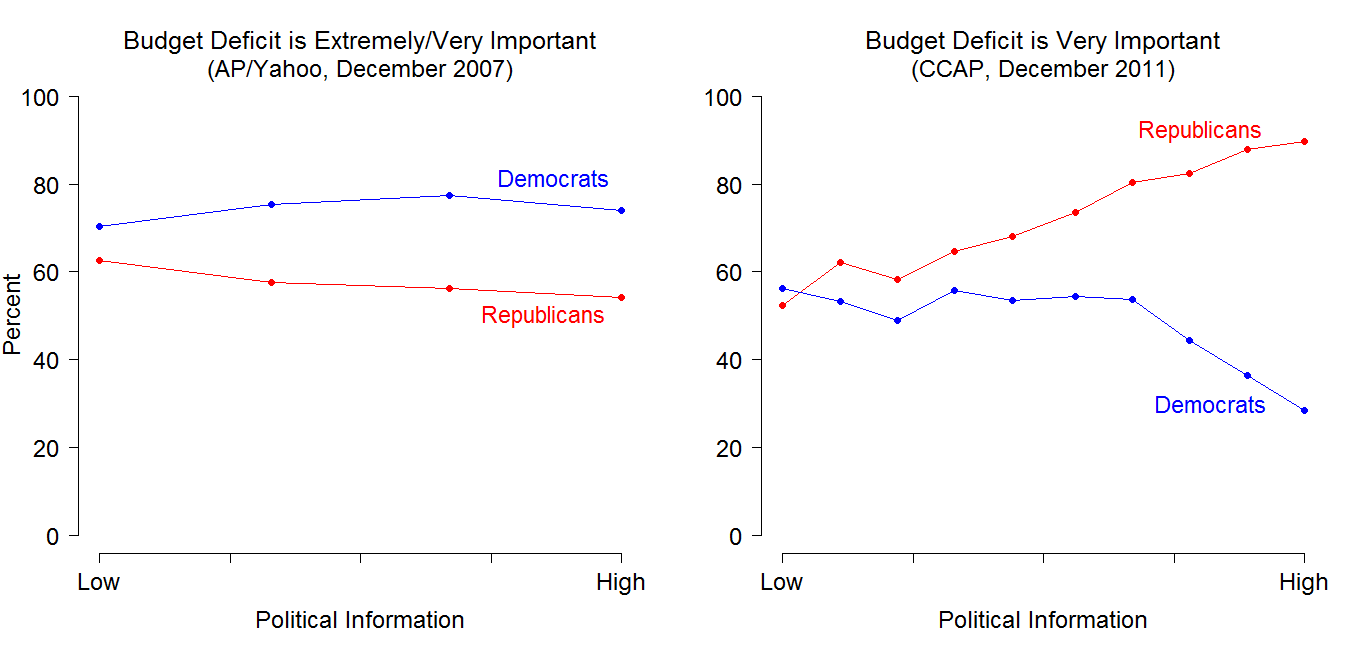
Michael Tesler finds “that public perceptions of the debt’s importance are fundamentally linked to which party is making it an issue”:
Back in December 2007, politically attentive Democrats were 20 percentage points more likely than politically attentive Republicans to say that the federal budget deficit was at least a very important issue. Four years later, though, the most politically attentive Republicans were now a whopping 60 points more likely than their Democratic counterparts to say the deficit is very important.
Yglesias adds:
[I]t’s crucial to understand that the flip-flopping happens with the best-informed people not the worst-informed people. If you’re well-informed you gain a lot of information about “your side’s argument” on the issues of the day and map your opinions to the shifting political currents.
Update from a reader:
I’m sure lots of people are emailing you about this today, but I figured I’d jump in anyway. We were in a very different place in the economic cycle in 2007 and 2011. Basic Keynesianism tells us that deficits are problematic when the economy is at full output but necessary during demand-driven recessions. It’s certainly true that Democrats are more likely to be Keynesians than Republicans, but that doesn’t make the change of opinion flip-flopping. It makes it an informed application of a consistent theory in changing circumstances. Yglesias got serious flack in his comments section for the post you quoted from, for this very reason.
A Dove In Hawk’s Clothing?
How Douthat understands Rand Paul’s strategy:
Paul has done what successful politicians tend to do: He’s picked his battles, done outreach to his critics, and consistently framed his arguments in language that conservative voters and activists understand. This has enabled him to break with the party’s hawkish tilt on a number of substantive questions, from the Libya and Syria debates to issues of executive power to the question of whether containment should be an option for dealing with Iran, without coming in for anything like the attacks that greeted Hagel’s nomination. He’s put his foot in his mouth here and there and taken fire from both his friends and foes along the way, and future world events (particularly events related to Iran) may upset his tightrope walk. But at the moment he seems like living, breathing proof that there’s room for actual foreign policy debate within the Republican coalition, and that not every non-hawk need be dismissed as a RINO and read out of the party.
Larison tackles a section of Ross’s post – on realism in the contemporary GOP.

