Guess Which Buzzfeed Piece Is An Ad, Ctd

A reader writes:

I think your strong aversion to the sponsored content model is due to two factors: 1) your profession 2) your generation. To someone like me (I’m 27), there isn’t much of a difference between ads and content. photoIn both categories, some are worth consuming and some aren’t. I’m just as likely to go to youtube to seek out a commercial I like as I am to search for a music video. I read that PS4 post without realizing it was an ad but when I found it was (through the Dish) I wasn’t offended and I didn’t feel duped.

Part of the reason is that I don’t see Buzzfeed as a site that operates within the confines of traditional “journalism” and I don’t think they’ve ever tried to position themselves that way. I think Ben Smith’s Buzzfeed Politics sort of exists as a separate piece of Buzzfeed and should have stricter rules for sponsored content, because while the format is slightly different, that part of the site is clearly committed to real, traditional journalism.  The main Buzzfeed site is not, and that’s where the PS4 post came out.

Most of the content is those silly scroll down photo-essays, which are a great way to waste 3 minutes. I don’t expect those posts to follow the traditional rules of journalism, because they’re not traditional journalism.

Making money on the web means we’re seeing new models evolve. The Dish is one model, the Atlantic is another and Buzzfeed is too. Buzzfeed is just really good at making content for the ADD types like me who sometimes just want to read something entertaining for 3 minutes.

Another writes:

Ten years ago, I would have been incensed that Buzzfeed would have approached the advertisement /content line the way they have, but at that time, consumers were still expecting to pay for content. Now, I’m much more open to alternative forms of revenue generation because we, the consumer, have broken the pact.
The Roth Of Her Generation?

Howard Megdal compares Lena Dunham to Philip Roth:

Roth went to Bucknell, a small liberal arts school in Pennsylvania, to study literature. Dunham went to Oberlin, a small liberal arts school in Ohio, to study film. Both worked relentlessly at their crafts, each taking the well-established path toward what tends to be limited success for few. For Roth, it was placing some short stories in literary magazines, with the hope of attracting the attention of a publisher. For Dunham, it was YouTube, a short film, and heading to SXSW with her feature Tiny Furniture in the hope of attracting a producer.

And then, suddenly: fame like no one expects. Work under a microscope. Roth, the great American hope as a novelist, and a Jew, with a great American novella about Jews. Dunham, “The voice of my generation. Or at least, a voice of a generation,” as Hannah describes herself to her parents in the Girls pilot. No one makes the front page of the New York Times Book Review at 26. No one has complete creative control of, writes and stars in an HBO television show at 26. Both of them had to answer for their successes.

He goes on to note the extent to which Girls and Goodbye, Columbus “serve as parallel works, Dunham and Roth as parallel artists, and American reaction as parallel paranoid nonsense”:

The love of Goodbye, Columbus was nearly universal, and not because it somehow accurately depicted all Jews. Girls resonates for precisely the same reason, not because it has the requisite number of black cast members.

When Mail Was Miraculous

Wayne Curtis looks at how our feelings about the postal service have changed over time:

As recently as a century ago, the conveyance of information was still considered a fairly heroic human endeavor. Temples were built to honor the carriers, and post offices occupied grandly columned structures on squares and village greens. (For the past half-century, new post offices tend to be unedifying, vinyl-sided boxes built at the edge of town, as if they were embarrassments best kept from sight.)

The grandest temple was arguably the James Farley Post Office in midtown Manhattan, built in 1912 and designed by McKim, Mead and White. It’s the one inscribed with a heroic quote adapted from Herodotus’s description of Persian Empire couriers: “Neither snow nor rain nor heat nor gloom of night stays these couriers from the swift completion of their appointed rounds.” It could be a slogan of the Justice League, or any other comic book confederation. Postmen were our superheroes.

Previous Dish on the post office here and here.

Bacteria On Speed Dial

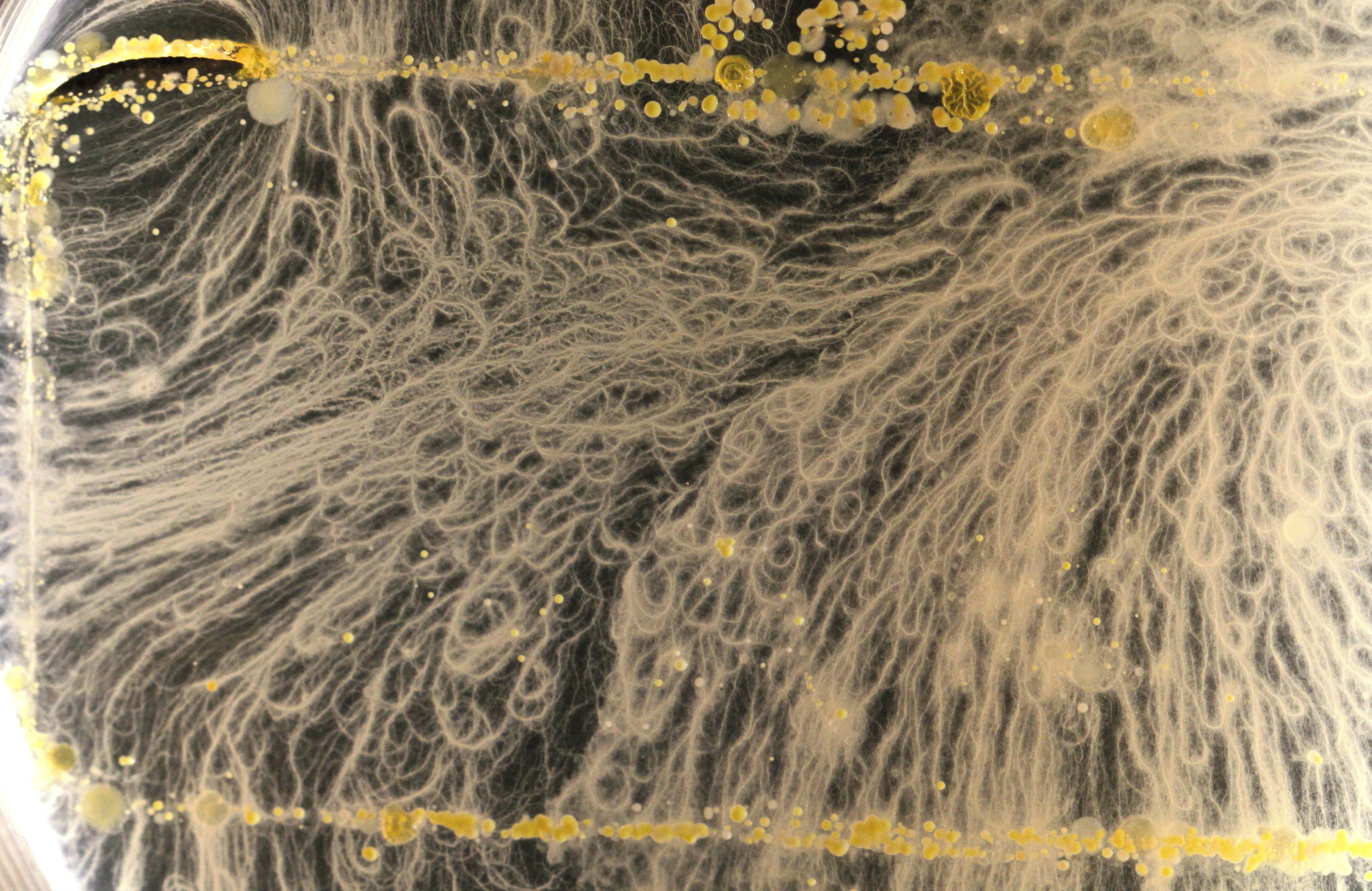
Simon Park, with the help of his Practical and Biomedical Bacteriology class, demonstrates just how disgusting your smartphone screen really is. Olivia Solon squirms:

According to Park, most of the bacteria were harmless ones normally found on the skin, such as the Micrococcus species. However, disease carrying bacteria such as Staphylococcus aureus were also found. Park is not surprised by this as around 20 percent of people persistently carry the bacterium, while 60 percent of us are intermittent carriers.

“The ecological niche on the body for Staphylococcus aureus is the nostrils, so a furtive pick of the nose, and quick text after, and you end up with this pathogen on your smartphone,” Park explained to Wired.co.uk.

Check out more images at Park’s blog, Exploring The Invisible.

Waste Not, Want Not

Adam Clark Estes explores whether human excrement might help address “a food shortage that is directly correlated with a fertilizer shortage”:

Worldwide, human waste produces 70 million tons of nutrients that could account for about 40 percent of the 176 million tons of nutrients needed to produce chemical fertilizer. The value of these nutrients is not lost on the farmers of the world, and in fact, human feces have long been a semi-secret source of fertilizer for centuries.

While culturally acceptable in some parts of the world, it was long frowned upon and even outlawed elsewhere, leading to a cottage industry in selling so-called “night soil.” This richly fertile soil was produced by skimming human waste off of cesspools and spreading it onto fields under the cover of darkness, hence the name. The practice became less popular with the advent of chemical fertilizer in the 20th century, but as those resources dwindle, the old poop fields are starting to look pretty appealing once again.

Indeed, the use of human waste as fertilizer is on the rise. As recently as 2008, nearly 200 million farmers in Asia, Africa, and Latin America depended on feces for fertilizing fields where they grew vegetables and grains. This food, the World Health Organization (WHO) estimated, fed as much as ten percent of the world’s population.

The Weekend Wrap

This weekend on the Dish, Andrew continued to think through Buzzfeed’s “sponsored content” model for online ads, pointed to an incisive comment on the issue from Kevin Drum, briefly riffed on the Atlantic’s new guidelines for native ads, offered a theological critique of Zero Dark Thirty, and noted what’s different this time about who will be selecting the next Pope (and if you’d like to be Pope, here’s some helpful tips). We also provided some helpful background to this year’s Oscars here, here, and here.

There was a lot of sex and drugs on the Dish this weekend, too. Connor Habib wondered what drives gay porn starts to take their own lives, Jon Millward combed the archives of the Internet Adult Film Database, Melissa Gira Grant revealed America’s pioneer prostitutes, and Margaret Hartmann looked at a rash of sexting cases among FBI employees. Ned Beauman surveyed the online recreational drug marketplace, Robert Morrison credited Thomas De Quincey’s Confessions of an English Opium-Eater for making drug culture highbrow, and Miles Klee considered accidental and involuntary highs.

We also offered our usual eclectic mix of religious, books, and cultural coverage as well. In matters of faith, doubt, and philosophy, Will McDavid mused on the relationship between love and justice in the work of Andre Dubus, Bill Vallicella unpacked Simone Weil’s understanding of God, Richard Holloway grappled with political theorist John Gray’s vision of life without redemption, and Irene Klotz reported on what the Higgs boson particle might teach us about the lifespan of the universe. Kevin Hartnett asked which religions are the most chaste, Giles Fraser contemplated the right way to pray, and Adam Kirsch reviewed the place of anti-Judaism in western thought and culture.

In literary coverage, Jeannette Winterson praised Virginia Woolfe’s Orlando, Michael W. Clune explored the artist’s impulse to overcome time’s defeat of novelty, Alexander Nazaryan pushed back against literary sprawl, and Juliet Escoria realized she’d never be a novelist. Andrew Gallix pondered the purpose of intentionally difficult books, Michael Bourne uncovered the core of Truman Capote, Adam Kirsch tackled contemporary essayists, and Sean Wilentz deconstructed Oliver Stone’s revisionist take on American history. Read Saturday’s poem here and Sunday’s here.

The Economist investigated social networking data getting factored into credit scores here. Your weekend dose of really gay here and the latest viral dance meme here. MHBs here and here, FOTDs here and here, VFYWs here and here, and the latest window contest here.

– M.S.

Edible Clones

Nicola Twilley contrasts the “domesticated apple’s endless monoculture and its wild diversity”:

Every apple for sale at your local supermarket is a clone. Every single Golden Delicious, for example, contains the exact same genetic material; though the original Golden Delicious tree (discovered in 1905, on a hillside in Clay County, West Virginia) is now gone, its DNA has become all but immortal, grafted onto an orchard of clones growing on five continents and producing more than two hundred billion pounds of fruit each year in the United States alone.

Embedded within this army of clones, however, is the potential for endless apple diversity. Each seed in an apple is genetically unique: like human siblings, seed sisters from the same fruit remix their source DNA into something that has never been seen before — and is likely, at least in the case of the apple, to be bitter, tough, and altogether unpalatable. The sheer variety of wild apples is astonishing: in its original home, near Almaty in Kazakhstan, the apple can be the size of a cherry or a grapefruit; it can be mushy or so hard it will chip teeth; it can be purple- or pink-fleshed with green, orange, or white skin; and it can be sickly sweet, battery-acid sour, or taste like a banana.

The Season For Conceiving

Birthday_Map

Beth Skwarecki admires Matt Stiles’ heat map of birth dates and wonders why so many births happen in the fall:

Several factors might be at work here. One popular explanation is that it’s there is a “Christmas effect” resulting from either holiday merriment or being snowed in with nothing better to do. Both explanations have their weaknesses. For example, does your snow/holiday season start around October … or ever? Plus, I’d expect the major sexy holiday to be Valentine’s Day — and yet there is no uptick in births in early November. But this is, in fact, a testable hypothesis: What happens in other countries and climates?

Data from northern Europe show a strong seasonality trend, and this is a region that has a major winter holiday and plenty of snow. The problem is, conceptions there are lowest in winter — and they correlate inversely with the darkest days, not the holiday season. This pattern puts the major peak of births in spring; much of Europe has this spring peak, in contrast to the autumn peak in the US. But since 1970 or so, the pattern in Europe has been shifting, with autumn becoming the major peak. The reason isn’t clear. One paper suggests that partners who are separated might get together for the holidays. Another points out that decreasing spring conceptions could correspond with a declining trend in the European tradition of August vacations.

Evolutionary Nostalgia

Marlene Zuk contemplates what she calls our “paleofantasies”, the “idea that our modern lives are out of touch with the way human beings evolved and that we need to redress the imbalance”:

If they had known about evolution, would our cave-dwelling forebears have felt nostalgia for the days before they were bipedal, when life was good and the trees were a comfort zone? Scavenging prey from more-formidable predators, similar to what modern hyenas do, is thought to have preceded, or at least accompanied, actual hunting in human history. Were, then, those early hunter-gatherers convinced that swiping a gazelle from the lion that caught it was superior to that newfangled business of running it down yourself? And why stop there? Why not long to be aquatic, since life arose in the sea? In some ways, our lungs are still ill suited to breathing air. For that matter, it might be nice to be unicellular: After all, cancer arises because our differentiated tissues run amok. Single cells don’t get cancer.

She zooms out:

It’s common for people to talk about how we were “meant” to be, in areas ranging from diet to exercise to sex and family. Yet these notions are often flawed, making us unnecessarily wary of new foods and, in the long run, new ideas.

Guess Which Buzzfeed Piece Is An Ad, Ctd

Derek Thompson, moderator of last week’s throwdown, sounds off:

I wish both sides conceded one final point to the other. I wish Ben conceded that BuzzFeed advertorials are intimate mimics of BuzzFeed articles — it’s not unreasonable to be confused once or twice — and it creates a tension with transparency. BuzzFeed is trying to make ads that are as charming and delightful as articles, but the more clearly they say WARNING THIS IS A WEB ADVERTISEMENT, the more likely people are to ignore their charming delights, because we have been taught to ignore all Web ads. I wish Andrew had paused in his fiery attack on advertorials and BuzzFeed to acknowledge something simple: Advertising does a good thing in the world. It pays great journalists to find and tell the truth. It’s a tradition worth preserving through both experimentation and severe transparency.

I thought I did say that at one point. Advertizing has long been an essential revenue source for journalism, and I am a big fan of it. The Dish has run a “Cool Ad Watch” for years, we’ve been paid in the past by media institutions that get a lot of money through ads, and I sure haven’t ruled out having them in the future, if a subscription-only model cannot get us enough revenue to roughly maintain the budget we had last year at the Beast.

My issue is with advertizing that is crafted in-house by the publication for clients and that is designed to look almost exactly like a regular editorial page and nowhere has the word “advertisement” on it to separate it from editorial copy. I notice that such ethical clarity is still not considered even at the Atlantic.

You can smell the bullshit a mile away. The very phrases – “sponsored content”, “native advertizing” – are as accurate as “enhanced interrogation.” It’s either an advertisement or your media company is producing content. Creating editorial content for advertizers for money, rather than for readers for its own sake, is a major shift in this industry. There is an obvious solution, as Derek suggests. It is to make the advertorials look more different from editorial than they now do and slap a clear word ADVERTISEMENT on top of it.

If that ethical labeling ruins your business model, it’s proof that your business model isn’t ethical. Right? Or am I missing something?