Are There Limits To A Father’s Love?

Will McDavid considers the relationship between love and justice in Andre Dubus’ brilliant short story, “A Father’s Story,” in which the main character, Luke Ripley, refuses to divulge that his daughter killed a pedestrian in a car accident:

[T]he movement of atonement comes to its highest pitch in relation to the father’s betrayal of ethics. Ethics is rational, clear and defined, but the aesthetic is turbulent, unpredictable – “she woke what had flowed dormant in my blood since her birth.” Our aesthetic hero sacrifices himself, sacrifices ethics and justice, throws it all out on account of love. Luke Ripley’s arguments with God about whether or not he had done the right things raise the question of whether ethics can ever be suspended by love, and this cuts, in the most concrete way, to the struggle of faith – Jacob’s wrestling with God in the wilderness (the question of whether a deceiver can receive blessing), the question of love suspending ethics.

And it does, because love trumping truth is weakness to the world (“foolishness to the Greeks”), but it’s the one and only place where the gap can be bridged. The impossibility of communication is ever-present in the sphere of abstract truth, but in action united with emotion – i.e. fatherly love – something is communicated, and whatever it is fulfills the promise of the “awful solitude of the heart,’ that is, the promise of solitude’s negation, that the difference, in some way, can be annulled, and the disparate joined:

So, He says, you love her more than you love Me.
I love her more than I love truth.
Then you love in weakness, He says.
As You love me, I say, and I go with an apple or carrot out to the barn.

A Poem For Sunday

SONY DSC

“Year After Year” by Caroline Knox:

The mower releases a scent
of autumnal flat creeping thyme.
Not only thyme but salt, magical seasonings.
Among those present,
the fox’s bark, the sound of owl’s wings.

Hence this set piece in ode mode with end rhyme,
but not standing on ceremony
beside flora that hurricanes volunteer
and granite outcroppings, a natural history,
hand over hand and year after year.

(Reprinted from Flemish © 2013 by Caroline Knox. Reprinted with permission of Wave Books and the author. Photo by Flickr user dbaron)

How The Oscars Have Aged

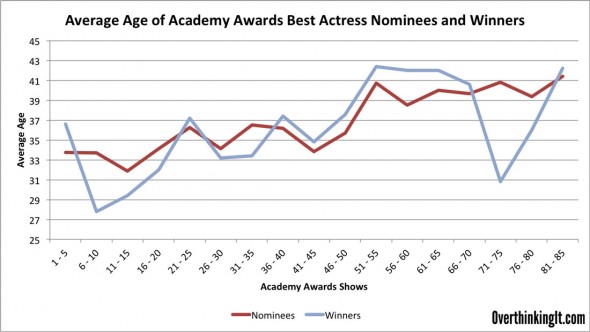
Matthew Belinkie wondered whether Hollywood prizes beauty over age. He crunched some numbers:

Best Actress nominees used to be about 34. Now they’re over 40. Best Actor nominees have jumped up nearly a decade. Best Supporting Actress remains refreshingly random. As for the winners, those are only 1/5th the data so the lines are far more erratic. It seems that despite Hollywood’s youth-obsessed reputation, the big prizes are going to older and older thespians.

Why It’s Different This Time

It’s not just the fact of a papal resignation, it’s the lack of an obvious successor, the relatively large number of cardinals for whom this will be their second conclave (50 compared with just two last time around), the maelstrom of scandal that may or may not have precipitated the Pope’s decision to quit, and the new – actually old – rule that requires a two-thirds majority for any Pope to emerge, however long that takes. John Allen has a solid, very helpful primer on the whole thing here.

Non-Sponsored Quote For The Day

“Here’s a little story that might shed some light on this. Several years ago, a friend of mine came over and noticed a three-ring binder sitting on my desk. It was full of stories clipped from the LA Times. “Why did you save these?” he asked. I told him to take a closer look. “Do you notice anything similar about them?”

Nope. Finally I pointed at the bylines. They were all by me, written when I interned at the Times during college.

The moral of the story is that people who don’t inhale news simply don’t notice bylines. They’re practically invisible. It’s possible this is different at BuzzFeed, where reporters develop a loyal following, but I doubt it. I’ll bet 90 percent of their readers never even notice their bylines.

And I’m pretty certain the folks at BuzzFeed know this perfectly well. They do everything they can to make advertising look staff-written, including in tone, style, and format, but leave themselves an out by putting corporate bylines on the ads and pretending that everyone will notice them. Hey, it says Sony Entertainment Network at the top! What more do you want? I imagine this is a glimpse of our future.

You have been warned,” – Kevin Drum. We sure have been.

A $45,000 Consolation Prize

Samantha Bonar examines the swag bag that all Oscar nominees will receive:

The gift-bag items run the gamut from trips to Australia, Hawaii and Mexico to gift certificates for injectable fillers to condoms to tequila to hand-illustrated tennis shoes to gluten-free macarons. The highest-ticket item ($12,000) is a stay at a choice between two luxury resorts in Australia — one located atop the Great Barrier Reef, the other in the middle of the Outback. The bag also includes a $7,400 gift certificate from a home-design firm and something called the Vampire Facelift, valued at $5,000.

Amazingly, this is relatively cheap:

[T]he bag has hit its lowest value in five years. In fact, it has decreased every year since 2010, when the goods were worth a record $93,108, thanks to a $45,000 safari tour.

Culturally Out Of Tune

Alex Pappademas deems the Oscar category of Best Song “a travesty-generating machine“:

 Here’s the problem: Everyone in the Academy gets to vote for Best Song, but only composers and songwriters get to make nominations, so the Best Song category continues to honor traditionally composed-and-written show-tune-style pop-vocal songs throughout the ’60s and ’70s, effectively looking the other way as genres like rock, soul, funk, and disco (i.e., music by artists who aren’t in the Academy) transform the sound of American film. The 1964 Best Song Oscar goes to “Chim Chim Cher-ee” from Mary Poppins; the Beatles’ title song from A Hard Day’s Night isn’t nominated. The 1967 award goes to “Talk to the Animals” from Doctor Dolittle; Simon and Garfunkel’s “Mrs. Robinson,” written for The Graduate, isn’t nominated. The 1969 award goes to “Raindrops Keep Fallin’ on My Head”; the Byrds’ “Ballad of Easy Rider” isn’t nominated.

His proposed fix:

Instead of — or, OK, fine, in addition to — a category honoring written-to-order movie songs, we need an Oscar for Best Soundtrack, one that would recognize the use of music in films regardless of that music’s provenance. We give awards to adapted screenplays; why can’t we honor the curatorial ambition and taste behind music-saturated movies like Django and Silver Linings Playbook or even Pitch Perfect, movies in which previously released songs are arguably as crucial to the storytelling as a traditional score would be?

Leaping Through The Other Side

This embed is invalid

From Simone Weil’s Gravity and Grace:

A case of contradictories which are true. God exists: God does not exist. Where is the problem? I am quite sure that there is a God in the sense that I am quite sure that my love is not illusory. I am quite sure that there is not a God in the sense that I am quite sure nothing real can be anything like what I am able to conceive when I pronounce this word. But that which I cannot conceive is not an illusion.

Bill Vallicella muses on this passage, which he summarizes as “you must stop thinking and see“:

Weil’s thesis is that there is a divine reality, but it is inconceivable by us. She is saying that access to the divine reality is possible through love, but not via the discursive intellect. There is an inconceivable reality…

How then interpret the Weilian sayings? What Weil is saying is logically nonsense, but important nonsense. It is nonsense in the way that a Zen koan is nonsense. One does not solve a koan by making distinctions, distinctions that presuppose the validity of the Faculty of Distinctions, the discursive intellect; one solves a koan by “breaking through to the other side.” Mystical experience is the solution to a koan.

Recent Dish on Weil here.