Which Religions Are The Most Chaste?

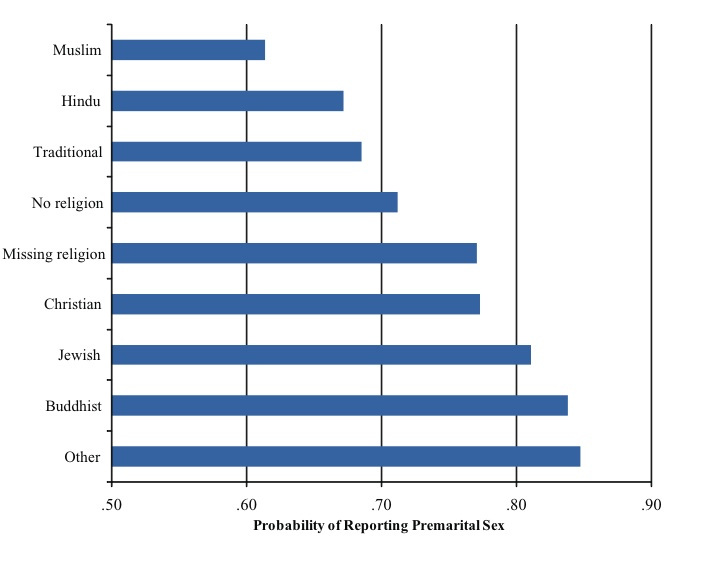
religion-chart

Kevin Hartnett highlights a fascinating study, “Religion and Sexual Behaviors,” by Amy Adamczyk and Brittany Hayes of CUNY:

All major religions prohibit premarital sex, but Muslims appear to take Islam’s proscriptions especially seriously. Why? Adamczyk and Hayes wanted to know whether the low level of premarital sex among Muslims was more a matter of individual choices (micro level effects) or national cultural forces (macro level effects). To test this, they looked at how the probability of a Muslim woman having had premarital sex changes depending on how dominant Islam is in the country where she lives. They found big effects, leading them to conclude that national culture has stronger effects than individual preferences:

If this woman lives in a nation where 1 percent of residents are Muslim, her predicted probability of reporting premarital sex would be .72. In a nation where 23 percent of residents are Muslim… the woman’s predicted probability would be .61. Finally, in a nation where 90 percent of residents are Muslim…the woman’s predicted probability of reporting premarital sex would tumble to .28.

While the researchers offer explanations for Muslim chastity, they have less to say about why Buddhists—perhaps surprisingly—rank highest in premarital sex. They offer that it could be because Buddhism is not monotheistic and has fewer “strict rules about specific behaviors.” But of course Hinduism is not monotheistic, either, and indeed, the field seems open for a follow-up paper on the religious dimensions of allowance.

Under Covers

[youtube http://www.youtube.com/watch?v=ACALaPcarFM]

Margaret Hartmann shines a flashlight on the “rash of sexting cases” among FBI employees:

The report (pdf) doesn’t list agents’ personal information, but it gives an outline of their behavior and the disciplinary action taken. Interestingly, getting a DUI in your own car, shoplifting from a grocery store, and lying about dating a known drug dealer will lead to dismissal. However, infractions such as “unauthorized use of FBI database to search for information about friends and coworkers,” “broke spouses e-reader in half and pointed unloaded gun at dog’s head,” and “used government-issued Blackberry to send sexually explicit messages to another employee,” will only earn you a suspension.

Similarly, former CIA officer Reuel Marc Gerecht reveals how when he was in the service, “the CIA was a fairly randy place” where “affairs and divorce were almost a rite of passage.” It wasn’t as dangerous as some might assume:

The idea that our enemies will use infidelity against us is not borne out by history. To my knowledge, the CIA has always kept its distance from operations that might pit girlfriend against boyfriend, mistress against lover, or wife against husband. Sex is just too unpredictable to manage in the context of an intelligence operation.

We have a pretty good idea why American officials and soldiers have betrayed their country over the years. The primary reasons: greed, ideology, professional disappointment, narcissism, ethnic loyalties, and the sheer thrill of being a mole. Although it is certainly true that the KGB targeted homosexuals, this was done not because Soviet intelligence thought sexual blackmail was particularly effective, but because the KGB believed homosexuals were more narcissistic, more prone to see themselves as disconnected from the group, than heterosexuals. But there is very little evidence to suggest that in America such targeting ever turned an agent of any value, or probably any agent at all. The odds of using “honey traps” to lead men or women to treason are very small indeed.

Today, sex is a more serious offense in the agency. Gerecht fears that means we’ll “equate fidelity to a spouse with fidelity to a nation”:

There is no correlation between serially cheating in a marriage and compromising loyalty to country. Patriotism is a very different kind of love.

The Average Porn Star

average-face-pornstar-big

most-common-pornstar-names

Jon Millward combed the archives of the Internet Adult Film Database – essentially the Wikipedia of porn – to “find out once and for all which stereotypes about porn stars are true, which are bogus, and what these men and women have been doing for the last forty years.” Among his findings:

[T]he most common bra size for a female porn star is a surprisingly handleable 34B. Not double-D, not even a D. Double-D actually came in 4th, behind B, C and D. The most common set of measurements for the women was 34–24-34. So, if the average female porn star is a 5’5″ woman who weighs 117lbs and has B-cup breasts, what colour is her hair? Blonde, presumably, if my friends’ guesses were anything to go by. Apparently not. Dark-haired porn stars outnumber blonde ones almost 2-to-1.

Amanda Hess throws a little cold water, noting that Millward’s data set is incomplete. But he is the first to admit the study’s limitations:

In order to weed out pages too skimpy to provide any helpful data, Millward kept his analysis to “records for performers whose year of birth was known,” he told me. That means the sample is skewed toward higher-profile performers with available biographical data. That’s why he cautions readers to view the study as one of “porn stars” as opposed to “performers.” And straight, cisgender performers at that: Millward declined to run stats on some stars—gay men and trans performers—to accommodate “the average attention span of a blog reader.” … He hopes to expand his study sample in the future. “I’m sensing a sequel: ‘Going Deeper!'”

A Poem For Saturday

OLYMPUS DIGITAL CAMERA

“Artichoke Heart” by Ibn at-Talla´ (11th century):

Of earth and water, daughter
Yielding her abundance

Only if you wait
Finger-licking at her castle gate

Pale she seems, her haven
Hard of access, a Greek

Virgin, who lingers
Behind a curtain of lances

(Translated by Christopher Middleton and Letitia Garza-Falcón from Spanish versions of the original Arabic. Reprinted with permission from Andalusian Poems, David R. Godine, Publisher © 1993 by Christopher Middleton and Letitia Garza-Falcón. Photo by dospaz)

When Drug Culture Went Highbrow

Robert Morrison credits Thomas De Quincey’s Confessions of an English Opium-Eater:

De Quincey invented recreational drug-taking, not because he was the first to swallow opiates for non-medical reasons (he was hardly that), but because he was the first to commemorate his drug experience in a compelling narrative that was consciously aimed at — and consumed by — a broad commercial audience. Further, in knitting together intellectualism, unconventionality, drugs, and the city, De Quincey mapped in the counter-cultural figure of the bohemian. He was also the first flâneur, high and anonymous, graceful and detached, strolling through crowded urban sprawls trying to decipher the spectacles, faces, and memories that reside there. Most strikingly, as the self-proclaimed “Pope” of “the true church on the subject of opium,” he initiated the tradition of the literature of intoxication with his portrait of the addict as a young man. De Quincey is the first modern artist, at once prophet and exile, riven by a drug that both inspired and eviscerated him.

Some accused De Quincey of encouraging drug abuse. His response:

Teach opium-eating! – Did I teach wine drinking? Did I reveal the mystery of sleeping? Did I inaugurate the infirmity of laughter? . . . My faith is – that no man is likely to adopt opium or to lay it aside in consequence of anything he may read in a book.

Pioneer Prostitutes

Rye Gal

Sex workers were some of the first women in early American settlements:

Take New Orleans, future home of America’s largest licensed red light district. In 1721, there were fewer than 700 men settled in the whole colony of Louisiana, a number which excludes men held in slavery. The French government sent 80 women to the colony by ship, in the hopes that Louisiana’s free men would marry these women and would refrain from having sex with Native American women. Many of the migrant women, however, had been serving time for prostitution charges in French prisons, and upon arriving in the colony found the sex trade provided them more independence than any arranged marriage to settlers.

These women were followed later in the same year by, as legal historian Judith Kelleher Schaffer described them, “other more respectable women.” She continued:

“One historian has remarked on the incredible fecundity [of these new women] and the tragic infertility of the prostitutes, as almost all of Louisiana’s most important families of French descent trace their origin to the former while none claim to have descended from the latter.”

(Photo: “‘Storyville’ Red light district at the start of the 20th century. Seated woman wearing striped stockings, drinking ‘Raleigh’ Rye.” By E. J. Bellocq via Wikimedia)

“Intoxication Without Intent”

Miles Klee considers accidental and involuntary highs:

Any number of drugs can flood our consciousness with faulty perceptions. And if the sensory apparatus isn’t filtering properly, you receive an excess of environmental information when you’re least equipped to handle it. This helps explain why the same drug can generate wildly different results—a CIA field agent whose coffee is secretly spiked with LSD might run screaming into the street, while college buddies can drop a tab and spend all day giggling in a grassy field. The recreational drug user in theory understands that she is messing with her own head. The man who doesn’t know he’s been dosed may conclude that existence has been usurped by mere chaos.

The Atlantic’s New “Sponsor Content” Guidelines

Jim Fallows helpfully unpacks the two quotes I put up yesterday and argues the full chronology of them does not imply some big internal disagreement at the magazine. I’m delighted to say that the Atlantic has devised a new post-Scientology policy with regard to “native advertizing”, “sponsor content,” “enhanced communication techniques”,  or whatever newspeak is used in creating confusing advertorials, designed to look like Atlantic articles, as a way to bring in more corporate income. Here it is, in full. Below is the critical section dealing with “Sponsor Content” or, as I think I’ll call them “enhanced advertorial techniques”:

SPONSOR CONTENT GUIDELINES

The guidelines in the following section shall apply to all Sponsor Content served by or appearing in the print and digital publications of The Atlantic, including ads purchased under AAAA/IAB Standard Terms and Conditions. (These are in addition to the general guidelines for advertising content that appear above, which apply to Sponsor Content as well.)

Sponsor Content is content created by or expressly on behalf of advertisers in conjunction with The Atlantic’s marketing team (“Atlantic Marketing”). The Atlantic allows Sponsor Content in two forms: (1) Content produced by Atlantic Marketing on behalf of its advertising partners and (2) Content produced by advertisers.

As with all advertising, Sponsor Content ultimately reflects the views and choices of the advertiser—not of The Atlantic or its editors. Accordingly, The Atlantic will prominently display the following disclaimer on all Sponsor Content: ‘SPONSOR CONTENT.’ The Atlantic will additionally include the following disclaimer on all Sponsor Content: ‘This article is written by or on behalf of our Sponsor and not by The Atlantic’s editorial staff.’ The Atlantic may additionally include, in certain areas and platforms, further explanation defining Sponsor Content to Atlantic readers. In addition, The Atlantic will ensure the treatment and design of Advertising and Sponsor Content is clearly differentiated from its editorial content.

The Atlantic does not require that Sponsor Content steer clear of controversy. Indeed, we expect that Sponsor Content, like our own editorial content, will sometimes address contested issues and will be written with a distinct point of view. That said, even with the caveat that Sponsor Content reflects the views of an advertiser and not of The Atlantic or its editors, The Atlantic will refuse publication of such content that, in its own judgment, would undermine the intellectual integrity, authority, and character of our enterprise.

As with all advertising, and consistent with the foregoing General Advertising Guidelines, The Atlantic may reject or remove any Sponsor Content at any time that contains false, deceptive, potentially misleading, or illegal content; is inconsistent with or may tend to bring disparagement, harm to reputation, or other damage to The Atlantic’s brand.

The Atlantic may in its sole discretion enable readers to comment on Sponsor Content on The Atlantic’s sites. If comment functionality is enabled on Sponsor Content, the sponsor will not have any role in moderating such comments. The only moderation of such comments will be performed by Atlantic employees who implement The Atlantic’s generally applicable Terms and Conditions — which prohibit spam, obscenity, hate speech, and similar content—elsewhere on the site.

I’m going to put this document out there before commenting. I have some issues with it – but it does seem at least to recognize a real problem, whereas Buzzfeed thinks that the corrupting bugs here are exciting new features. That may be because Buzzfeed understands itself more as an entertainment site – and its journalism and reporting are relatively new. But so far as I can tell, the dubious ethics of this exercize haven’t even seemed to cross their minds. “Andrew,” as one of my Buzzfeed hosts told me, “you have a lot to learn from us.” Obviously, I do. Consider me on a learning curve. And what I learn I intend to pass on to Dish readers, so you can also get a better idea of how to distinguish journalism from corporate propaganda online.
Reversing Literary Sprawl

[youtube http://www.youtube.com/watch?v=p3Kod7vzbQk]

After reading Mark Binelli’s Detroit City Is the Place To Be and Jonathan Franzen’s notorious essay on the state of the novel, “Perchance To Dream”, Alexander Nazaryan compares the decline of the great American novel to the decline of Detroit as an industrial powerhouse:

I guess what I am calling for is the literary equivalent of “rightsizing,” in the lingo of urban planners. The concept suggests that we reclaim cities by returning them to their core functions, by shedding the sprawl that doomed them in the second half of the 20th century — the same cultural sprawl that has diluted American fiction. Writing of Detroit’s plan to rightsize back in 2010, The Economist was glad that “harsh realities have produced radical thinking,” praising Mayor Dave Bing for recognizing the “painful necessity” that the Detroit of bustling factories could never be again. In fact, Detroit’s automotive industry has become back: not enough to return the city to its halcyon days, not enough to heal the scars of its decline, but certainly more than doomsayers would have expected a decade ago. It has done so by becoming leaner, smarter, no longer peddling Hummers, thinking of green energy and efficiency as more than just the fads of coastal elites.

Publishing will have to do the same thing if it wants to save the literary city. It will likely have to look at smaller presses that are publishing less but editing more, who are repacking classics in unexpected ways, who are finding ways to be beat Amazon at the ebook game.

Caption for the above video:

This Landsploitation Short explores the Detroit Book Depository as a scene of memory and forgetting, departing from an exploration of crumbling texts to raise questions about print, media, preservation, and the role of history in the age of digital archives.