
Yogyakarta, Indonesia, 12.32 pm
Adam Kirsch tackles contemporary essayists:
Essayists such as Rothbart and Crosley and Sedaris, one might say, represent the prose equivalent of reality TV. They, too, claim to be recording their lives, while in fact they are putting on a performance; and they, too, count on the reader to know the rules of the game, the by now familiar game of meta. What makes this kind of performance different from the performance of a fiction writer is that, by “acting” under their own names, they inevitably involve motives of amour-propre. The essayist is concerned, as a fiction writer is not, with what the reader will think of him or her. That is why the new comic essayists are never truly confessional, and never intentionally reveal anything that might jeopardize the reader’s esteem. “Love me” is their all-but-explicit plea.
Alan Jacobs chips in two cents.
Juliet Escoria describes the feeling:
I was in a heightened state of being, where I was entirely losing my shit (and by ‘shit,’ I mean ‘mind’). During this, I looked back at my novel-in-progress. I had written exactly ninety-nine pages, and this had taken me exactly six months. I looked at these pages, and realized that my book would be mediocre at best. I simply could not plant myself into my life at seventeen in a way that would enable my book to be great. I could not do this because of something I explained in my previous column, which is, to put it briefly, that my memory is shit. And while my imagination is a good one, it is only good enough to create a world that is semi-compelling. I can no longer allow myself to create something that is merely semi-compelling. I cannot allow myself to spend hours and years on a book that is mediocre.
Instead, she turned to writing a memoir – and began facing her fears, including mental illness:
If you want to be true to yourself, you have to be vulnerable. I’m sure you’ve all heard that you should only write about the things that scare you. If I want to be true to myself, I have to talk about exactly what it is like to be crazy, because doing this scares me more than anything else in this world. And I have to attach my own name and experiences to it, because doing so will make me that much more vulnerable. I have to open my ribcage and bleed out my heart.
I wanted to be a novelist, I really did. I wanted to do it to prove to myself that I was a hard worker, that I was a Real Writer. Some inner lit snob inside of me whispered and told me that fiction was where it’s at, in terms of ‘real art.’ That voice told me that memoir-writing is lesser than, not good enough, a genre for celebrities and former journalists. I don’t even know if what I’m working on now could be considered a memoir, but what I do know is this: That lit snob voice? She stems from the same little dark spot in my heart as my two illnesses. And that chick needs to be bled out. She needs to shut the fuck up.
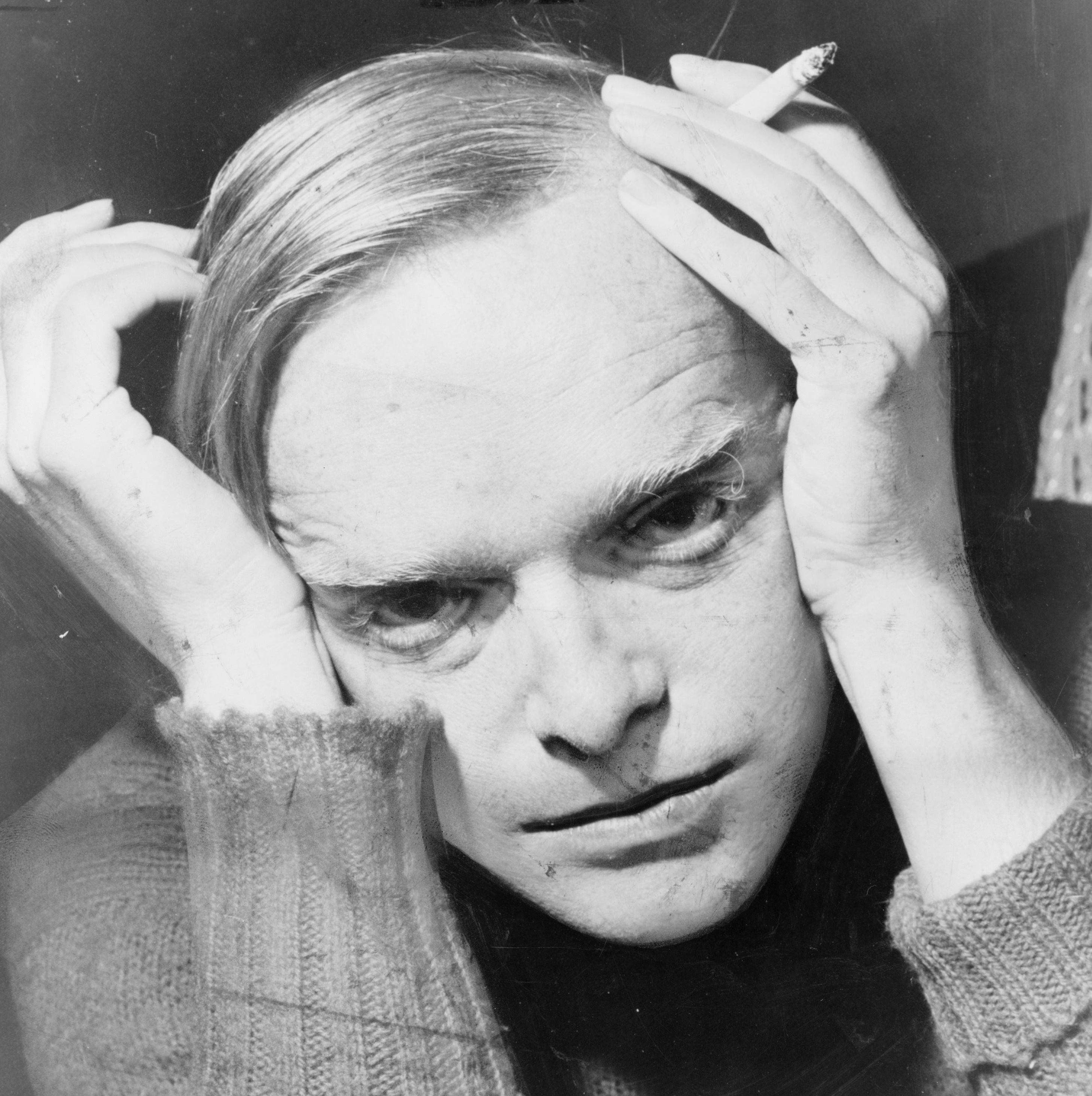
Michael Bourne states that “there is no tale sadder than the biography of Truman Capote” in all of American letters. He seizes upon this revealing passage from the author’s first novel, Other Voices, Other Rooms:
[A]ll his prayers in the past had been simple concrete requests: God, give me a bicycle, a knife with seven blades, a box of oil paints. Only how, how, could you say something so indefinite, so meaningless as this: God, let me be loved.
Bourne’s take:
This is the leitmotif for Capote’s entire life and career. All his characters wish only to be loved, and finding it impossible to be loved in any conventional way, seek love wherever they can find it, sometimes creatively, sometimes in ways that destroy themselves or others. In Other Voices, Joel’s father is alive, but reduced to a pathetic grotesque, a quadriplegic kept in a box who can communicate only by dropping red tennis balls to telegraph his distress. Instead, Joel finds his father figure in his deliciously odd Cousin Randolph, who watches him from an upstairs window wearing a woman’s dress and towering white wig. At the novel’s end, Randolph in drag beckons to Joel from the window, and Joel, finally understanding who he is, goes to him “unafraid, not hesitating,” pausing only briefly to look back “at the boy he had left behind.”
Previous Dish on Capote here and here.
(Photo of Capote in 1959, via Wikimedia Commons)
Andrew Gallix ponders the purpose of intentionally difficult, almost unreadable books:
If literature cannot be reduced to the production of books, neither can it be reduced to the production of meaning. Unreadability may even be a deliberate compositional strategy. In his influential essay on “The Metaphysical Poets”, TS Eliot draws the conclusion that modern poetry must become increasingly “difficult” in order “to force, to dislocate if necessary, language into its meaning”. The need to breathe life back into a moribund language corrupted by overuse, chimes with Stéphane Mallarmé‘s endeavour to “purify the words of the tribe”. The French writer was very much influenced by Hegel, according to whom language negates things and beings in their singularity, replacing them with concepts. Words give us the world by taking it away. This is why the young Beckett‘s ambition was to “drill one hole after another” into language “until that which lurks behind, be it something or nothing, starts seeping through”.
Related Dish debate on the opacity of poetry here.

You have until noon on Tuesday to guess it. City and/or state first, then country. Please put the location in the subject heading, along with any description within the email. If no one guesses the exact location, proximity counts. Be sure to email entries to contest@andrewsullivan.com (the old address still works as well). Winner gets a free The View From Your Window book. Have at it.
Ned Beauman surveys the online recreational drug marketplace, which is largely made up of experimental chemical compounds. The drugs, “still legal or quasi-legal because no legislative body can possibly keep up with an enterprising chemist,” are usually sold under various names – bath salts, plant food, pool cleaner:
These websites don’t just have shopping carts and checkouts: they also have user reviews, product alerts, seasonal sales and multiple worldwide delivery options. (“Really great product these pellets are. compared to the “o5” pellets, and the 6apb powder ive had from numerous sources, these absolutely blew me away. 2 pellets made for an amazing reaction, the 5apb adds SO much to the mix. Also, top notch customer support and service, as usual. Shipped same day. rc-lab is always a pleasure to do business with.”)
But Beauman fears that online clearing houses have a major problem:
Methoxetamine, methiopropamine, ethylphenidate, etizolam, benzofuran, camfetamine, pentedrone—who can keep up? The merchants can give you the best customer service in the world, but the one thing they can’t do is explain the effect of these drugs and how much you might want to swallow, because, remember, they’re only selling plant food. Could it be that, just when it seemed like the internet was robbing the drug world of all its dangerous glamor, the problem’s actually just been flipped upside down? In the old days, you knew what you wanted but didn’t know where to get it. In 2013, you can get almost anything but have no idea what it is.
Earlier Dish on synthetic drugs here.
Sean Wilentz tears into Oliver Stone and Peter Kuznick’s The Untold History of the United States, especially its hagiographic treatment of JFK and Communist-sympathizer Henry Wallace:
With a few twists, above all its defense of the liberal anti-Communist (and Stone’s longtime personal hero) John F. Kennedy, The Untold History of the United States, both the book and the televised series, is a quirky summa of the old Progressive rhetoric, as proclaimed by Stone and Kuznick’s other hero, Henry Wallace, but presented as brand new. They fail to say that in 1952 Wallace published his article “Where I Was Wrong,” writing that he had been inadequately informed about Stalin’s crimes and
did not see…the Soviet determination to enslave the common man morally, mentally and physically for its own imperial purposes…. More and more I am convinced that Russian Communism in its total disregard of truth, in its fanaticism, its intolerance and its resolute denial of God and religion is something utterly evil.
He supported Dwight Eisenhower and, in 1960, Richard Nixon for president. Although the book by Stone and Kuznick is heavily footnoted, the sourcing, as the example of Wallace’s 1952 article suggests, recalls nothing so much as Dick Cheney’s cherry-picking of intelligence, particularly about the origins and early years of the cold war. The authors also devote many thousands of words to criticism of such destructive American policies as Ronald Reagan’s in Central America and George W. Bush’s in Iraq, but much of this will be familiar to readers of these pages, as will their objections to Barack Obama’s use of predator drones. This book is less a work of history than a skewed political document, restating and updating a view of the world that the independent radical Dwight Macdonald once likened to a fog, “caused by the warm winds of the liberal Gulf Stream coming in contact with the Soviet glacier”—but now more than twenty years after the dissolution of the Soviet empire.
The Economist recently reported on social networking data getting factored into credit scores:
Applicants who type only in lower-case letters, or entirely in upper case, are less likely to repay loans, other factors being equal, says Douglas Merrill, founder of ZestFinance, an American online lender whose default rate is roughly 40% lower than that of a typical payday lender. [The efforts of Neo, a start-up that assesses the creditworthiness of car-loan applicants] to improve accuracy include recording borrowers’ Facebook data: Mr Bathija reckons that within a year there will be enough evidence to determine if making racist comments on Facebook is correlated with a lack of creditworthiness.
Tongue in cheek, Nicholas Carr imagines “a new revenue stream for Facebook here — some kind of automated friend-portfolio management app that optimizes your mix of friends”:
Maybe Facebook could even set up an exchange for trading friend-portfolio derivatives. You could have everything from Aaa-rated friend portfolios (stable marriages, high-net-worth zip codes, regular statin intake) to speculative junk-rated friend portfolios (druggies, socialists, poets).
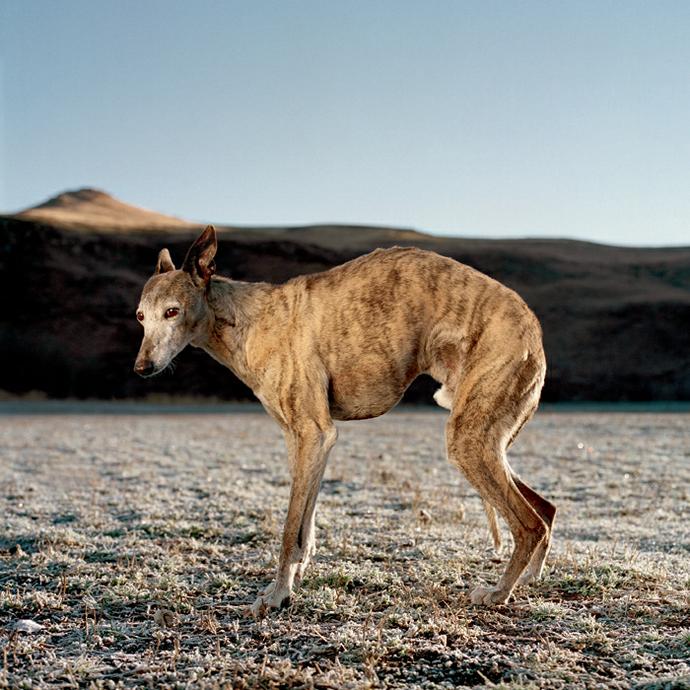
Amanda Gorence is impressed by Daniel Naudé’s recent project, Animal Farm::
The book began on a road trip from Cape Town to Mozambique when Naudé experienced a profound encounter with a feral Africanis dog … He began tracking these feral creatures throughout South Africa, capturing regal portraits reminiscent of formal animal paintings of centuries past. Naudé’s Africanis trek soon morphed into a five year exploration of the country’s land, animal and people.
Throughout the book Naudé balances the wild, feral dog with a myriad of domesticated animals and their owners, a combination that alludes to the spectrum of relationships between man and beast.


