Charts Of The Day

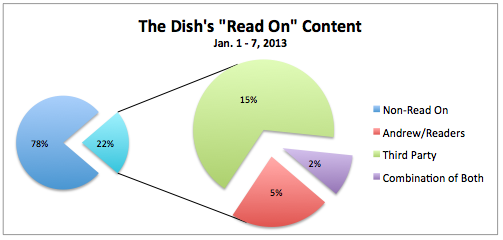
Jay Pinho has been tracking the Dish’s use of read-ons before and after we implemented the meter. A pre-meter snapshot:
before-meter

After the meter went up:

after-meter

Note that the percentage of posts that contain a read-on has stayed almost exactly the same. Pinho explains the difference:

[W]hereas 67.3% of all “Read On” sections before the meter contained mostly third-party content, now the plurality of “Read Ons” (44.0%) consist of content provided by Andrew and his readers (from analysis to letters to views from people’s windows). The proportion composed of third-party content has fallen to 40.0%, with the remaining 16.0% of all “Read On” sections comprised of material that contains both.

What this likely means is that Sullivan and his team have taken to heart the precautions of readers and commentators who noted that, to charge for content, the part that’s hidden to non-subscribers should tend to be more original — as opposed to a curation of third-party material.

Also, regarding third-party posts, almost all of their read-ons are inserted below a blogger’s link, thus publicizing his or her byline and the original piece for all Dish readers to see and visit, regardless of subscription. Pinho looks ahead:

I believe Sullivan mentioned recently that if the pace of subscribers didn’t pick up, he may “nudge” them towards paying their dues. This could happen in one of two ways. Either he could reduce the number of monthly “Read On” clicks it takes to trigger the meter (it’s currently at seven), or he could introduce more “Read On” posts as a percentage of his total posts. As an early subscriber, it doesn’t really matter to me which one he chooses. But so far at least, the content lying beyond the “Read On” button certainly seems to justify the annual fee.
The Perfect Admissions Essay

Phillip Lopate believes it should be rooted in doubt:

Ever since Michel de Montaigne, the founder of the modern essay, gave as a motto his befuddled “What do I know?” and put forth a vision of humanity as mentally wavering and inconstant, the essay has become a meadow inviting contradiction, paradox, irresolution and self-doubt. The essay’s job is to track consciousness; if you are fully aware of your mind you will find your thoughts doubling back, registering little peeps of ambivalence or disbelief.

Instead he thinks, “more often than not, the applicant is expected to put forward a confident presentation of self that is more like an advertisement, a smooth civic-minded con job, circumventing the essay’s gift for candid, robust self-doubt.” On a related note, an admissions officer discusses reading essays on the job:

You wouldn’t believe some of the essays kids write. Last year there was an essay about this girl’s sexual exploits, right down to this whole voyeuristic thing about her having sex on golf courses. Why would we want to read about that? We also get a lot of religious-themed essays on why you shouldn’t have sex before marriage. I also got what was basically a report on the negative effects of abortion. People write reports on global warming too. That’s not a personal statement!

The Top Of The Carbon Chain

One more reason to take care of the animal kingdom – extinction fuels climate change:

Predators are bigger animals at the top of the food chain and their diets are comprised of all the smaller animals and plants in the ecosystem, either directly or indirectly. As a result, the number of predators in an ecosystem regulates the numbers of all the plants and animals lower in the food chain. It’s these smaller animals and plants that play a big role in sequestering or emitting carbon.

Julia Whitty illustrates the process:

[T]he researchers experimented on three-tier food chains in experimental ponds, streams, and bromeliads in Canada and Costa Rica by removing or adding predators. Specifically by adding or removing three-spined stickleback fish (Gasterosteus aculeatus) and the invertebrate predators stoneflies (Hesperoperla pacifica) and damselflies (Mecistogaster modesta). When all the predators were removed the ecosystems emitted a whopping 93 percent more carbon dioxide to the atmosphere.

Prop 8 Goes To Washington

Lyle Denniston checks in on the Prop 8 battle. He analyzes the Olson-Boies pro-equality brief (above):

The two California same-sex couples’ fifty-four-page brief was a bold attempt to portray the constitutional idea of marriage equality as a victim of homophobia, and to persuade the Court not to settle for a California-only decision, or for one that moved gays and lesbians only a bit closer to marriage, but rather to give them a right to wed as fully as any other couple has, regardless of race, sex, or sexual orientation.

With such a sweeping approach, the brief took a considerable risk that it might be more than the Justices were ready to accept.  But it also has the potential virtue of making it easier for the Court to settle for a ruling for same-sex marriage on narrower grounds – as the Ninth Circuit Court had done in striking down Proposition 8 a year ago.

An excerpt from the brief:

Proponents accuse Plaintiffs (repeatedly) of “redefining marriage.” But it is Proponents who have imagined (not from any of this Court’s decisions) a cramped definition of marriage as a utilitarian incentive devised by and put into service by the State—society’s way of channeling heterosexual potential parents into “responsible procreation.” In their 65-page brief about marriage in California, Proponents do not even mention the word “love.” They seem to have no understanding of the privacy, liberty, and associational values that underlie this Court’s recognition of marriage as a fundamental, personal right. Ignoring over a century of this Court’s declarations regarding the emotional bonding, societal commitment, and cultural status expressed by the institution of marriage, Proponents actually go so far as to argue that, without the potential for procreation, marriage might not “even..exist[ ] at all” and “there would be no need of any institution concerned with sex.” (internal quotation marks omitted). Thus, under Proponents’ peculiar, litigation-inspired concept of marriage, same-sex couples have no need to be married and no cause to complain that they are excluded from the “most important relation in life.” Indeed, Proponents’ state-centric construct of marriage means that the State could constitutionally deny any infertile couple the right to marry, and could prohibit marriage altogether if it chose to pursue a society less committed to “responsible” procreation.

This, of course, reflects a complete “failure to appreciate the extent of the liberty at stake,” not to mention matters such as love, commitment, and intimacy that most Americans associate with marriage. As Proponents see it, marriage exists solely to serve society’s interest; it makes no sense to speak of an individual’s right to marry.

Also, various DOMA briefs are being filed today.

Rethinking College Rankings

In the wake of attempts by colleges to game the US News & World Report’s rankings [NYT], a new paper proposes a system that looks at the actual choices made by students. Eric Hoover has details:

[The] researchers propose a method of ranking colleges according to students’ “revealed preferences”—the institutions they choose to attend over others that have accepted them. Using survey data from a national sample of high-achieving students, the researchers determined the winners and losers of each applicant’s “matriculation tournament.” They then used those outcomes to rank about 100 selective colleges. (Harvard University topped the list, but you already knew that; the University of Notre Dame nearly cracked the top 10.)

This model enabled the researchers to approximate the odds that an applicant would choose one college over another. For instance, there was a 59-percent chance that a student considering only Harvard and the California Institute of Technology would choose Harvard. If the student were choosing between only Harvard and Wellesley College—10 spots below Harvard on the revealed-preferences list—there was a 93-percent chance that she would end up heading to Cambridge, Mass.

Climate Policy’s Biggest Ally?

Victims Of Superstorm Sandy Continue To Recover As House Votes On Aid Package

According to Jim Malewitz, it might not be who you’d expect:

“The insurance industry, without a doubt, is in a unique position to influence society in reducing risks,” says Cynthia McHale, director of the insurance program at Ceres, a coalition of investors who advocate for sustainable business practices. Why would insurers want to wade into that politically fraught debate? Because climate disasters are forcing them to pay more claims than ever before. Hurricanes, floods, tornados, droughts and wildfires continue to pummel the U.S. with growing frequency and ferocity, particularly in places with swelling populations.

So far, few U.S.-based insurers have joined the call for emissions reductions and other comprehensive solutions to climate threats. But the story is different overseas, where the subject of climate change is far less divisive.” For example, German-based insurer Munich Re Group boldly proclaims on its website that climate change is “one of the greatest risks facing mankind,” and boasts that it has “actively supported and advanced climate protection and adaptation to global warming.”

Additionally, the US Government Accountability Office recently added large payouts due to extreme weather events to its “High Risk List”, which “calls attention to agencies and program areas that are high risk due to their vulnerabilities to fraud, waste, abuse, and mismanagement, or are most in need of transformation”:

Climate change poses significant financial risks to the federal government, which owns extensive infrastructure, such as defense installations; insures property through the National Flood Insurance Program; and provides emergency aid in response to natural disasters. GAO added this area because the federal government is not well positioned to address the fiscal exposure presented by climate change and needs a government-wide strategic approach with strong leadership to manage related risks.

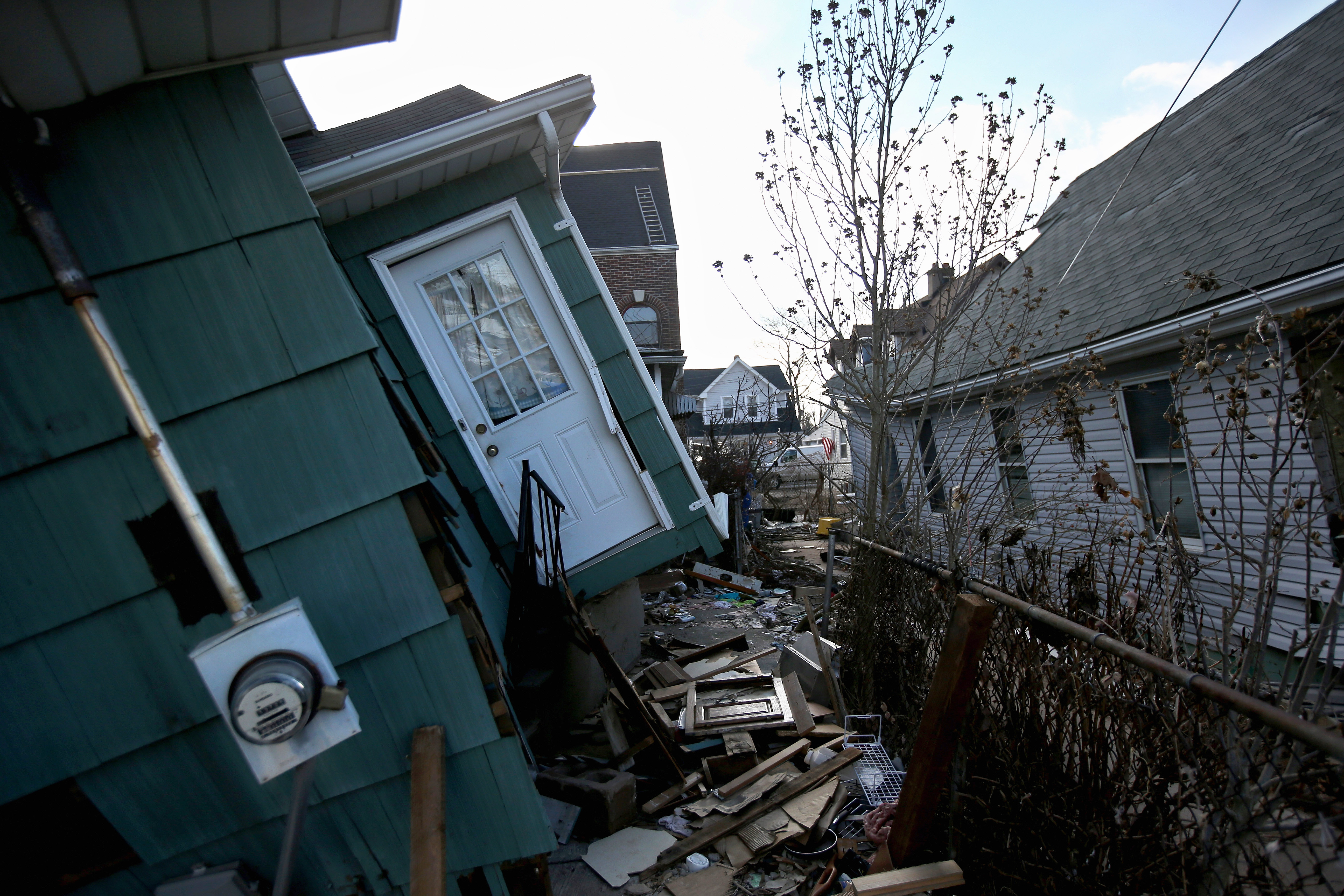
(Photo: A storm-damaged home awaits demolition on January 4, 2013 in the New Dorp area of the Staten Island borough of New York City. By John Moore/Getty Images)

Shopping At Invisible Stores

This embed is invalid


A Chinese company is rethinking e-commerce by using augmented reality and vacant lots:

Chinese e-commerce site YiHaoDian is launching 1,000 virtual supermarkets across the country–but don’t expect to find any brick and mortar landmarks. All the stores, launched in late 2012, can only be seen with the YiHaoDian iPhone and Android app. Anyone using the app can see the 1,200 square meter stores on their phones if they’re holding it up in the right location–and purchase up to 1,000 food products that can be delivered in one to two days. All of the shops are located in vacant lots in what the company deems iconic areas of Shanghai, Beijing, Guangzhou and Shenzhen.