A Cannabis Workers Union

Not as crazy as it sounds:

Though the image of straight-laced hard-working blue-collar labor collaborating with hippy stoners doesn’t quite seem to match up, it is actually a match made in heaven. Labor union memberships have been flagging for some time, and they are in desperate need of a growth industry to latch on to. Meanwhile, marijuana dispensaries have both a branding problem (lacking legitimacy) and a lobbying problem (inability to organize), both of which unions can be of great help.

(Hat tip: Drug WarRant)

Rapping Truth To Power

http://vimeo.com/11330377

Pushing back against the idea that rappers frequently “glorify criminality”, Lisa Wade highlights a recent study that analyzed the lyrics of popular hip-hop songs:

[Criminologists Kevin] Steinmetz and [Howard] Henderson concluded that the main law enforcement-related themes in hip-hop are not pleasure and pride in aggressive and criminal acts, but the unfairness of the criminal justice system and the powerlessness felt by those targeted by it. Lyrics about law enforcement, for example, frequently portrayed cops as predators exercising an illegitimate power. Imprisonment, likewise, was blamed for weakening familial and community relationships and described a modern method of oppression.

The study’s authors concluded that “the overwhelming message in hip-hop wasn’t that the rappers disliked the idea of justice, but they disliked the way it was being implemented.” More insights from the authors via Meredith Mohr:

“[T]he music is maturing, evolving,” Henderson said. “Take Jay-Z for example. If you look at his lyrical content from 1990-2012, you see the evolution from talking about drug selling at the beginning of his career to now talking about meeting with the president, helping with the campaign. It’s a very different conversation. We never saw an artist go backwards. You only saw them mature as they age, and experience and their music changes with them.”

Part of this, Henderson said, is because the audience has also changed with the artists. “Jay-Z’s listenership has aged with him,” Henderson said. “Part of it is that artists recognize that if they go back and talk about that very animalistic behavior, their listeners are going to say, ‘hey listen, this is not what I want to hear,’ and they’re going to go somewhere else.

SOS In 140 Characters Or Less

In the wake of a natural disaster, it can be hard for relief workers to determine where help is needed most. But Ben Schiller looks at the improvements offered by “micro task” services:

Following last December’s Typhoon Pablo, in the Philippines, [the Digital Humanitarian Network] identified 20,000 relevant tweets, and then called on CrowdFlower to find volunteers to make the first assessment. The groups identified, one, messages with links to photos and video, and, two, messages that referred to damage that could be geo-tagged. From about 100 tweets, the UN Office for the Coordination of Humanitarian Affairs (OCHA) could then build a map plotting damaged houses and bridges, flooding, and so on.

“The entire project was carried out in less than 20 hours after OCHA’s request. This would not have been possible without the use of CrowdFlower as the first major filter of the 20,000-plus tweets,” says [DHN director of social innovation Patrick] Meier, who writes about the response here.

The Art World’s Rebel Darling

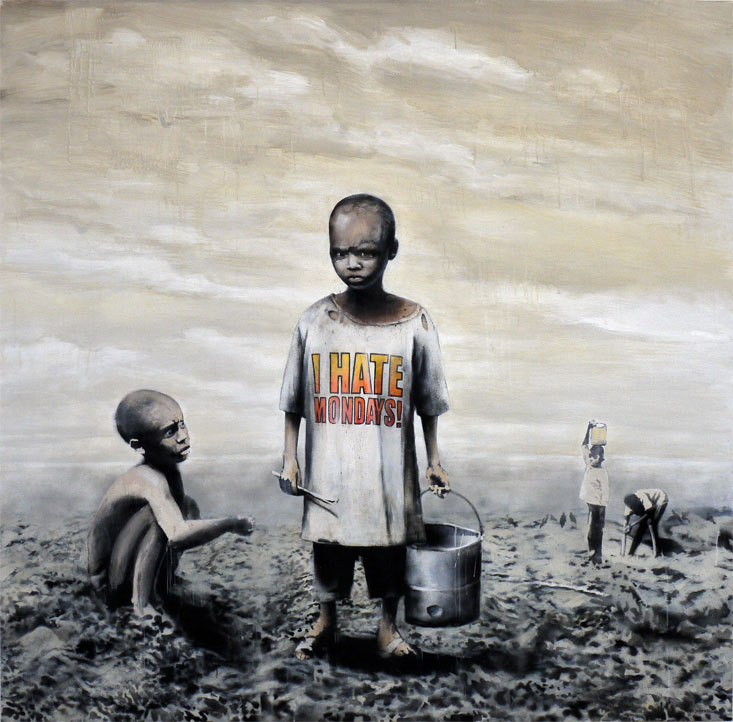
Will Ellsworth-Jones profiles the legendary street artist Banksy:

The riots in the Stokes Croft area of Bristol in spring 2011 offer a cautionary tale. The episode began after police raided protesters, who were opposed to the opening of a Tesco Metro supermarket and living as squatters in a nearby apartment. The authorities later said that they took action after receiving information that the group was making petrol bombs. Banksy’s response was to produce a £5 “commemorative souvenir poster” of a “Tesco Value Petrol Bomb,” its fuse alight. The proceeds, he stated on his website, were to go to the People’s Republic of Stokes Croft, a neighborhood-revival organization. Banksy’s generosity was not universally welcomed. Critics denounced the artist as a “Champagne Socialist.”

He has countered this kind of charge repeatedly, for instance, telling the New Yorker by e-mail: “I give away thousands of paintings for free. I don’t think it’s possible to make art about world poverty and trouser all the cash.” (On his website, he provides high-resolution images of his work for free downloading.)

“I love the way capitalism finds a place—even for its enemies. It’s definitely boom time in the discontent industry. I mean how many cakes does Michael Moore get through?”

(Image by Banksy)

China’s Culture Of Spying

Max Fisher summarizes a story that “chronicles the life and work of Qi Hong, a specialist in removing surveillance equipment who might do dozens of freelance jobs for government officials every week”:

Chinese officials have taken to hugging one another at every meeting — not a traditional Chinese practice — to pat down one another for bugs, Qi says that a government official from Shanxi province told him. Qi tells story after story of removing tiny, high-tech, professional spying devices from the offices and cars of officials. Some of them expected it, others didn’t. One speculated that the spying had been ordered by his mistress, wondering if she herself had been “planted” by a rival official. The ones who did not find spying equipment seemed to assumed it was only because the cameras or microphones were too sophisticated to be detected.

Fisher theorizes that the “culture of no-holds-barred spying that seems to have pervaded Chinese officialdom might also inform why some of those same officials have seemed so aggressive about spying on others — including foreigners.”

The Daily Wrap

PAKISTAN-UNREST-SOUTHWEST

Today on the Dish, Andrew cautiously ushered in a new season of sanity on the right, explained the Dish Model to Planet Money and the NYT, and contemplated the rigors of an overly-public life in the context of the British royal family. In our continuing “Sully and Hitch After Dark” series, the conversation turned to fundamentalists and the compulsory nature of religion.

Meanwhile, Matt Duss relayed the latest McCarthyite attacks on Hagel, and Rich Lowry issued a mea culpa while others remained silent, and Dan Friedman revealed that he had accidentally started the “Friends of Hamas” rumor mill to begin with. Frum shot down a claim about the rarity of gun accidents, Jack Shafer called for a smarter debate over infrastructure spending, Dolan gave a deposition, and George Packer pinned the blame for Walmart’s recent struggles on the payroll tax. We dug into the GOP’s attempts to saddle Obama with the sequester, projected the winners and losers when Americans start to feel its effects, weighed the influence of region on economic development, and put Rubio’s appeal to Hispanics in context. Looking abroad, we wondered if the Saudis would be next to go nuclear, dove into the details on China’s recent cyberattacks, and witnessed how sectarian violence in Pakistan led to some heartbreaking protests.

In assorted coverage, Alain de Botton explored the overlap between revolting and erotic, Patricia T. O’Conner and Stewart Kellarman decided to brazenly split their infinitives, readers debated the eating of horse meat, and we walked the line between ethics and insult on journalist gifts. Linda Besner delivered a verdict on the chicken-egg debate, Carl Zimmer found hope for sufferers of brain disease, and Ackerman cast light on the next generation of camouflage. Will Hermes interviewed a “Prince” of the indie music scene, Tom Jokinen revealed the top pick in the corpse draft, Daniel Burke profiled the antichrist throughout history, SNL previewed Djesus Uncrossed, and the Daily Mail claimed that beards lengthen lifespans.

In entertainment coverage, Movie theaters rolled out upscale offerings to compete with the couch, Ken Auletta heralded the demise of TV antennas, pay-per-view knocked boxing out of the mainstream, and a reader marveled at her 4 year-old daughter’s ability to understand COPS. Pizza stole the scene in the MHB, Arkansas froze over in our VFYW, and a panda panted for our FOTD.

– D.A.

(Photo: Pakistani Shiite Muslims gather around the coffins of relatives during a mass burial ceremony in Quetta on February 20, 2013. Mass burials for 89 victims of a bomb attack targeting Pakistani Shiite Muslims began after three days of nationwide protests at the government’s failure to tackle sectarian violence. By Banaras Khan/AFP/Getty Images)
Dolan Deposed Today

He was under oath today about his actions or lack of them as Archbishop of Milwaukee to do with the rape and sexual abuse of children by priests under his authority and before his time, alleged pay-offs to rapist priests to get them to resign – and in particular a shady scheme to minimize payments to victims of rape and abuse.

Dolan has recently said of the principal victims’ group, Survivors Network of those Abused by Priests: “SNAP has no credibility whatsoever.” And like Cardinal Mahony, recently proven as complicit in shielding child-rapists, he’ll be off soon to pick the next Pope.

The Dish Experiment

The NYT’s Brian Stelter interviewed yours truly about it:

This embed is invalid


If you want to be a part of this, and maybe help kickstart a new, clearer, sustainable model for new media, you can subscribe [tinypass_offer text=”here”]. We need you to make this work, because only you can make this work. My original manifesto for the entire project is here.

Why Don’t We Eat Horse? Ctd

A reader writes:

About three years ago, I was eating at a grotto in Lugano, Switzerland. I saw the word “puledro” on the menu. Not knowing the term, I reasoned that it sounded a bit like “pollo,” so I guessed it was chicken. I ordered it. To my surprise, a steak was brought to the table. I proceeded to eat what was the best steak I’ve ever eaten in my entire life (and I live in Kansas City, so I’ve had a lot of great steaks). The next day I raved about the wonderful steak to my friends. Then I mentioned it to my friend who is the dean of the college where I was teaching that summer. “Steak?” she said, “I didn’t know they served steak there. What was it called?” “Puledro,” I replied. “Oh,” she said, “that means you just ate horse.”

The strange thing is, just knowing this leaves me doubting I could ever order it again. It reveals a lot about how our social custom and schemes of classifying animals and foods according to what is acceptable and unacceptable shape everything about our choices. I don’t plan to eat horse again. But I’d be lying if I pretended it wasn’t delicious!

Another writes:

Mr. Shafer needs to do just a tad more research. We don’t eat horse in the US because horses are not specifically raised for food here. And that is a big problem because the horses that do end up in the food supply are full of a wide variety of chemicals that range from unhealthy to downright dangerous. I have a horse and he routinely gets a number of drugs that are specifically labelled “not for use in animals intended for food”.

Perhaps the most dangerous horse drug, and one of the most commonly used, is phenylbutazone, an anti-inflammatory with such distinct carcinogenic properties in humans that EU specifically forbids horses who have ingested it from being used in human food. It never clears the horse’s system. Horses are not tracked like cattle are in the US. There is no food safety mechanism for horse meat. Horse brokers routinely falsify the documents that accompany slaughter horses that are supposed to certify that the horses are drug free.  So pity the poor Europeans who thought they were eating free range American mustangs and who were getting instead broken-down race horses full of steroids, bute, de-wormer, and other unsavory substances.

In addition, horses are very uneconomic to raise, taking much longer to reach market weight and are therefore less profitable. They are also a mess to slaughter as their blood volume is much greater than cattle, resulting in a waste water nightmare. If you google Kaufman, TX and the closure of Canadian horse slaughter plants, you will learn more than you ever want to know about the environmental downside of horse slaughter.

The horse meat found in the latest scandal came from Romania … who knows what their food safety processes are. I am a horse owner and horse lover. I would never eat horse because of emotional issues but because I know far too much about where the meat came from and how lax the controls on the supply are.

Another:

The reason we don’t eat horses is that our lives depended on them for centuries.  They have killed themselves to be loyal, and they are perceptive and intelligent in a way a cow or a deer or a pig is not.  Our entire civilization was, until recently, based in their labor.  I cannot believe that obtuse reader thinks it’s some weird cultural attachment.  To get a better understanding of their contributions, and to fully understand what kinds of horses wind up in the killing pen, read the bestseller The Eighty-Dollar Champion.

The Caricatures Of COPS, Ctd

A reader quotes another:

The thing with COPS is that there’s an unspoken agreement – the cops will never be embarrassed. Can you imagine the blooper reel they could assemble?

One of the funniest things I’ve ever seen on TV is captured in this YouTube clip [seen above]. A Texas police officer, responding to a fire alarm, runs up to a house and breaks the window in order to rescue the poor old lady sleeping inside. Turns out, he got the wrong house. We then get to watch him have to apologize for attacking the wrong house. When I first saw it, I thought I was watching Reno 911.

A reader writes:

I accidentally found value in COPS about 12 years ago. One evening I needed to take a shower and give my 4-year-old daughter something to do while she was out of my sight for about 20 minutes. I put her favorite tape in the VCR and started it, but I didn’t realize that the tape was near the end. Of course, when a VCR tape ends, TV resumes. When I came out of the shower, I found her glued to the screen watching COPS, which just happened to be on at the same time. She was seriously engaged. She was asking me all kinds of questions about the people in the scenes, and I think the episode she saw was the one where the man hurls himself out of a second-story window.

I ended up having a long discussion with a 4-year-old about the problems of drugs, unplanned pregnancies and other poor choices that people make in life.

We also discussed how both drugs and unplanned pregnancies perpetuate poverty. Now, of course we didn’t talk about it with those big words, but we did effectively have that conversation. I asked her if she wanted to end up like these people, and she said “No!” I told her that if she avoided use of drugs and didn’t get pregnant until after she graduated college and could take care of herself and her child, then she would be much better off.

She became a regular viewer of COPS for the next few months, and she found it fascinating. Since that time, my daughter has paid more attention to news and social issues and she continues to discuss the problems of society. In turn, I learned to never underestimate the capacity of a 4-year-old to understand bigger issues.