The Youth Vote Doesn’t Always Lean Left

Voting By Generation

Harry Enten claims that the “stereotype of aged conservatives and liberal youth is wrong.” He compares the voting habits of various generations:

Most people part of the Eisenhower/Truman-generation, who vote more Republican than the nation at large, are likely to be around through the next three elections; estimates suggest life expectancies of about 9-16 years for people aged 80 to 70. Voters of the very Democratic Roosevelt-generation have life expectancies of less than eight years, being at least 85. Thus, the generations most likely to expire next are those who have historically been more Democratic.

Many might think that these Roosevelt-generation voters are going to be replaced by more liberal Obama-era voters, but polling casts that theory into doubt. Just because today’s college students are liberal doesn’t mean tomorrow’s will lean left, too.

He goes on to argue that “the generation of the next few years isn’t likely to be either conservative or overwhelmingly liberal; it’s probably going to be moderate” and that far “more than most young voters today, the next generation is likely to be up for grabs.”

(Chart from (pdf) Pew)

The Sexist Origins Of The Minimum Wage

Friedersdorf traces them:

In 1912, Massachusetts enacted America’s first minimum wage law, but it only applied to women and children. Unlike men, they were deemed weak, and in need of protection from employers. As an empirical matter, their wages were much lower and their working conditions more dismal. There was also social unease with the increasing number of unmarried women working and living alone in the city — if their wages didn’t provide for their sustenance, who knew how they might make ends meet? A woman ought to be allowed to forgo marriage and pursue work outside the home, an article in The Literary Digest conceded, but she must become sufficiently skilled to earn a living wage, “because she has given to society the equivalent of that which she expects in return.” Otherwise, she ought to stay in her father’s house. Yet “if she has been driven into industry, not because she deems it her vocation to lie therein, but because her father can not support her at home, she is, indeed, the victim of our bad economic system, which has so nearly broken down…. She it is that is in greatest danger of falling into prostitution.”

Our Defenses Against Meteors, Ctd

meteor impact map

Tim Murphy tracks down one man in charge of our defenses: Dr. Bong Wei, who approves of the Bruckheimer method:

Wie’s plan for destroying an Earth-bound asteroid is simple: Stick a massive nuclear device into it and blast it to smithereens. Notwithstanding the 168 factual inaccuracies NASA engineers have reportedly found in Armageddon, Bruce Willis and Billy Bob Thornton got it essentially right. “Astronauts will not be required, so clearly this would be an unmanned robotic mission—but we will need a nuclear device,” Wie says.

The key is, as Jerry Bruckheimer surmised, to drill beneath the surface of the asteroid. If the nuclear device explodes upon impact, it wouldn’t pack enough force to knock the asteroid off its collision course with us. And if the device hits the asteroid at too high a velocity—anything above 300 meters per second—it will simply disintegrate. Wie’s idea is to build a rocket that splits in two just before impact. The front end thereby acts as a blocker, plowing into the asteroid and forming a crater, which the nuclear device then drops into.

“Basically the whole thing was correctly described in the movie,” he says.

Carl Franzen explains the above map:

Now you can see the location of every recorded meteorite impact on Earth going back to 2,300 BCE all in one heat map created by Javier de la Torre, cofounder of geo software companies Vizzuality and CartoDB. De la Torre created the map using CartoDB’s mapping software, which relies on the free crowdsourced OpenStreetMap for its base layer. The meteorite impact site data — 34,513 individual points of impact in total — came from the [Meteoritical] Society, an international nonprofit scientific collaboration.

Did Redistricting Win It For Republicans?

Maybe not:

[L]ots of Republicans who were running as challengers or in open seats in 2010—and then won—ran as incumbents for the first time in 2012. We know that incumbency is a powerful factor in House elections, bringing candidates greater visibility, adding to their campaign coffers, and deterring quality challengers from running. On average, an incumbent in 2012 ran five percentage points ahead of a non-incumbent candidate from the same party in a similar seat. Sixty-one seats were were decided by less than this margin.

More important, once we took incumbency into account, the apparent effect of gerrymandering vanished. That is, the ability of Republicans to retain the House majority may have been due to incumbency advantage, not new and more favorable districts.

Is Marriage Equality Imminent In Illinois?

A new poll in Illinois finds the public backing marriage rights for gay couples 50 – 29 percent, with 20 percent unsure. This issue is being debated in the legislature – so this is more a backgrounder on public opinion and pressure on lawmakers than a prediction about a referendum. To my mind, this is the most interesting nugget:

In a bit of a surprise, intensity of feeling is strongest among supporters of legalization.

Of the 50 percent who favor passage statewide, 37 percent do so “strongly” and 13 percent “somewhat” — an almost 3-1 margin. Among opponents, 19 percent “strongly oppose” passage, compared with 10 percent who “somewhat oppose” passage — about a 2-1 margin. The differing splits are within the survey’s accuracy range but may indicate that lawmakers face as much or more political risk voting “no” as they do “yes.”

That’s a big change from the 1990s. The State Senate has passed an equality measure by 34-21. The House is supposed to be less favorable. But the vote could come soon. Stay tuned. Illinois would be a critical huge state, like New York and California, in persuading Supreme Court Justices it isn’t such a big deal to rule on this in a reformist direction. The public and state legislatures are currently ahead of the court.

Quote For The Day

“Do you ask me whence comes the custom of blessing those who sneeze? We produce three sorts of wind; that which comes from below is too foul; that which comes through the mouth implies some reproach of gluttony; the third is sneezing, and, because it comes from the head and is blameless, we give it this honourable greeting. Do not laugh at this conceit; it is, they say, Aristotle’s,” – Montaigne.

The Vatican Needs A Nate Silver

John Allen Jr. can’t predict the next pope:

Benedict XVI has set the stage for an election in which the cardinals have some room to maneuver. By separating the end of his papacy from the end of his life, Benedict has ensured that the run-up to the ballot will not be dominated by the sort of elegiac commentary that always follows the death of a major world leader, and that loomed so large in April 2005 when the cardinals had to pick their way through throngs of emotional mourners in Rome.

In effect, Benedict XVI has created a situation in which the cardinals can move in a somewhat different direction, if they’re so inclined, without seeming to speak ill of the dead. All by itself, that makes this papal election, and the choices for Catholicism it crystallizes, both harder to handicap—and more fascinating to watch.

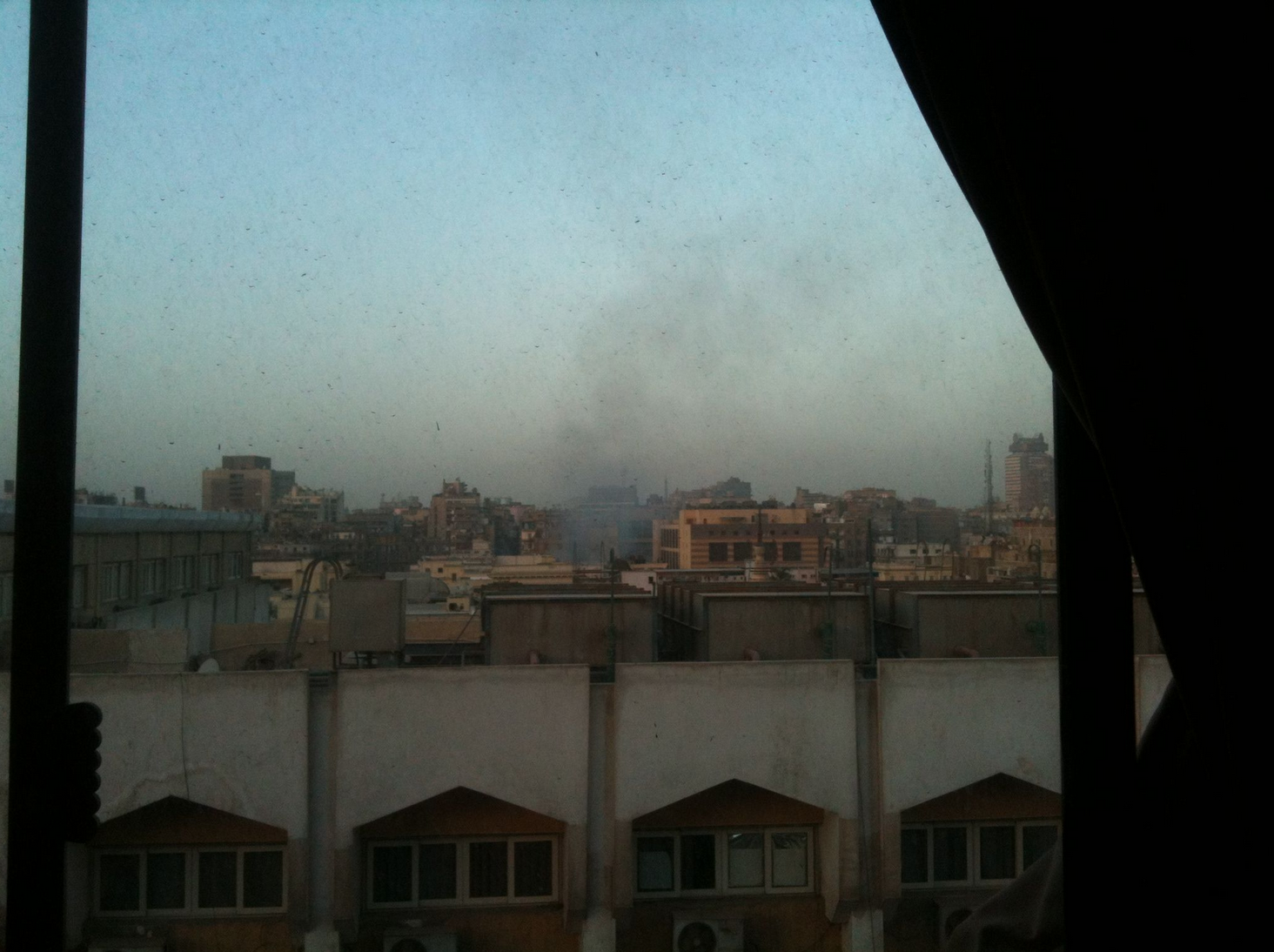
The View From Your Window Contest: Winner #141

vfyw_2-16

A reader writes:

Pollution, filthy window, characteristic air conditioners, paper over windows across the way (in lieu of curtains or shades) is typical in working people’s homes in China. Probably Beijing, possibly in or near Dashanzi industrial zone and 798 Arts District. Further than that I cannot say.

Another:

I was in Shanghai last summer and this view is reminiscent of the local architecture throughout the non-downtown areas.  So I’ll go with Shanghai as my guess and have a glass of scotch to soothe the trauma of a freshly renewed memory of a horrific cab ride through the city. My driver’s name was Crash … no more needs to be said.

Another:

Several buildings in the picture are very distinctive, so I tried a number of Google searches for “yellow and brown striped building” or “building that looks like it has an alien spaceship on top of it,” but sadly those searches yielded nothing. This place really seems like it could be anywhere cold and industrial, from Baltimore to Beijing. I’ll go with Harbin, China. I took a trip through the area a couple years ago, including a visit to the border with North Korea, and this scene definitely reminds me of the Northeastern Chinese cities that I traveled through.

Another:

I see dreariness, slightly Middle Eastern look but with not enough sat dishes and possibly wartorn. I’ll go with Grozny.

Another:

The pollution is a dead giveaway for a developing country – look at how dirty the buildings are from the coal burning! Beyond that, the color of the buildings and the unique fusion of the single skyscraper in the background suggest a city in Iran, perhaps?

Another:

The smoke and grimy window and American looking buildings and some sort of industry and presumably water cutting off the scenery beyond make me think of Gary, Indiana. A cheap hotel in Gary is my guess.

Another:

Where the meteor dropped some pieces: Deputatskoye, Russia. It’s a neat name even if not a winner. Sure looks like some Russian industrial town.

Another gets the right city:

Bad air, hot climate as suggested by the industrial air conditioners, muslim country as suggested by the one minaret or I’m hoping the Cairo Tower, but probably not.

Cairo, Egypt it is. Another gets more specific:

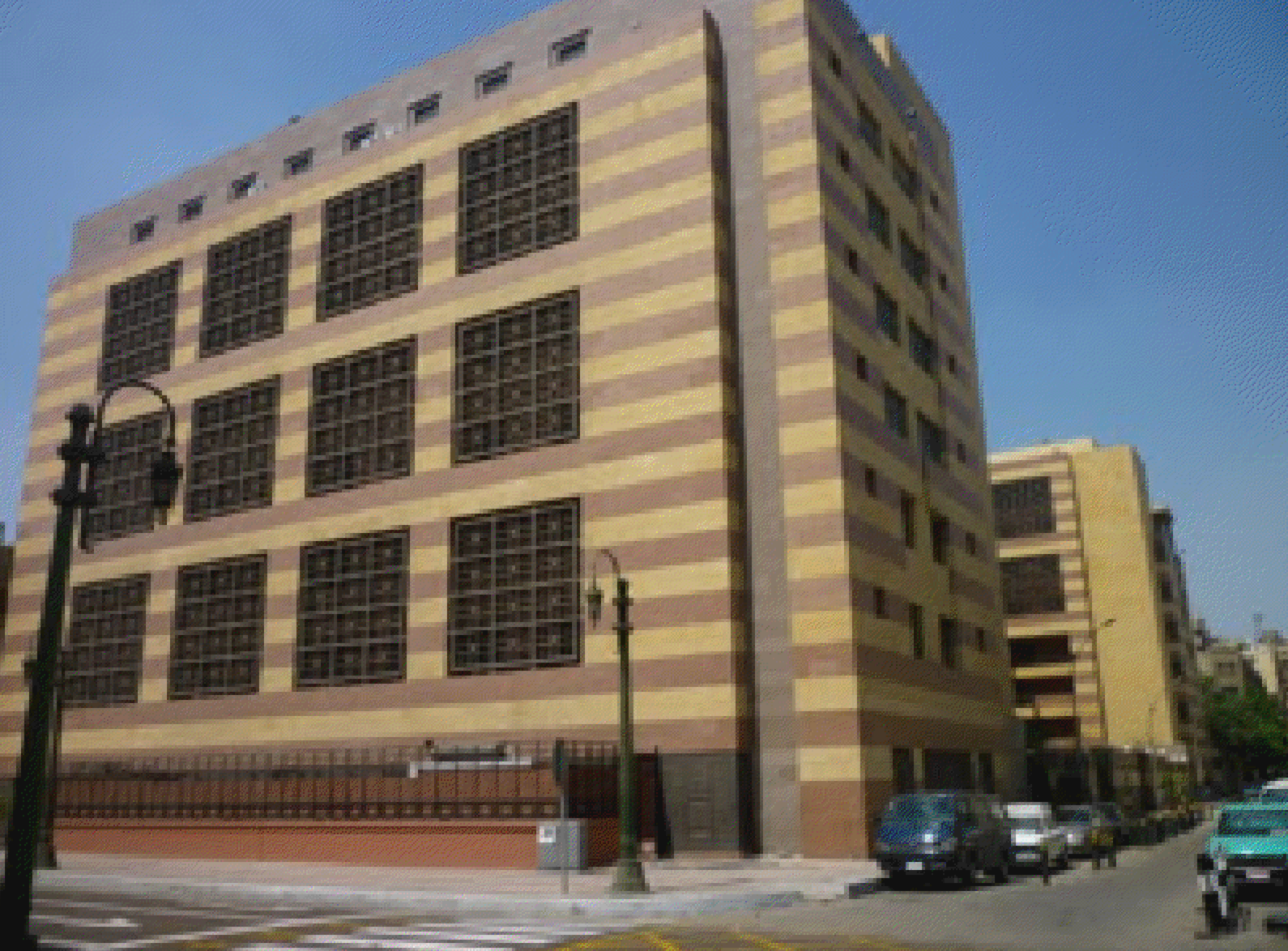
It didn’t take long to figure out that we’re looking at Cairo: the small striped building in the center is the Falaki Academic Center (part of American University in Cairo), and the distinctive building in the far right background belongs to Banque Misr.  Determining where exactly the photo was taken from proved far more challenging.  As best as I can figure, the photo was taken from the south side of Hussein Hegazy street, looking north into Cairo.

cairo

The adjacent rooftop structures seem to match (are those air conditioning units?), as does the light blue roof on the far left.  Unfortunately, I don’t have a window to highlight. But if it comes down to a tiebreaker this week, I was one of the many people who also identified the correct window last week. Hopefully that counts for something!

So close to breaking the tie, but the prize this week goes to the following reader, who got much more specific and who has also entered a dozen more contests than the previous reader:

A lot harder than last week!  My initial gut reaction was “Arab world” just based on the appearance of the buildings and a sort of resemblance to Amman, which I visited last year.  Amman was out, however, due to the flatness of the terrain visible, and the buildings were not modern enough for the Gulf, so my next thought was Syria.  I spent a while searching skylines of Damascus and then Aleppo with no luck, so I thought about what other cities in the region were big enough to have a view like the contest’s view, and Cairo occurred to me.

I spent another long while poring over skylines before I found the photo attached as “Cairo from old city” (link here).  I’ve put an arrow over the building which I’m pretty sure is the one on the right in the contest photo:
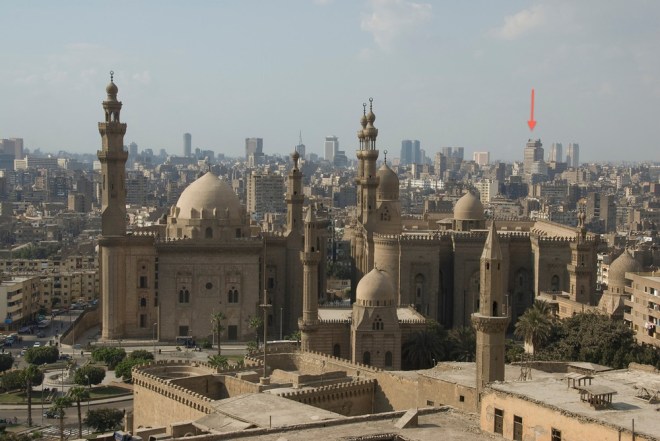
Cairo from old city

Next step: actually find where that is in Cairo.  The big mosque in the foreground was relatively easy – the Mosque Madrassa of Sultan Hassan, taken from the Citadel.  Then, I used the very helpful wikipedia page “List of tall buildings in Cairo” to identify the twin buildings in the far right background as the Nile City towers.  I then used Google maps to make a line-of-sight – somewhere along that line roughly was, if not the Window, then the key tower:

Line of sight

Aha!  If only I had drawn that line the first time around it would have saved me an embarrassingly long time combing the city, because as it happens the tower in question fell right on it!  The Banque Misr headquarters – satellite image attached, link here.  Here it is from the front, I think.

If only that were the actual Window.  I still had some work to do.  The absence of other large buildings and or visible open areas/parks from the shot narrowed down somewhat the possible directions we could be facing, but it took me a while of looking for the second-tallest building in the shot, the one on the far left, until I found this one.

More frustrating streetcombing with Google maps and image search, and another piece of the puzzle fell into place: The orange/tan stripey building in the center-right, midfield of the Window, is the Falaki Academic Center of the American University in Cairo, and is located here.  That would make the black smoke billowing upward in the center of the photo roughly coming from Sheikh Rihan street, the site of recent riots, or possibly from the front of the Egyptian Parliament, which has also seen its share of the riots.

Working backwards (south) from my triangulated points, passing the campus and the Egyptian Parliament, the first set of “roof stuff” that seemed to fit the necessary angle was this building on Hussein Hegazy street (green arrow, not red “A”), so that’s my answer – top floor:

The Window

I searched for the street number google suggested (12 Hussein Hegazy), and came across the Albawtaka Review, an “Arabic independent (non-governmental) non-profit online quarterly concerned with translating English short fiction.” (from here)  That sounds like Dish readership potential, so I’ll hazard that the photo came from their office.

So there we have it.  The first time I think I’ve gotten two windows in a row, and this one being the hardest one I’ve gotten.  Maybe this is my week to win!

Indeed. From the submitter:

The photo was taken at about 5:15 pm local time on January 26, 2013, in Cairo, Egypt. The smoke rising is from clashes near the interior ministry; my apartment is right next to the Cabinet and near a variety of other government buildings, so when things get hot, protestors head here. With the 2nd anniversary of the revolution yesterday and the government’s announcement of the outcome of trials of those police and protestors involved in the Port Saeed massacre of last year (21 received death, 70 some trials were delayed, including those of all police involved), things are not looking too hot in Egypt right now.

Follow-up from the submitter:

No way you chose my photo! This is excellent, much appreciated. I love the Dish, gonna subscribe now, rather than just mooch off my Google Reader.

In case you need any extra details should some creep figure out exactly where I sleep, I live at 12 Hussein Hegazy Street, in an area of Cairo called Mounira. I’m on the 9th floor (10th by American counting), and this is from the eastern-most window on the floor.

Thanks a lot for all the blogging!

Another close entry from a first-time contestant:

Finally, one that I recognize! This photo is taken in Cairo, Egypt, to the southeast of Tahrir Square. The cityscape immediately made me think Cairo, where I lived for a year back in 2006, but I’ve thought that before and been wrong. After I started looking closely, the striped building in the center looked familiar, and a Google image search confirmed that it is part of the American University in Cairo’s old campus near Tahrir. This building, which is called the Falaki center:

Screen Shot 2013-02-19 at 1.09.05 PM

I’m pretty sure the tall building on the right is the Banque Misr building, which means this photo is facing north. If my extrapolation is correct, the photo was taken on the 7th floor (or thereabouts) at 12 Hussein Hegazi Street, which is just a few blocks from where I used to live. The building in the foreground, with its quintessential third-world bureaucracy architecture, is part of the Ministry of Health, I believe. Tahrir Square is very close, a few blocks to the left of the Falaki building.

One reader totally nailed the right location – down to the exact floor – but he has already won a contest and VFYW book:

That was exhausting. I must have been to every souk and high rise from Amman to Riyadh before finding the right spot. This week’s view, however, comes from the heart of Cairo, Egypt. I believe the shot was taken from roughly the ninth floor of 12 Hussein Hegazy Street. The viewer was looking north, north eastward, with the Misr Bank Tower being the most distinctive landmark on the far right of the image. Egypt’s National Assembly building is only a block away, but it’s hidden from view by the building in the left foreground.

Hussein Hegazy Street is named for the first Egyptian soccer player to play in the professional English soccer leagues, way back in 1911. More recently, the street itself was the location of major protests over union and minimum wage issues in the spring of 2010. Only eight months later and a few blocks away some of those same protesters returned to Tahrir Square as the Egyptian revolution began.

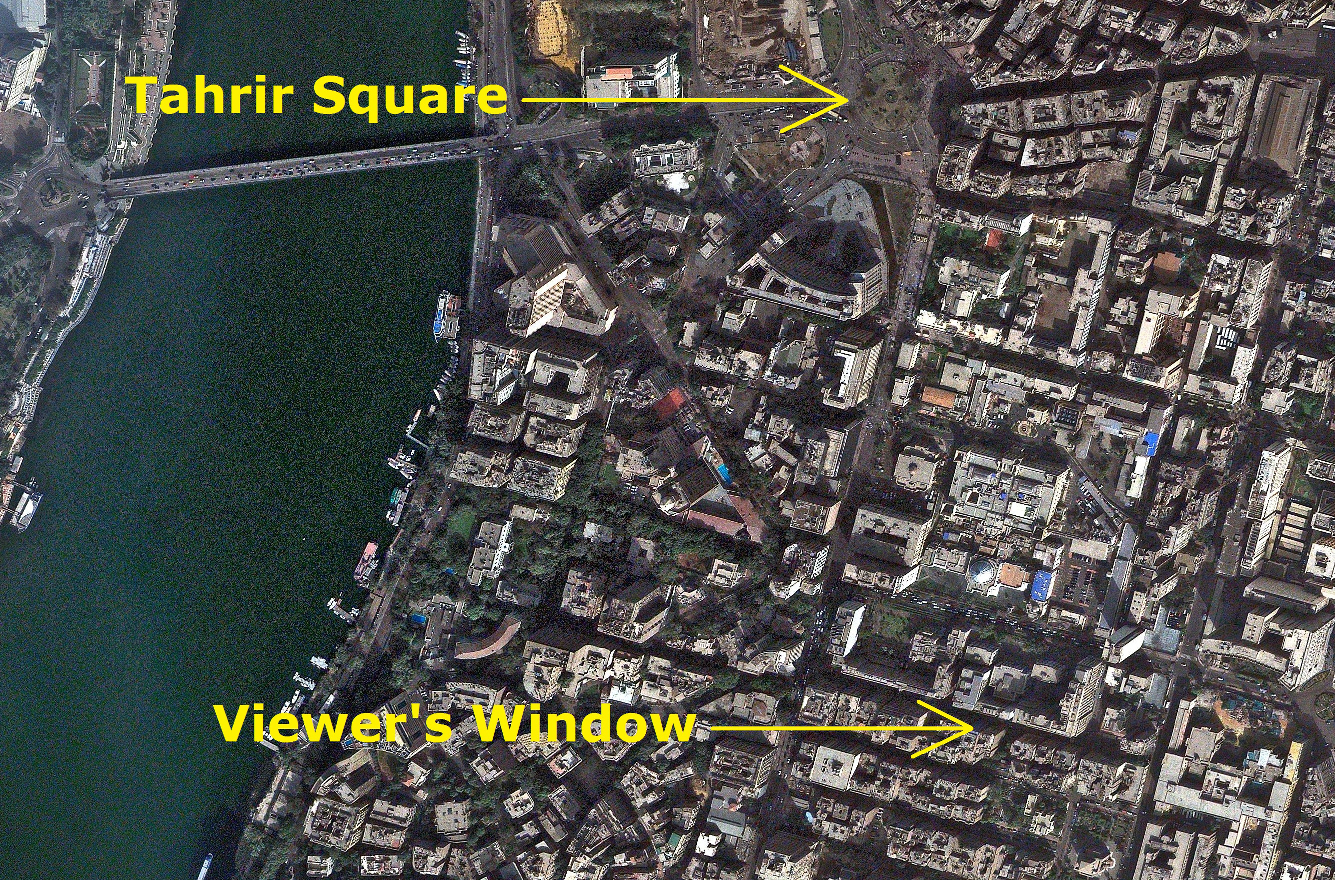
Attached is a labeled, high-resolution satellite view showing your viewer’s position in relation to Tahrir that was taken during the January 2011 revolution:

Cairo VFYW Overhead Marked2 - Copy

(Archive)

How Capitalism Creates The Welfare State

SKOREA-SOCIETY-SUICIDE

The two concepts are usually seen in complete opposition in our political discourse. The more capitalism and wealth, the familiar argument goes, the better able we are to do without a safety net for the poor, elderly, sick and young. And that’s true so far as it goes. What it doesn’t get at is that the forces that free market capitalism unleashes are precisely the forces that undermine traditional forms of community and family that once served as a traditional safety net, free from government control. In the West, it happened slowly – with the welfare state emerging in 19th century Germany and spreading elsewhere, as individuals uprooted themselves from their home towns and forged new careers, lives and families in the big cities, with all the broken homes, deserted villages, and bewildered families they left behind. But in South Korea, the shift has been so sudden and so incomplete that you see just how powerfully anti-family capitalism can be:

[The] nation’s runaway economic success … has worn away at the Confucian social contract that formed the bedrock of Korean culture for centuries. That contract was built on the premise that parents would do almost anything to care for their children — in recent times, depleting their life savings to pay for a good education — and then would end their lives in their children’s care. No Social Security system was needed. Nursing homes were rare.

But as South Korea’s hard-charging younger generations joined an exodus from farms to cities in recent decades, or simply found themselves working harder in the hypercompetitive environment that helped drive the nation’s economic miracle, their parents were often left behind. Many elderly people now live out their final years poor, in rural areas with the melancholy feel of ghost towns.

The result is a generation of the elderly committing suicide at historic rates: from 1,161 in 2000 to 4,378 in 2010. The Korean government requires the elderly to ask their families for resources if they can pay for retirement funding – forcing parents to beg children to pay for their living alone – a fate they never anticipated and that violates their sense of dignity. Hence the suicides.

We can forget this but the cultural contradictions of capitalism, brilliantly explained in Daniel Bell’s classic volume, are indeed contradictions. The turbulence of a growing wealth-creating free market disrupts traditional ways of life like no other. Even in a culture like ours used to relying from its very origins on entrepreneurial spirit, the dislocations are manifold. People have to move; their choices of partners for love and sex multiply; families disaggregate on their own virtual devices; grandparents are assigned to assisted living; second marriages are as familiar as first ones; and whole industries – and all the learned skills that went with them – can just disappear overnight (I think of my own profession as a journalist, but it is one of countless).

Capitalism is in this sense anti-conservative. It is a disruptive, culturally revolutionary force through human society. It has changed the world in three centuries more than at any time in the two hundred millennia that humans have lived on the earth. This must leave – and has surely left – victims behind. Which is why the welfare state emerged. The sheer cruelty of the market, the way it dispenses brutally with inefficiency (i.e. human beings and their jobs), the manner in which it encourages constant travel and communication: these, as Bell noted, are not ways to strengthen existing social norms, buttress the family, allow the civil society to do what it once did: take care of people within smaller familial units according to generational justice and respect. That kind of social order – the ultimate conservative utopia – is inimical to the capitalist enterprise.

Which is why many leaders in the nineteenth and twentieth centuries, conservatives as well as liberals, attached a safety net to such an unsafe, bewildering, constantly shifting web of human demand and supply. They did so in part for humane reasons – but also because they realized that unless capitalism red in tooth and claw were complemented by some collective cushioning, it would soon fall prey to more revolutionary movements. The safety net was created to save capitalism from itself, not to attack capitalism.

This is not to argue against the conservative notion that it is precisely because of capitalism that we have to foster greater family bonds, keep marriage alive, communities together. It is simply to argue that to argue for this and the kind of capitalism that Paul Ryan favors is a tall order. And it isn’t working. The forces of global capitalism – now unleashed on an unprecedented global scale with China, Russia, Brazil and India – are destroying the kind of society which allows and encourages stability, traditional families, and self-sufficient community.

One reason, I think, that Obama’s move toward a slightly more effective welfare state has not met strong resistance – and is clearly winning the American argument – is that the sheer force of this global capitalism is coming to bear down on America more fiercely than ever before. People know this and they look for some kind of security. In other words, it is precisely capitalism’s post-1980s triumph that has helped create the social dependency so many conservatives bemoan today. And this time, there is even a sense that whole industries are disappearing faster than ever before – not simply because of outsourcing but because of technology itself, tearing through old ways of life like acid through iron.

It is unstoppable. I fear its power – given that it relies on emitting carbon in vast quantities – will soon make the world less habitable for large numbers of people. I fear it may kill so many species we will have become God on our own earth. And I think an understanding that the state will have to step in to blunt the sharper edges of this newly creative extra-destruction is emerging slowly in the public at large.

Bell was right. Capitalism destroys the very structure of the societies it enriches. But I doubt even he would have anticipated the sheer speed at which this is now happening. It makes the conservative project all but impossible, if still necessary. It does require a defense of the family, of marriage, of personal responsibility. But it also demands a compassion toward the victims of this economic and social change, an understanding of their bewilderment – which can often express itself neurotically in fundamentalist forms of religion or culture.

All I know is that it is a core conservative idea that revolutions can end in nightmares. But we conservatives also long supported and indeed recently breathed new life into the industrial and post-industrial revolution. We see the consequences far beyond the suicides of elderly Koreans. And in my bleaker moments, I wonder whether humankind will come to see this great capitalist leap forward as a huge error in human history – the moment we undid ourselves and our very environment, reaching untold material wealth as well as building societies in which loneliness, dislocation, displacement and radical insecurity cannot but increase. It seems to me this is not the moment for Randian purism.

Do we not as conservatives have a duty to tend to the world we helped make?

(Photo: This photo taken on January 11, 2013 shows an anti-suicide monitoring device (L) installed by the government at Mapo Bridge -a common site for suicides- over Seoul’s Han river. The South Korean capital has installed anti-suicide monitoring devices on bridges over the city after 196 people jumped to their deaths on 2012 according to South Korean officials. The new initiative — in a country with the highest suicide rate among leading developed nations — incorporates closed-circuit television cameras programmed to recognize motions that suggest somebody might be preparing to jump from a bridge. By Pedro Ugarte/AFP PHOTO/Getty Images.)

The GOP’s Sequestration Trap


Tomasky suspects that Republicans will suffer politically if the sequestration cuts go into effect:

[I]t sure isn’t going to be looking very responsible to people, as the March 1 sequestration deadline approaches, for Republicans to be going before the cameras and saying that the cuts are unfortunate but necessary medicine, or whatever formulation they come up with. They’ve wanted these spending reductions for two years. It hardly matters much who invented the mechanism for the cuts. What matters, as the Republicans will find out, is that the people don’t want them.

I believe that is indeed Obama’s long game here. The precedent is the Gingrich government shutdown, which stopped his revolution in its tracks and gave Bill Clinton new political life. When cops are furloughed, when scientists complain about research cuts, when the military-industrial complex revs up its lobbying engines, I just don’t see how the sequester works politically for the GOP. It exists entirely because of their fixation on immediate austerity – despite the awful consequences that policy option has spawned in Europe.

But I don’t particularly like the Dems’ and Obama’s approach either. It may be politically savvy – they are going to target all sorts of populist tax loopholes for the very rich as an alternative to cuts, without making a serious effort to reform the insanely complex tax code as a whole. I’m working on a post on the sequester – and why, however crude and dumb, it may well be the least worst option in front of us. Stay tuned.