How Obama Legitimized Torture

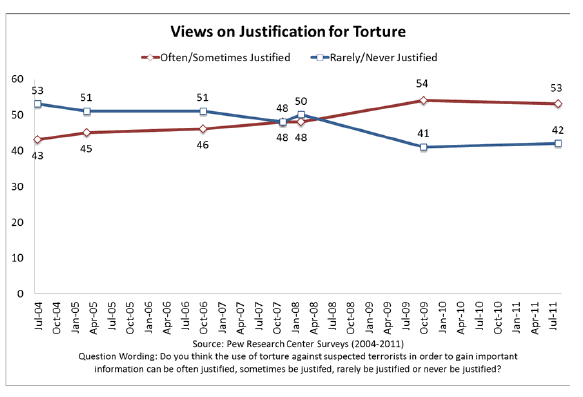
Screen shot 2013-02-19 at 11.42.08 AM

Jane Mayer compares Bush’s torture memos to Obama’s targeted killing memos, and makes a critical distinction that some have tried to elide:

Clearly there are plenty of troubling questions surrounding the Obama Administration’s targeted-killing program. But, that said, are Obama’s drones comparable in terms of human-rights violations, to Bush’s Torture program?

Those who argue so miss an important distinction, one that David Cole also has brought up: torture under all our systems of law—including the laws of war—is illegal. This is true without exception, regardless of the circumstances, including national-security emergencies. Torture is also condemned by every major religion. Waterboarding was, and is, a form of torture. This has been established as far back as the Spanish Inquisition, and as recently as the Vietnam War. To argue otherwise is to legalize criminality. That was what the Bush Administration’s torture memos did. …

Obama, in contrast, has tried to bring his counterterrorism program inside the law by reasserting the criminality of torture and by trying to define which drone strikes are legal. The Obama Administration’s lawyers’ attempt to define those boundaries in their white paper isn’t prima facie scandalous, because the Constitution authorizes lethal combat, unlike torture.

She goes on to make various valid critiques of Obama’s targeted killing program, but the above distinction is worth keeping in mind during these debates. It comes up again and again, on the hard left and, of course, on the hard right. Take this sentence from Jeffrey Rosen, unwilling to accept that some of his legal friends are war criminals:

Although the Obama administration’s brief is directed at the assassination of Americans abroad, the arguments it offers could apply with equal force to the assassination of Americans at home; lawyers for the Bush administration who tried to justify lesser outrages have been pilloried for supporting torture.

But they did support torture, didn’t they? And there is no conceivable way for that to be legal, right? Part of my frustration with this debate from the get-go has been the assumption that the rule of law is something just to get around, rather than to abide by. And so torture is immediately discussed by Greater Israel fanatics like Alan Dershowitz as if it were an actual, live option in a society governed by the rule of law. It is not and for a very long time has not been a legal option, as Dershowitz well knows. And as David Luban recently noted, the crime of torture carries a 20 year prison sentence and the death penalty if the victim is tortured to death, as happened well over a dozen times under the criminal regime of Bush and Cheney. Every single war criminal – except a few grunts at the very bottom of the chain taking signals from their superiors at Abu Ghraib prison – walked free. War criminals who actually destroyed the video evidence of their torture sessions now sit on AEI panels and brag of their criminality to Beltway applause. With perjury a civil suit for sexual harassment, illegality among high oficials led to one president’s impeachment. With the criminal felony of torture, the rule of law matters not at all. We are not even allowed to see the Senate’s report on the torture program.

By allowing all CIA officials who tortured prisoners off any legal hook, and by deciding that Cheney and Bush and the architects of the plainly illegal torture program were easily integrated back into respectable American society – with the chief war criminal, Dick Cheney, still treated as an elder statesman on network television – the Obama administration may have stopped torture but they also helped legitimize it. By refusing to deal with it as a serious crime, they allowed many other Americans to take the same position.

Can you see when public approval for torture begins to rise in the graph above? After Obama and Holder told us it was no big deal, and no one should be held in the slightest way accountable.
McCain: Still A Douche, Ctd

Politico actually managed to use the word “tortured” to describe the long history between Chuck Hagel and the ornery, failed presidential candidate. But class difference is the really telling point:

Among the more than 58,000 Americans killed in the war, 84 percent were enlisted men and all but a sliver of these were without a college degree. Hagel himself had just a few college semesters to his credit. His teenage brother Tom was fresh out of high school when they enlisted in 1967.

More than race or income, it was this education divide — promoted by draft deferments in the 1960s — that most explains those who were in combat in Vietnam and those who were not. That history, which McCain knows, was what made it so striking last week when Cruz, a sophisticated Princeton and Harvard Law graduate, seemed to question Hagel’s patriotism by his line of questioning before the Senate Armed Services Committee.

That was when McCain finally had enough of the newest Joe McCarthy in the Senate. But he was still capable of letting Hagel twist in the wind so his buddy Butters could gain some far right cred in South Carolina.

The Most Caffeinated New Yorkers

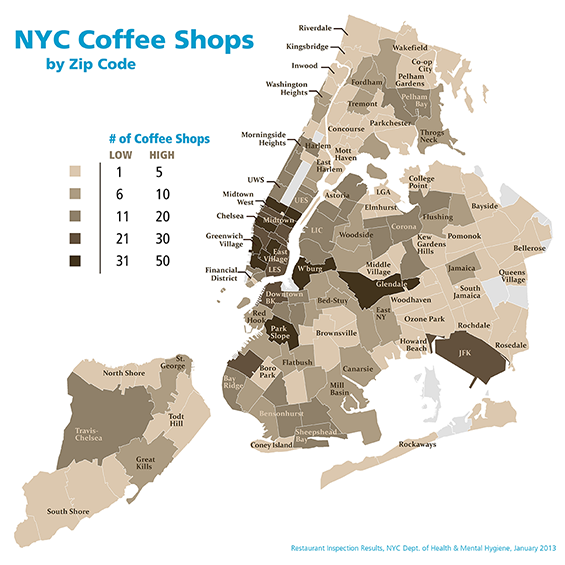
As if they need any more reason to rush. StatsBee plotted out the city’s coffee addiction:

Manhattan neighborhoods have the highest density of cafés per ZIP code. The East Village ZIP code of 10003 has the highest number of shops with 49, closely followed by Midtown/Hell’s Kitchen (10019) with 47. Midtown East (10017) and SoHo (10012) each have 41, and Tribeca/Chinatown (10013) has 40. The non-Manhattan neighborhoods with the highest concentration of caffeine are Williamsburg (11211) with 31 shops, Glendale (11385) with 32 shops, and Park Slope (11215) with 32 shops.

More on the country’s habit in general:

According to Accounting Principals, half of all American workers now buy coffee throughout the week, spending over $5 per work day and about $1,092 annually on coffee. Younger workers (18 to 34 years old) are spending about twice as much weekly on coffee as workers over 45 ($24.74 vs. $14.15).

Cannabis Isn’t So Green, Ctd

A reader complements a recent post on the environment hazards of unregulated pot growing:

My city, Chico, California, tried to develop regulations for the growing of medical marijuana by individuals and for the establishment of dispensaries.  California state law has provisions for both. The city approached the issue as a land-use issue, just as the city or county might regulate other agricultural or commercial uses, or public nuisances.  The city discussion began from a complaint by a resident concerning the odors emanating from a neighbor’s individual grow, odors not only from the marijuana plants when in bloom, but from fertilizers and pesticides.

The city worked on a medical marijuana ordinance for at least 18 months.  The entire process was contentious on many levels.  But the city council and staff kept working on it.  The final proposal included regulations for grows and for dispensaries. Then, just two weeks before the final version of the ordinance was to be voted on, the mayor read a letter at a city council meeting.  It was from the US Attorney for our district.

The letter essentially said that under Federal law, city employees who administered this local ordinance would be subject to prosecution for aiding and abetting the production of a controlled subtance.  That is, a city permit officer granting a land-use permit for an individual grow, or a police officer not arresting someone for growing marijuana, could be arrested.  The police department had been supportive of the ordinance, but no more. The city attorney advised that there was no way to write the local ordinance to protect city employees.  The entire ordinance was scrapped.

Mendocino County had a permitting system that worked well, until a similar threat was made by the US Attorney.  The system was suspended. Worth looking into what happened there – it was administered by the Sheriff. (I have a vaque recollection you reported on this.)

For the record, I do not use marijuana either medicinally or recreationally.  But I am persuaded that legalizing it and regulating it as alcohol is legal and regulated makes better sense than our current system.  And the environmental damage done is one reason.

Country Isn’t So White

While reviewing the compilation Country Funk 1969-1975, Nathan Rabin laments that country music is thought of as “the official music of rednecks, xenophobes, conservatives, and truck-driving suburbanites”:

To me, country is a glorious mutt of a genre that mirrors the eclecticism and disorder of the nation that berthed it. It’s telling that Jimmie Rodgers, the man heralded as “The Father of Country Music,” was a pot-smoking, hard-living bluesman with an inexplicable (and influential) fondness for yodeling, and whose music and persona were deeply linked to black music and culture at a time when the whole nation, not just radio, was segregated.

Rodgers was a primitive American original who paved the way for similarly complicated, contradictory figures like Hank Williams, who famously learned how to play guitar from a black street musician nicknamed Tee Tot and howled the blues with feverish intensity, and Bob Wills, a charismatic bandleader, fiddler, and proto-hype man who perfected a frisky, dance-friendly fusion of country and jazz called western swing. From Willie Nelson (who recorded a reggae album, for God’s sake) to Johnny Cash to Townes Van Zandt, many country icons revered black music and incorporated those influences into their own work.

At The Mercy Of The Paper Trail

Living a nomadic life, Jamaal Glenn is sick of the perfunctory mailing address needed for official business:

Even if I wanted to, I can’t really stop getting mail, or more specifically, I can’t stop needing a mailing address. My mailing address has become much more than a physical location where I sleep at night or a place where I receive physical goods. It has become inextricably and unnecessarily linked with my identity.

Paying for a parking ticket online? I need an address. Donating to a nonprofit online? I need an address. Paying my phone bill directly from my iPhone? PayPaling a friend? Betting on sports digitally? Address. Address. Address.

Debating The Minimum Wage, Ctd

In the above video, Congresswoman Marsha Blackburn of Tennessee worries that raising the minimum wage will keep teenagers out of the workforce, preventing them from gaining valuable experience:

I remember my first job, when I was working at a retail store, growing up down there in Laurel, Mississippi, I was making like $2.15 an hour. And I was being taught how to responsibly handle those customer interactions, and I appreciated the opportunity.

Travis Waldron crunches the numbers:

[W]hat Blackburn didn’t realize is that she accidentally undermined her own argument, since the value of the dollar has changed immensely since her teenage years. Blackburn was born in 1952, so she likely took that retail job at some point between 1968 and 1970. And according to the Bureau of Labor Statistics’ inflation calculator, the $2.15 an hour Blackburn made then is worth somewhere between $12.72 and $14.18 an hour in today’s dollars, depending on which year she started.

Relatedly, McArdle wonders how indexing the minimum wage for inflation would impact the economy:

Would we see a sharp spike in the unemployment rate?  Unlikely.  Even if 10% of minimum wage workers were laid off, that would be a fraction of 1% of the overall job market. But I would expect to see higher unemployment among young and low-skilled workers during recessions, when employers are facing a lot of pressure on their margins.  If your sales fall by 30%, so does the output of each worker.  So that overall, monetary policy would become at least slightly less effective at managing the employment declines during recession.

Cunningham’s Quiet Crusade

Dan Shaw celebrates NYT photographer Bill Cunningham as “an incognito activist who has celebrated gay pride week after week even as he excused himself from the increasingly sexualized society that he chronicled”:

Two decades after the Stonewall riots, a new strain of homophobia was sweeping the city, and when the “Sunday Styles” section was born in 1992, Bill stealthily took every opportunity he could to bolster the gay community’s morale. Although he was technically a freelancer, he was given unprecedented real estate in the newspaper every week: a half page for his “On the Street” fashion column and two facing half pages for “Evening Hours” party pictures. He was his own boss in the hierarchical newsroom, and he made sure that AIDS benefits received as much coverage as galas at the Metropolitan Opera and Carnegie Hall. …

One of the sexiest “On the Street” columns Bill ever produced was published on Independence Day 1993. The headline read simply: “Men in Skirts.” All of the pictures had been taken at the Pride Parade of buff, bare-chested guys in short kilts and heavy work boots. Bill wrote the caption: “The imagery brought to mind ancient warriors depicted in Greek and Roman sculpture, now reflected in the gym-perfected bodies of today’s generation. The look reveals how a generation that worships the body perceives its image as that of the Uber-male.”

The recent documentary made about Cunningham is available for streaming on Netflix.

Gangs On The Inside

After a recent wave of violence ordered by prison gangs in Brazil, Benjamin Lessing details the difficulties lawmakers must face in trying to control them:

Because [prison gangs] keep order among prisoners, they often win a degree of informal control over inmate life. This gives them leverage over anyone on the outside with a reasonable chance of incarceration. … Paradoxically, policymakers’ go-to responses—anti-gang sweeps, longer sentences, and harsher prison conditions—can make prison gangs stronger. The key is that unlike street gangs, prison gangs can best reward (or punish) their street affiliates after they are imprisoned.